
Privacy Assistance for SMEs: What Support You Actually Need

Most SMEs do not need “privacy help” in the abstract. They need practical support that reduces risk, keeps operations moving, and produces evidence of compliance under Jamaica’s Data Protection Act.
If you are a small or growing business, the biggest mistake is buying the wrong kind of help, for example paying for policies you cannot implement, or buying cyber tools without fixing access control and vendor contracts first. This guide breaks down what privacy assistance for SMEs should actually include, what you can realistically do in-house, and when it makes sense to bring in specialist support.
What “privacy assistance” should mean for an SME
For an SME in Jamaica, privacy assistance is not just drafting documents. It is a set of outcomes:
You know what personal data you have, where it lives, who uses it, and why.
You can explain your processing to customers and staff (clear notices and internal rules).
You can respond when someone exercises their rights (access, correction, deletion, objection).
You can reduce the chance and impact of a breach (security basics and an incident plan).
You can prove what you are doing (a simple evidence pack).
That last point is often missed. Regulators, clients, banks, and enterprise customers increasingly want to see proof of controls, not just promises.
A quick reality check, before you hire anyone
Before you pay for privacy support, do a short internal scan. You are looking for the biggest risk multipliers, not perfection.
Ask yourself:
Do we collect personal data through a website, WhatsApp, email, paper forms, or point of sale?
Do we store customer or employee data in shared inboxes, spreadsheets, personal devices, or unmanaged cloud drives?
Do vendors handle personal data for us (payroll, HR, accounting, email marketing, CRM, CCTV, cloud hosting)?
Can anyone in the business export data to a USB drive, forward it externally, or download full customer lists?
If a customer asked for a copy of their data, could we find it within a reasonable timeframe?
If we had a breach on Friday night, do we know who does what on Saturday morning?
If even a few of these feel unclear, you do not need “more awareness” first. You need structured privacy assistance that creates visibility, assigns owners, and implements controls.
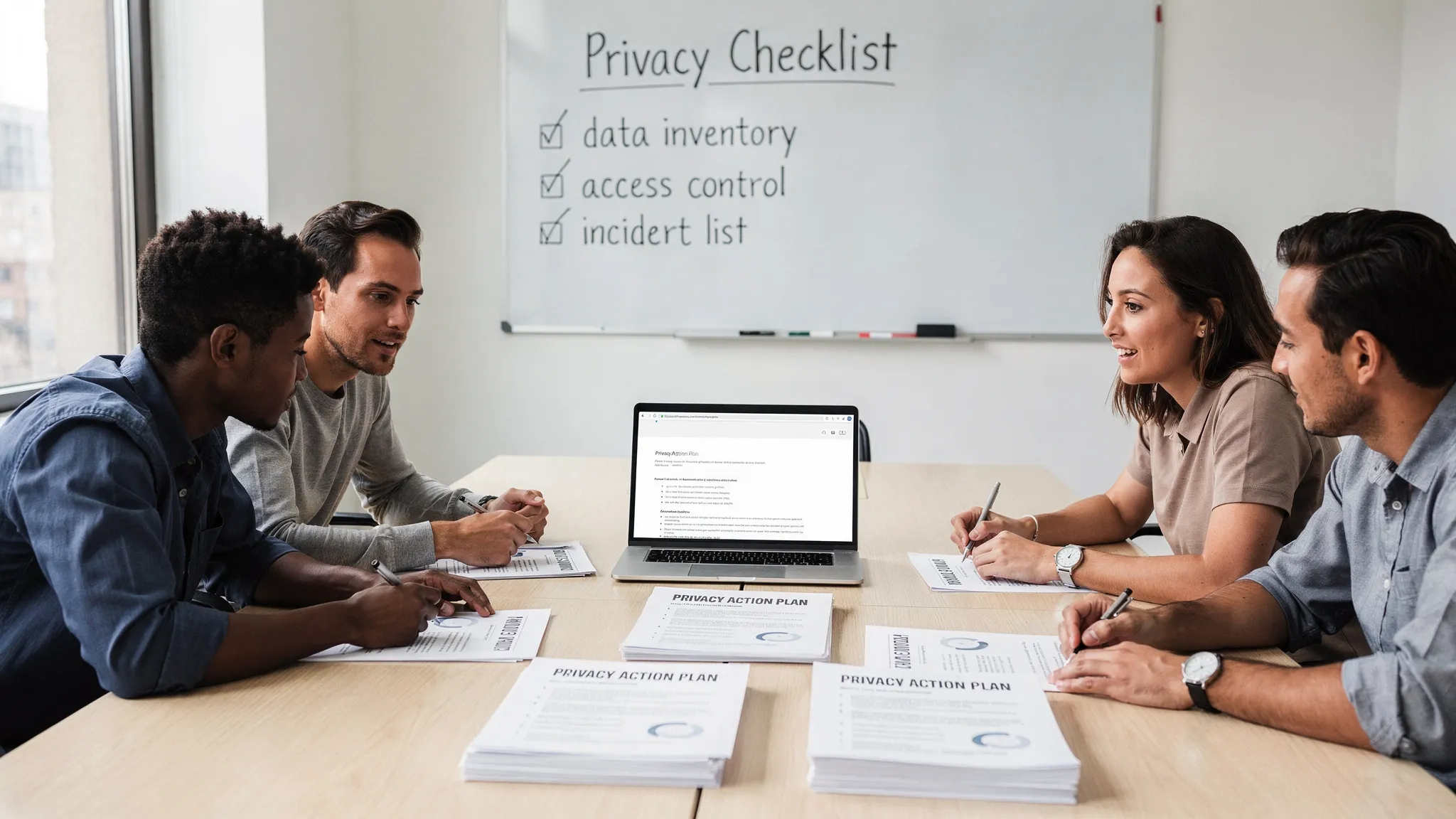
The support SMEs actually need (and what “good” looks like)
Different businesses need different depth, but most SMEs benefit from the same core building blocks. Use the table below to sanity-check what you are buying.
Support area | What good looks like in an SME | What you should end up with (evidence) |
1) Ownership and accountability | One named owner, clear responsibilities, simple reporting to leadership | Role assignment, decision log, meeting notes or a lightweight governance pack |
2) Data inventory (data mapping) | A practical view of personal data flows, systems, and vendors, updated when things change | Data inventory, system list, vendor list, basic data flow notes |
3) Privacy notices and internal rules | Clear customer and staff notices, aligned to actual processing, plus internal handling rules | Privacy notice(s), employee privacy notice, internal handling guide |
4) Rights handling process | A repeatable way to validate identity, search data sources, respond, and record outcomes | Rights request SOP, request log, response templates |
5) Vendor and contract support | Vendors are identified, risk-rated, and contract clauses are addressed for data handling | Vendor due diligence checklist, contract addendum points, vendor register |
6) Security and incident readiness | Access control basics are in place, plus a realistic incident response playbook | Access review notes, MFA rollout status, incident response plan, tabletop results |
7) Training that changes behaviour | Short, role-based training tied to your processes, not generic slides | Attendance records, training content outline, phishing or handling scenarios |
If your vendor is only offering policies without these operational deliverables, you may end up with a binder of documents and no actual risk reduction.
What to keep in-house vs what to outsource
A useful way to think about privacy assistance for SMEs is: keep decisions and accountability internal, outsource specialist build work and heavy lifting.
Keep in-house (even if you are small):
Appointing a privacy lead (someone who owns the programme internally)
Approving what data you collect and why (business decisions)
Enforcing staff behaviour (management responsibility)
Common items to outsource or co-build:
Building your first data inventory and vendor register
Drafting or updating notices, SOPs, and templates based on your real workflows
Setting up incident response playbooks and running tabletop exercises
Targeted staff training for teams that handle the most sensitive data (HR, customer support, finance)
If your SME does not have a dedicated privacy officer, consider a fractional approach (part-time, retained advisory) to keep momentum without carrying a full-time cost.
Three engagement models, and how to choose
SMEs typically buy privacy assistance in one of three ways. Each can work, if it matches your maturity and capacity.
Model | Best for | What you get | Watch-outs |
DIY with templates | Very small teams, low data complexity, strong internal discipline | Low cost starting point | Risk of generic documents that do not match your systems, vendors, or workflows |
Done-with-you (co-building) | Most SMEs | Workshops + tailored deliverables + coaching to implement | Requires internal time and follow-through |
Outsourced / managed (fractional) | SMEs with higher risk, faster growth, or limited capacity | Ongoing ownership support, reviews, continuous improvement | Can fail if leadership treats privacy as “someone else’s problem” |
A practical rule: if you cannot confidently answer “where is our customer data stored” and “who has access,” start with done-with-you. It creates the visibility you need while building internal capability.
The minimum viable privacy programme for an SME
If your budget is limited, do not spread it thin. Fund the items that reduce the most risk and unlock everything else.
A minimum viable programme usually includes:
A data inventory and vendor register that reflects reality
Updated privacy notices that match your processing
A basic rights request workflow and log
Access control hygiene (especially for email, cloud storage, and admin accounts)
An incident response plan, even if it is one page plus contact numbers
Once these exist, additional work becomes easier and cheaper because your consultant, your staff, and your vendors are all working from the same map.
If you want a deeper baseline on legal obligations, use PLMC’s related resources like:
Those guides are helpful, but the gap for most SMEs is not knowing what to do, it is getting it implemented and evidenced.
What “good help” looks like in week 1 to week 4
When privacy assistance is working, you should see momentum quickly. Here is a realistic 30-day pattern for many SMEs.
Week 1: Set scope and assign owners
A consultant should help you define scope in plain language, for example customer data + employee data + top vendors, and agree who signs off decisions. You should also agree how evidence will be stored, so you can find it later.
Week 2: Build your data inventory and vendor list
This is typically a short set of workshops that documents:
Systems (email, cloud drives, POS, CRM, HR tools)
Data categories (customers, staff, prospects)
Purposes (sales, delivery, payroll, compliance)
Vendors and data sharing
Week 3: Implement the “first controls”
This is where assistance becomes operational, for example tightening access, setting retention rules, and establishing a rights request intake channel.
If you want to align security work to recognised practice, many SMEs map basic controls to frameworks like the NIST Cybersecurity Framework and adapt it to their size.
Week 4: Finalise notices, SOPs, and incident readiness
By the end of the first month, an SME should have usable documents plus at least one practical test, such as a short incident tabletop exercise.
If your support provider cannot explain what will be delivered by day 30 (and what your team must do), you are likely buying activity, not outcomes.
Questions to ask before paying for privacy assistance
Use these questions to quickly tell whether you are getting SME-appropriate support.
How will you build our data inventory, and what do you need from us to do it fast?
Which vendors do you expect to review first, and what due diligence evidence should we keep?
How will you handle rights requests in our environment (email, WhatsApp, paper, POS)?
What will you do to ensure our notices and policies match our real workflows?
How will you connect privacy work to cyber security basics (access control, MFA, backups, incident response)?
What will “done” look like in 30 days, and what evidence pack will we have?
How do you support implementation after documents are delivered?
A credible provider will welcome these questions and answer without vagueness.
Red flags: common ways SMEs waste money on privacy support
SMEs often get stuck because the support purchased does not match the reality of running a small business.
Watch for:
Policy-only deliverables with no implementation plan, no ownership model, and no evidence pack
One-size-fits-all templates that ignore your actual systems, vendors, and data flows
Unclear scope (you think it includes vendors and security, they think it is just a privacy notice)
No linkage to cyber (privacy and security are not identical, but in SMEs they are tightly connected)
Training that is generic and not tied to the tasks your staff actually perform
Where to find authoritative guidance in Jamaica
SMEs should also keep an eye on local regulatory guidance and updates. The Office of the Information Commissioner (Jamaica) is a key reference point for data protection oversight and public guidance.
Frequently Asked Questions
What is privacy assistance for SMEs, in practical terms? Privacy assistance for SMEs is hands-on support to identify personal data, implement workable controls, prepare notices and processes, train staff, and keep evidence of compliance.
Do I need to hire a Data Protection Officer (DPO) as an SME in Jamaica? Many SMEs start by assigning an internal privacy lead and using fractional or advisory support. The right choice depends on your risk level, data volume, and client requirements.
What should I do first, policies or security? Start with visibility and control: data inventory, access control basics, and vendor mapping. Policies should reflect what you actually do and what controls you can enforce.
How long does it take to get “baseline ready”? Many SMEs can reach a practical baseline in about 30 days with focused support, assuming key staff are available for workshops and quick implementation.
What should I expect from a consultant in the first month? You should expect a data inventory, vendor register, tailored notices, a rights request process, an incident response plan, and an evidence pack you can maintain.
Get privacy assistance that fits how SMEs operate
If you want privacy support that is practical and matched to Jamaica’s Data Protection Act, PLMC provides privacy and compliance assistance designed for real-world teams, including implementation support, training, and risk assessment tools.
You can start by exploring PLMC resources like the Data Protection Jamaica compliance roadmap for 2026 or request a conversation through Privacy & Legal Management Consultants Ltd. to discuss what level of assistance makes sense for your SME.