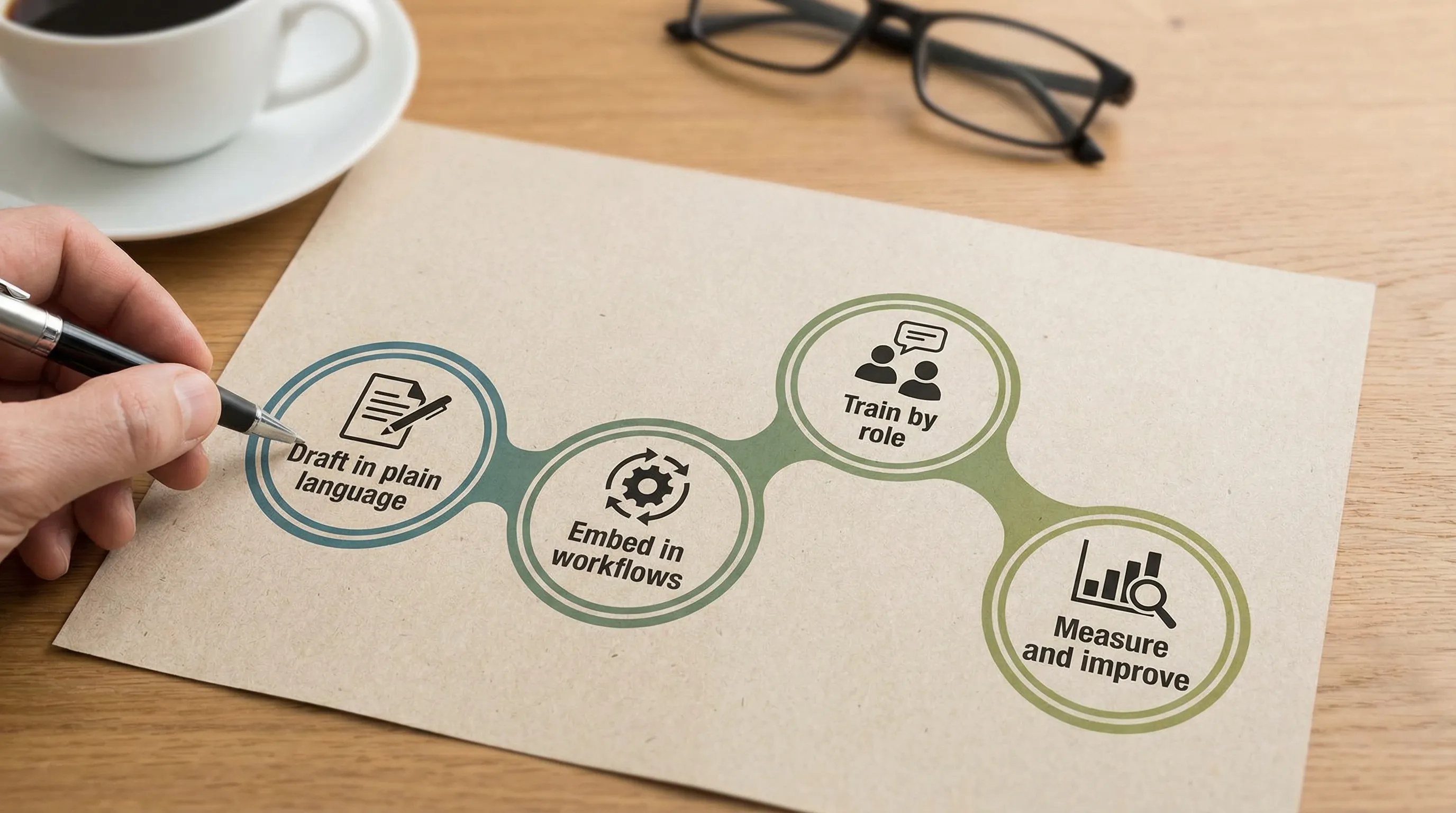

Privacy and Policies: Building a Culture People Follow

Most organisations don’t fail at privacy because they lack a policy. They fail because the policy is not how work actually gets done.
“Privacy and policies” only protect your organisation when staff can apply the rules at the moment it matters, onboarding a new employee, launching a marketing campaign, responding to a customer request, selecting a vendor, or reporting a suspected breach. In Jamaica, the expectations set by the Data Protection Act make this practical reality even more important: accountability is not just having documents, it is being able to show that your controls work in day-to-day operations.
This article breaks down how to build a privacy culture people follow, not one they click through.
Why privacy policies get ignored (even by good employees)
When a privacy programme is not “sticky,” it is usually a systems problem, not a people problem. Common causes include:
Policies are written for auditors, not for users. If the only people who can interpret a policy are Legal, it will not drive behaviour in HR, Sales, Operations, or Customer Service.
No one owns the policy in practice. A document with no accountable owner quickly becomes outdated, especially where systems and vendors change.
The policy conflicts with the workflow. If the CRM allows exporting full customer lists with no friction, “do not export personal data” becomes aspirational.
Training is too generic. Annual, one-size-fits-all training rarely changes decision-making in high-risk roles.
There is no feedback loop. Staff do not know whether they handled a request correctly, and managers do not track privacy performance.
A policy library can be “complete” and still fail if the organisation has not built the habits, tools, and reinforcement mechanisms that make compliance the easiest option.
What a privacy culture people follow looks like
A strong privacy culture is visible in everyday decisions:
Staff can explain, in plain language, what personal data they handle and why.
Teams default to collecting less data, sharing less, and retaining it for a defined purpose.
People know where to go for answers (and feel safe raising concerns early).
Routine controls exist (templates, checklists, approvals, system permissions) so that privacy is not dependent on memory.
Leaders treat privacy as operational risk management, not a legal afterthought.
In other words, your culture is your controls, repeatedly performed.
Start with “moments of truth,” not a 40-page policy
If you want people to follow privacy rules, identify the moments when staff actually make privacy-impacting decisions, then build policy, guidance, and controls around those moments.
Moment of truth (where mistakes happen) | What the policy needs to achieve | What you make easy for staff | Evidence you can produce later |
Collecting data (forms, onboarding, call scripts) | Collect only what’s needed and be transparent | Approved scripts, standard wording, mandatory fields only | Versioned forms, privacy notice text, approvals |
Sharing data internally | Limit access to those who need it | Role-based access, “need to know” guidance | Access logs, permission reviews |
Using vendors and cloud tools | Ensure processors meet requirements | Vendor due diligence checklist, standard contract clauses | Signed agreements, risk assessments |
Handling data subject requests | Meet timelines and verify identity securely | A simple intake channel and triage workflow | Request log, outcomes, communications |
Retention and disposal | Keep data only as long as necessary | Retention schedule, automated deletion where possible | Retention policy, deletion reports |
Incident reporting | Detect and escalate quickly | “If you see X, report here” playbook | Incident register, post-incident reviews |
This approach helps you avoid writing policies in a vacuum and creates an audit trail that supports accountability.
Build a policy set that matches Jamaica’s Data Protection Act expectations
For Jamaican organisations, policies should clearly support the practical obligations under the Data Protection Act, including transparency, purpose limitation, data minimisation, accuracy, storage limitation, security safeguards, and accountability.
Instead of trying to publish everything at once, build a core set and expand based on risk. A typical “core” library includes:
Privacy policy / privacy notice standard (what you tell customers, staff, and the public)
Data handling and classification policy (how to treat different data types)
Access control policy (who can access what, and how approvals work)
Records retention and disposal policy
Incident response and breach management procedure
Vendor and third-party management policy
Data subject rights request procedure
If you need a compliance starting point, PLMC’s resources on the Data Protection Act and operational readiness can help frame the essentials, for example:
Write privacy policies that humans can use
A “followable” policy reads like operational guidance, not legal theory. Practical techniques that consistently improve adoption:
Use plain language and define the decision
Most staff are not asking, “What is the definition of personal data?” They are asking, “Can I send this spreadsheet?” and “Where do I store this file?”
Policies should:
Define the decision and the safe default
Give a clear escalation path when the situation is unusual
Include examples that look like your real work (HR files, customer lists, CCTV footage, WhatsApp messages, email attachments)
Put the rule next to the task
If the policy sits on a shared drive but the work happens in a ticketing system, CRM, HR system, or inbox, the policy will be forgotten.
Bring policy into the workflow using:
Short checklists embedded in request forms
Standard clauses inside procurement templates
Tooltips and prompts in internal portals
Approved templates for privacy notices and consent wording
Reduce the “interpretation burden”
People break rules when they are forced to interpret them under pressure.
Borrow from established guidance on policy usability and accountability, such as the UK ICO’s resources on data protection governance and accountability (ICO guidance) and the NIST Privacy Framework, which emphasises repeatable processes and outcomes.
Make privacy part of performance, not just training
Training matters, but training without reinforcement becomes a checkbox.
Shift to role-based training
Role-based training means each function learns what they need for the decisions they make:
Customer-facing teams: identity verification, handling access requests, what not to disclose on calls
HR: handling employee records, medical information, background checks, retention
Marketing: lawful basis, consent management, mailing lists, tracking pixels, vendor platforms
IT and Security: access controls, logging, incident escalation, secure configurations
Procurement: processor due diligence, contractual controls, cross-border considerations
Where possible, include short scenario exercises based on your real incidents and near misses.
Teach managers how to lead privacy
Culture is set by what leaders tolerate. Equip managers to:
Ask “Why do we need this data?” in project discussions
Challenge unnecessary sharing and retention
Praise early reporting of mistakes (so issues surface before they become breaches)

Turn policy into controls: the operational layer
A privacy culture becomes durable when the safest path is the easiest path. That requires operational controls that align with policy.
Examples of “policy-backed controls” include:
Access controls and permission reviews: ensure staff only access what they need, and review access periodically.
Standard retention schedules: define how long common record types are kept, then enforce through process or automation.
Vendor onboarding gates: require privacy and security checks before a new tool or service goes live.
Change management hooks: ensure new systems, integrations, or campaigns trigger a privacy review.
Incident reporting playbook: define what to report, how to report, and what happens next.
These controls reduce reliance on memory and make it easier to demonstrate accountability when asked.
Measure what people actually do (and report it)
If you cannot measure adoption, you cannot manage it. Measurement also helps leadership understand privacy as business risk.
Useful indicators include:
Training effectiveness: completion plus short scenario-based checks, not just attendance.
Rights request performance: number received, average time to acknowledge, average time to complete, repeat errors.
Vendor governance: percentage of critical vendors reviewed, contract coverage, remediation status.
Incidents and near misses: frequency, root causes, time to escalate.
Retention compliance: evidence that data is disposed of when it should be.
Keep reporting simple and consistent. A quarterly privacy dashboard to senior management is often enough to drive improvement, especially when paired with clear action items.
Plan for exceptions without creating loopholes
Real operations require exceptions. The goal is to manage them without normalising non-compliance.
A workable exception process usually includes:
A clear definition of what counts as an exception
Time limits (exceptions should expire)
Documented risk acceptance and compensating controls
One accountable approver
This protects the organisation from “informal workarounds” that later look like negligence.
Align culture with credibility: what customers and regulators notice
Stakeholders rarely see your internal policy documents, but they do notice outcomes:
Customers receive clear notices and respectful communication.
Requests are handled professionally and on time.
Staff do not overshare, especially in public or semi-public channels.
Incidents are detected and managed with speed and transparency.
That is why culture is not a soft concept. It is a measurable risk control, and it is central to trust.
Getting help building privacy and policies that work in practice
If your organisation already has policies but adoption is uneven, support usually needs to focus on implementation, workflow design, training, and evidence. PLMC supports Jamaican organisations with data protection implementation, training sessions, risk assessment tools, and broader Governance, Risk, and Compliance integration.
If you want to pressure-test whether your policies match how work gets done, you can start with a gap assessment and an implementation plan, then prioritise the highest-risk moments first. You can learn more about PLMC’s approach and request a consultation at Privacy & Legal Management Consultants Ltd..