

A Practical DSAR Workflow for Jamaican Organisations
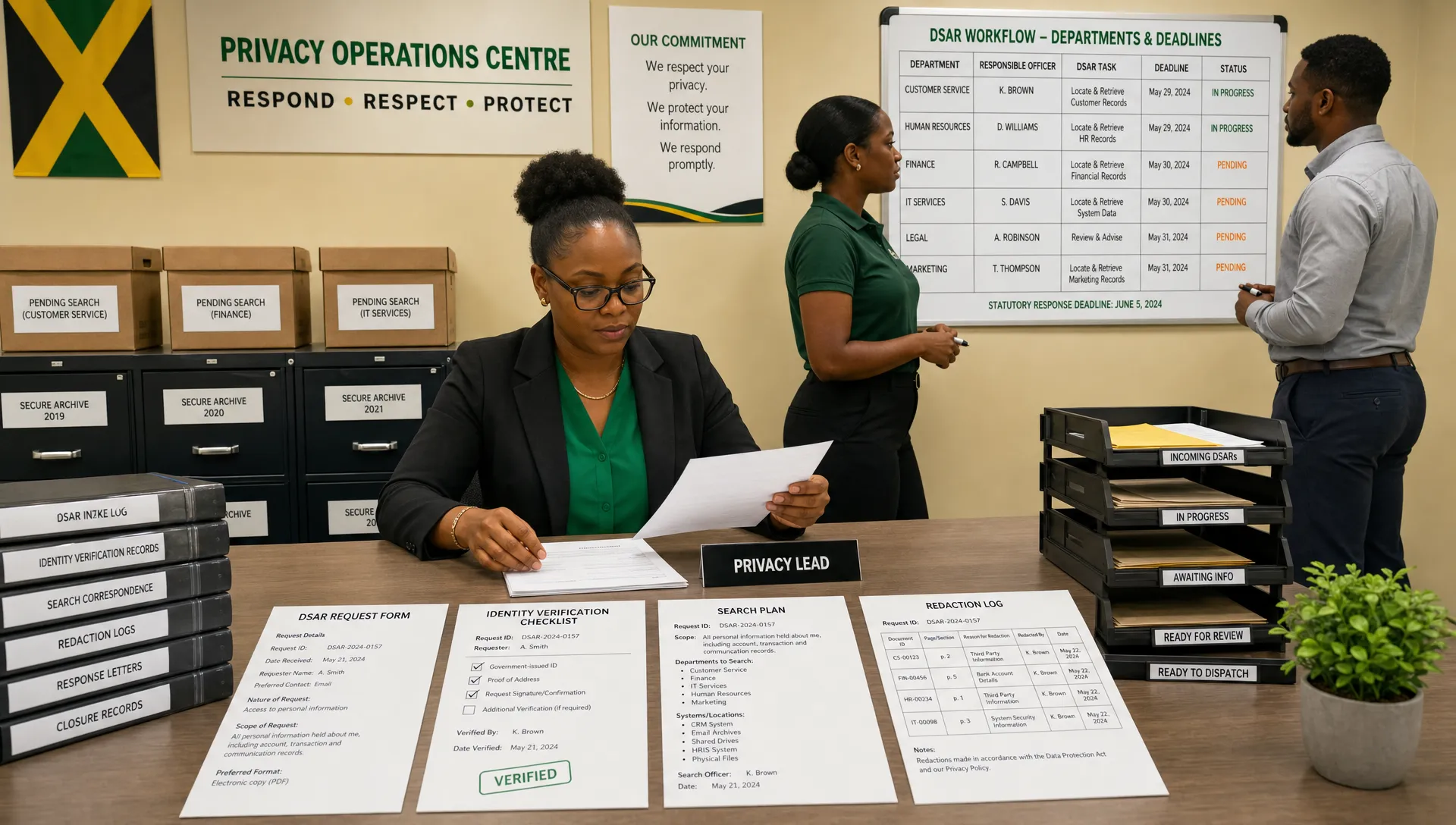
A data subject access request, often shortened to DSAR, is one of the clearest tests of whether a privacy programme works in real life. Policies may look good on paper, but when a customer, employee, student, patient, tenant or vendor asks, “What personal information do you have about me?”, the organisation must know exactly what happens next.
For Jamaican organisations, DSAR handling should be treated as a core operational process under the Data Protection Act, 2020. It is not only a legal task for the Data Protection Officer or legal team. It touches front desk teams, HR, IT, compliance, records management, customer service, marketing, branch operations and sometimes third-party processors.
This guide sets out a practical DSAR workflow that Jamaican organisations can adapt to their size, sector and risk profile. It is general guidance, not legal advice, and complex requests should be reviewed with appropriate legal or privacy support.
What counts as a DSAR?
A DSAR is a request from an individual to access personal data that an organisation processes about them. The person does not need to use the words “data subject access request” or quote the Data Protection Act, 2020. A request can arrive by email, letter, web form, social media message, WhatsApp, in-person conversation, call centre recording or through a representative.
A request may sound like:
Request wording | Likely classification | First action |
“Please send me all information you have on me.” | Access request | Log as a DSAR and begin verification. |
“I want a copy of my employment file.” | Employee DSAR | Route to HR and privacy lead while preserving confidentiality. |
“Who did you share my loan application with?” | Access request about recipients | Search customer, credit, email and processor records. |
“Correct my address and stop sending marketing texts.” | Rectification and marketing objection | Treat as a broader data subject rights request, not only access. |
“My attorney is requesting my medical records.” | Representative request | Verify identity and written authority before disclosure. |
If your team is unsure whether a message is a DSAR, log it and escalate it. It is safer to triage quickly than to miss the deadline because the request was sitting in an inbox or branch file.
For a refresher on the legal concepts behind controllers, processors, personal data and sensitive personal data, see this plain-English guide to the Jamaica Data Protection Act explained for businesses.
The practical DSAR workflow at a glance
A good DSAR process is simple enough for frontline teams to recognise, but controlled enough to prevent identity fraud, accidental disclosure and missed deadlines. For most access requests, Jamaican organisations should design their process around a 30-day completion target from receipt, while confirming any sector-specific or case-specific requirements against current law, regulatory guidance and legal advice.
Stage | Main owner | Output | Evidence to retain |
Recognise and log | Any receiving team, then privacy lead | DSAR register entry | Original request, date and channel received |
Acknowledge and verify | Privacy lead, customer service, HR | Verified requester or authorised representative | Verification method and authority check |
Clarify and scope | Privacy lead with business owner | Search plan | Scope notes and systems list |
Search and collect | IT, HR, business units, processors | Retrieved records | Search instructions and confirmations |
Review and redact | Privacy lead, legal, records owner | Response-ready data pack | Redaction log and exemption rationale |
Approve and respond | DPO or authorised approver | Secure DSAR response | Final response copy and delivery proof |
Close and improve | Privacy lead, compliance | Closed case and lessons learned | Closure note, metrics and follow-up actions |
The workflow below turns that overview into day-to-day actions.
Step 1: Recognise the request early
The first control is awareness. A DSAR can fail before the privacy team ever sees it. This is especially common where requests are received at a branch, reception desk, HR office, WhatsApp number, shared mailbox or social media inbox.
Train frontline staff to look for phrases such as “send me my file,” “what information do you have on me,” “delete my data,” “who accessed my account,” “give me my records,” or “I want to know why I was declined.” Not all of these are pure access requests, but all should trigger escalation to the person responsible for data protection.
The receiving employee should not debate the law with the requester. A simple response is enough: “We have received your request about your personal information and will forward it to the appropriate team for handling.”
Step 2: Log the DSAR in a central register
Every DSAR should be entered into a central register on the same day it is received or as soon as practicable. A spreadsheet may be enough for a small organisation, while larger organisations may use a case management tool. The important point is that there is one source of truth.
Your DSAR register should capture:
Date and time received
Channel received
Name and contact details of the requester
Relationship to the organisation, such as customer, employee or applicant
Exact wording of the request
Request category, such as access, correction, erasure or objection
Verification status
Internal owner and departments involved
Deadline and current status
Date of response and closure notes
The date received matters. Do not start the clock only when the request reaches legal, compliance or the DPO. Build your internal service level so requests are escalated immediately.
Step 3: Verify identity without over-collecting data
Identity verification protects the requester and the organisation. A DSAR response may contain sensitive personal data, financial details, employment history, health information, CCTV footage or complaint records. Sending that information to the wrong person can create a serious privacy incident.
At the same time, verification should be proportionate. If the requester is logged into an existing customer portal, that may be enough for a low-risk request. If the request involves sensitive personal data, employment records, children’s data, legal proceedings or a high-value account, stronger verification may be justified.
Avoid collecting new identity documents automatically for every request. If you do need identification, collect the minimum necessary, protect it securely and define how long it will be retained. Do not create a new privacy risk while trying to manage an existing one.
Where a lawyer, parent, guardian, union representative or other third party makes the request, verify both the requester’s identity and their authority to act. Keep a record of the authority check, but avoid retaining excessive documentation unless necessary.
Step 4: Clarify scope without blocking the right of access
Some DSARs are broad. A person may ask for “everything you have about me” after years of interactions. The organisation can ask for clarification to help locate the information, especially where the request covers multiple products, branches, departments or time periods.
Clarification should be used to make the process workable, not to frustrate the request. If the person does not narrow the request, your organisation should still assess what reasonable searches are required based on the information available.
Useful scoping questions include:
Are you asking about a specific account, service, incident, job application or time period?
Do you want copies of records, information about recipients, or both?
Have you used any previous names, email addresses or account numbers with us?
Are you requesting information held by a particular department or branch?
Document the clarification request and the response. If the scope changes, update the DSAR register and search plan.
Step 5: Build a search plan before collecting data
A rushed search leads to missed records, duplicated effort and inconsistent responses. Before teams start exporting data, the privacy lead should prepare a short search plan.
Start with your data inventory or records of processing activities if you have one. If your inventory is incomplete, the DSAR process will expose gaps that should be fixed. For broader programme design, PLMC’s guide on building a data compliance programme that works in day-to-day operations is a useful companion.
Common sources for Jamaican organisations include:
Data source | Typical owner | DSAR search questions |
Customer relationship management system | Customer service or sales | What profiles, notes, complaints and account records exist? |
Core business system | Operations, finance or service team | What transactions, applications, approvals or service history are linked to the person? |
HR and payroll systems | HR and finance | What employment, performance, leave, payroll or disciplinary records exist? |
Email and collaboration tools | IT and business units | Which custodians are likely to hold relevant communications? |
CCTV and access logs | Security or facilities | Is footage still retained and does it identify the requester? |
Call recordings and chat logs | Contact centre or customer service | Are recordings searchable by number, account, date or agent? |
Third-party processors | Vendor owner or procurement | What personal data is held on behalf of the organisation? |
Do not forget paper files. Many Jamaican organisations still maintain physical records in branches, HR offices, warehouses or archived storage. A DSAR search plan should include both digital and manual records where relevant.

Step 6: Collect records securely and keep an audit trail
When departments search for data, give them clear instructions. Tell them the requester’s verified identifiers, the date range, the systems to search, the file types to include and the deadline for returning results. Ask each department to confirm whether records were found, not only to send records when they exist.
For email searches, avoid overly broad searches that capture irrelevant third-party information. Start with likely custodians and relevant search terms. For CCTV or call recordings, confirm retention periods quickly because these records may be overwritten under standard retention schedules.
Third-party processors must be included where they hold or handle personal data for your organisation. Your contracts and vendor management procedures should require processors to assist with rights requests within a timeframe that allows you to meet your own deadline.
Keep a record of who searched, what they searched, when they searched and what was returned. This evidence is vital if the requester challenges the completeness of the response or if the organisation later faces a compliance review.
Step 7: Review the data and apply redactions carefully
The purpose of a DSAR is to give the individual access to their personal data, not to disclose every document in full. A record may contain information about the requester, other employees, other customers, internal reviewers, witnesses or confidential business matters.
Before disclosure, review the material for:
Personal data that relates to the requester
Personal data about other identifiable individuals
Sensitive personal data requiring additional care
Legal privilege or litigation-related material
Fraud, security or investigation concerns
Confidential references, internal opinions or third-party material that may require legal review
Redaction is one of the highest-risk stages. Over-redaction may undermine the requester’s rights. Under-redaction may expose another person’s personal data. Use a consistent redaction tool, avoid reversible highlighting, and keep an internal redaction log explaining what was removed and why.
Where an exemption or restriction may apply, do not rely on guesswork. Seek legal or specialist privacy advice and document the rationale.
Step 8: Prepare a clear and secure response
A good DSAR response should be understandable. The requester should not need to decode internal system names, abbreviations or database fields. Where appropriate, explain the context of the data, the purposes of processing, categories of recipients, retention approach and any rights or escalation options available.
The response should usually include:
Response component | Practical purpose |
Confirmation of processing | Tells the requester whether the organisation processes their personal data. |
Copy or extract of personal data | Provides the personal data in a usable format, subject to lawful limits. |
Explanation of purposes | Shows why the organisation processes the data. |
Categories of recipients | Identifies who the data has been shared with, such as service providers or regulators, where applicable. |
Source information | Explains where the data came from if not collected directly from the requester. |
Retention information | Explains how long the data is kept or the criteria used. |
Redaction or refusal explanation | Gives a clear reason if some information is withheld. |
Contact and escalation route | Tells the requester how to raise concerns with the organisation. |
Delivery must match the sensitivity of the information. A password-protected file may be suitable for some low-risk responses, while highly sensitive data may require a secure portal, encrypted transfer, registered delivery or in-person collection. Avoid sending sensitive records to an unverified personal email address without appropriate safeguards.
Step 9: Close the case and learn from it
After sending the response, update the DSAR register and close the file. Closure should not mean deleting all evidence. Keep a proportionate DSAR case file showing how the request was handled, who approved the response and what was sent.
Your closure pack should include the original request, acknowledgement, verification record, scope notes, search instructions, departmental confirmations, processor responses, review notes, redaction log, approval record, final response and delivery proof.
These records support accountability. They also help the organisation prepare for audits or regulator enquiries. If you are formalising your evidence approach, this guide to audit-ready data protection policies and procedures explains how procedures, logs and approvals fit into a wider compliance framework.
A sample 30-day DSAR timetable
The exact timeline will depend on complexity, verification and the volume of records, but the table below gives a practical operating model. Treat it as an internal discipline, not as a substitute for legal advice on statutory deadlines.
Timeline | Action | Owner |
Day 0 | Request received, recognised and escalated | Receiving team |
Day 1 | DSAR logged, owner assigned and deadline calculated | Privacy lead or DPO |
Days 1 to 3 | Acknowledgement sent and identity verification started | Privacy lead, HR or customer service |
Days 3 to 7 | Scope confirmed and search plan issued | Privacy lead and business owners |
Days 7 to 14 | Systems, emails, paper files and processor records searched | IT, departments and vendor owners |
Days 14 to 21 | Records reviewed, duplicates removed and redactions applied | Privacy lead, legal and records owners |
Days 21 to 25 | Quality assurance and approval completed | DPO or authorised approver |
Days 25 to 30 | Response delivered securely and case file closed | Privacy lead |
For complex DSARs, build internal escalation points well before the deadline. If a department has not responded by Day 10, the issue should be escalated. If redactions are not ready by Day 21, legal or senior management support may be needed.
Common DSAR mistakes to avoid
DSAR errors are often operational rather than legal. They happen because staff were not trained, data maps were incomplete, processor contracts were weak or the organisation had no evidence trail.
Mistake | Why it creates risk | Practical control |
Treating a DSAR as a general complaint only | The access request may be missed. | Train staff to identify rights language and escalate immediately. |
Waiting for the DPO before logging the request | Deadlines may be lost. | Log at first receipt, then assign ownership. |
Asking for excessive ID | Creates unnecessary data collection and may discourage valid requests. | Use risk-based verification. |
Searching only the main database | Important records in email, paper files or processors may be missed. | Use a documented search plan. |
Disclosing full documents without review | Third-party data may be exposed. | Review and redact before disclosure. |
Sending sensitive data insecurely | A DSAR response can become a data breach. | Match delivery method to sensitivity. |
Keeping no evidence of searches | The organisation cannot prove reasonable handling. | Maintain a DSAR case file. |
One serious mistake is deleting, altering or suppressing records after receiving a request. Normal retention rules still matter, but once a DSAR is received, relevant records should be handled carefully and in line with legal advice, especially where there is a complaint, dispute or investigation.
Make DSAR handling part of your privacy governance
A DSAR workflow should not sit alone. It should connect to privacy notices, retention schedules, information security controls, vendor contracts, staff training, breach response, records management and internal audit.
At least quarterly, review DSAR metrics such as average response time, number of requests by department, missed internal deadlines, volume of redactions, processor response times and recurring requester concerns. These metrics show where the privacy programme needs improvement.
For example, repeated DSARs about marketing lists may indicate weak consent or opt-out management. Repeated employee DSARs during disputes may show that HR records are hard to search or inconsistent. Repeated delays from a vendor may reveal a contract or vendor oversight issue.
The UK Information Commissioner’s Office provides useful operational guidance on the right of access, although Jamaican organisations must always adapt practices to Jamaica’s Data Protection Act, 2020 and guidance from Jamaica’s Office of the Information Commissioner.
Frequently Asked Questions
Does a person have to say “DSAR” for the request to count? No. If the person is asking to access personal data your organisation holds about them, treat it as a potential DSAR even if they use informal wording.
Can a Jamaican organisation ask for identification before responding? Yes, where identity verification is necessary and proportionate. The organisation should avoid collecting more identification than needed and should protect any verification records securely.
What if the request is very broad? You can ask the requester to clarify the scope, such as the relevant service, time period or department. However, clarification should not be used simply to delay or avoid the request.
Do emails, CCTV and call recordings have to be searched? They may need to be considered if they contain personal data about the requester and are within scope. The search should be reasonable, documented and guided by retention periods and the facts of the request.
Should employee DSARs be handled differently from customer DSARs? The same core rights and controls apply, but employee DSARs often involve sensitive HR records, disciplinary matters, performance reviews and third-party comments. They should receive careful HR, privacy and legal review.
Need help building a DSAR process that works?
A practical DSAR workflow protects individuals, reduces compliance risk and gives your team confidence when requests arrive. Privacy & Legal Management Consultants Ltd. supports Jamaican organisations with data protection implementation, privacy awareness, governance, risk and compliance services.
If your organisation needs to design, test or improve its DSAR process under the Data Protection Act, 2020, start with a free consultation with PLMC.