

International Data Transfers: A Practical Compliance Guide

Moving personal data across borders is now a normal part of doing business. A Jamaican company may use a cloud CRM hosted in the United States, outsource payroll support to a regional provider, send customer records to a parent company overseas or allow a foreign IT support team to log in remotely. Each activity may be efficient, but each also creates a compliance question: is the organisation protecting people’s personal data when it leaves Jamaica or becomes accessible from another country?
International data transfers are not just a legal issue for multinationals. They affect hotels, financial institutions, professional services firms, health providers, schools, e-commerce businesses, BPOs, charities and public bodies. If personal data is sent, stored, viewed or supported outside Jamaica, the organisation should be able to explain the purpose, the risk and the safeguards.
This guide sets out a practical way to manage international data transfers under Jamaica’s Data Protection Act, 2020, with additional context for organisations that may also face GDPR, UK GDPR or other foreign privacy requirements.
What counts as an international data transfer?
An international data transfer happens when personal data moves from one jurisdiction to another or when someone outside Jamaica can access personal data that is controlled by a Jamaican organisation. The transfer does not need to be dramatic. It can occur through ordinary business tools and everyday vendor arrangements.
Common examples include:
Storing customer, employee or supplier records in a cloud platform hosted outside Jamaica.
Giving an overseas service provider remote access to local systems for IT support, analytics, accounting, HR or customer service.
Sharing personal data with a parent company, subsidiary, franchise network or regional head office outside Jamaica.
Sending files by email or secure portal to foreign lawyers, auditors, insurers, consultants or regulators.
Using overseas payment processors, marketing platforms, booking engines or helpdesk software.
A transfer can also happen even if the data remains on a Jamaican device or server, if a person in another country can access it. Remote viewing, remote administration and outsourced processing should be assessed in the same disciplined way as file exports.
Not every data movement is a transfer of personal data. Truly anonymised data that cannot reasonably identify a living individual falls outside the usual personal data analysis. Pseudonymised data, encrypted files and coded records often still count as personal data if someone can re-identify the individual using another key or dataset.
The Jamaican compliance baseline
Jamaica’s Data Protection Act, 2020 establishes standards for how data controllers process personal data. For international data transfers, the central compliance point is that personal data should not be transferred outside Jamaica unless the destination ensures an adequate level of protection for the rights and freedoms of data subjects in relation to the processing.
In practical terms, an organisation should not treat a foreign vendor, affiliate or cloud provider as safe simply because it is reputable or widely used. The data controller should assess the arrangement and keep evidence of that assessment. The Office of the Information Commissioner is the key regulatory body for Jamaica’s data protection regime, so organisations should monitor its guidance as local expectations continue to mature.
An adequacy review is usually not a single yes or no question. It should consider the type of data, the purpose of transfer, the destination country, the recipient’s legal obligations, the security measures in place, the transfer duration, any onward sharing and the rights available to individuals.
For Jamaican organisations that serve foreign customers or process data for overseas clients, local law may not be the only concern. The EU GDPR, UK GDPR, US sector laws or regional privacy requirements can apply depending on whose data is processed and how the business is structured. For a broader view of when foreign rules may be triggered, see PLMC’s guide to international privacy rules Jamaican businesses cannot ignore.
A practical workflow for approving international data transfers
The strongest transfer programmes are built into procurement, IT change management, contract review and vendor onboarding. If the transfer review happens only after a system is live, the organisation may have little leverage to fix weak terms or unsafe practices.
Map the transfer before approving it
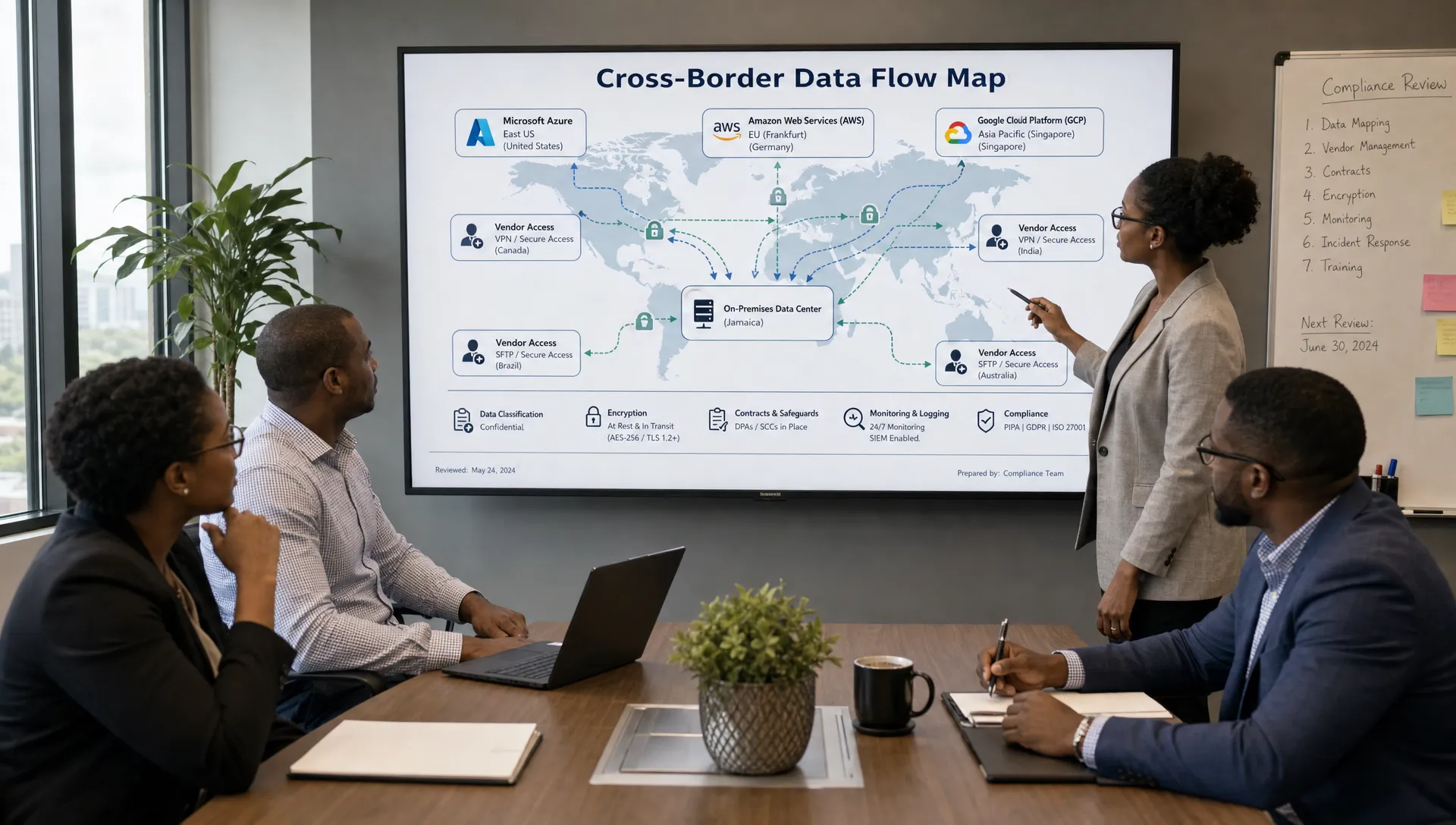
Start with a basic but complete description of the data flow. Who is sending the data? Who is receiving it? Which systems are involved? Where is the data stored? Who can access it? Is the data returned, deleted or retained at the end of the service?
A useful transfer record should capture the business purpose, categories of personal data, categories of data subjects, destination country, recipient identity, role of each party, legal basis for processing, security controls, retention period and contract reference. This does not need to be a complex exercise for every low-risk tool, but it should be clear enough that a manager, auditor or regulator can understand the decision.
Identify whether the recipient is a controller or processor
The compliance duties are different depending on the recipient’s role. A processor acts on the controller’s instructions, such as a payroll platform or outsourced IT provider. Another controller decides its own purposes and means, such as an insurer, regulator or independent professional adviser receiving data for its own legal obligations.
This distinction matters because processor arrangements normally require stricter instruction-based contracts, confidentiality requirements, security obligations, assistance with data subject rights, breach notification duties and deletion or return rules. Controller-to-controller transfers still need governance, but the agreement may focus more on each party’s responsibilities, lawful use, transparency, security and limits on onward disclosure.
Assess destination risk and legal protection
A transfer to a country with mature privacy laws, independent regulatory oversight and enforceable rights may present a different risk profile from a transfer to a jurisdiction with limited privacy protections or broad state access powers. The assessment should be proportionate. A large-scale transfer of health, financial or children’s data needs deeper analysis than an occasional transfer of business contact information.
The UK Information Commissioner’s Office provides detailed international transfer guidance that can be useful as a benchmark, especially where UK GDPR concepts are relevant to the organisation. EU-focused organisations should also be aware of the European Data Protection Board’s recommendations on supplementary measures for international transfers, which influenced how many global organisations evaluate transfer risk after the Schrems II decision.
Review question | Evidence to keep | Typical owner |
What personal data is being transferred? | Data inventory entry, system record, file classification | Privacy lead, data owner |
Why is the transfer necessary? | Business case, service description, processing purpose | Business unit |
Where will the data be stored or accessed? | Vendor hosting details, support location, sub-processor list | IT, procurement |
What safeguards protect the data? | Contract clauses, encryption details, access controls, audit reports | Legal, IT security |
How will the transfer be monitored? | Review schedule, vendor risk rating, renewal checklist | Compliance, procurement |
Choosing the right transfer safeguard
There is no single safeguard that fits every transfer. A practical compliance decision usually combines legal, contractual, technical and organisational controls.
Adequacy assessment
For Jamaica data privacy compliance, the starting point is whether the destination offers adequate protection. If the organisation concludes that protection is adequate, it should document why. That conclusion may rely on the destination’s privacy laws, the recipient’s regulated status, binding professional duties, contract terms and technical safeguards.
Adequacy should be reviewed if the arrangement changes. A new hosting location, new sub-processor, wider access rights, merger, security incident or change in law can alter the risk profile.
Contractual protections
Contracts are one of the most practical tools for governing international data transfers. At minimum, the contract should describe the processing, limit use to agreed purposes, require confidentiality, set security obligations, control sub-processing, require breach notification, assist with rights requests and provide for deletion or return at the end of the relationship.
Where the EU GDPR or UK GDPR applies, Standard Contractual Clauses, the UK International Data Transfer Agreement or the UK Addendum may be required depending on the transfer route. Jamaican law does not become irrelevant simply because a GDPR tool is used. The organisation should still confirm that the contract supports its Data Protection Act compliance obligations in Jamaica.
A contract alone may not be enough for higher-risk transfers. If a vendor has poor access controls, unclear hosting arrangements or broad rights to reuse data, stronger wording will not fix the operational weakness unless the vendor changes its practices.
Consent and necessity
Consent may support some limited transfers if it is freely given, specific, informed and documented. It should not be the default answer for routine vendor operations, employee administration or core customer services because it can be difficult to prove, may be withdrawn and may not address all security or adequacy concerns.
In some cases, a transfer may be necessary to perform a contract with the individual, comply with a legal obligation, establish or defend legal claims or protect vital interests. Even then, necessity should be interpreted carefully. If the same objective can be achieved with a safer local or lower-risk arrangement, the organisation should consider that option.
Security controls that make transfers defensible
Legal paperwork is only credible when operational controls match it. The organisation should be able to show that personal data is protected before, during and after transfer.
Encryption in transit and at rest is often expected for sensitive data. Access should be limited by role, protected by strong authentication and reviewed regularly. Logs should show who accessed the system and when. Files should not be sent through personal email accounts, consumer messaging apps or unapproved storage tools simply because they are convenient.
Vendor access should be time-bound where possible. Remote support sessions should be approved, logged and limited to what is needed. Shared accounts create accountability problems and should be avoided. If data is exported for testing, analytics or development, consider whether masking, pseudonymisation or synthetic data can reduce risk.
Secure transfer habits also matter for day-to-day teams. PLMC has covered practical controls for secure file sharing with teams and external partners, including file classification, approved channels and access control discipline.
Managing onward transfers and sub-processors
Many international transfer risks sit below the main vendor. A Jamaican organisation may contract with a well-known cloud provider, but that provider may rely on support teams, hosting partners, analytics tools or group companies in other countries. These onward transfers need visibility and control.
A good contract should require the recipient to disclose sub-processors, seek approval for material changes, impose equivalent protections on sub-processors and remain responsible for their actions. For higher-risk data, the controller may also want audit rights, security certifications, data residency commitments or advance notice before support access moves to a new region.
The organisation should keep a current list of vendors and critical sub-processors. Procurement and IT teams should not approve new tools in isolation from privacy review. Shadow IT can create international data transfers that nobody has assessed, especially when staff sign up for free trials, AI tools, file sharing apps or browser extensions.
When a transfer needs extra scrutiny
Some transfers deserve a deeper review before approval. These include large-scale customer databases, employee monitoring data, health information, financial records, biometric data, children’s data, criminal offence information, national identifiers and data that could expose people to discrimination, fraud or physical harm.
Extra scrutiny is also appropriate where the recipient is in a country with weak privacy enforcement, where state access powers are broad, where the vendor refuses meaningful contract terms or where the data will be used for analytics, profiling, AI training or marketing beyond the original purpose.
For these higher-risk arrangements, conduct a documented transfer risk assessment. In some cases, a wider privacy impact assessment is also sensible, particularly where the transfer forms part of a new system, outsourcing project or digital transformation programme. The assessment should recommend controls, assign owners and set a review date.
Documentation auditors will expect to see
A defensible transfer programme depends on evidence. If a regulator, client, board member or auditor asks why a transfer was approved, the organisation should not have to reconstruct the answer from scattered emails.
Your records should include the transfer map, risk assessment, approval decision, contract or data sharing agreement, vendor due diligence, security review, privacy notice updates, staff guidance and monitoring schedule. If the decision relies on consent, keep the consent wording, collection method, date, version and withdrawal process.
This documentation should fit into the wider compliance programme rather than sit in a separate privacy folder that nobody updates. PLMC’s article on how to build a data compliance programme that works in day-to-day operations explains how scope, ownership, records and monitoring can be embedded into business processes.
Common mistakes to avoid
One common mistake is assuming that cloud services are automatically compliant because they are global brands. Many reputable vendors provide strong security, but the controller still has to select the right settings, review the terms, understand locations and control user access.
Another mistake is treating international data transfers as an IT issue only. Legal, privacy, procurement, information security, HR and business owners all have a role. A transfer can be technically secure but legally weak if the contract allows broad reuse of data or fails to restrict onward sharing.
Organisations also overlook transparency. Privacy notices should explain, in clear language, when personal data may be transferred overseas and what safeguards apply. If individuals would be surprised by the transfer, the organisation should revisit its notice, consent process or service design.
Finally, many businesses fail to review transfers after approval. Vendor locations change, sub-processors change, laws change and internal use cases expand. A transfer approved two years ago for one purpose may no longer be appropriate if the vendor now supports AI analytics, broader marketing or new offshore support teams.
Frequently Asked Questions
Does using a foreign cloud provider count as an international data transfer? Yes, if personal data is stored, processed or accessed outside Jamaica. The organisation should assess the hosting location, support access, contract terms, security controls and any sub-processors involved.
Can consent make any international transfer lawful? Consent can help in limited cases, but it is not a universal solution. It must be specific, informed and properly recorded, and the organisation still needs suitable safeguards for security, purpose limitation and accountability.
Do Jamaican organisations need GDPR clauses for every overseas vendor? Not always. GDPR transfer tools are required when the GDPR or UK GDPR applies to the relevant data flow. Even when they are not legally required, similar contractual protections can still be useful as good practice.
How often should transfer risk assessments be reviewed? Review them when there is a material change, such as a new destination, new sub-processor, new purpose, major security incident or contract renewal. High-risk transfers should also be reviewed on a scheduled basis.
Who should own international transfer compliance? The data controller remains accountable, but ownership should be shared across privacy, legal, IT security, procurement and the business unit using the service. Clear approval roles prevent gaps and delays.
Strengthen your cross-border data compliance
International data transfers can support growth, outsourcing and better technology, but they need disciplined governance. The practical goal is simple: know where personal data goes, why it goes there, who can access it and what safeguards protect individuals.
Privacy & Legal Management Consultants Ltd. helps Jamaican organisations with data protection implementation, compliance reviews, privacy training, cyber security alignment and GRC integration. If your organisation is reviewing vendors, adopting cloud tools or preparing for Data Protection Act compliance, contact PLMC to discuss a practical way forward.