

International Privacy Rules Jamaican Businesses Cannot Ignore
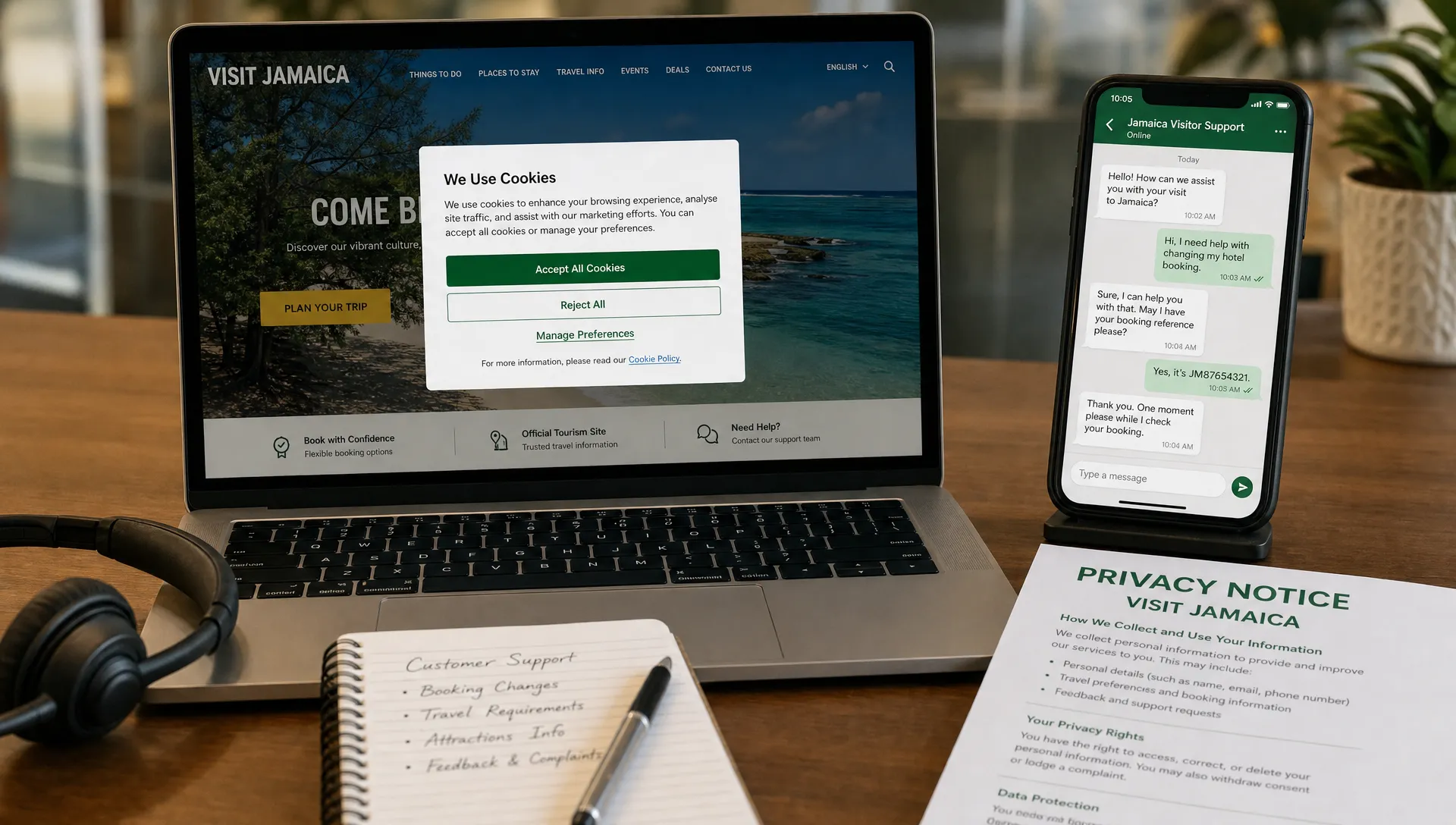
Jamaican businesses no longer need an overseas branch to face overseas privacy obligations. A hotel in Montego Bay taking bookings from Europe, a Kingston software company supporting a Canadian client, a BPO provider handling US customer records, an online retailer shipping abroad or a professional services firm using global cloud tools may all touch international privacy rules.
That matters because privacy risk is now commercial risk. Regulators may investigate, overseas clients may audit, payment partners may impose security requirements and customers may walk away if personal data is handled carelessly. Jamaica's Data Protection Act is the starting point for local accountability, but it is not the end of the conversation for businesses with cross-border customers, vendors or data flows.
This guide explains the international privacy rules Jamaican businesses cannot ignore, the triggers that make them relevant and the practical steps to reduce exposure. It is general information, not legal advice.
Why international privacy rules matter for Jamaican businesses
Jamaica's economy is deeply connected to global markets. Tourism, remittances, financial services, outsourcing, ecommerce, education, healthcare, entertainment and professional services all depend on cross-border trust. Personal data moves with that trade.
A Jamaican company might collect passport details from a UK guest, process payroll information for a US client, store customer records in a cloud platform hosted overseas or run advertising tools that track website visitors from several jurisdictions. Each activity can create privacy obligations beyond Jamaica.
International privacy rules matter for three practical reasons.
First, many modern privacy laws have extra-territorial reach. They can apply when a business outside the country offers goods or services to individuals in that country or monitors their behaviour online.
Second, business contracts often import foreign privacy standards. Even where a foreign regulator is unlikely to knock first, an overseas client may require GDPR clauses, US security certifications, breach notification timelines or audit rights.
Third, privacy expectations travel faster than laws. Customers now expect clear notices, limited collection, secure handling, fast breach response and respect for access or deletion requests. Businesses that treat privacy as a governance issue are better placed to win trust.
Common triggers that bring foreign privacy laws into scope
Not every Jamaican business is subject to every international privacy law. The key is to identify the trigger. A privacy assessment should look at who the data relates to, where the data came from, what the business does with it and whether the company is acting for itself or for another organisation.
Common triggers include:
Selling goods or services to individuals in another country, especially when prices, advertising or shipping are targeted to that market.
Monitoring overseas website visitors through cookies, analytics, behavioural advertising or app tracking.
Processing personal data on behalf of a foreign client, such as customer support, payroll, software hosting or call centre services.
Handling sensitive data, including health, biometric, financial, child-related or identification data.
Using overseas vendors, cloud platforms, payment processors or marketing tools that transfer data across borders.
Sending marketing emails or messages to people in jurisdictions with strict consent or opt-out rules.
Receiving personal data from an overseas partner that must comply with its own transfer restrictions.
The practical point is simple: do not assess privacy law only by the location of your registered office. Assess it by the location of the people, clients, systems and data flows involved.
The international privacy rules to watch
EU GDPR
The EU General Data Protection Regulation remains one of the most influential privacy laws in the world. The European Commission's GDPR guidance for businesses explains that the regulation applies to organisations established in the EU, but it can also apply to non-EU organisations that offer goods or services to people in the EU or monitor their behaviour.
For a Jamaican business, GDPR risk may arise through European guests, students, patients, subscribers, app users or business clients. A tourism operator actively marketing to EU residents, a SaaS provider serving EU users or a Jamaican processor handling EU customer data for a European company should treat GDPR as a serious consideration.
Key obligations include lawful basis for processing, transparent privacy notices, data subject rights, data minimisation, security, processor contracts, breach notification and transfer safeguards. The GDPR also has significant penalty powers, with maximum administrative fines reaching the higher of €20 million or 4% of annual worldwide turnover for the most serious infringements.
UK GDPR and the UK Data Protection Act 2018
The UK has its own data protection regime after Brexit. It is similar to the EU GDPR, but it is legally separate and supervised by the UK Information Commissioner's Office. The ICO's UK GDPR resources remain a practical reference for organisations dealing with UK personal data.
This matters for Jamaican businesses because the UK is a major source market for tourism, education, family connections and business services. A business that receives data from UK clients may need appropriate contracts, security measures and a clear process for UK data subject requests.
United States privacy and security rules
The US does not have one single GDPR-style federal privacy law covering all private sector activity. Instead, Jamaican businesses may encounter a mix of state privacy laws, federal sector rules and enforcement by agencies such as the Federal Trade Commission.
The FTC's business guidance on privacy and security is especially relevant for companies that make privacy or security promises to US consumers. If a business says it protects data in a certain way, then fails to do so, that representation may create enforcement risk.
State laws also matter. California's Consumer Privacy Act, as amended by the CPRA, is the best-known example, and the California Attorney General's CCPA page explains consumer rights and business obligations. The law does not apply to every foreign business, but it can matter where thresholds and California targeting are present. Other states have adopted privacy laws too, including Virginia, Colorado, Connecticut, Utah and several others.
US sector rules can also appear in contracts. Health data may raise HIPAA questions, financial data may involve Gramm-Leach-Bliley Act requirements, children's data may involve COPPA and marketing activity may trigger CAN-SPAM or telephone and messaging rules. For a deeper US-focused discussion, PLMC has also covered when US data protection rules can apply to Jamaican businesses.
Canada PIPEDA and provincial privacy laws
Canada's federal private sector privacy law, PIPEDA, applies to many organisations engaged in commercial activities. The Office of the Privacy Commissioner of Canada explains PIPEDA's role in private sector privacy and how organisations must manage consent, accountability, safeguards and access rights.
A Jamaican organisation may encounter Canadian privacy requirements when serving Canadian customers, supporting Canadian companies or processing information with a real and substantial connection to Canada. Some provinces also have their own private sector privacy laws, so a Canadian client may impose specific contractual terms.
Brazil LGPD and other global privacy laws
Brazil's Lei Geral de Proteção de Dados, known as LGPD, follows many GDPR-style concepts. It can apply to processing carried out in Brazil, processing related to offering goods or services to individuals in Brazil or data collected in Brazil. For Jamaican companies expanding into Latin America, it is worth checking whether Brazilian personal data is in scope.
Other jurisdictions also have strong privacy frameworks, including China, South Korea, Singapore, South Africa and several Caribbean territories. A Jamaican business does not need to memorise every law worldwide. It does need a process to identify which laws become relevant before launching into a new market or signing a cross-border contract.
Rule or framework | Why Jamaican businesses should care | Example risk trigger |
EU GDPR | Applies to targeted EU goods, services, monitoring and EU client processing | A Jamaican app has paying users in France and tracks in-app behaviour |
UK GDPR | Separate UK regime with similar obligations to GDPR | A resort markets directly to UK guests and stores booking profiles |
US state and federal rules | Privacy duties vary by state, sector and business practice | A BPO provider handles customer data for a US healthcare or fintech client |
Canada PIPEDA | Applies to many commercial activities with Canadian personal data | A Jamaican service provider supports a Canadian ecommerce company |
Brazil LGPD | Relevant when offering services to people in Brazil or handling data collected there | A Jamaican online education platform recruits Brazilian students |
PCI DSS | Not a privacy law, but often required for payment card security | An online retailer accepts card payments through a merchant provider |
How international rules connect with Jamaica's Data Protection Act
Jamaica's Data Protection Act, 2020 gives local organisations a legal foundation for responsible data handling. It requires attention to lawful processing, purpose limitation, data minimisation, accuracy, retention, security, transparency and individual rights. PLMC has outlined the key obligations under Jamaica's Data Protection Act for organisations building their local compliance programme.
A strong Jamaican privacy programme makes international compliance easier because many concepts overlap. If your organisation already knows what data it holds, why it holds it, who can access it, how long it is retained and which vendors touch it, you are in a better position to answer GDPR, UK, Canadian or US client questions.
Still, local compliance does not automatically satisfy foreign rules. International regimes may require different consent standards, transfer mechanisms, breach timelines, contract clauses, cookie controls or consumer rights processes. Treat Jamaica's Act as your baseline, then layer on jurisdiction-specific requirements where your business activities create exposure.
High-risk areas Jamaican businesses should review first
Websites and apps are often the easiest place for foreign privacy issues to arise. A basic brochure website may carry low risk, but ecommerce, account portals, booking engines, analytics tags, advertising pixels and chat widgets can collect data from people overseas. If your site targets multiple countries, your privacy notice and cookie practices should match that reality.
Vendor management is another frequent weak point. Cloud storage, HR platforms, CRM systems, payment gateways, email marketing tools and outsourced IT providers can all move data outside Jamaica. The business remains accountable for choosing reliable vendors, documenting the arrangement and ensuring the contract reflects privacy and security obligations.
Customer service operations deserve special attention. Call centres, support desks and WhatsApp or social media channels often collect identity details, complaints, account information and sometimes sensitive data. Staff need clear rules on what to collect, what not to collect, how to verify identity and when to escalate a rights request or breach concern.

Marketing is also a common source of risk. Email lists, loyalty programmes, retargeting campaigns and lead forms must be designed around consent, unsubscribe rights, purpose limitation and proof of permission. Buying contact lists or reusing customer data for unrelated campaigns can quickly create compliance issues.
Finally, breach response must be practical, tested and cross-border aware. If a security incident affects foreign personal data, the notification clock may be shorter than your normal internal reporting cycle. Contracts may also require rapid notice to an overseas client, sometimes within 24 or 48 hours, even where the law gives more time.
A practical compliance plan for cross-border privacy risk
International privacy compliance becomes manageable when it is treated as a repeatable governance process. The goal is not to panic over every foreign law. The goal is to know your exposure, document decisions and build controls that can scale.
Map your data flows by country: Identify whose data you collect, where those individuals are located, where systems store the data, which vendors receive it and which clients control it.
Define your role for each activity: Decide whether you are a controller using data for your own purposes, a processor acting for a client or sometimes both. Many international obligations depend on this distinction.
Update privacy notices and internal policies: Your notices should explain what you collect, why you collect it, who you share it with, how long you keep it and how people can exercise rights. If you need a local foundation, review what a company privacy policy should include.
Check lawful basis and consent standards: Consent that works for one jurisdiction may not work for another. Marketing, cookies, sensitive data and children's data require closer review.
Strengthen vendor contracts: Include confidentiality, security, subprocessor, breach notification, return or deletion, audit and cross-border transfer clauses where appropriate.
Prepare for rights requests: Build a process for access, correction, deletion, objection, portability and withdrawal of consent requests where these rights apply.
Train staff by role: Front-line teams, HR, sales, IT, finance and executives all see different privacy risks. Training should match their daily decisions.
Review new markets before launch: Before targeting a new country, launching a campaign or signing a foreign client, run a privacy trigger assessment.
A helpful test is to ask whether your business could explain its data handling to a regulator, client auditor or concerned customer without scrambling for answers. If not, the issue is not only legal. It is operational.
Mistakes that increase international privacy exposure
One common mistake is assuming that a small Jamaican business is invisible to foreign rules. Size matters for some laws, especially threshold-based US state laws, but size does not eliminate contractual duties or customer expectations. A small vendor can still mishandle a large client's data.
Another mistake is copying a generic privacy policy from the internet. International privacy rules often require specific information about purposes, rights, sharing, retention and transfers. A vague policy may create more risk if it promises controls the business does not actually operate.
Businesses also underestimate analytics and advertising tools. These tools may collect identifiers, location data, browsing behaviour and device information. If you use them to monitor overseas users, they should be included in your data map and privacy notice.
The final mistake is treating privacy as a one-time documentation exercise. Laws, vendors, systems and markets change. A policy written two years ago may not reflect today's data flows. Privacy governance should be reviewed when business models change, not only when a problem occurs.
Frequently Asked Questions
Do international privacy rules apply if my company is registered only in Jamaica? Yes, they can. Registration in Jamaica does not prevent foreign privacy rules from applying if your business targets people overseas, monitors their behaviour, processes data for a foreign client or signs contracts requiring foreign privacy standards.
Is GDPR relevant to every Jamaican business with a website? No. A website that is merely accessible from Europe does not automatically create GDPR exposure. Risk increases when the business targets EU individuals, offers goods or services to them, monitors their behaviour or processes EU data for another organisation.
Which US privacy law should Jamaican firms check first? Start with the activity. Consumer marketing may raise FTC, CAN-SPAM or state privacy questions. Health, finance, children and telecom-related data may involve sector rules. California law matters where CCPA thresholds and California targeting are present.
Does using an overseas cloud provider create international privacy risk? It can. Cloud use may involve cross-border transfers, vendor due diligence, security obligations and contractual requirements. The risk depends on the data type, provider location, customer location and terms of service.
What is the best first step for a Jamaican business with international customers? Start with a data inventory and country-based trigger assessment. Identify whose data you hold, where it comes from, where it goes, which laws or contracts may apply and what gaps exist in notices, contracts, security and rights handling.
Need help assessing international privacy exposure?
International privacy rules are easier to manage when privacy, cyber security, governance and compliance work together. Privacy & Legal Management Consultants Ltd. supports Jamaican organisations with data protection implementation, corporate governance, anti-money laundering compliance, cyber security services, GRC integration, training, risk assessment tools and educational resources.
If your organisation serves overseas customers, processes data for foreign clients or wants to strengthen its compliance posture, consider starting with a free consultation with Privacy & Legal Management Consultants Ltd..