

How to Prepare for a Global Privacy Questionnaire
Receiving a global privacy questionnaire is usually a good sign: a prospective client, investor, regulator, insurer or business partner is considering trusting your organisation with personal data. It can also be stressful if the request arrives with a tight deadline, unfamiliar terminology and dozens of control questions that cut across privacy, cyber security, contracts, corporate governance and sometimes anti-money laundering compliance.
For Jamaican organisations, the goal is not to sound like a multinational with a perfect compliance machine. The goal is to give clear, evidence-based answers that show you understand your obligations, including the Data Protection Act 2020, and that your controls match the risk of the work you will perform.
What a Global Privacy Questionnaire Is Really Testing
A privacy questionnaire is part of a wider due diligence process. The requester wants to know whether your organisation can protect personal data in a way that meets its legal, contractual and reputational expectations.
The document may be called a privacy questionnaire, vendor risk assessment, data protection questionnaire, supplier security review or third-party due diligence form. Whatever the label, it usually asks about the same core areas: governance, lawful processing, transparency, individual rights, data retention, security, vendors, cross-border transfers, breach response and staff training.
If your organisation serves overseas clients, handles customer records, processes employee data for a group company or supports regulated sectors, these questionnaires are now a normal part of doing business. For a deeper view of what overseas buyers tend to look for, PLMC has also covered what global clients expect from your privacy controls.
Start by Understanding the Business Context
Before answering the first question, identify why the questionnaire was sent. A generic response often creates more follow-up questions because it does not match the proposed service.
Clarify the type of personal data involved, the countries connected to the work, the systems that will be used and whether your organisation will act as a controller, processor, service provider or business partner. If the requester uses GDPR language, map the terms to your actual role rather than copying language that does not fit.
This context also helps you decide who should review the response. A questionnaire about payroll processing needs input from HR, IT, legal and operations. A questionnaire about payment monitoring may also need compliance or anti-money laundering stakeholders.
Build a Small Response Team for the Global Privacy Questionnaire
A global privacy questionnaire should not be completed by one person guessing across the entire organisation. Even a small company needs a practical response team.
The privacy or compliance lead should coordinate the answers and keep the final version consistent. IT or cyber security should confirm technical controls. Legal or management should review contractual commitments. Business owners should confirm what actually happens in the service delivery process.
This does not need to become a committee that delays every answer. It can be a short working group with named owners, a shared evidence folder and a deadline. The key is accountability. If a client later asks for proof, you should know which document supports each answer.
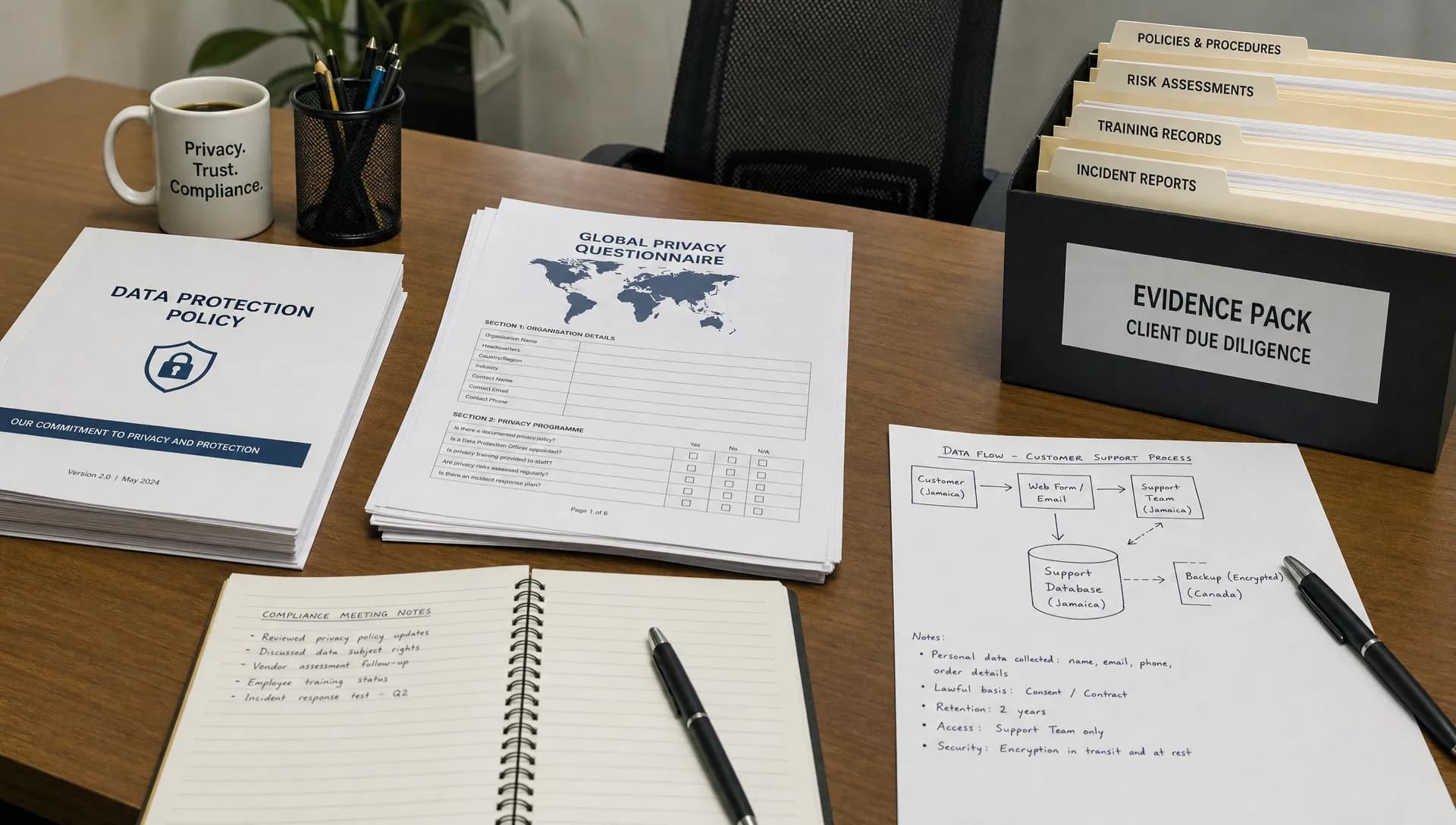
Prepare an Evidence Pack Before You Answer
Most privacy questionnaires are not only asking, “Do you have a policy?” They are asking, “Can you prove that your policy operates in practice?”
Create an evidence pack that contains the documents you are comfortable sharing, plus a confidential internal folder for documents that should only be summarised. This prevents staff from sending sensitive internal files unnecessarily while still allowing accurate answers.
Useful evidence may include:
Privacy policy and employee privacy notice
Data protection policy or governance framework
Data inventory or record of processing activities
Information security policy
Incident and breach response procedure
Data retention schedule
Vendor or third-party assessment records
Staff data privacy training records
Template data processing agreement or privacy clauses
Business continuity or disaster recovery summary
If your privacy programme still feels informal, use a practical baseline first. PLMC’s privacy and data protection checklist can help Jamaican organisations identify what should be documented before responding to more demanding external reviews.
Map Questions to Local and International Requirements
Global clients may refer to the EU General Data Protection Regulation, UK GDPR, California privacy laws, sector rules or internal standards such as ISO/IEC 27001. That does not mean every overseas law automatically applies to your organisation, but it does mean the client expects a recognisable privacy control environment.
For Jamaican organisations, the Data Protection Act 2020 should be a central reference point. It establishes local expectations around personal data processing, rights, security safeguards, accountability and lawful handling of information. When a questionnaire asks about these themes, answer in a way that reflects your local compliance work and the contractual expectations of the global client.
If the form uses terms such as “GDPR Jamaica”, treat the question carefully. The requester may be asking whether a Jamaican service provider can meet GDPR-style obligations when processing data for an EU or UK client. Do not claim full GDPR compliance unless that has been properly assessed. Instead, explain the safeguards you have in place and identify any contractual measures used for the engagement.
Common Questionnaire Topics and the Evidence to Prepare
The table below shows how common questions can be translated into practical evidence. Use it as a preparation guide before you begin writing responses.
Questionnaire area | What the requester wants to know | Evidence you can prepare |
Governance | Who owns privacy and how decisions are made | Privacy roles, board or management reporting, policies |
Lawful processing | Why personal data is collected and used | Data inventory, privacy notices, consent records where relevant |
Security | Whether data is protected from unauthorised access | Access controls, encryption summary, cyber security policy |
Individual rights | How people can access, correct or object to data use | Rights request procedure and response logs |
Breach response | Whether incidents are detected, escalated and managed | Incident response plan and breach register template |
Vendors | How third parties are assessed and monitored | Vendor due diligence records and contract clauses |
Retention | Whether data is kept longer than necessary | Retention schedule and disposal procedure |
Training | Whether staff understand privacy responsibilities | Training attendance records and awareness materials |
Answer Accurately, Not Aspirationally
One of the biggest mistakes is answering based on what the organisation intends to do rather than what is currently in place. If the questionnaire asks, “Do you perform annual privacy training?” and the last training happened three years ago, do not answer yes without qualification.
A better response is precise: “Privacy training is provided during onboarding, and a refreshed annual training programme is scheduled for implementation.” If the client allows comments, explain the improvement plan and timeline. That approach is more credible than overstating maturity.
The same rule applies to certifications. If your organisation follows controls aligned with ISO/IEC 27001, say that. Do not state that you are ISO certified unless a valid certification exists. If you use GDPR concepts in contracts, say that. Do not claim GDPR compliance without a clear legal and operational basis.
Be Careful With Yes or No Questions
Many questionnaires force yes or no answers, but privacy controls rarely fit neatly into a checkbox. Where the form allows comments, use them to add context without writing long explanations.
For example, if asked whether all personal data is encrypted, the accurate answer may depend on whether the data is at rest, in transit, in backups or in paper form. A short comment can prevent misunderstanding: “Personal data transmitted through approved systems is encrypted in transit. Access to stored data is restricted based on role. Legacy storage locations are under review.”
If a control does not apply, explain why. “Not applicable” is stronger when linked to the service scope, such as “No payment card data is collected or processed under this engagement.”
Review Your Vendors Before the Client Does
A global privacy questionnaire often includes questions about your own vendors. This can surprise organisations that focus only on internal controls.
If you rely on cloud hosting, payroll providers, customer support tools, couriers, consultants or software platforms, the requester may want to know how those third parties are assessed. They may ask whether contracts include confidentiality, data protection, security, breach notification and subcontracting obligations.
Before submitting your response, identify the vendors connected to the proposed engagement and confirm whether any will handle personal data. If your vendor process is not yet mature, start with a risk-based approach rather than trying to assess every supplier at the same level. PLMC’s guide on running a simple vendor privacy assessment explains how to keep this proportionate.
Check for Cross-Border Data Transfer Issues
Global business usually means personal data may move across borders, even when the main service is delivered from Jamaica. Transfers may occur through cloud storage, remote support, regional head offices, analytics tools or outsourced service providers.
Your response should identify where personal data is stored, who can access it and what safeguards apply. If the client is in the European Union, the GDPR rules on processors and transfers may influence the contract terms even where your organisation is based in Jamaica.
Be specific enough to build confidence but avoid disclosing unnecessary technical details. A client does not need a full network diagram in a first-stage privacy questionnaire unless the risk level requires it.
Create a Reusable Answer Library
After completing one global privacy questionnaire, do not let the answers disappear in an email thread. Build a controlled answer library that can be reviewed and reused.
The library should include approved wording for common topics such as governance, security, breach response, retention, rights requests, staff training and vendor management. Add the date of last review, the evidence source and the internal owner for each answer.
This saves time, but it also reduces inconsistency. If one department says data is retained for seven years and another says indefinitely, the client will notice. A maintained answer library helps your organisation speak with one voice.
Run a Final Risk Review Before Submission
Before sending the completed questionnaire, review it as if you were the client. Look for vague claims, unsupported “yes” answers, missing attachments and commitments that may create contractual risk.
Pay close attention to questions that mention audit rights, penalties, breach notification timelines, indemnities or mandatory standards. These may move beyond privacy operations into legal and commercial risk. If the questionnaire forms part of a contract, management or legal review is essential.
It is also useful to create a simple issue log. Mark each gap as low, medium or high risk and identify the owner. That way, even if the client accepts the response, your organisation can continue improving.
Frequently Asked Questions
What is the purpose of a global privacy questionnaire? A global privacy questionnaire helps a client, investor or partner assess whether your organisation can protect personal data and meet relevant privacy, security and governance expectations before work begins.
Should we answer yes if a control is planned but not yet implemented? No. Answer based on what exists today, then explain the planned improvement if the questionnaire allows comments. Overpromising can create contractual, operational and reputational risk.
How does the Data Protection Act 2020 affect Jamaican organisations responding to overseas clients? The Data Protection Act 2020 provides the local privacy framework Jamaican organisations should be able to explain. Overseas clients may also impose contractual requirements that reflect their own laws or internal standards.
Do we need GDPR compliance to work with global clients? Not always. It depends on the client, the data, the countries involved and your role. If EU or UK personal data is involved, GDPR-style obligations may appear in the contract or questionnaire and should be reviewed carefully.
Who should complete the questionnaire? The privacy or compliance lead should coordinate it, but IT, legal, operations, HR, finance or anti-money laundering stakeholders may need to confirm specific answers depending on the service and data involved.
Need Help Preparing a Client-Ready Response?
A strong questionnaire response is not a writing exercise. It is proof that your privacy, data protection compliance, security and governance controls are organised enough to withstand external review.
Privacy & Legal Management Consultants Ltd. supports organisations in Jamaica with data protection implementation, corporate governance, cyber security, GRC integration, anti-money laundering compliance, training and risk assessment support. If a global privacy questionnaire has landed on your desk, PLMC can help you understand the questions, gather evidence and respond with confidence through a practical, risk-based approach.