

How to Handle a Misaddressed Email With Personal Data

A misaddressed email can happen in seconds. An employee selects the wrong John from autocomplete, attaches the wrong spreadsheet, replies all to a group, or sends a customer file to a personal address instead of an internal mailbox. If that email contains personal data, the mistake is no longer just embarrassing. It is a data protection incident that must be contained, assessed, documented, and, in some cases, escalated.
For Jamaican organizations, the key is to respond calmly and consistently. The goal is not to punish the person who made the error. The goal is to reduce harm to the individual, comply with the Data Protection Act, 2020, preserve evidence, and prevent the same mistake from happening again.
Below is a practical, staff-friendly guide for handling a misaddressed email with personal data.
Why a misaddressed email matters
Personal data is information that relates to an identified or identifiable living person. In practice, that can include names, contact details, account numbers, payroll records, customer complaints, employee files, medical details, national identification information, disciplinary records, photographs, location data, or information contained in attached documents.
A misaddressed email may amount to an unauthorized disclosure of personal data. Even if the recipient promises to delete it, the organization has still lost control of the information for a period of time. The level of risk depends on what was sent, who received it, whether the information was opened, whether it was forwarded, and what harm could result.
The Office of the Information Commissioner Jamaica is the supervisory authority for data protection in Jamaica. While every incident depends on its facts, organizations should treat misdirected personal data as part of their wider data protection compliance and incident response program, not as an informal IT problem.
First response: contain the email quickly
The first few minutes matter. The sender should not ignore the error, wait to see what happens, or try to quietly fix it without telling anyone. Fast containment can reduce the likelihood of further disclosure and helps the organization show that it acted responsibly.
If you sent the email to the wrong person, take these actions immediately:
Stop sending related messages until you understand what happened.
Attempt an email recall if your system supports it, but do not rely on recall as proof that the email was not seen.
Notify your manager, data protection officer, privacy lead, or incident response contact using your organization’s reporting channel.
Contact the unintended recipient with a short, professional request to delete the message and any attachments, and not to read, copy, forward, download, print, or use the information.
Preserve the original sent email, including recipients, time sent, subject line, attachments, and any follow-up messages.
Do not delete your own sent copy unless the incident response lead tells you to do so.
The accidental recipient should also be handled carefully. If they are inside the organization, ask them to delete the message and confirm deletion, but still record the event. If they are outside the organization, the request should be clear and formal. If the information is sensitive or high risk, the privacy lead or legal team should usually manage the contact.
A useful deletion request can be simple:
We sent you an email in error that contains information not intended for you. Please do not read, use, copy, forward, save, print, or disclose the email or its attachments. Please delete it from your inbox, deleted items, downloads, and any other location where it may have been saved, then confirm by reply that this has been done.
Do not include additional personal data in the correction email. For example, do not write, 'Please delete the email containing Mr. Brown’s medical report and insurance number.' That can make the disclosure worse.
Decide whether it is a breach, a near miss, or a low-risk incident
Not every misaddressed email has the same impact. A draft email typed to the wrong person but caught before sending may be a near miss. A message sent to the wrong internal team with a single customer name may be a lower-risk incident. A spreadsheet sent to an external Gmail address with hundreds of customer records, identification numbers, or financial data is much more serious.
Use a structured triage approach. Do not decide based on embarrassment or convenience. Decide based on risk to the individuals whose data was involved.
Scenario | Likely risk level | Immediate response |
Email drafted to the wrong address but not sent | Near miss | Record, correct process, remind staff |
Email sent internally to the wrong employee, no sensitive data | Lower to moderate | Ask recipient to delete, record incident, review cause |
Email sent externally with names and contact details | Moderate | Contain, document, assess recipient trust and possible misuse |
Email sent externally with financial, health, HR, child, complaint, or KYC data | Higher | Escalate quickly, preserve evidence, assess notification duties |
Bulk email exposes many recipients in CC instead of BCC | Variable | Contain, assess volume and sensitivity, consider affected persons |
A near miss still matters. It shows a weakness in process, training, technology, or workload. PLMC has written more on how to use risk management after a data protection near miss so small errors become learning opportunities instead of repeated incidents.
Assess the risk to the individual
The most important question is not 'How bad does this look for the organization?' The key question is 'What could happen to the person if this information is misused, disclosed further, or acted upon?'
When assessing risk, consider the nature of the personal data, the person who received it, the likelihood of further access, and the possible harm. The UK Information Commissioner’s Office provides useful guidance on assessing personal data breaches, especially the need to consider risk to people’s rights and freedoms. Jamaican organizations should apply that same risk-based thinking while following local law and guidance.
Risk factor | Questions to ask | Why it matters |
Sensitivity of data | Does it include health, financial, HR, legal, disciplinary, child, biometric, or anti-money laundering due diligence information? | Sensitive data can create greater harm if exposed. |
Volume | Does it concern one person, a small group, or hundreds of people? | More affected persons usually means greater impact and complexity. |
Recipient | Is the recipient an employee, trusted partner, customer, competitor, unknown individual, or public mailbox? | Trust and control affect the likelihood of misuse. |
Access | Was the email opened, downloaded, forwarded, printed, or saved? | Confirmed access increases concern. |
Security | Was the attachment encrypted or password protected? Was the password sent separately? | Strong controls may reduce the likelihood of actual access. |
Possible harm | Could the data lead to fraud, discrimination, distress, reputational damage, identity theft, loss of employment, or physical risk? | Harm to the person drives escalation decisions. |
Be careful with assumptions. If an external recipient says they deleted the email, record that response, but do not treat it as a guarantee that the data was never seen or stored. Email systems may sync across devices, cloud backups, downloads, and archives.
Document the incident before details are forgotten
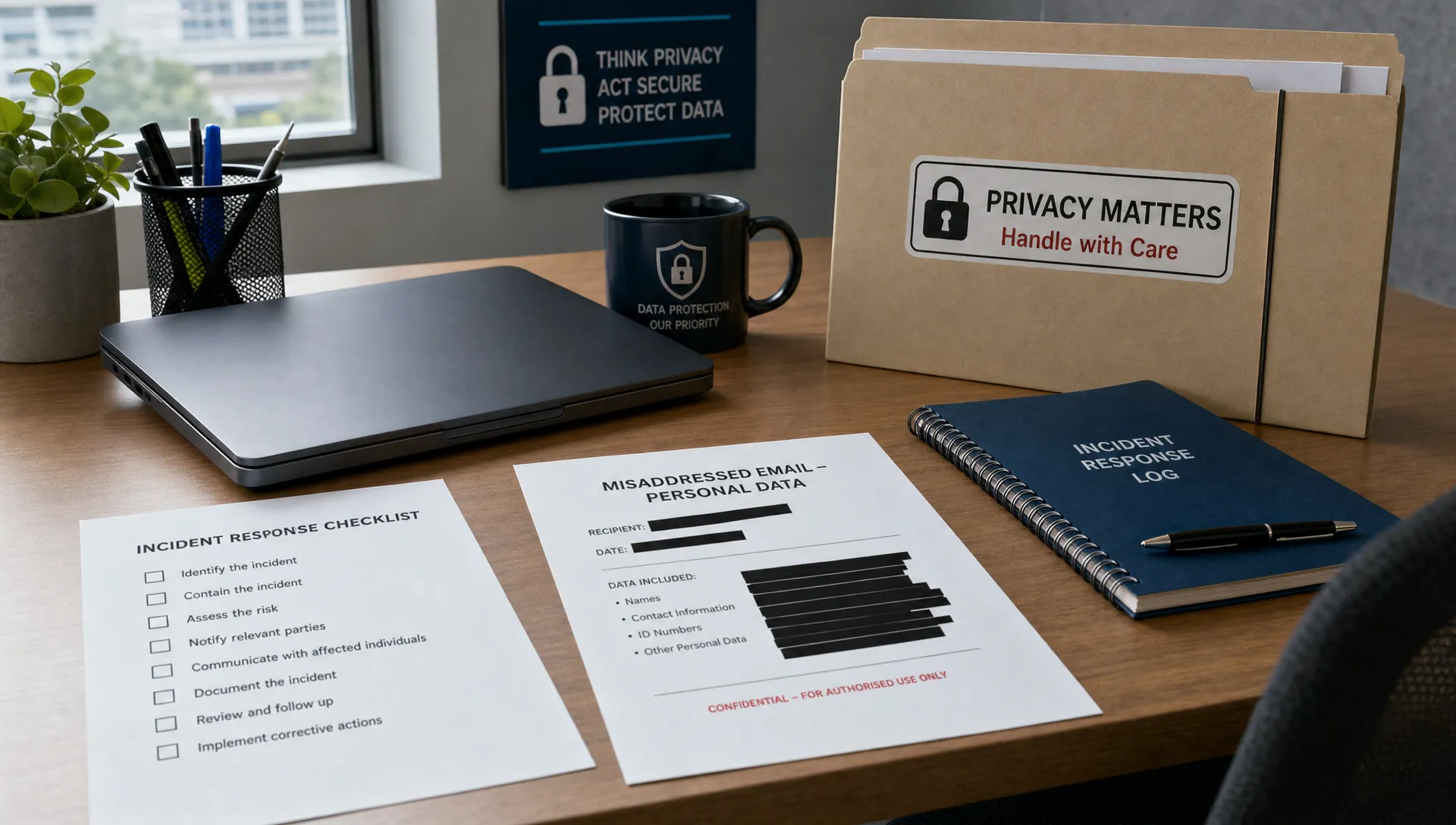
Good documentation is one of the simplest ways to show accountability. It also helps the organization identify repeat causes, such as autocomplete errors, unclear distribution lists, weak review processes, or staff rushing under deadline pressure.
Your incident record should capture the facts without exaggeration or blame. Include:
Date and time the email was sent and discovered.
Sender, intended recipient, unintended recipient, and any CC or BCC recipients.
Subject line and general description of the personal data involved.
Number of affected individuals, if known.
Attachments included and whether they were encrypted or password protected.
Actions taken to recall, delete, contain, and verify the email.
Responses received from unintended recipients.
Initial risk assessment and escalation decisions.
Lessons learned and actions to prevent recurrence.
The incident log should be controlled and confidential. Do not create a wider disclosure by circulating the full personal data to people who do not need it. Where possible, describe the data type rather than reproducing the actual data.
For day-to-day prevention, it helps when employees understand basic handling rules for personal information. A short, practical reference, like these personal information privacy handling rules for staff, can reduce confusion during routine email tasks.
Escalate to the right people
A misaddressed email should be escalated through your internal data protection incident process. In many organizations, that means notifying the data protection officer, privacy lead, compliance manager, legal counsel, IT security, records manager, or senior management, depending on the nature of the data and the seriousness of the event.
Escalation is especially important where the email includes sensitive personal data, financial records, login details, disciplinary matters, legal advice, customer complaints, children’s data, employee records, or due diligence documents. It is also important where the email has gone outside the organization, to an unknown person, or to someone with a possible conflict of interest.
Avoid informal decision-making. A manager should not simply say, 'It was a mistake, just delete it.' The privacy lead needs enough information to decide whether the organization must notify affected individuals, notify the regulator, take additional security steps, or seek legal advice.
Consider whether notification is required
Notification decisions should be made by the appropriate privacy or legal lead, not by the sender alone. The exact duty will depend on the facts, the Data Protection Act, 2020, applicable guidance, contractual obligations, sector rules, and the organization’s internal policies.
Affected individuals may need to be told where there is a real risk that the disclosure could harm them or where notification is legally required. A clear notification should usually explain what happened, what data was involved, what the organization has done, what the individual can do to protect themselves, and who to contact for questions. It should not be vague, defensive, or overly technical.
Regulatory notification may also need to be considered for serious incidents. If the organization is unsure, it should seek professional advice quickly and record the reasoning behind its decision. Delayed internal reporting makes proper notification harder, which is why staff should be encouraged to report mistakes immediately.
What not to do after a misaddressed email
Some responses make the incident worse. Organizations should train staff to avoid panic reactions, cover-ups, and unnecessary additional sharing.
Do not | Why it creates risk |
Ignore the mistake because it was accidental | Accidental disclosure can still create legal and operational risk. |
Delete your sent email to hide the error | This can destroy evidence needed for assessment and accountability. |
Send repeated apology emails with more details | Each message may expand the disclosure. |
Ask the unintended recipient to forward the email back | That creates another transmission of the same personal data. |
Blame an individual before understanding the process failure | Fear of punishment discourages timely reporting. |
Wait until the end of the week to report it | Delay can reduce containment options and complicate notification. |
A strong privacy culture treats quick reporting as responsible behavior. Staff should know that the worst response is usually silence, not the original mistake.
Preventing repeat misaddressed emails
The best incident response is prevention. Misaddressed emails are often caused by small habits that can be improved through practical controls and training.
Common prevention measures include delaying outbound email by one or two minutes, disabling or managing autocomplete for high-risk teams, using clear naming conventions for contacts, checking recipients before sending attachments, using secure portals for sensitive documents, password protecting files where appropriate, limiting bulk email permissions, and using BCC for external mailing lists.
Teams that handle sensitive information should also use a final check before sending. A simple 'recipient, attachment, sensitivity' pause can prevent many mistakes. Before clicking send, the sender asks: Is this the right recipient? Is this the right attachment? Is this the minimum necessary personal data for the purpose?
Training should be practical, not theoretical. Employees remember real scenarios better than abstract definitions. For example, show staff how autocomplete errors happen, how similar customer names can be confused, and how a copied spreadsheet tab can contain hidden personal data. PLMC’s guidance on data protection awareness training ideas that actually stick is a useful starting point for turning email safety into a repeatable workplace habit.
Build a simple internal rule
A useful rule for staff is: report first, fix with guidance second. Employees should not have to decide alone whether an incident is serious. They should know exactly where to report, what details to provide, and what not to do.
Your internal procedure should answer these questions clearly:
Who receives the first report?
What information must the employee provide?
Who contacts external unintended recipients?
Who assesses legal and regulatory notification duties?
Where is the incident recorded?
Who approves closure and lessons learned?
This does not need to be complicated. A one-page procedure, supported by short training and manager reinforcement, is often more effective than a long policy that no one remembers during a stressful moment.
Frequently Asked Questions
Is a misaddressed email always a data breach? Not always, but it should always be treated as a data protection incident until assessed. If personal data was disclosed to someone who was not authorized to receive it, it may amount to a breach depending on the circumstances.
What should I do if I receive an email with someone else’s personal data? Do not read more than necessary, do not forward it, do not save it, and do not use the information. Tell the sender it appears to have been sent in error, delete it when asked, and confirm deletion if appropriate.
Can an email recall solve the problem? No. Recall may help if the recipient has not opened the email and both parties use compatible systems, but it is not reliable. You should still report, document, and assess the incident.
Should the affected person be notified? Sometimes. Notification depends on the sensitivity of the data, the likelihood of misuse, the possible harm, and legal requirements. The decision should be made by the organization’s privacy or legal lead and properly recorded.
How can organizations in Jamaica reduce misaddressed emails? Combine clear procedures, staff training, email controls, careful use of attachments, secure sharing tools, and a culture that encourages immediate reporting. Prevention works best when it focuses on everyday behavior.
Need help strengthening your email incident response?
A misaddressed email with personal data is manageable when your organization has the right process, training, and accountability structure. Without those safeguards, a small error can become a serious data protection compliance issue.
Privacy & Legal Management Consultants Ltd. helps Jamaican organizations with data protection implementation, privacy training, risk assessment, governance, and compliance support. If you need help reviewing your incident response process or preparing staff to handle privacy mistakes properly, contact Privacy & Legal Management Consultants Ltd. to arrange a consultation.