
How to Choose a Privacy Consultant for a Complex Project
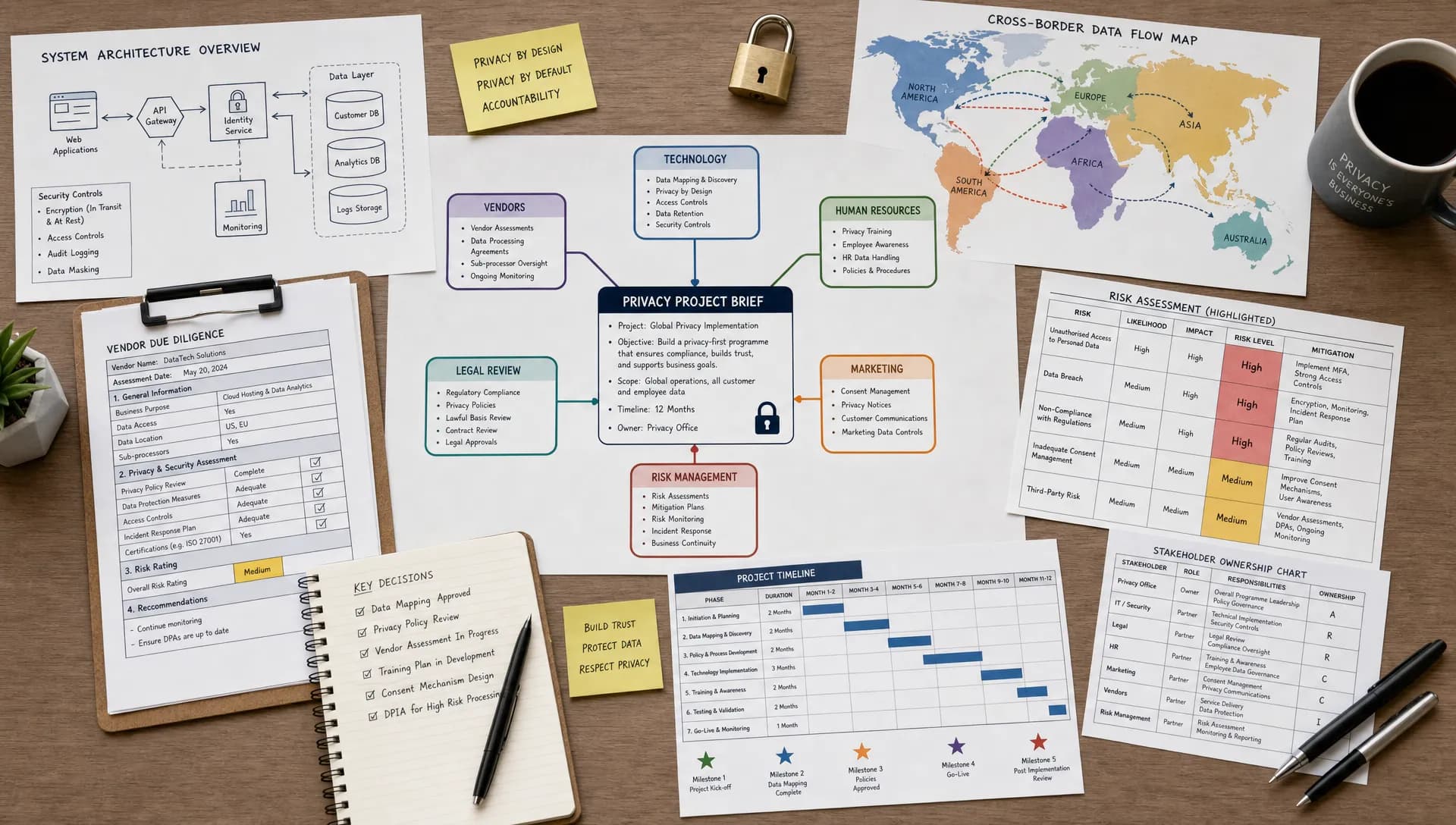
Choosing a privacy consultant for a complex project is not the same as finding someone to draft a privacy notice or deliver a one-off training session. Complex projects involve moving parts: new technology, sensitive personal data, multiple vendors, cross-border transfers, regulatory expectations, cyber security implications, and internal politics.
For Jamaican organisations, the stakes are especially high. The Data Protection Act, 2020 places clear obligations on organisations that process personal data, and privacy decisions now need to be embedded into governance, procurement, technology, HR, marketing, and risk management. A consultant who looks impressive on paper may still be the wrong fit if they cannot manage complexity across these areas.
The right privacy consultant should help you reduce uncertainty, make defensible decisions, and turn compliance requirements into practical controls that work inside your organisation. This guide explains how to evaluate that fit before you commit.
What makes a privacy project “complex”?
A privacy project becomes complex when it is no longer a single compliance task. Instead, it affects several business functions, requires decisions about risk, or involves data practices that could have a significant impact on individuals.
Common examples include a cloud migration, customer data platform implementation, HR system replacement, financial onboarding project, health or education records initiative, anti-money laundering compliance programme, merger integration, data analytics initiative, or vendor ecosystem review.
Complexity usually comes from a combination of the following factors:
Complexity factor | Why it matters | What the consultant must handle |
Sensitive or high-volume personal data | Greater potential harm if data is misused, exposed, or inaccurate | Risk assessment, safeguards, minimisation, retention controls |
Multiple departments | Privacy decisions may affect IT, legal, HR, compliance, marketing, finance, and operations | Stakeholder management and clear governance |
Third-party vendors | Processors, cloud providers, and outsourced teams create shared compliance risk | Vendor due diligence, contract review, monitoring approach |
Cross-border processing | Data may be accessed, hosted, or supported outside Jamaica | Transfer risk analysis and alignment with international expectations |
New technology | Automation, analytics, AI, biometrics, or platforms may create new privacy risks | Privacy by design and technical control review |
Tight implementation timeline | Delayed privacy input can cause costly redesigns | Prioritisation, project planning, escalation support |
If your initiative has several of these characteristics, you may need more than general compliance support. You may need a privacy lead who can work alongside technical, legal, governance, and operational teams.
For projects involving sensitive data, new systems, or major organisational change, it is worth reviewing when to bring in data protection specialists for a high-risk project before deciding on the level of support required.
Start with the outcome, not the consultant’s résumé
Many organisations begin by asking, “Who is the best privacy consultant?” A better question is, “What do we need this consultant to help us achieve?”
Before approaching the market, define the problem in plain language. Are you trying to comply with Jamaica’s Data Protection Act? Reduce risk before launching a digital service? Prepare for an audit? Build a privacy programme from the ground up? Strengthen board-level oversight? Assess vendors? Train staff? Respond to a regulator, customer, or business partner?
A strong scope should clarify:
The business objective of the project
The types of personal data involved
The systems, vendors, and departments in scope
The jurisdictions involved, including any overseas hosting or support
The internal decision-makers and project sponsor
The expected deliverables and deadlines
The level of implementation support required
This step prevents a common mistake: hiring a consultant for a “privacy review” when the actual need is a multi-phase implementation project. A review can identify gaps, but it may not fix them. A complex project often needs diagnosis, prioritisation, implementation, training, and governance follow-through.
Look for practical knowledge of Jamaica’s Data Protection Act
For a Jamaican organisation, the consultant must understand the local regulatory environment. Familiarity with global frameworks such as the GDPR can be useful, especially where international customers, parent companies, or service providers are involved. However, GDPR knowledge alone is not enough.
The consultant should be able to explain how Jamaica’s Data Protection Act, 2020 applies to your organisation’s role, data uses, policies, contracts, operational practices, and accountability obligations. They should also be able to translate legal concepts into business actions that staff can actually follow.
Useful signs of local competence include the ability to discuss:
Data controller and data processor responsibilities
Privacy notices and transparency requirements
Lawful and fair processing principles
Data subject rights handling
Security safeguards and breach readiness
Retention and disposal practices
Vendor and processor oversight
Governance roles and internal accountability
The Office of the Information Commissioner in Jamaica is an important source for regulatory information and public guidance. A credible consultant should be aware of the local regulatory landscape and should not rely only on generic imported templates.
Assess whether they can work across legal, technical, and governance issues
Complex privacy projects rarely sit neatly inside one department. A consultant may need to understand how a database is structured, how contracts allocate responsibility, how policies are approved, how employees are trained, and how the board receives assurance.
That does not mean one person must be an expert in everything. It does mean the consultant or consulting team should know how to coordinate the right expertise.
For example, a privacy consultant working on a customer portal may need to review collection notices, map data flows, assess vendor access, work with cyber security teams, advise on retention, and help design a process for handling data subject requests. On an anti-money laundering project, the consultant may need to balance legal retention duties, customer due diligence requirements, access controls, and privacy transparency.
Ask how the consultant approaches projects that require multiple disciplines. If they treat privacy as only a legal paperwork exercise, they may miss operational and technical risks. If they treat privacy as only an IT security issue, they may miss governance, transparency, and rights-based obligations.
Decide whether you need advisory support, implementation support, or both
Some consultants are strongest at strategy and regulatory interpretation. Others are strongest at documentation, training, project management, or technical risk assessment. For a complex project, you may need a combination.
A useful distinction is between advisory work and implementation work. Advisory work answers questions such as “What does the law require?” and “What is our risk exposure?” Implementation work answers questions such as “Who will update the process?”, “What evidence will we maintain?”, and “How will staff do this consistently?”
Support type | Best suited for | Typical outputs |
Strategic advisory | Board briefings, risk appetite decisions, project direction | Privacy strategy, risk memos, governance recommendations |
Compliance assessment | Understanding current gaps | Data protection assessment, gap analysis, maturity report |
Implementation support | Turning recommendations into working controls | Policies, procedures, registers, templates, workflows |
Technical privacy support | New systems, cyber risk, vendor architecture | Data flow maps, access control review, privacy by design input |
Training and awareness | Staff readiness and culture change | Role-based training, leadership briefings, awareness materials |
Ongoing assurance | Sustaining compliance after go-live | Monitoring plan, audit support, remediation tracking |
If you are weighing whether a tool, a consultant, or a hybrid model is the best fit, this guide on choosing between data privacy software and consulting support can help frame that decision.
Examine their methodology, not just their credentials
Credentials matter, but methodology reveals how the consultant will actually work. For complex projects, ask for a clear explanation of their approach from discovery to close-out.
A strong methodology should include an initial scoping phase, stakeholder interviews, document review, data flow analysis, risk assessment, prioritised recommendations, implementation planning, and knowledge transfer. It should also identify decision points where management must approve risk positions or allocate resources.
Be cautious if the proposed approach is vague. “We will review your privacy compliance” is not enough for a complex project. You need to know what will be reviewed, who will be interviewed, what evidence will be examined, how risks will be rated, and what deliverables will be produced.
The best consultants make their work auditable. They do not simply give opinions. They produce evidence, rationale, and practical outputs that your organisation can use later during audits, board reporting, vendor reviews, or regulatory engagement.
Ask for deliverables that match the project risk
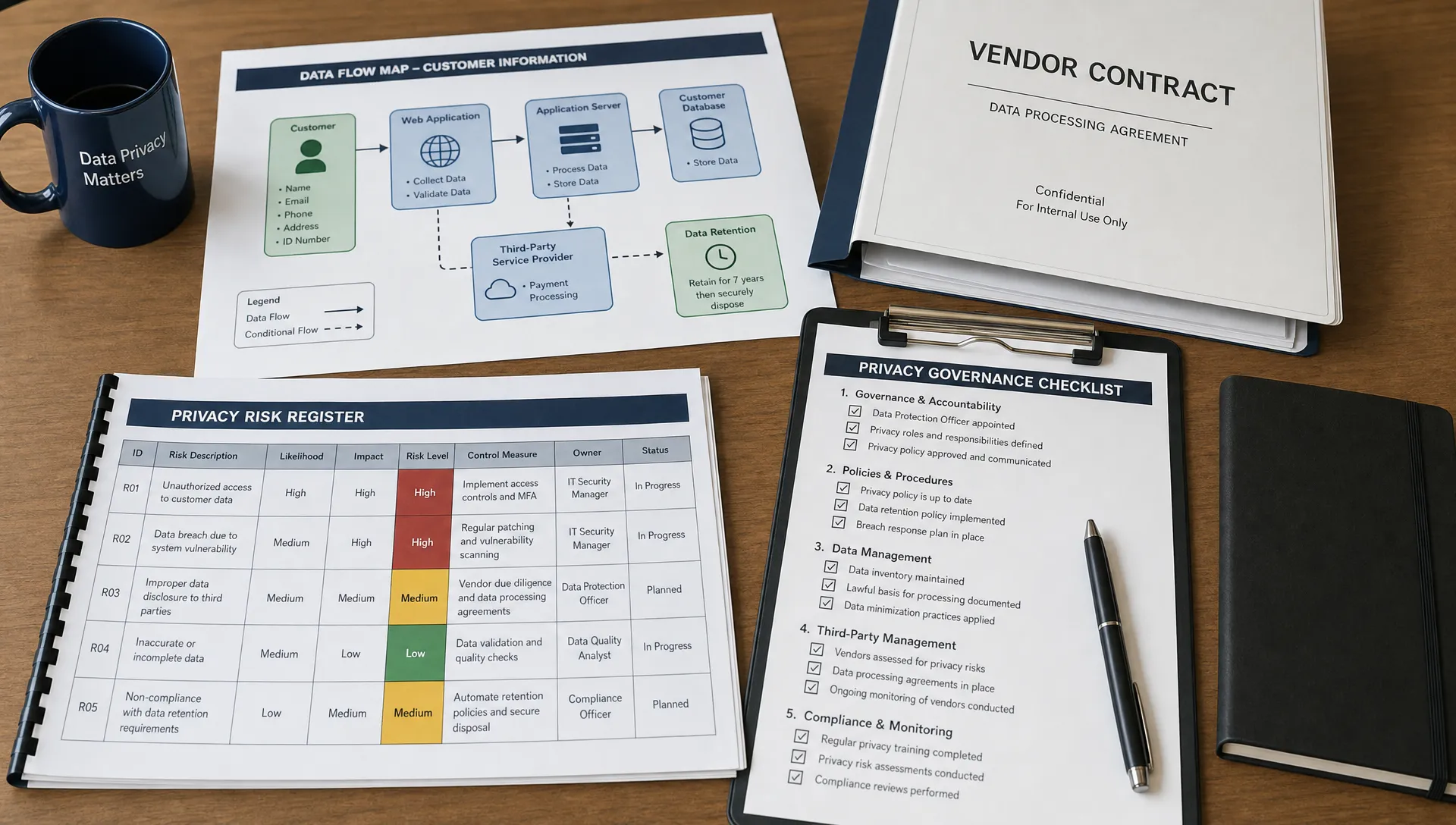
For a simple project, a short memo may be sufficient. For a complex project, deliverables should be specific enough to support real implementation and accountability.
Depending on the nature of the project, relevant deliverables may include:
Project privacy risk assessment
Data inventory or record of processing activities
Data flow maps
Privacy impact assessment or similar risk review
Vendor privacy due diligence checklist
Contract review notes for data processing arrangements
Privacy notices or consent language
Retention and disposal recommendations
Data subject rights procedure
Incident escalation and breach readiness guidance
Role-based training materials
Board or senior management briefing
Implementation roadmap with priorities and owners
Not every project needs every document. The point is proportionality. A consultant should recommend deliverables based on your actual risk profile, not sell a large pack of templates that may never be used.
For vendor-heavy initiatives, you may also need a structured process for vendor due diligence in privacy and compliance, especially where third parties will store, access, or process personal data on your behalf.
Test their ability to communicate with different stakeholders
A privacy consultant for a complex project must be able to speak to executives, IT teams, lawyers, compliance officers, procurement, HR, front-line staff, and sometimes external vendors. Each audience needs a different level of detail.
Executives need concise risk implications, budget impacts, and decision options. IT teams need specific control requirements and integration points. Legal and compliance teams need defensible reasoning. Operational teams need practical procedures. Staff need clear examples of what to do and what to avoid.
During the selection process, pay attention to how the consultant communicates. Do they explain issues clearly, or do they hide behind jargon? Do they ask thoughtful questions about your business model? Do they listen to operational constraints? Can they simplify complex legal requirements without oversimplifying the risk?
A useful interview question is: “How would you explain this project’s privacy risk to our board in five minutes?” The answer will reveal whether the consultant can translate complexity into decision-ready insight.
Evaluate project management discipline
Privacy expertise alone will not save a poorly managed project. Complex projects need timelines, dependencies, meeting rhythms, escalation paths, and clear ownership.
Ask how the consultant manages workstreams. Will there be a project plan? How often will progress be reported? Who will track actions? How will risks and assumptions be documented? What happens if internal stakeholders miss deadlines? How will scope changes be handled?
A consultant does not need to replace your project manager, but they should be organised enough to integrate with your project governance. If your organisation already has a project management office, the consultant should be able to work within that structure.
A strong privacy consultant will also be honest about dependencies. For example, they may need access to system architecture diagrams, vendor contracts, HR policies, customer forms, marketing workflows, or cyber security documentation. If those inputs are unavailable, they should explain how that affects timing and confidence in the findings.
Use a weighted evaluation matrix
For a complex project, choosing based only on price is risky. The cheapest proposal may become expensive if it misses key issues, delays the project, or produces generic documents that cannot be implemented.
A weighted matrix helps compare consultants more objectively. You can adjust the weightings based on your organisation’s priorities.
Evaluation area | Suggested weight | What to look for |
Jamaica data protection knowledge | 20% | Clear understanding of local obligations and regulatory context |
Relevant project experience | 20% | Similar work involving complex systems, sensitive data, or regulated sectors |
Methodology and deliverables | 20% | Structured approach, practical outputs, evidence-based analysis |
Technical and cyber awareness | 10% | Ability to work with IT, security, cloud, and vendor risk teams |
Governance and change management | 10% | Board reporting, accountability structures, staff adoption support |
Communication quality | 10% | Clear explanations for executive and operational audiences |
Value for money | 10% | Realistic pricing aligned to scope, risk, and deliverables |
This approach encourages a balanced decision. A proposal with a higher fee may offer better value if it reduces rework, supports implementation, and helps the organisation make defensible decisions.
Ask better interview questions
The interview should test judgement, not just knowledge. A consultant who can recite privacy principles may still struggle when a project requires trade-offs.
Strong questions include:
How would you scope the first 30 days of this project?
What information would you need from our IT, legal, compliance, and business teams?
How do you decide whether a privacy risk is high, medium, or low?
How would you handle disagreement between business objectives and privacy requirements?
What deliverables would you consider essential, and which would be optional?
How do you help organisations move from assessment to implementation?
What would you escalate to senior management or the board?
How do you approach third-party processors and overseas service providers?
Listen for practical examples. A strong consultant should be able to describe how they would work through uncertainty, not just promise compliance.
Watch for red flags
The wrong consultant can create false comfort. They may deliver polished documents while leaving operational risks unresolved.
Red flag | Why it matters |
They promise “full compliance” without a detailed assessment | Compliance depends on facts, implementation, and ongoing controls |
They offer only generic templates | Complex projects require tailored analysis and practical procedures |
They ignore IT, cyber security, or vendor risk | Privacy risk often depends on technical and third-party controls |
They cannot explain their methodology | You may not know what work is being done or how conclusions are reached |
They avoid discussing limitations | Every assessment has assumptions and dependencies |
They focus only on GDPR and not Jamaica’s Data Protection Act | International knowledge is useful, but local obligations must be addressed |
They do not define deliverables clearly | Vague outputs lead to disputes and weak implementation |
A credible consultant will be clear about what they can do, what they cannot do, and where specialist input may be required.
Consider cultural fit and independence
Complex privacy projects can involve sensitive internal discussions. Teams may need to acknowledge gaps, challenge long-standing practices, or change how customer and employee data is handled. The consultant must be trusted enough to hear the truth and independent enough to give honest advice.
Cultural fit does not mean the consultant simply agrees with management. It means they can work respectfully with your teams while maintaining professional judgement. They should be able to challenge assumptions without creating unnecessary conflict.
Independence is also important where the consultant is reviewing a vendor, system, or prior implementation. Ask whether they have any relationship with technology providers or other parties involved in the project. If there is a potential conflict, it should be disclosed and managed.
Clarify knowledge transfer before the project begins
A complex privacy project should leave your organisation stronger, not dependent. The consultant should help internal teams understand the controls, evidence, and responsibilities that will remain after the engagement ends.
Before signing, ask how knowledge transfer will happen. Will there be workshops? Handover sessions? Training for process owners? Final documentation explaining how to maintain registers, update notices, review vendors, or handle requests?
This is especially important for organisations building privacy maturity. The goal is not simply to “pass” a project review. The goal is to embed privacy into normal governance, risk, and compliance activity.
Final checklist before you choose
Before selecting a privacy consultant for a complex project, confirm that you can answer these questions with confidence:
Does the consultant understand Jamaica’s Data Protection Act and your sector context?
Have they worked on projects with similar complexity?
Is their methodology clear and evidence-based?
Are deliverables specific, practical, and proportionate?
Can they work with legal, IT, cyber security, compliance, and business teams?
Do they address vendor and cross-border data risks where relevant?
Is there a realistic project plan with clear roles and assumptions?
Will they support implementation, training, and knowledge transfer?
Are fees aligned to scope and value, not just hours or templates?
Have they been transparent about limitations and dependencies?
If the answer to several of these questions is unclear, pause before signing. Complex projects reward careful selection.
Frequently Asked Questions
When should we hire a privacy consultant instead of handling the project internally? You should consider external support when the project involves sensitive data, new technology, multiple departments, third-party processors, cross-border processing, or significant regulatory risk. Internal teams may still lead the work, but a consultant can provide specialist guidance, structure, and independent challenge.
Is GDPR expertise enough for a privacy project in Jamaica? No. GDPR knowledge can be valuable, especially for international operations, but Jamaican organisations need advice grounded in Jamaica’s Data Protection Act, 2020 and the local regulatory environment. The consultant should be able to align global good practice with local obligations.
What should a privacy consultant deliver at the end of a complex project? The answer depends on scope, but common outputs include a risk assessment, data flow maps, gap analysis, implementation roadmap, policy or procedure updates, vendor review findings, training materials, and management reporting. The deliverables should be practical enough for your organisation to use after the engagement.
How do we compare two privacy consultants with very different fees? Compare scope, methodology, deliverables, experience, implementation support, and risk coverage. A lower fee may exclude important work. A higher fee should be justified by clearer outputs, deeper expertise, stronger project management, or better support for complex risks.
Should the consultant also understand cyber security? For many complex projects, yes. Privacy and cyber security are closely connected, especially where systems, access controls, vendors, cloud hosting, or incident response are involved. The consultant does not always need to be a cyber specialist, but they should know when technical expertise is required.
Need support choosing the right privacy approach?
Complex projects require more than a checklist. They need clear judgement, practical implementation, and governance that fits the organisation.
Privacy & Legal Management Consultants Ltd. supports organisations in Jamaica with data protection implementation, corporate governance, anti-money laundering compliance, cyber security services, GRC integration, training, and privacy awareness. If you are planning a complex project and need help understanding your risks, you can start with a consultation through Privacy & Legal Management Consultants Ltd..