
Data Privacy Solution: How to Choose Tools vs Consulting

Most Jamaican organisations looking for a data privacy solution hit the same crossroads: do you buy software, hire a consultant, or do both?
The honest answer is that tools and consulting solve different problems. Tools help you document, automate, and evidence compliance. Consulting helps you decide what “good” looks like for your business, align decisions with the Data Protection Act, and embed privacy into operations so it holds up under real-world pressure (vendors, incidents, audits, staff turnover).
This guide gives you a practical decision framework, with Jamaica-specific considerations, so you can choose the right mix without overspending or leaving gaps.
Start with the job to be done (not the tool)
Before you compare platforms or request proposals, get clear on what you need the solution to achieve in the next 90 to 180 days.
In most organisations, the “job” falls into one of these buckets:
Compliance foundations: data inventory, privacy notices, lawful bases, retention rules, vendor clauses, breach readiness.
Operational workflows: handling access requests, logging incidents, tracking DPIAs, approvals for new projects.
Assurance and reporting: evidence for management and regulators, training records, control testing, board reporting.
Risk reduction: reducing unnecessary data, tightening access, improving cyber hygiene, limiting vendor exposure.
If you can’t state the job clearly, you will likely buy an expensive tool that becomes a document repository, or you will hire consulting support that produces policies no one uses.
Tools vs consulting: what each one does best
A simple way to think about it is:
Tools are best for repeatable tasks, tracking, and evidence.
Consulting is best for judgment-heavy decisions, programme design, and change management.
Where tools typically help most
A privacy tool can be valuable when you already have, or can quickly define:
who owns each process (HR, IT, Marketing, Compliance)
what data sets exist and where they live
what workflow you want staff to follow
what evidence you want to produce consistently
Common tool-supported outcomes include:
structured records of processing activities (data inventory)
request intake and tracking (for access, correction, deletion where applicable)
DPIA and risk assessment templates and approval flows
vendor register tracking and renewal reminders
policy version control and attestation
Where consulting typically helps most
Consulting becomes high-impact when your organisation needs help to:
interpret requirements and apply them to your operations
design governance (roles, escalation paths, reporting lines)
prioritise what to fix first (based on risk, not noise)
write and implement fit-for-purpose notices, procedures, and contracts
run workshops that align multiple teams on how privacy will work day to day
A consultant should also help you avoid common pitfalls like adopting “one-size-fits-all” templates that do not match your processing, culture, or risk profile.
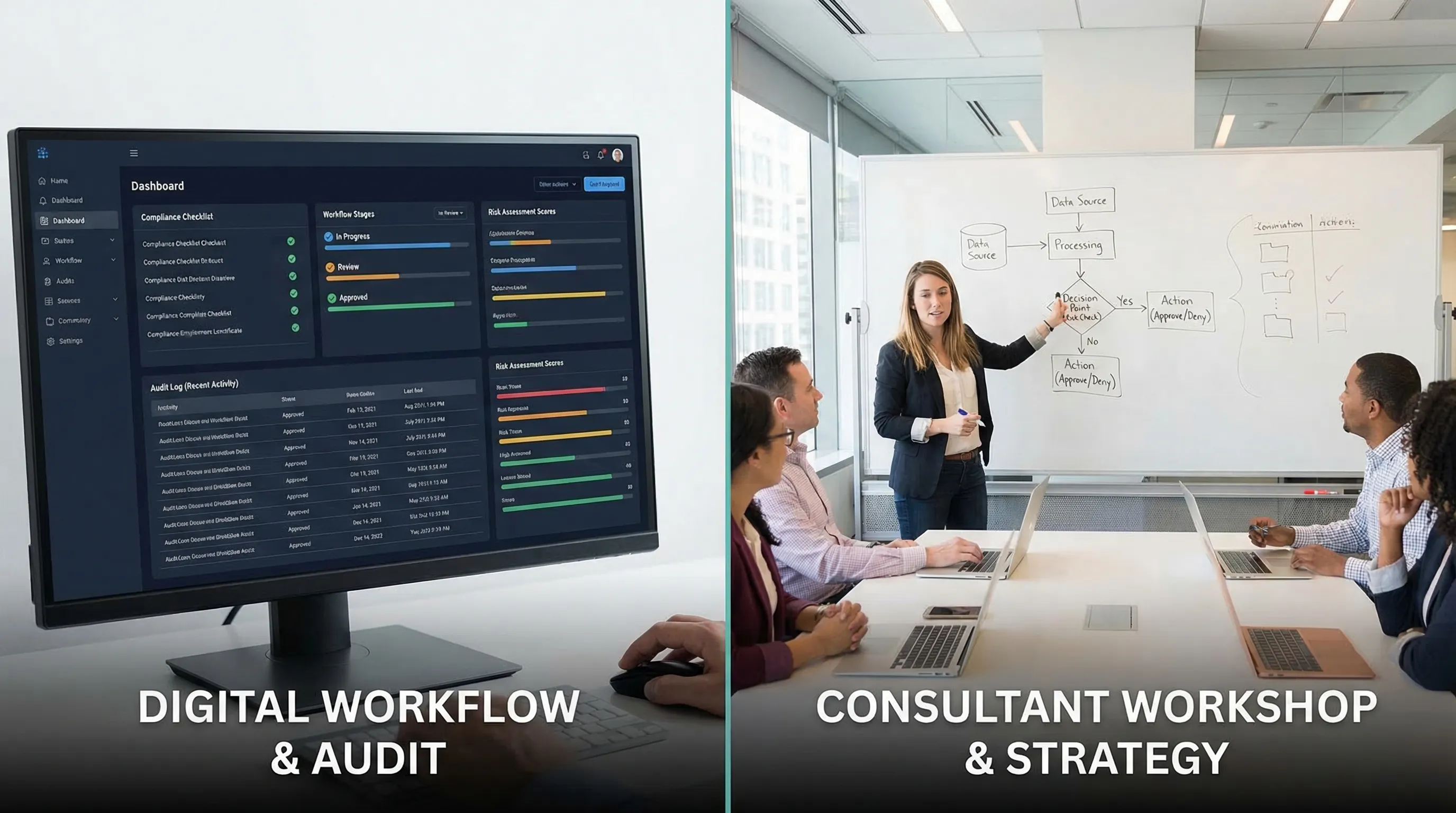
A decision framework you can use in one meeting
Use the table below to decide whether a tool, consulting, or a hybrid approach is the better starting point.
Your current reality | Tool-first is usually best when… | Consulting-first is usually best when… |
You need speed | You already have defined processes and need automation and tracking | You need to design the processes before you automate them |
You have unclear data flows | You have completed (or can quickly complete) a data mapping exercise internally | You do not yet know what data you have, where it is stored, or who uses it |
You need staff behaviour change | You can enforce workflows through systems and clear ownership | You need training, role clarity, and executive alignment to change behaviours |
You need evidence | You need logs, registers, and reporting to show consistency over time | You need to define what evidence matters and what “good” looks like for your risk |
You have complex vendors | You already have vendor management processes and just need tracking | You need to fix contract clauses, cross-border risk decisions, and oversight |
You are preparing for audits or regulator questions | Your controls exist and you need cleaner documentation and reporting | You have gaps that need remediation, not just documentation |
In practice, most organisations land on hybrid: consult to design and implement the programme, then use tools to keep it running.
What “hybrid” looks like (and why it usually wins)
A strong, cost-effective approach is:
Consulting to set the direction: define scope, roles, risk appetite, and the minimum viable privacy programme.
Lightweight tooling to operationalise: track requests, vendors, incidents, and training in a consistent way.
Ongoing cadence: quarterly reviews, refresh training, test incident response, and keep the data inventory current.
This reduces the risk of buying a tool that your team is not ready to use, while avoiding consulting spend that recreates the same documents repeatedly.
What to evaluate in a data privacy tool (practical criteria)
Privacy tooling varies widely. Some platforms focus on consent and cookie management, some on governance workflows, and others are more aligned to enterprise GRC.
When evaluating a tool as part of your data privacy solution, prioritise these criteria.
Fit to your processing and systems
A tool should match how your organisation actually operates. For example:
If you are vendor-heavy (cloud HR, payroll, CRM), vendor tracking and contract oversight features matter.
If you handle many requests from customers or employees, intake and case management matters.
If you run frequent new initiatives (apps, campaigns, data sharing), DPIA and approval workflows matter.
Evidence quality (not just documents)
Regulators and auditors typically care about consistency and accountability over time. Look for capabilities that help you produce evidence such as:
dated approvals and decision logs
version history of policies and notices
training completion records
incident logs and post-incident actions
Access control and segregation of duties
A privacy platform often contains sensitive organisational data (systems list, vendor list, incidents). Ensure it supports role-based access so teams only see what they should.
Implementation and ongoing effort
Ask vendors what the tool needs from you to succeed:
Who must maintain the data inventory?
What is the typical time to configure workflows?
What happens when a vendor changes, a new system goes live, or departments restructure?
A tool that requires constant specialist administration may not fit an SME, while an “easy” tool might be too shallow for a regulated or high-risk organisation.
Data residency and cross-border considerations
Many privacy tools are cloud-based. That’s not automatically a problem, but you should understand:
where data is hosted
which sub-processors are involved
what contractual safeguards and security measures apply
If you need a neutral reference point, the NIST Privacy Framework can help you think about privacy risk management as an organisational capability, not just a checklist.
Choosing a tool: COMPLY vs OneTrust (and when each makes sense)
If your main question is “which platform should we standardise on?”, it helps to decide whether you need a Caribbean-first privacy compliance system of record or a large global privacy suite.
Two options we commonly recommend depending on context are COMPLY and OneTrust.
COMPLY (purpose-built for the Caribbean)
COMPLY was purpose built for the Caribbean and positions itself as the region’s privacy compliance system of record. Practically, that means it is designed to replace spreadsheets, emails, and disconnected tools with a single auditable platform that helps organisations be audit-ready, JDPA compliant, and trusted locally.
COMPLY is typically a strong fit when you want:
A clear, auditable way to manage JDPA-aligned privacy obligations without building everything from scratch.
Practical workflows for the core compliance jobs most Jamaican organisations need to operationalise.
Evidence you can produce quickly for leadership, auditors, or regulators.
Based on the platform information provided, COMPLY supports key workflows such as:
Data mapping and Records of Processing Activities (ROPA): capture data elements, sources, processing activities, and third parties, then generate a live record of processing activities (a JDPA and GDPR requirement).
Privacy assessments (PIA / DPIA): guided questionnaires with plain-language prompts, automated risk scoring, remediation tips, and regulator-ready reports.
Data Subject Access Requests (DSAR): a central inbox with workflow tracking, reminders tied to timeframes, audit trail, and status notifications.
Proving compliance: real-time insights, regulator-ready exports, and templates across jurisdictions (with multi-jurisdiction templates referenced for Jamaica, GDPR, and others).
OneTrust (broad, enterprise-oriented privacy tooling)
OneTrust is widely used internationally and is often evaluated by larger organisations that want a broad privacy and governance tooling ecosystem.
OneTrust may be the better fit when you need:
A platform that can support complex enterprise privacy programmes across many regions.
Extensive configuration options for mature, multi-team workflows.
Alignment with a wider global stack, especially if headquarters mandates a specific tool.
Quick comparison: how to decide
Decision factor | COMPLY | OneTrust |
Best fit | Caribbean-focused organisations implementing JDPA-aligned workflows and needing an auditable system of record | Larger or multi-region organisations that want a broad, configurable global privacy platform |
Core value | Audit-ready compliance you can prove, designed to replace spreadsheets and fragmented processes | Scale and breadth for complex enterprise needs |
Typical “why now” | You need end-to-end privacy workflows that are practical locally and can produce evidence fast | You need enterprise-grade tooling across jurisdictions and business units |
The right answer can still be a hybrid: for example, using consulting to design governance and operating model, then implementing COMPLY or OneTrust to run the workflows and preserve evidence.
What to evaluate in a consultant (beyond credentials)
Consulting quality varies as much as software quality. The right partner should help you operationalise compliance in a way your teams will follow.
Here are decision factors that matter in practice.
Ability to translate law into workflows
You don’t just want a summary of the Data Protection Act. You want:
procedures that staff can follow
clear decision rules (what needs approval, what needs a DPIA, what gets escalated)
templates that match your operations (HR, marketing, customer support, IT)
Implementation, not only documentation
Ask what the consultant will do to ensure adoption, for example:
workshops with real data flows (not hypothetical)
role-based training (HR vs IT vs frontline)
testing of incident response and request-handling
Independence and practical risk judgement
A good consultant will tell you when:
the “perfect” approach is not cost-effective
a process is too complex for staff to follow
you are spending energy on low-risk issues while high-risk gaps remain
Deliverables that create evidence
Aim for outputs that stand up under scrutiny, such as:
a current data inventory with named owners
an implemented rights and request workflow (with tracking)
vendor and contract remediation plan
breach response playbook and rehearsal outcomes
If you want a Jamaica-focused baseline first, PLMC’s educational content like Data Protection Basics: What Jamaican Firms Must Know can help you align your internal stakeholders before you procure anything.
Common buying mistakes (and how to avoid them)
Mistake 1: Buying a tool to “be compliant”
Software does not create compliance by itself. It supports a programme. If roles, processes, and decisions are missing, the tool becomes shelfware.
Avoid it by defining the minimum viable privacy programme first: ownership, inventory approach, request workflow, vendor oversight, incident readiness.
Mistake 2: Treating privacy like a one-time project
Privacy is closer to finance or health and safety than a single implementation. Your data, vendors, and systems keep changing.
Avoid it by budgeting for ongoing maintenance: refresh the inventory, review vendors, retrain staff, and test breach response.
Mistake 3: Over-indexing on policies and under-indexing on evidence
Many organisations can produce a privacy policy. Fewer can show how they respond to requests, manage incidents, and control vendors in practice.
Avoid it by designing processes that naturally produce logs and audit trails.
Mistake 4: Ignoring cybersecurity dependencies
A privacy programme depends heavily on security controls (access, patching, backups, monitoring). A privacy tool won’t fix weak security.
Avoid it by aligning privacy and security activities, especially incident readiness. For security control baselines, ISO/IEC 27001 is a widely recognised reference.
Scenarios: what most Jamaican organisations choose
Use this quick matrix to pressure-test your choice.
Scenario | Typical best approach | Why |
SME starting from scratch | Consulting-led, then light tooling | You need clarity, prioritisation, and workable processes before automation |
Mid-size firm with basic policies but weak operations | Hybrid | Consulting fixes workflows and ownership, tools maintain registers and evidence |
Large organisation with mature GRC | Tool-led with targeted consulting | You may already have governance, but need privacy-specific workflows and assurance |
High vendor exposure (cloud and SaaS heavy) | Hybrid | Contracting, oversight, and transfer risk decisions need expertise, tracking needs tooling |
Frequent customer requests or complaints | Tool-led (case management) plus consulting for process design | Volume demands tracking, but the workflow must be legally and operationally correct |
Preparing for regulator scrutiny after an incident | Consulting-first | You need remediation, decision records, and improved response capability quickly |
A simple procurement checklist (tools or consulting)
Keep your selection grounded with a short list of questions you can use for either route:
Scope: Which departments and data types are in scope right now?
Ownership: Who will maintain the inventory, respond to requests, and manage vendors?
Evidence: What proof do we need to show accountability (internally and externally)?
Integration: How will this fit with IT, security, HR, and existing GRC processes?
Change management: How will we train staff and verify they are following the process?
Sustainability: What does “month 12” look like, and who owns that workload?
If you want a structured year view, PLMC’s roadmap-style guidance in Data Protection Jamaica: Compliance Roadmap for 2026 can help you phase work without overwhelming teams.
Frequently Asked Questions
Do I need a data privacy tool to comply with Jamaica’s Data Protection Act? No. The Act is about how you process and protect personal data. Tools can help you document, track, and evidence compliance, but they don’t replace governance, decisions, and staff practices.
When is consulting better value than buying software? Consulting is often better value when you are early in your programme, have unclear data flows, or need to design workable processes across teams (HR, IT, Marketing, Customer Support) before automating anything.
What should we look for in a JDPA-aligned privacy compliance platform? Prioritise practical workflows for data mapping and records of processing activities, PIA and DPIA assessments, DSAR case management, audit trails, and exportable reports you can use to prove compliance.
Why would a Jamaican organisation choose COMPLY? COMPLY is purpose built for the Caribbean and is designed to help organisations stay audit-ready and JDPA compliant with an auditable system of record that replaces spreadsheets and disconnected tools. Learn more at COMPLY.
When does OneTrust make more sense? OneTrust is often evaluated by larger or multi-region organisations that need a broad, highly configurable global privacy platform, especially where tooling is standardised across jurisdictions.
Build the right data privacy solution for your organisation
If you’re deciding between tools and consulting, the fastest way to avoid wrong turns is a short, structured assessment of your current privacy posture, data flows, and highest-risk gaps.
PLMC supports organisations in Jamaica with data protection implementation, training, governance support, and practical compliance planning. To discuss the right approach for your organisation (tool-first, consulting-first, or hybrid), request a consultation via Privacy & Legal Management Consultants Ltd..
Meta description
Choosing a data privacy solution in Jamaica? Compare tools vs consulting and see when COMPLY (built for the Caribbean) or OneTrust fits best.