

How to Build a Global Privacy Programme From Jamaica
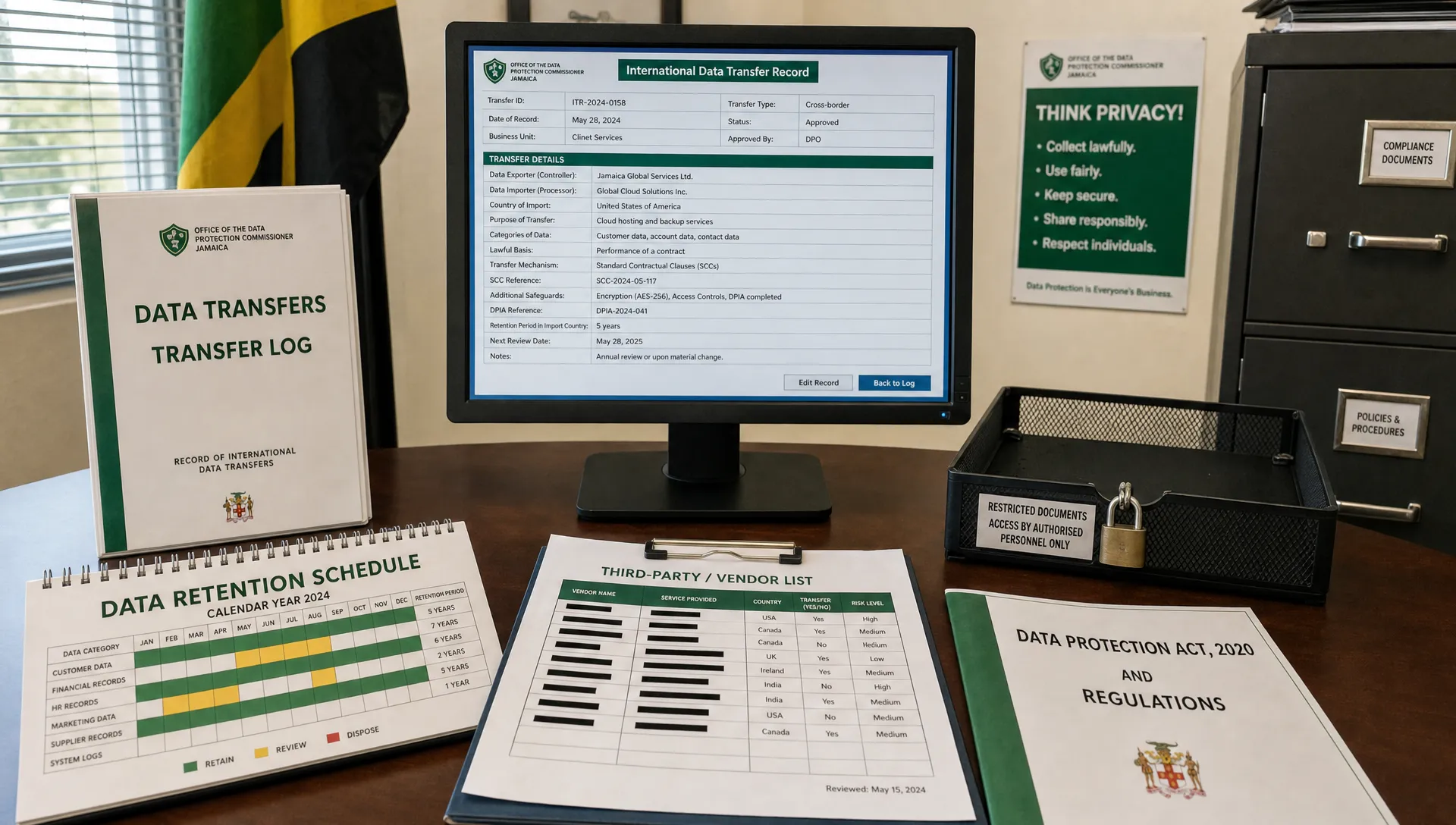
A Jamaican organisation does not need to be multinational in size to have multinational privacy risk. A hotel group may take bookings from Europe. A fintech may use cloud infrastructure in the United States. A BPO provider may process customer data for a Canadian client. A professional services firm may store client files in software hosted outside Jamaica.
That is why a global privacy programme should not be treated as something reserved for large overseas corporations. For many Jamaican organisations, it is the practical way to meet the Data Protection Act, 2020, satisfy cross-border clients and reduce the operational risk that comes with modern data flows.
The goal is not to build separate compliance projects for every country. The better approach is to create one strong privacy management system from Jamaica, then adapt it for the jurisdictions, contracts and sectors that apply to your organisation.
Start with the right ambition: global by design, Jamaican by foundation
A global privacy programme built from Jamaica should have two anchors. The first is local compliance with Jamaica's Data Protection Act, 2020 and guidance from the Office of the Information Commissioner. The second is a practical understanding of the foreign privacy rules that may apply when your organisation handles the data of people outside Jamaica or works with overseas partners.
This is especially relevant for organisations in tourism, outsourcing, financial services, health, education, e-commerce, logistics and professional services. In these sectors, personal data often moves across borders before the business even thinks of itself as international.
A Jamaican business should ask early questions such as:
Whose personal data do we collect, Jamaican residents only or people in other countries?
Where is the data hosted, accessed, backed up and supported?
Which overseas clients, processors, affiliates or vendors touch the data?
Do contracts require GDPR, UK GDPR, HIPAA-style controls, PCI DSS or other privacy and security commitments?
Can we prove what we do, not just describe it in a policy?
If your organisation is still building its local baseline, a focused implementation roadmap for Jamaica's Data Protection Act can help you establish the core before expanding globally.
Map legal exposure before writing policies
Many privacy programmes start with templates. That feels efficient, but it often creates documents that do not reflect how data is actually used. A global programme should begin with a legal and operational applicability map.
For Jamaican organisations, the most common global triggers include offering goods or services to people in another jurisdiction, monitoring behaviour online, acting as a processor for an overseas controller, using vendors in other countries or receiving data under contract from a regulated client.
The EU General Data Protection Regulation is the most recognised example. The official GDPR text applies in some circumstances beyond the EU, including certain offerings to people in the EU and monitoring of their behaviour. Other laws may also matter depending on your business model, including UK data protection law, Canadian privacy law, United States state privacy laws, Brazil's LGPD and Caribbean privacy frameworks.
You do not need to master every law at once. You do need a defensible method for deciding which laws apply, which controls overlap and where local adjustments are required. For a broader view of cross-border exposure, it is worth reviewing the international privacy rules Jamaican businesses cannot ignore.
Trigger | Example from a Jamaican organisation | Programme response |
Overseas customers | A hotel collects guest details from EU or UK residents | Review notice, lawful basis, rights handling, retention and transfer safeguards |
Overseas client contract | A BPO processes customer service data for a Canadian company | Define controller and processor roles, security obligations, audit rights and breach reporting |
Foreign cloud vendor | HR, CRM or finance data is hosted outside Jamaica | Assess vendor risk, location, sub-processors, contracts and transfer safeguards |
Behavioural tracking | A website uses analytics or advertising tools on visitors abroad | Review cookies, consent, transparency and profiling controls |
Group company access | A parent company or affiliate outside Jamaica can access employee or customer data | Document access purpose, role, transfer basis and security controls |
Build one control baseline, then localise exceptions
The most efficient global privacy programmes use a common baseline. This prevents every department, country or client contract from creating its own isolated rulebook.
Your baseline should reflect Jamaica data privacy obligations, but it should also be strong enough to satisfy reasonable international expectations. That does not mean copying the GDPR word for word into every process. It means aligning your day-to-day controls with recognised privacy principles such as lawfulness, fairness, transparency, purpose limitation, data minimisation, accuracy, storage limitation, security and accountability.
Programme layer | Jamaican foundation | Global extension | Evidence to keep |
Governance | Named owner, management oversight and documented accountability | Board or executive reporting for multi-jurisdiction risk | Terms of reference, minutes, risk registers |
Data inventory | Records of key processing activities and data locations | Mapping by jurisdiction, vendor and business line | Data maps, system inventories, process registers |
Transparency | Clear privacy notices for customers, workers and other individuals | Localised notices for foreign markets where needed | Published notices, version history, approval logs |
Individual rights | Workflow for access, correction and other applicable rights | Jurisdiction-specific deadlines and identity checks | Request logs, response templates, decision records |
Vendor management | Due diligence and contractual controls for processors | Transfer safeguards, sub-processor tracking and audit terms | Vendor assessments, contracts, review records |
Security | Technical and organisational measures aligned to risk | Client-specific or sector-specific security obligations | Access reviews, incident logs, test reports |
Assurance | Periodic monitoring and remediation | Independent reviews where required by clients or regulators | Audit reports, KPIs, remediation plans |
A good baseline reduces duplication. A great baseline also tells teams when they must escalate because a processing activity is new, risky, cross-border or contractually sensitive.
Put governance where decisions are made
Privacy cannot sit only with legal, IT or compliance. It depends on how HR recruits, how sales collects leads, how customer service verifies callers, how marketing uses analytics and how finance retains records. A global programme needs governance that reaches the business units where data decisions happen.
At a minimum, assign a privacy lead or data protection officer where required, supported by representatives from IT, legal, compliance, HR, operations, procurement, marketing and information security. For regulated entities, privacy should connect with corporate governance, anti-money laundering, cyber security and enterprise risk management rather than run as a separate island.
This is where a GRC mindset matters. Privacy risks overlap with operational risk, third-party risk, cybersecurity risk, conduct risk and reputational risk. When governance forums treat them separately, issues fall between committees. When they are integrated, leaders can see where one weak control creates multiple exposures.
For Jamaican organisations that want to make accountability operational, not ceremonial, the principles in building privacy accountability into governance are directly relevant.
Create a data map that follows the real journey
A global privacy programme stands or falls on the quality of its data map. If you cannot explain where personal data comes from, why it is used, who receives it, where it is stored and when it is deleted, you cannot reliably manage cross-border privacy risk.
Start with your highest-risk data flows rather than trying to document everything perfectly at once. Employee records, customer identification documents, payment-related data, health information, children's data, complaints, call recordings and sensitive client files should usually receive early attention.
A useful data map should show the full journey from collection to disposal. It should identify the business purpose, legal basis or lawful justification, categories of individuals, data categories, systems, internal users, external recipients, countries involved, retention period, security measures and applicable contracts.
This exercise often reveals uncomfortable facts. Old spreadsheets are still circulating. Former vendors retain data. Systems have administrator accounts that were never reviewed. Cloud tools are being used without procurement approval. Those findings are not a failure of the privacy programme. They are the reason the programme exists.

Make international transfers a design issue, not a paperwork issue
Cross-border transfers are one of the most important areas for a global privacy programme from Jamaica. Personal data may be transferred through hosting, remote access, support services, outsourced processing, group company access, email, collaboration tools or backup arrangements.
The practical mistake is to treat transfers as a clause added at the end of a contract. Transfer risk should be considered when choosing systems, selecting vendors, designing access rights and deciding whether data needs to leave Jamaica at all.
A strong transfer model should answer several questions. Which countries receive or access the data? Is the recipient a controller, processor, sub-processor or independent third party? What safeguards apply? Are there onward transfers? Can the organisation suspend or terminate the transfer if safeguards fail? Has the business assessed whether the recipient can protect the data in practice?
For organisations dealing with UK data, the UK Information Commissioner's Office guidance on international transfers is a useful reference point. Even when UK law does not apply, the discipline of documenting transfer purpose, risk and safeguards helps Jamaican organisations demonstrate responsible data protection compliance.
Operationalise privacy rights and incidents
A global programme needs repeatable workflows for individual rights and incident response. These are the moments when policies are tested.
For rights requests, design a workflow that covers intake, identity verification, deadline tracking, search, review, exemptions, approval, response and recordkeeping. The process should also identify when a request is governed only by Jamaican law and when another jurisdiction's timelines or rights may apply.
For incidents, build a response process that connects privacy, cyber security, legal, communications, operations and senior management. Not every cyber incident is a personal data breach, and not every privacy breach is caused by a cyber attack. Lost files, misdirected emails, excessive access, unauthorised disclosure and improper disposal can all create privacy consequences.
Your incident process should include a clear severity model, evidence preservation, containment steps, regulatory notification assessment, client notification assessment and lessons learned. The point is not to over-report every issue. The point is to make timely, documented and defensible decisions.
Train for roles, not just awareness
Annual awareness training is useful, but it is not enough for a global privacy programme. People need training that reflects what they actually do with data.
HR teams need to understand employee privacy, recruitment data, medical information and retention. Sales and marketing teams need guidance on consent, lead sources, cookies and direct marketing. Customer service teams need identity checks, call handling rules and escalation triggers. IT teams need privacy-by-design, access control, logging and secure configuration. Procurement teams need vendor due diligence and contract review.
Training should also include cross-border scenarios. For example, a Jamaican customer service agent handling a European data subject request needs to know when to escalate. A marketing manager using a new analytics tool needs to understand cookies and behavioural tracking. A project team onboarding a foreign cloud vendor needs to recognise transfer and sub-processor issues before signing.
Build proof into the programme
In 2026, privacy compliance is increasingly judged by evidence. A regulator, client, auditor or board will not be satisfied by a policy that no one can connect to actual practice. They will ask for proof.
Good evidence is not just paperwork. It is the operating trail that shows decisions were made, risks were assessed and controls were maintained. Evidence should be simple enough to keep current, but detailed enough to support accountability.
Area | Practical metric | Why it matters |
Data mapping | Percentage of high-risk processes mapped and approved | Shows visibility over priority processing activities |
Rights handling | Number of requests received, closed on time and escalated | Shows whether individuals can exercise rights effectively |
Vendor risk | Percentage of high-risk vendors assessed before onboarding | Shows control over third-party processing |
Training | Completion by role and business unit | Shows privacy awareness reaches the right teams |
Incidents | Time to detect, contain, assess and close incidents | Shows operational readiness and improvement |
Retention | Number of systems with approved retention rules | Shows data is not kept indefinitely without purpose |
Assurance | Open privacy issues by severity and age | Shows whether remediation is managed |
The best metrics are reviewed by management and tied to remediation. A dashboard that shows red issues without ownership is decoration. A dashboard that assigns owners, deadlines and follow-up is governance.
Use a 90-day launch plan to gain momentum
A global privacy programme takes time, but the first 90 days can create structure and confidence. The aim is to move from uncertainty to a managed programme with visible priorities.
Period | Main objective | Key outputs |
Days 1 to 30 | Establish scope and governance | Programme charter, owner, steering group, priority business units, initial legal trigger map |
Days 31 to 60 | Discover data flows and risks | High-risk data maps, vendor list, transfer map, gap assessment, quick-win remediation plan |
Days 61 to 90 | Build repeatable controls | Rights workflow, incident workflow, vendor checklist, privacy notice updates, training plan, management reporting pack |
Do not try to solve every issue in 90 days. Focus on the areas where the organisation faces the highest regulatory, contractual or reputational exposure. For many Jamaican organisations, that will include customer data, employee data, overseas vendors, client-mandated controls and breach readiness.
Avoid common mistakes when going global
The first mistake is treating Jamaica's Data Protection Act as a local administrative requirement rather than the foundation of responsible data governance. A weak local programme cannot support global obligations.
The second mistake is assuming GDPR Jamaica compliance is always required or never required. Both assumptions can be wrong. GDPR applicability depends on the facts, including who the data subjects are, what services are offered, whether behaviour is monitored and what role the Jamaican organisation plays.
The third mistake is relying too heavily on templates. Templates help, but only when they are adapted to real data flows, contracts and risk decisions.
The fourth mistake is separating privacy from cyber security. Data protection requires security, but privacy also covers fairness, transparency, purpose, rights, retention and accountability. A secure misuse of personal data can still be a privacy problem.
The fifth mistake is failing to maintain the programme after launch. New systems, vendors, markets, products and regulations can change your risk profile quickly. Privacy management must be a living process.
Frequently Asked Questions
Can a Jamaican organisation build one privacy programme for multiple countries? Yes. The practical approach is to build a strong common baseline from Jamaica, then add local requirements for specific jurisdictions, clients or sectors. This avoids duplication while still allowing targeted compliance.
Does GDPR apply to every Jamaican business with a website? No. A website alone does not automatically make GDPR apply. The analysis depends on factors such as offering goods or services to people in the EU, monitoring their behaviour or processing EU personal data on behalf of another organisation.
What is the first step in building a global privacy programme from Jamaica? Start with scope. Identify whose data you process, where it moves, which vendors and clients are involved, which laws or contracts may apply and who inside the organisation owns privacy decisions.
How often should a global privacy programme be reviewed? Review core risks at least annually and whenever there is a major change, such as a new system, vendor, market, business line, merger, outsourcing arrangement or regulatory requirement.
Is privacy training necessary if policies already exist? Yes. Policies set expectations, but training helps people apply them in daily work. Role-based training is especially important for HR, IT, procurement, marketing, customer service, compliance and management.
Build a privacy programme that can travel
A global privacy programme from Jamaica is not about copying foreign laws into local binders. It is about building a disciplined privacy management system that starts with Jamaica's Data Protection Act, 2020, understands international exposure and produces evidence that your organisation can be trusted with personal data.
Privacy & Legal Management Consultants Ltd. supports organisations with data protection implementation, corporate governance, AML compliance, cyber security, GRC integration, training and practical risk assessment. If your organisation needs to strengthen local compliance or prepare for cross-border privacy expectations, Privacy & Legal Management Consultants Ltd. can help you take the next step with clarity and confidence.