

How to Assess Privacy Risk in HR Workflows
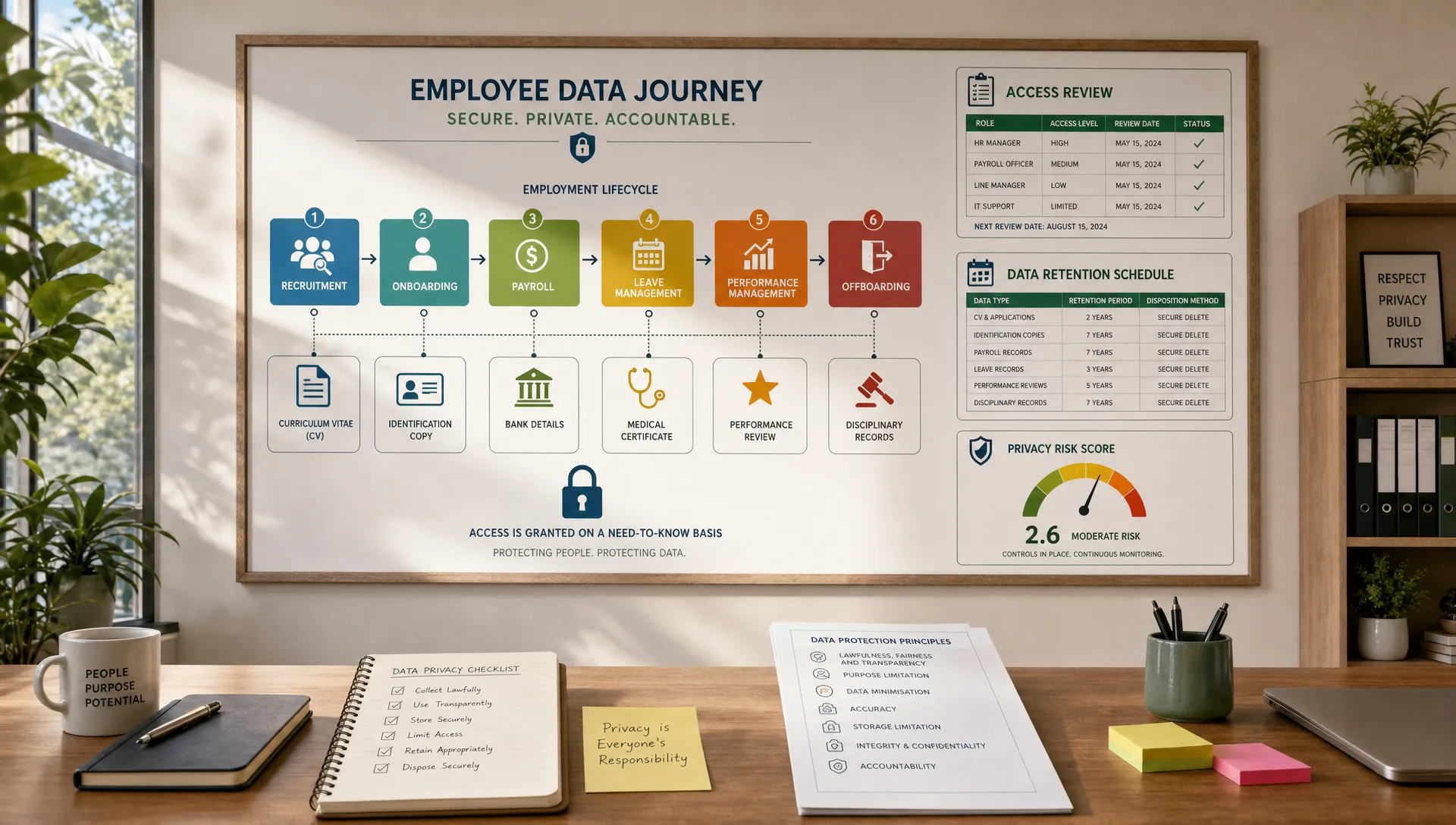
HR is one of the highest-risk areas for privacy because it handles personal data at every stage of the employment relationship. A single HR workflow can include CVs, interview notes, Taxpayer Registration Numbers, bank details, medical certificates, performance records, disciplinary files, emergency contacts and payroll information. Some of this information may be sensitive, and much of it can affect a person’s livelihood, reputation or dignity if it is mishandled.
For Jamaican organisations, assessing privacy risk in HR workflows is not just a compliance exercise. It is a practical way to show that the organisation understands its obligations under Jamaica’s Data Protection Act, 2020 and has controls in place to protect workers, applicants and former employees. The Office of the Information Commissioner is the primary public source for regulatory information in Jamaica, but each organisation must still translate data protection standards into daily HR practice.
A good HR privacy risk assessment answers three basic questions: what personal data is moving through the workflow, what could go wrong, and what must change to reduce the risk to an acceptable level. The goal is not to create paperwork for its own sake. The goal is to make HR decisions fairer, safer, more transparent and easier to defend.
What privacy risk means in an HR workflow
Privacy risk is the possibility that personal data will be collected, used, accessed, shared, retained or deleted in a way that causes harm or breaches a legal obligation. In HR, that harm can include identity theft, unfair treatment, discrimination, embarrassment, loss of employment opportunities, regulatory complaints, employee distrust or litigation.
HR also has a unique power imbalance. Employees and applicants may feel they have little choice when asked for personal information. That makes transparency and proportionality especially important. A privacy risk assessment should therefore look beyond whether the organisation has permission to collect data. It should ask whether the collection is necessary, fair, secure and limited to the purpose being pursued.
In 2026, organisations should be moving beyond policy creation into evidence-based compliance. That means being able to show how HR data is mapped, who can access it, how long it is kept, which vendors receive it, and how issues are escalated.
Start with a workflow inventory
Assessing HR as one broad category is too vague. Recruitment creates different risks from payroll, and employee monitoring creates different risks from offboarding. Begin by listing the main HR workflows and the data involved in each one. If your organisation has not yet mapped HR data, PLMC’s guide to starting a data mapping project is a useful companion because it explains how to begin with one defined business process.
HR workflow | Typical personal data | Common privacy risk signals |
Recruitment | CVs, interview notes, references, background check results | Over-collection, informal sharing, long retention of unsuccessful applications |
Onboarding | IDs, TRN, NIS or NHT information where applicable, emergency contacts | Too many copies, broad access, unclear notices |
Payroll and benefits | Salary, bank details, tax data, deductions, dependants | Vendor exposure, spreadsheet errors, email attachments |
Leave and health records | Sick leave, medical certificates, accommodation requests | Sensitive data access, excessive medical details, weak separation from personnel files |
Performance and discipline | Appraisals, complaints, investigation notes, warnings | Inaccurate records, unfair access, uncontrolled manager notes |
Monitoring and attendance | CCTV, access logs, time records, device logs, biometric data where used | Lack of transparency, disproportionate monitoring, purpose creep |
Offboarding | Exit interviews, final pay, references, former employee records | Delayed access removal, indefinite retention, unclear reference practices |
This inventory does not need to be perfect on the first attempt. What matters is that each workflow is specific enough to test. If a workflow cannot be described clearly, it cannot be assessed properly.
Step 1: Map how the data moves
Before scoring risk, map the data journey from collection to deletion. Many HR privacy failures happen because teams know the official system but miss the informal copies: email attachments, WhatsApp messages, manager folders, printed forms, shared drives and exported spreadsheets.
For each workflow, document the following:
Whose data is collected, such as applicants, employees, contractors, interns, dependants or emergency contacts.
What data fields are collected, including identifiers, contact details, financial data, health information or disciplinary records.
Why each data field is needed and which HR decision or legal obligation it supports.
Where the data is stored, including HR systems, payroll platforms, physical files and shared folders.
Who can access it, approve it, edit it, export it or delete it.
How long it is kept and what triggers deletion, archiving or anonymisation.
Which third parties receive it and whether any processing occurs outside Jamaica.
Do not start by asking whether the HR system is secure. Start by asking whether every item of personal data has a clear purpose. If no one can explain why a data field is collected, it should be challenged.
Step 2: Test the purpose and necessity
Jamaica’s Data Protection Act, 2020 reflects core data protection standards such as fair and lawful processing, purpose limitation, data minimisation, accuracy, retention limitation, security, respect for individual rights and restrictions on certain international transfers. In practical HR terms, those standards mean that each workflow should have a defined purpose before data is collected.
For example, collecting a candidate’s CV and work history may be necessary to assess suitability for a role. Collecting a national ID number at the first CV submission stage may not be necessary if identity verification only becomes relevant later. Similarly, a manager may need to know that an employee has a certified medical restriction, but may not need to know the full diagnosis.
Consent should be treated carefully in HR. Because of the employment relationship, consent may not always be genuinely voluntary. Where HR relies on consent, the assessment should confirm that the person can refuse without unfair consequences and that the consent is specific, informed and documented. In many HR contexts, another lawful basis or employment-related obligation may be more appropriate, but this should be assessed with proper legal and compliance input.
Step 3: Identify sensitivity and employee impact
Not all HR data carries the same level of risk. A work email address is not the same as a medical certificate, criminal record check, biometric template or harassment complaint. Sensitive personal data, data about vulnerable individuals, and data that can affect employment decisions require stronger controls.
Impact should be assessed from the individual’s perspective, not only from the organisation’s perspective. If payroll data is sent to the wrong person, the organisation may face a breach response. The employee may face embarrassment, financial exposure or loss of trust. If inaccurate disciplinary notes are retained and later used in promotion decisions, the harm may be career-related and long lasting.
A strong assessment asks: could this data affect the person’s job, income, reputation, safety, health, dignity or legal rights? If the answer is yes, the workflow deserves closer review.
Step 4: Score likelihood and impact
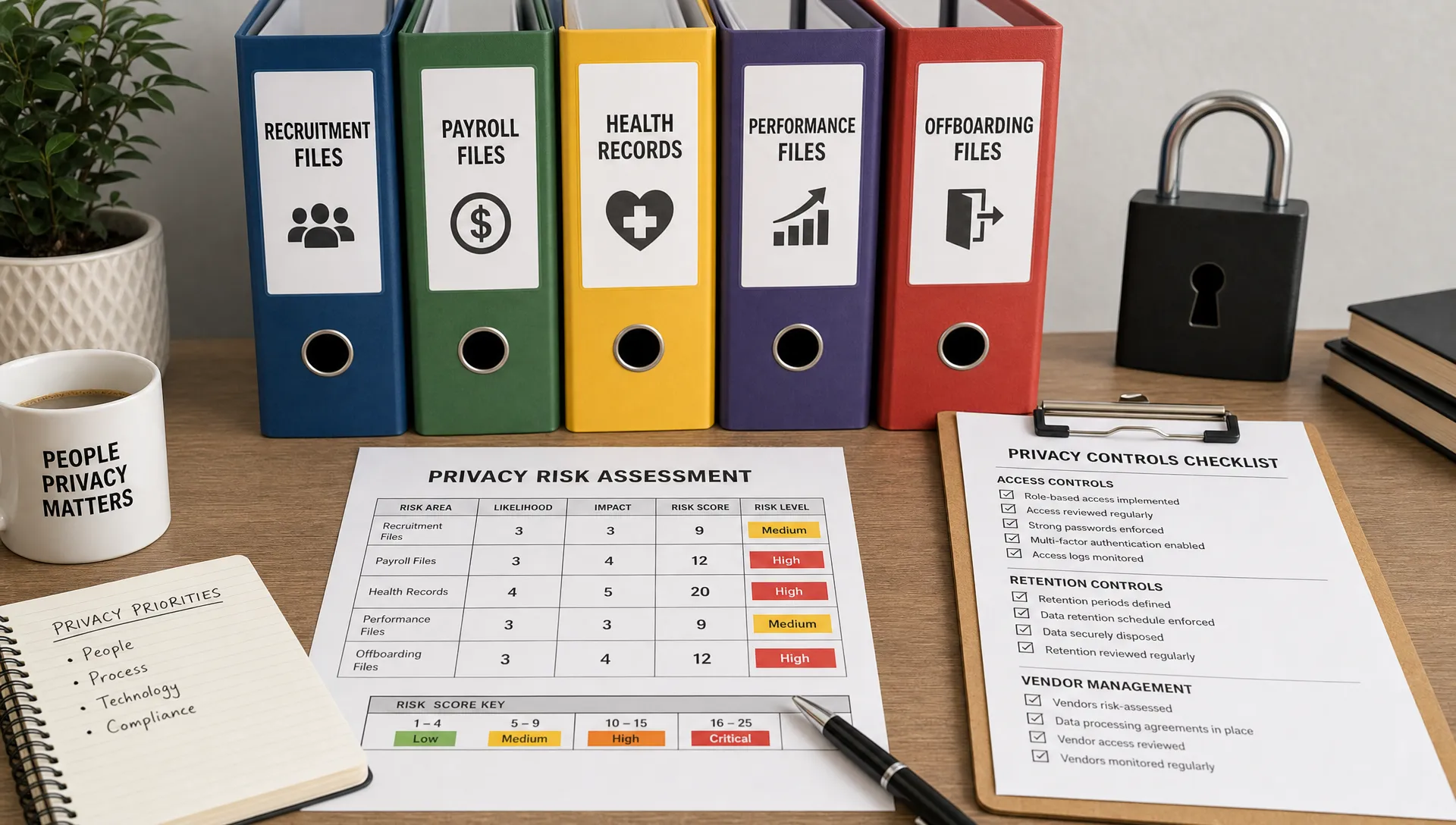
A simple scoring model is often enough for HR workflows. The purpose is to create consistent decisions, not mathematical perfection. Score both likelihood and impact before controls, then again after controls to understand residual risk.
Score | Likelihood | Impact |
1 | Unlikely, limited access, stable process, few records | Minor inconvenience or limited internal issue |
2 | Possible, several users or manual steps, moderate record volume | Financial, employment or reputational harm to individuals |
3 | Likely, broad access, frequent sharing, weak controls or high volume | Serious harm, sensitive data exposure, regulatory complaint or loss of trust |
You can multiply likelihood by impact to create a basic risk score. For example, a payroll spreadsheet containing bank details that is emailed monthly to several managers may have high likelihood and high impact if there is no encryption, no access restriction and no clear business need for those recipients. That risk should not be treated the same as a controlled HR report with limited fields and audited access.
Record the reasoning behind the score. A score without explanation is difficult to defend. A short risk statement is better: payroll bank details are exported into spreadsheets and emailed to non-HR recipients, creating a high risk of unauthorised disclosure and financial harm to employees.
Step 5: Test the controls that actually reduce risk
Policies are useful, but an HR privacy risk assessment should test whether the controls work in practice. The assessment should examine technical controls, organisational controls and human behaviour.
Control area | What to check | Useful evidence |
Access control | Whether access is limited by role and reviewed regularly | Access matrix, review logs, approval records |
Security | Whether HR files are protected in storage and transmission | System settings, encryption practices, secure file transfer records |
Retention | Whether records are deleted or archived when no longer needed | Retention schedule, deletion logs, archive rules |
Accuracy | Whether employees can update or challenge incorrect data | Correction process, audit trail, HR case notes |
Transparency | Whether applicants and employees know how their data is used | Applicant and employee privacy notices |
Third parties | Whether payroll, benefits or screening providers are assessed | Contracts, due diligence records, processor questionnaires |
Training | Whether HR and managers understand handling rules | Training records, scenario results, refresher schedules |
A control should be specific enough to verify. Saying that HR files are confidential is not enough. The assessment should be able to show who has access, why they need it, when access was last reviewed and what happens when a person changes roles.
What to assess in common HR workflows
Recruitment and background screening
Recruitment often creates privacy risk before a person becomes an employee. Applicants may submit detailed CVs, references, education records and personal contact details. If the role involves financial responsibility, regulated activity or work with vulnerable persons, background screening may also be involved.
Assess whether the organisation collects only what is needed at each stage. Early-stage applicants should not usually be asked for every document that would only be required after a conditional offer. Interview notes should be factual, relevant and stored in the approved location, not in personal notebooks or unmanaged email folders.
Background checks should be proportionate to the role. The assessment should ask who approves them, what information is received, how results are interpreted, how long they are retained and whether applicants receive appropriate notice. Unsuccessful candidate records should not be kept indefinitely just because storage is cheap.
Onboarding and personnel file creation
Onboarding is where HR often collects the widest range of identity, tax, payroll and emergency contact data. The risk is not only collection. It is also duplication. Copies of IDs, forms and bank details can spread across email inboxes, shared drives and printed files.
Assess whether onboarding uses a controlled checklist, whether documents are uploaded securely, and whether managers can only see information they need for their role. Emergency contact details should be used for genuine emergency purposes, not general convenience. Personnel files should be structured so that sensitive records, such as medical or investigation documents, are not visible to everyone who can view basic employment details.
Payroll, benefits and statutory administration
Payroll data is attractive to attackers and damaging if disclosed. It can include salary, bank accounts, tax information, deductions and dependant information. In Jamaica, payroll may also involve statutory contribution information, where applicable. Errors in this workflow can create financial and trust-related harm.
Assess how payroll data is transferred, who can approve changes, and how bank account updates are verified. If payroll or benefits administration is outsourced, the third party should be assessed before employee data is shared. PLMC’s guide on how to run a simple vendor privacy assessment is especially relevant for payroll processors, benefits providers, recruitment platforms and HR software vendors.
The assessment should also test whether payroll reports contain more data than necessary. A manager may need cost centre totals, but not every employee’s bank details. Data minimisation should apply to internal reporting as much as external sharing.
Leave, health and accommodation records
Health-related HR data requires particular care. A sick leave certificate, disability accommodation request or workplace injury record can reveal highly personal information. Mishandling this data can cause embarrassment, discrimination or loss of trust.
Assess whether HR collects the minimum medical information needed to administer leave, benefits, workplace safety or reasonable accommodation. In many cases, managers need to know work limitations, expected absence periods or approved adjustments, not the full medical diagnosis. Health records should be separated from general personnel files and access should be limited to those with a clear need.
Retention is also important. Medical documents should not be kept forever simply because they were once relevant. The organisation should identify the legal, operational or dispute-related reason for retention and delete or archive records when that reason no longer applies.
Performance, disciplinary and grievance workflows
Performance reviews, disciplinary files and grievance investigations can shape an employee’s career. They also contain opinions, allegations, witness statements and sometimes sensitive information about other employees. The privacy risk is both confidentiality and fairness.
Assess whether records are accurate, relevant and dated. Informal manager notes can create major risk if they contain unsupported assumptions or are later used in formal decisions. Access should be restricted to HR, authorised decision-makers and others with a documented need. Investigation files should be handled separately from routine performance records where possible.
The assessment should also check whether employees have a defined route to challenge inaccurate personal data, consistent with data protection rights and fair HR practice.
Monitoring, attendance and workplace technology
Monitoring can include CCTV, access cards, vehicle tracking, device logs, email review, productivity tools, time clocks and biometric attendance systems. These workflows deserve careful assessment because they can feel intrusive and can easily expand beyond their original purpose.
Assess whether the monitoring is necessary, proportionate and clearly explained. Employees should know what is being monitored, why, who reviews the data, how long it is kept and whether it may be used for disciplinary purposes. If data was collected for security, using it later for unrelated performance management may create purpose limitation concerns.
Biometric and large-scale monitoring should be treated as higher risk. The assessment should consider whether a less intrusive method could achieve the same purpose.
Offboarding and former employee records
Privacy risk does not end when employment ends. Offboarding should include access removal, return or deletion of local files, final payroll processing, reference handling and retention decisions. Former employee records may still be needed for statutory, tax, pension, dispute or audit reasons, but not every record needs the same retention period.
Assess whether HR and IT coordinate access revocation promptly. Check whether former managers retain private copies of employee documents. Review how references are provided and who is authorised to provide them. A short, controlled reference process can reduce the risk of inaccurate or excessive disclosure.
Produce a practical treatment plan
After risks are scored, decide how each risk will be treated. Some risks can be reduced quickly through access changes, revised forms or secure transfer methods. Others require system configuration, vendor contract review, new retention rules or staff training.
A useful treatment plan should include the risk statement, current rating, agreed action, owner, deadline and residual rating. For example, if recruitment folders are accessible to all managers, the treatment may be to create role-based folders, restrict access to interview panels, remove old candidate files and implement a retention rule for unsuccessful applicants.
Do not leave all actions with HR. HR privacy risk often sits at the intersection of HR, IT, Legal, Compliance, Procurement and business managers. The owner should be the person with authority to make the control work.
Keep evidence of the assessment
A privacy risk assessment is only useful if the organisation can show what was assessed and what changed. Evidence supports accountability, internal audit, board reporting and regulator engagement if an incident occurs.
Keep records such as:
Workflow maps and data inventories for each HR process.
Risk scoring worksheets with rationale and dates.
Applicant and employee privacy notices.
Access reviews and approval records.
Vendor due diligence and contract records.
Retention schedules and deletion evidence.
Incident logs and lessons learned.
Training records for HR, managers and IT support teams.
Because many HR privacy issues arise from everyday behaviour, training should be tied to the risks identified in the assessment. Generic awareness is rarely enough. Department-specific data protection training for HR, IT and customer teams can help staff understand the actual scenarios they face, such as sending payroll files, handling medical notes or responding to employee access requests.
Common mistakes to avoid
One common mistake is treating HR confidentiality as the same thing as privacy compliance. Confidentiality is essential, but privacy also requires fairness, purpose limitation, minimisation, retention controls, rights handling and accountability.
Another mistake is assessing only the HR software and ignoring exports, emails, printed forms and manager-held copies. In many organisations, the highest-risk data is not in the official system. It is in the spreadsheet created to solve a short-term problem and then reused for years.
Organisations also weaken assessments by rating everything medium. If every risk has the same score, the assessment will not help leaders prioritise. Sensitive data, broad access, weak vendor controls, cross-border processing, monitoring and large data volumes should influence the rating.
Finally, HR should not wait for a breach to review its workflows. Recruitment changes, new HR systems, outsourcing, restructuring, monitoring tools and new benefit providers are all triggers for reassessing privacy risk.
Frequently Asked Questions
How often should HR privacy risk assessments be done? HR workflows should be reviewed at least periodically and whenever there is a material change, such as a new HR system, new payroll provider, new monitoring tool, restructuring, outsourcing or a change in the type of employee data collected.
Is payroll always a high-risk HR workflow? Payroll is often high risk because it includes financial identifiers, salary data, statutory information and bank details. The actual rating depends on volume, access, transfer methods, vendor involvement and existing controls.
Can HR rely on employee consent to process personal data? Consent can be difficult in employment because employees may feel they cannot freely refuse. HR should assess whether consent is genuinely voluntary and whether another lawful basis or employment-related obligation is more appropriate.
What is the difference between HR data mapping and HR privacy risk assessment? Data mapping identifies what personal data exists, where it goes and who uses it. Privacy risk assessment uses that map to identify what could go wrong, score the risk and choose controls to reduce it.
Who should be involved in assessing HR privacy risk? HR should lead on the workflow details, but IT, Legal, Compliance, Procurement, Information Security and relevant business managers should be involved where systems, vendors, contracts, access rights or employment decisions are affected.
Need support assessing HR privacy risk?
HR privacy risk assessments are most effective when they are practical, evidence-based and connected to governance. Privacy & Legal Management Consultants Ltd. supports Jamaican organisations with data protection implementation, GRC integration, training and risk assessment support.
If your organisation needs help reviewing HR workflows, strengthening controls or preparing for data protection compliance obligations, visit Privacy & Legal Management Consultants Ltd. to learn how PLMC can support your next step.