

Global Privacy Compliance for Remote Teams
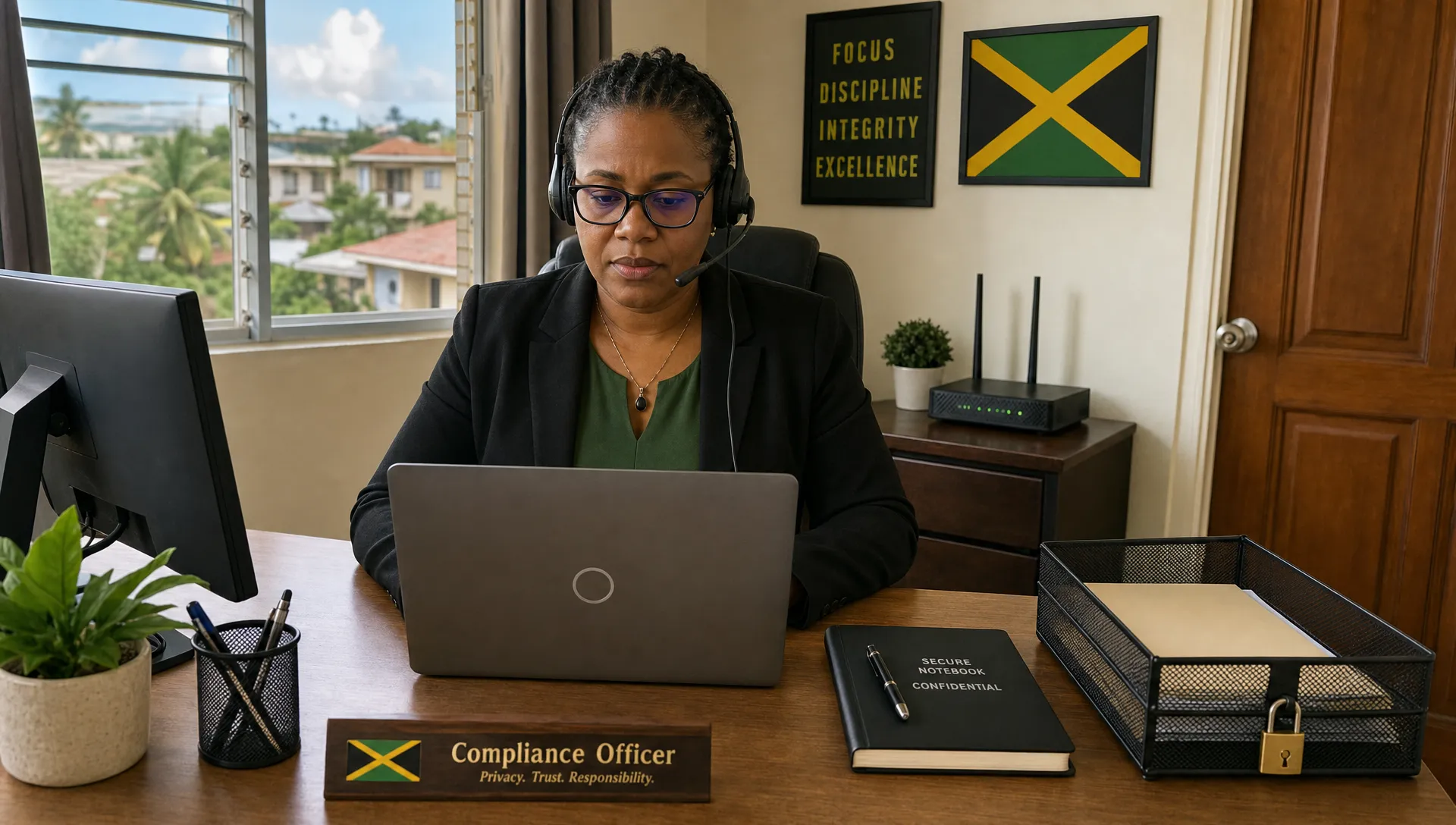
Remote work has made it easier for Jamaican organisations to hire, serve clients and collaborate across borders. It has also made privacy compliance harder to control. A customer service agent in Kingston, a developer in Canada and a finance contractor in Barbados may all touch the same personal data, but they may be subject to different laws, contracts and security expectations. That is why global privacy compliance for remote teams must be designed as an operating model, not a one-time policy document.
For organisations in Jamaica, the starting point is the Data Protection Act, 2020. For remote teams serving overseas clients or handling data about individuals in the EU, UK, US or other regions, local obligations can quickly overlap with international requirements. The goal is not to copy every privacy law into one giant manual. The goal is to build consistent controls that work wherever your people sit.
Why remote teams create privacy compliance pressure
Remote work changes the privacy risk profile because personal data leaves the controlled office environment. Staff may access systems from home networks, use shared living spaces, connect through global cloud platforms or collaborate with external partners in different time zones.
The issue is not simply that people are remote. The issue is that privacy accountability can become unclear. A manager may approve a new app without involving IT. A contractor may download client files to meet a deadline. A team member may use personal email because a file is too large to send through the approved platform.
Privacy risk increases when:
Personal data is stored outside approved systems
Access permissions are not updated when roles change
Staff use consumer tools for business data
Vendors process data without a written agreement
Data subjects, systems and staff are located in different countries
Remote work is sustainable only when the organisation knows what data is being handled, who can access it, where it goes and what controls apply.
Global privacy compliance for remote teams starts with a data map
A data map is the foundation of global privacy compliance for remote teams because it shows how personal data actually moves through the organisation. Without it, policies become guesswork. You cannot assess cross-border transfers, retention periods, breach exposure or vendor risk if you do not know where the data is.
A useful data map does not need to be complicated at the beginning. It should answer practical questions that business, legal, privacy and technology teams can understand.
Data mapping question | Why it matters | Remote team example |
What personal data is collected? | Helps classify sensitivity and apply safeguards | Names, contact details, ID numbers, HR records or customer complaints |
Whose data is involved? | Determines which laws and rights may apply | Jamaican customers, EU users, employees or client contacts |
Where is the data stored? | Identifies cloud, device and transfer risks | CRM hosted overseas, shared drive, payroll platform or laptop |
Who can access it? | Supports least privilege and audit controls | Sales team, external accountant, contractor or overseas manager |
Why is it processed? | Connects activity to lawful purpose and minimisation | Service delivery, recruitment, billing or compliance screening |
How long is it kept? | Reduces unnecessary exposure | Deleting inactive customer records after a defined retention period |
The map should include internal systems, collaboration tools, cloud services, vendors and manual workarounds. In remote environments, the workaround is often where the real risk sits.
Set a jurisdiction-aware compliance baseline
Jamaican organisations should begin with the Data Protection Act, 2020 and guidance from the Office of the Information Commissioner. The Act establishes data protection standards, individual rights and obligations for data controllers and processors. These principles should shape the organisation’s baseline, even when work is being performed remotely.
If your organisation handles personal data connected to overseas clients, you may also need to consider GDPR, UK GDPR, sector rules, client contractual requirements or other local privacy laws. The European Commission’s data protection resources are a useful starting point for organisations that may handle EU personal data.
Scenario | Compliance question | Practical control |
Jamaican company serving local customers | Are Data Protection Act, 2020 obligations being met? | Maintain policies, notices, data maps, security controls and response procedures |
Jamaican team supporting EU customers | Could GDPR apply to the processing activity? | Assess role, lawful basis, transfer mechanism and data subject rights process |
Overseas client outsourcing work to Jamaica | What does the client contract require? | Review data processing clauses, confidentiality terms and audit rights |
Remote contractor outside Jamaica | Does access create a transfer or processor risk? | Use contracts, access limits, approved devices and offboarding controls |
This article is not legal advice. It is a practical compliance framework for governance and risk planning.
Clarify whether you are a controller or processor
Remote teams often blur roles. A Jamaican organisation may act as a controller for its own HR and customer records, but as a processor when handling data on behalf of an overseas client. The distinction matters because it affects notices, instructions, contracts, incident reporting and data subject rights.
If the organisation decides why and how personal data is processed, it is more likely to be acting as a controller. If it processes personal data only on a client’s documented instructions, it is more likely to be a processor. Some arrangements are more complex, especially where analytics, marketing or shared platforms are involved.
Use the common denominator approach
Where several laws or client standards apply, remote teams should follow the strictest practical control as the default. For example, if one client contract requires multi-factor authentication, role-based access and deletion certification, applying those controls more broadly may reduce operational confusion.
This approach does not replace legal analysis, but it helps staff follow one clear way of working instead of trying to memorise multiple rules for each jurisdiction.
Build remote work controls employees can actually follow
Remote privacy rules fail when they are written for auditors but not for employees. A policy that says “protect confidential information” is too vague. Staff need to know which systems to use, what they must not download, when they can share files and how to report a mistake.
Start with access controls. Every remote worker should have access only to the data needed for their role. Access should be approved, reviewed periodically and removed quickly when a person changes job function or leaves the organisation. Multi-factor authentication should be standard for systems containing personal data, especially cloud email, CRM, HR, finance and client platforms.
Device rules should also be clear. Company-managed devices are preferable where feasible. If bring-your-own-device arrangements are allowed, the organisation should define minimum security requirements, including screen locks, updates, encryption, anti-malware and restrictions on local downloads.
File sharing deserves special attention because it is one of the easiest ways for personal data to leak. Remote teams should use approved platforms, avoid personal email and apply classification rules before sharing sensitive data. PLMC has a separate guide on secure file sharing rules for teams and external partners that covers this issue in more detail.
Manage cross-border transfers and global cloud tools
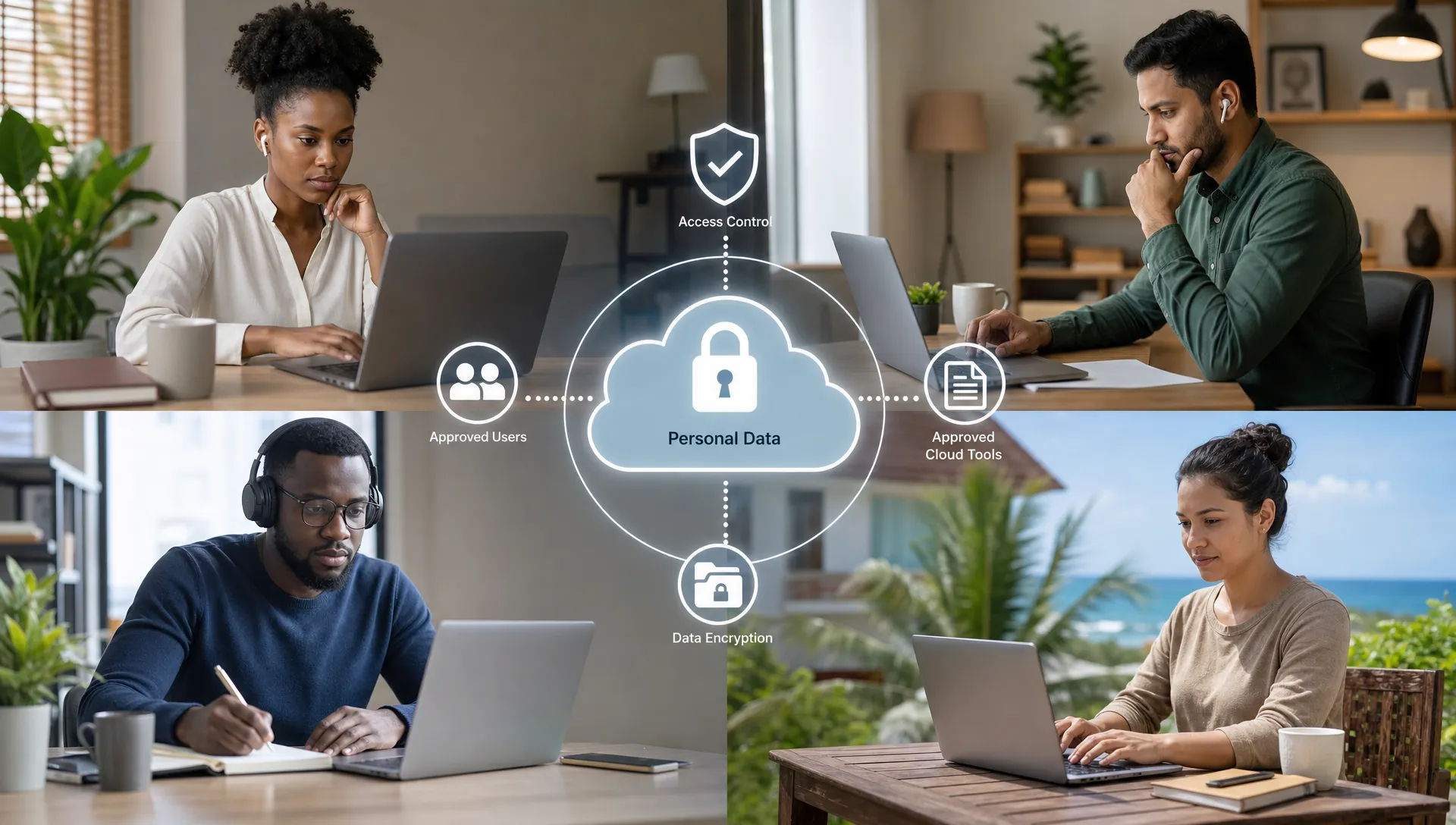
A remote team can create a cross-border data transfer even when no file is manually sent overseas. If a staff member in another country accesses a Jamaican customer database, or if a cloud provider hosts data in another region, transfer considerations may arise.
The compliance question is not simply “Where is the company based?” It is “Where can the data be accessed, stored, backed up, supported or disclosed?” Global cloud providers, outsourced support desks, payroll platforms and collaboration tools should all be reviewed.
Vendor due diligence should cover:
The provider’s role as controller, processor or independent service provider
Data hosting and support locations
Subprocessor use
Security measures and certifications
Breach notification commitments
Return or deletion of data at contract end
Audit rights or assurance reports
Contracts with processors should include clear instructions, confidentiality obligations, security requirements, limits on subcontracting, breach cooperation, retention rules and deletion requirements. For overseas transfers, organisations should assess whether appropriate safeguards are needed under the relevant law or client contract.
For more detail on the cloud angle, see PLMC’s guide to privacy risks when using global cloud providers, especially if your organisation relies on platforms such as Microsoft Azure, AWS, Google Cloud or international SaaS tools.
Make breach response work across time zones
A privacy incident can start with a simple mistake: a misdirected email, a lost laptop, an exposed shared folder or an account compromise. Remote work adds delay if employees are unsure whom to contact or if the privacy lead is in a different time zone.
Incident response should define what counts as a suspected privacy incident and make reporting easy. Staff should not wait until they are certain a breach occurred. Early escalation gives the organisation time to contain harm, preserve evidence, assess legal obligations and communicate appropriately.
The privacy and cyber security teams should work from one incident playbook. Security may detect unauthorised access, but privacy must assess the personal data impact, data subject risk and notification obligations. If these teams operate separately, the organisation can lose critical hours. PLMC’s guide on how to align cyber security and privacy teams explains how to join those responsibilities in practice.
Your breach procedure should identify the incident owner, legal or compliance reviewer, technical lead, communications contact and executive escalation route. It should also include after-action reviews so the organisation can correct root causes, not just close tickets.
Train remote staff for judgement, not paperwork
Training is where global privacy compliance for remote teams becomes real. Remote employees need judgement because they make privacy decisions without a supervisor standing nearby. They need to recognise sensitive data, challenge unnecessary collection, avoid unsafe sharing and report mistakes quickly.
Short scenario-based training is usually more effective than long annual presentations. Use examples from real workflows, such as onboarding a new employee, handling a customer complaint, sending files to a client or using a new productivity tool.
Training should cover:
What counts as personal data and sensitive personal data
Approved systems for storing and sharing information
How to verify recipients before sending data
When to use encryption or restricted access
How to respond to data subject requests
How to report suspected incidents
Managers need additional training because they approve tools, assign access and shape team habits. A manager who rewards speed while ignoring privacy controls will undermine even the best-written policy.
Create a simple operating model for accountability
Remote privacy compliance needs ownership. If everyone is responsible, no one is accountable. Organisations should define roles clearly and revisit them as remote operations expand.
Role | Key responsibility | Remote team focus |
Executive sponsor | Sets expectations and approves resources | Makes privacy a business requirement, not just a legal task |
Privacy lead or compliance officer | Coordinates the privacy programme | Maintains policies, data maps, assessments and incident procedures |
IT or cyber security lead | Implements technical safeguards | Manages access, devices, monitoring and secure configuration |
HR and training owner | Embeds staff obligations | Handles onboarding, confidentiality, training and offboarding |
Department managers | Apply controls in daily work | Approve access, enforce procedures and escalate issues |
Vendor owner | Oversees service providers | Tracks contracts, due diligence and performance obligations |
This model should connect to broader governance, risk and compliance processes. Privacy cannot sit apart from corporate governance, cyber security, anti-money laundering compliance or operational risk. The same remote team may handle customer identity documents, transaction records and confidential business data, so controls should be coordinated.
A practical checklist for remote privacy readiness
Before expanding a remote team or taking on international client work, leaders should ask whether the basics are in place. The following checklist gives a practical starting point.
Control area | Readiness question |
Data mapping | Do we know what personal data remote staff access and where it is stored? |
Legal basis and notices | Are individuals told how their data is used and why? |
Access management | Are permissions role-based, reviewed and removed promptly? |
Device security | Are remote devices secured, updated and protected against unauthorised access? |
File sharing | Are staff using approved channels for personal and confidential data? |
Vendor contracts | Do processors have written obligations for security, confidentiality and breach support? |
Transfers | Have overseas access, hosting and support locations been assessed? |
Training | Do staff know the rules in practical workflow terms? |
Incident response | Can employees report suspected breaches quickly from any location? |
Governance | Is someone accountable for privacy risk across remote operations? |
This checklist is not a complete compliance programme, but it helps identify gaps before they become client concerns, audit findings or reportable incidents.
Frequently Asked Questions
Does Jamaica’s Data Protection Act, 2020 apply if employees work remotely? Yes, remote work does not remove an organisation’s obligations under Jamaica’s Data Protection Act, 2020. If the organisation controls or processes personal data within the scope of the Act, it must maintain appropriate governance, security, transparency and accountability measures.
Can remote access count as a cross-border data transfer? It can. If personal data is accessed, stored, supported or backed up from another country, the organisation should assess whether transfer rules, contractual safeguards or client requirements apply.
Is GDPR relevant to Jamaican organisations? It may be relevant where a Jamaican organisation offers goods or services to individuals in the EU, monitors their behaviour or processes EU personal data on behalf of a client. The specific facts matter, so organisations should review their role and processing activities carefully.
What should a remote privacy policy include? It should cover approved systems, access rules, device security, file sharing, use of personal devices, confidentiality, incident reporting, data subject requests, retention and offboarding. It should be written in plain language employees can follow.
How often should remote teams receive privacy training? Training should occur during onboarding and be refreshed regularly, especially when systems, laws, client requirements or business processes change. Short, scenario-based sessions are often more effective than infrequent long sessions.
Strengthen privacy compliance before remote risk expands
Remote teams can help Jamaican organisations compete globally, but only if privacy governance keeps pace with the business model. The strongest programmes combine data mapping, clear accountability, secure tools, practical training and cross-border awareness.
Privacy & Legal Management Consultants Ltd. supports organisations with data protection implementation, corporate governance, anti-money laundering compliance, cyber security services, training and integrated GRC support. If your remote team handles personal data across borders, connect with PLMC to discuss how to build a privacy compliance framework that fits your operations.