

Employee Monitoring: Privacy Questions Employers Must Ask
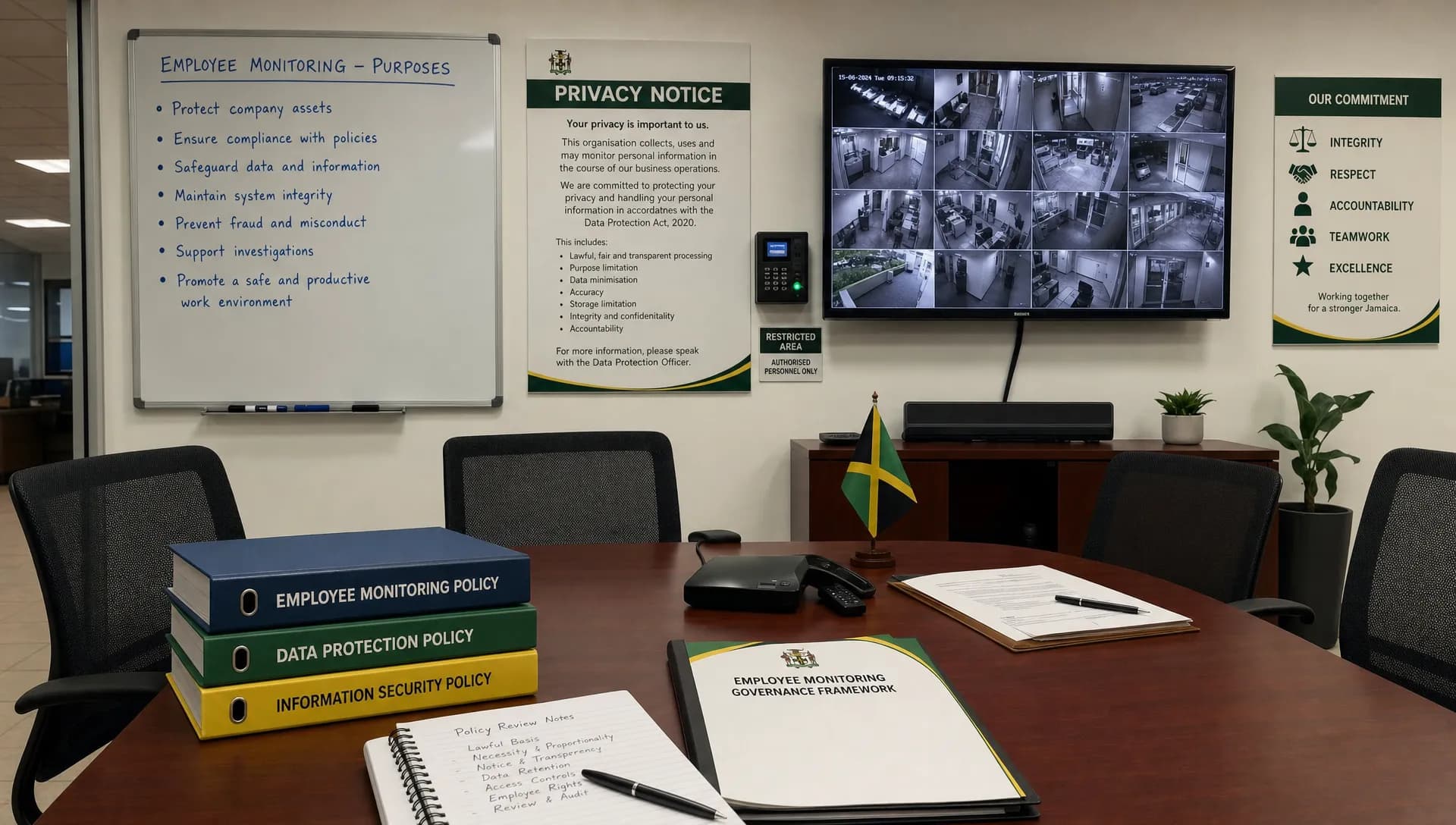
Employee monitoring sits where management, security, compliance and privacy meet. Employers may have sound reasons to monitor workplace activity, from protecting company assets to investigating fraud, meeting anti-money laundering obligations, improving service quality or keeping staff safe. The privacy risk arises when monitoring becomes broader than the problem it is meant to solve, or when employees do not understand what is being collected and why.
In Jamaica, employee monitoring should be approached as a data protection compliance issue, not only an HR or IT decision. If an organisation decides why and how monitoring data is collected, it is likely acting as a data controller under the Data Protection Act, 2020. That means the organisation must think about fairness, necessity, purpose, security, retention and employee rights before the monitoring begins.
The practical question is not simply whether an employer can monitor staff. The better question is whether the monitoring is lawful, proportionate, transparent and controlled enough to withstand scrutiny.
Why employee monitoring deserves a privacy review
Employee monitoring usually involves personal data because it links information to identifiable workers. CCTV footage, access card logs, GPS records, call recordings, email metadata, productivity dashboards and screenshots can all reveal how a person works, where they go, who they speak with and when they take breaks.
That data can quickly move beyond ordinary workplace administration. Location records may reveal medical appointments or trade union activity. Email monitoring may capture private messages or confidential communications. Video footage may record customers, visitors and contractors as well as employees. Even a simple access control log can become a detailed attendance and behaviour profile if managers use it in a new way.
Jamaican organisations should also remember that employee monitoring often touches more than one governance area. A tool introduced for cyber security may create HR risks. A tool introduced for performance management may affect employee relations. A tool introduced for anti-money laundering compliance may capture sensitive operational information. This is why monitoring decisions should involve HR, legal, compliance, IT security and business leadership, not one department acting alone.
For HR teams, monitoring should be reviewed alongside other people processes. PLMC has a separate guide on how to assess privacy risk in HR workflows, which is a useful starting point before introducing surveillance into recruitment, onboarding, attendance, performance or disciplinary processes.
The privacy questions employers must ask first
1. What specific business problem are we trying to solve?
A monitoring programme should begin with a defined problem, not a vague concern. Protecting a cash room, investigating repeated stock losses, recording customer service calls or securing a remote access environment are clearer purposes than keeping an eye on staff.
The more specific the purpose, the easier it is to choose a proportionate control. If the problem is unauthorised access to a server room, targeted access logs and CCTV at the entrance may be enough. Full-day screen recording of every employee would be difficult to justify for that purpose.
Employers should be able to write the purpose in one or two plain sentences. If the purpose keeps expanding during discussion, that is a sign the organisation may be collecting data just in case, rather than for a necessary and fair reason.
2. What personal data will the monitoring collect?
Many monitoring projects are approved based on a tool description rather than a data map. That is risky. Before procurement or deployment, employers should identify exactly what data will be captured, whether it includes staff, customers or visitors and whether the data can reveal sensitive patterns.
Monitoring activity | Personal data likely captured | Privacy concern to assess |
CCTV | Images, time, location, behaviour and interactions | Can reveal work habits, visitors, disputes and activities unrelated to the stated purpose |
Access control | Entry times, exit times, badge ID and location | Can become attendance or movement tracking if reused without notice |
GPS tracking | Vehicle location, routes, stops and timestamps | May track employees outside working hours if not configured properly |
Email and internet logs | Senders, recipients, URLs, time stamps and sometimes content | May capture private messages, confidential communications or employee concerns |
Call recording | Voice, customer details, staff performance and call content | Captures data about employees and third parties, including customers |
Productivity software | App use, idle time, screenshots, keystrokes or task activity | Can be highly intrusive and may create misleading performance assumptions |
Biometric systems | Fingerprints, facial templates, voice patterns or other identifiers | Creates high-risk identity data that cannot easily be replaced if compromised |
This mapping should include hidden data as well as obvious data. For example, a call recording tool may also create transcripts, sentiment scores, performance tags and supervisor notes. A vehicle tracking tool may also show stop duration, route deviations and after-hours movement.
3. Is the monitoring necessary and proportionate?
Necessity asks whether the organisation genuinely needs the monitoring to achieve its stated purpose. Proportionality asks whether the privacy impact is reasonable in light of that purpose.
An employer should consider whether a less intrusive measure would work. Could better access controls reduce the need for continuous video monitoring? Could system alerts detect suspicious activity without recording every screen? Could spot checks, audit logs or manager approvals address the issue without blanket surveillance?
Proportionality also depends on scope. Monitoring a restricted storage area is different from filming every desk. Tracking a company vehicle during work hours is different from tracking an employee's personal phone all weekend. Recording customer calls for quality assurance is different from recording all internal staff conversations.
The Data Protection Act, 2020 is built around standards such as fair and lawful processing, purpose limitation, data minimisation, security and retention. These principles are also familiar to organisations that have worked with GDPR Jamaica requirements, but local organisations should anchor their decisions in Jamaica's own legal framework and guidance from Jamaica's Office of the Information Commissioner.
4. Have employees been told clearly and early?
Transparency is one of the most important safeguards in employee monitoring. Staff should know what is being monitored, why, when monitoring happens, who can access the information, how long it will be kept and what rights they have.
A short clause buried in a handbook is rarely enough for intrusive monitoring. Employers should use clear notices, practical policies and manager briefings. CCTV areas should have visible signs. GPS monitoring should be explained before the device or app is used. Email and internet monitoring should be covered in acceptable use policies that employees can actually understand.
Covert monitoring is especially high risk. It should not become a routine management shortcut. If an organisation believes covert monitoring is necessary for a serious investigation, the decision should be limited, documented, approved at senior level and reviewed with legal and privacy advice.
5. What is our lawful basis for processing the data?
Employers should identify the lawful basis or applicable condition for processing before monitoring starts. In an employment context, consent can be problematic because staff may not feel they have a genuine choice. That does not mean consent is never relevant, but it should not be used casually to justify intrusive monitoring.
Depending on the facts, an employer may be relying on legal obligations, contractual necessity, legitimate organisational interests or another appropriate basis recognised by applicable law. The key is to document the reasoning and match it to the actual purpose of the monitoring.
If monitoring captures sensitive information, the threshold should be higher. Employers should ask whether additional safeguards are needed, whether fewer people can access the data and whether the same purpose can be achieved without collecting that category of information.
6. Who can access monitoring data and for what reason?
Monitoring data becomes more dangerous when access is broad. CCTV footage, call recordings, location data and productivity reports should not be open to any manager who is curious. Access should be limited to people with a defined business need, such as security personnel, HR investigators, compliance officers or authorised managers.
Employers should set rules for viewing, exporting, downloading and sharing monitoring data. They should also keep audit logs where possible, especially for sensitive systems. A manager who reviews GPS trails for operational scheduling may not need the same access as a compliance officer investigating suspected misconduct.
Retention is part of access control. Data should be kept only as long as needed for the stated purpose, unless a specific incident, legal requirement or investigation justifies longer retention. Keeping monitoring data indefinitely increases breach risk and makes it easier for the data to be reused for purposes employees were never told about.
7. Are third party tools or vendors involved?
Many employee monitoring tools are cloud-based. That means workplace data may be processed by vendors outside the organisation and sometimes outside Jamaica. Employers should review vendor contracts, security controls, data locations, sub-processors, breach notification terms and deletion procedures before staff data is uploaded.
A vendor privacy assessment does not need to be complicated for every tool, but it should be risk-based. A simple scheduling app is not the same as software that records screens, analyses keystrokes or stores identity data. Before signing, use a structured process like PLMC's guide on how to run a simple vendor privacy assessment.
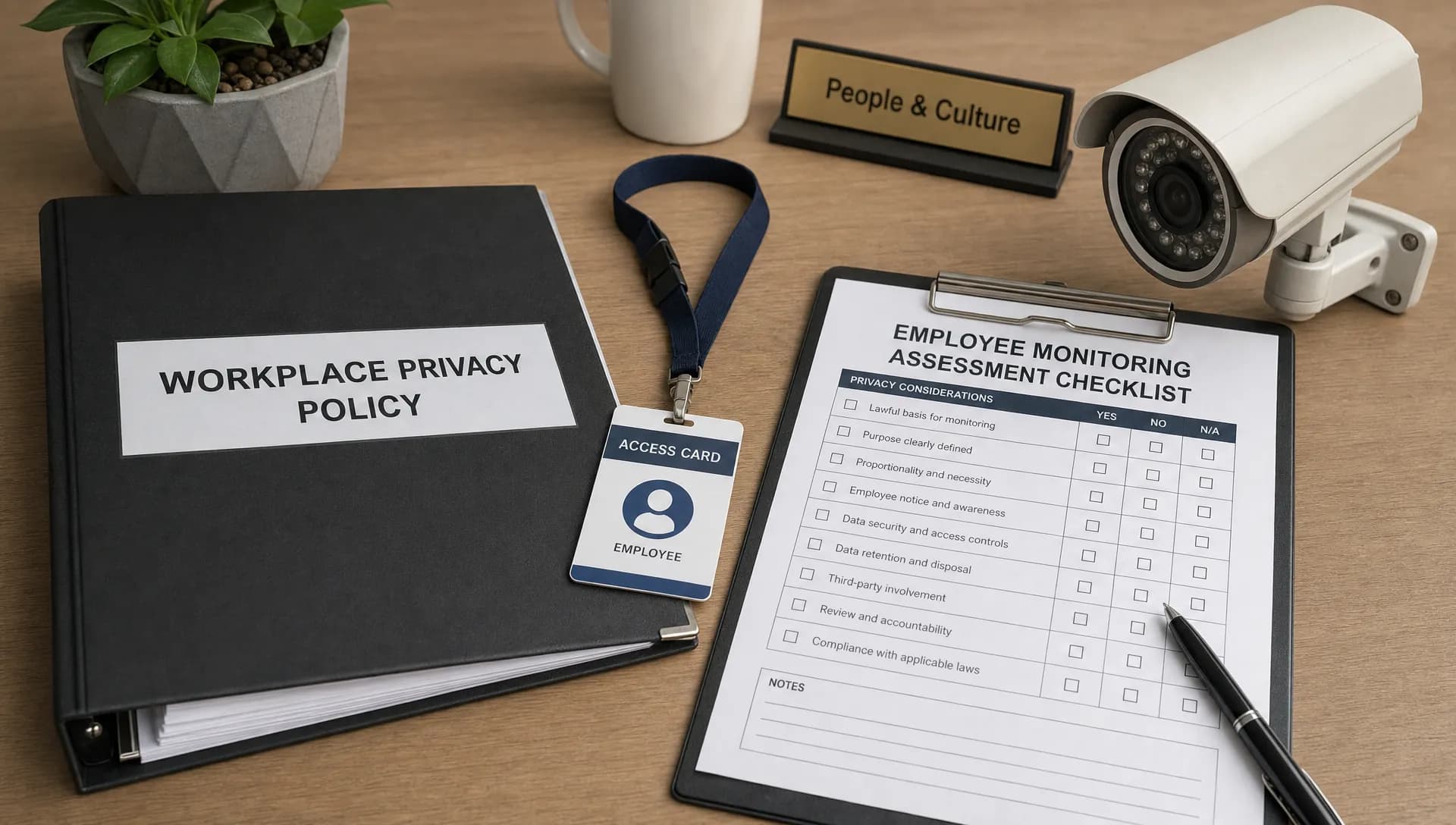
Extra questions for common monitoring methods
Different monitoring methods raise different privacy questions. Employers should avoid using one generic policy for every tool. A CCTV camera, a GPS tracker and a productivity monitoring platform do not create the same risks.
Monitoring method | Ask this before deployment | Practical safeguard |
CCTV | Are cameras aimed only at areas where there is a genuine security or safety need? | Avoid private areas, use visible signage, restrict playback access and set a retention period |
GPS tracking | Is tracking limited to work vehicles, work hours and operational purposes? | Disable after-hours tracking where possible and explain how route data may be used |
Email monitoring | Are we reviewing metadata, content or both? | Use acceptable use policies, limit content review to justified cases and separate personal use rules |
Call recording | Are customers and employees both notified? | Use call notices, restrict recordings to quality, training, dispute or compliance purposes and control access |
Productivity software | Does the tool measure work outputs or surveil behaviour continuously? | Prefer task-level metrics over screenshots or keystroke capture, and test accuracy before disciplinary use |
Biometric access | Is biometric identification truly necessary compared with cards, PINs or other controls? | Treat it as high-risk, complete a privacy assessment and apply strict security and retention controls |
Biometric monitoring deserves special care because biometric identifiers are difficult or impossible to replace if compromised. If your organisation is considering fingerprint, facial recognition or voice authentication, review the privacy issues in PLMC's article on biometric data risks for employers before implementation.
When employee monitoring becomes high risk
Some monitoring is routine and relatively limited, such as CCTV at a building entrance. Other monitoring can have a significant impact on trust, dignity and employee autonomy. The risk increases when monitoring is continuous, hidden, used for disciplinary decisions, linked with automated scoring or applied to personal devices.
Employers should pause and conduct a more formal privacy risk assessment if any of these warning signs apply:
The monitoring captures audio, screenshots, keystrokes, precise location or biometric data.
Staff are monitored outside working hours or away from work premises.
The tool creates automated productivity scores or behavioural ratings.
Managers want to use data collected for one purpose for a new disciplinary or performance purpose.
Employees have not received a clear notice or policy before monitoring begins.
Data will be stored by a vendor in another country or shared across a group of companies.
High risk does not always mean prohibited. It means the employer needs stronger justification, better safeguards and clearer documentation.
How to document your decision
A good monitoring decision should leave a paper trail. If a staff member, regulator, auditor or court later asks why monitoring was introduced, the organisation should be able to show that it considered privacy before acting.
Document or record | What it should show |
Business justification | The specific risk, problem or legal obligation the monitoring addresses |
Data map | The categories of employee, customer or visitor data collected by the tool |
Necessity assessment | Why monitoring is needed and what less intrusive alternatives were considered |
Privacy notice or policy | What staff were told about monitoring, access, retention and rights |
Access matrix | Which roles can view, export, share or delete monitoring data |
Retention schedule | How long data is kept and when it is deleted or archived |
Vendor review | Contract, security, transfer, breach notification and deletion controls for third party tools |
Review date | When the monitoring will be reassessed to confirm it remains necessary |
This documentation should be updated when the purpose changes. For example, CCTV installed for building security should not quietly become a productivity tool without a fresh privacy review and updated employee notice.
How to communicate monitoring without damaging trust
Poor communication can make even lawful monitoring feel unfair. Employees are more likely to accept monitoring when the organisation explains the business reason, sets boundaries and shows that managers are also bound by rules.
Communication should be practical. Instead of saying the company may monitor systems for legitimate purposes, explain which systems are monitored, what examples of misuse may trigger review and who approves access to monitoring data. Employees should know whether personal use is allowed on company systems and what level of privacy they can reasonably expect.
Training matters as well. Managers should understand that monitoring data is not a shortcut for suspicion-based management. HR should understand when monitoring data can and cannot be used in disciplinary processes. IT should understand that technical access does not equal permission to view employee information.
The most effective approach is to treat employee monitoring as part of a wider privacy culture. Staff should see that the organisation protects personal information consistently, whether the data belongs to employees, customers, vendors or visitors.
Frequently Asked Questions
Is employee monitoring legal in Jamaica? Employee monitoring can be lawful in Jamaica if it is fair, necessary, proportionate, transparent and properly secured under the Data Protection Act, 2020. The employer should document the purpose, lawful basis, data collected, access rules and retention period before monitoring begins.
Do employees have to consent to monitoring? Not always. Consent may be weak in an employment relationship because employees may feel they cannot refuse. Employers should identify the appropriate lawful basis for the specific monitoring activity and should not rely on consent unless it is genuinely informed and freely given.
Can an employer monitor personal phones or personal email accounts? This is high risk and should generally be avoided unless there is a very specific, lawful and documented reason. Employers should use company systems for business activity, set clear acceptable use rules and avoid collecting private information from personal devices wherever possible.
How long should CCTV or monitoring records be kept? There is no single retention period that fits every workplace. Records should be kept only as long as needed for the stated purpose, unless an incident, investigation, insurance issue or legal requirement justifies keeping them longer. The retention rule should be written down and followed.
Can monitoring data be used for disciplinary action? It may be possible, but only if the monitoring was lawful, the employee was properly informed, the data is relevant and the disciplinary process is fair. Data collected for one purpose should not automatically be reused for another purpose without a fresh privacy assessment.
Need help reviewing an employee monitoring programme?
Employee monitoring can support security, compliance and operational oversight, but only when it is designed with privacy from the start. Jamaican employers should ask the hard questions before buying the tool, installing the camera or activating the dashboard.
Privacy & Legal Management Consultants Ltd. supports organisations in Jamaica with data protection implementation, privacy risk assessments, training, corporate governance, cyber security and GRC integration. If your organisation is planning or already using employee monitoring, contact PLMC to review the privacy risks and strengthen your compliance approach.