

Biometric Data Risks: What Employers Need to Know
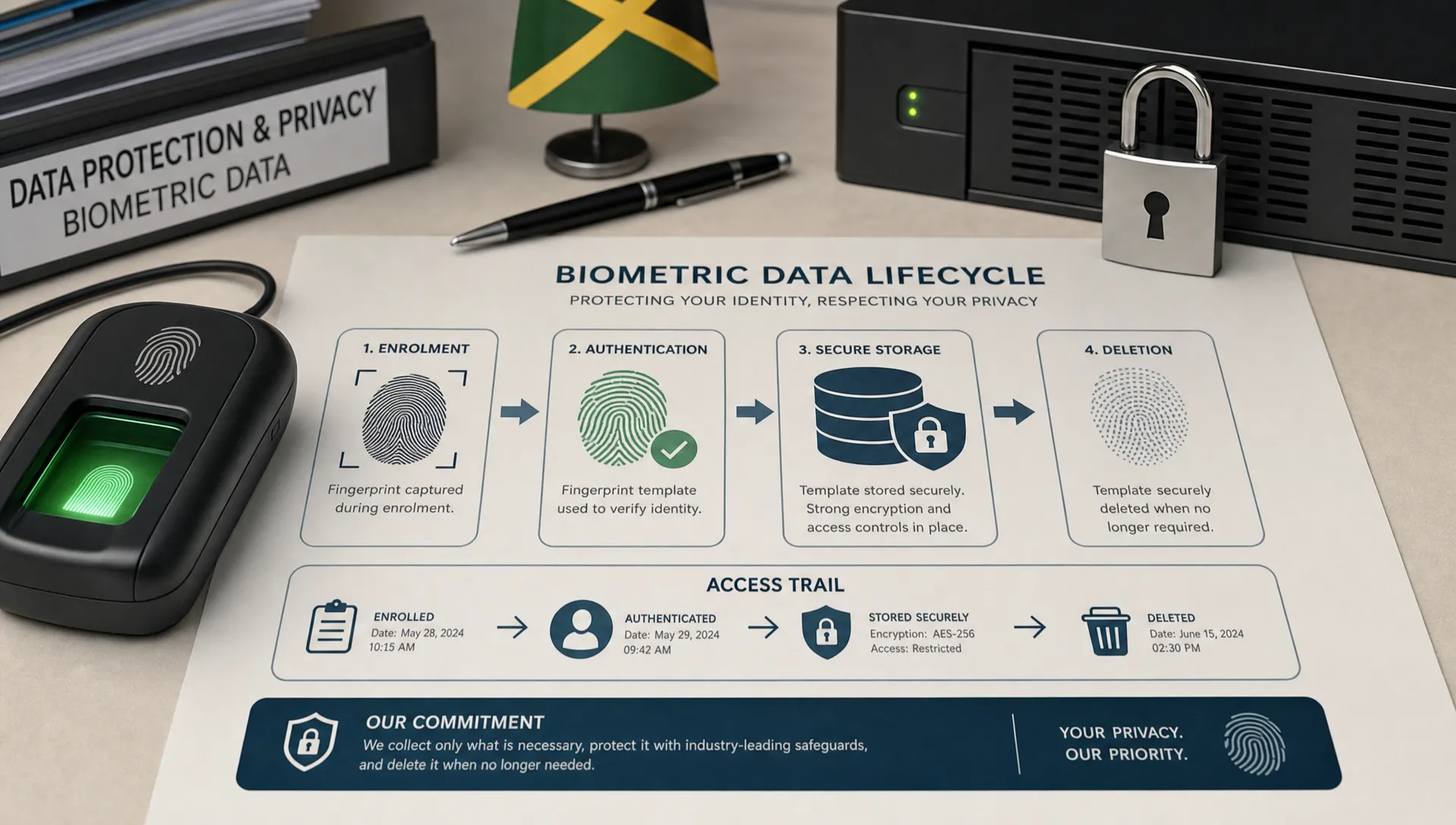
Biometric tools are no longer limited to airports and high-security facilities. Employers now use fingerprint readers for clock-ins, facial recognition for access control, voice authentication for call centres, and biometric logins for devices or apps. These systems can reduce buddy punching, strengthen physical security, and make access faster for staff.
But biometric data is not ordinary HR information. A password can be reset. A staff ID card can be replaced. A fingerprint, face pattern, iris scan, or voiceprint is tied to a person’s body and identity. If it is misused, over-collected, or exposed in a breach, the impact can follow an employee for years.
For Jamaican employers, the key question is not simply whether biometric technology works. The better question is whether the organisation can justify it, secure it, explain it, and limit it under the Data Protection Act, 2020. This article outlines the main biometric data risks employers should understand before introducing or expanding workplace biometric systems.
What counts as biometric data in the workplace?
Biometric data is information created from physical or behavioural characteristics that can identify a person. The National Institute of Standards and Technology describes biometrics as technologies that use biological or behavioural characteristics for recognition.
In employment settings, biometric data may include:
Fingerprint templates used for time and attendance systems
Facial geometry used for entry to offices, warehouses, vaults, or restricted rooms
Voiceprints used to authenticate employees in call centres or remote support environments
Iris or retina scans used in highly secure areas
Hand geometry used for access control
Behavioural patterns, such as keystroke dynamics or gait, where they are used to identify or verify a person
A practical point matters here: many systems do not store a raw image of a fingerprint or face. They store a template, which is a mathematical representation created from the biometric sample. That can reduce risk, but it does not eliminate it. If the template can be linked back to a person, used for authentication, or misused in another system, it still deserves strong protection.
Why biometric data creates higher risk than ordinary employee data
Employers already process sensitive HR information, including payroll records, national identifiers, health certificates, disciplinary files, and emergency contact details. Biometric data adds a different level of concern because it is permanent, unique, and difficult to separate from the person.
The first risk is irreversibility. If an employee’s work email password is compromised, IT can force a reset. If a biometric template is compromised, the employee cannot change their fingerprint or face. This makes security design especially important.
The second risk is function creep. A fingerprint system introduced for attendance can gradually become a tool for monitoring breaks, movements, productivity, or access patterns across sites. Even if the original purpose was reasonable, later expansion may become excessive or unfair if employees were not informed and the new use was not assessed.
The third risk is trust. Employees may view biometric collection as intrusive, especially if the business has not explained why less invasive methods are inadequate. A biometric system that feels imposed can damage workplace relations even if it is technically effective.
The fourth risk is unequal impact. Facial recognition systems, in particular, may perform differently across demographic groups or under poor lighting, camera angle, or image quality. A NIST study on face recognition algorithms found demographic differentials in some systems. Employers should not assume that a vendor’s accuracy claims will automatically hold true in their own workplace.
The Jamaican Data Protection Act lens
Under Jamaica’s Data Protection Act, 2020, employers that decide why and how employee personal data is processed are generally acting as data controllers. Biometric data that identifies, or is intended to identify, an individual should be treated as sensitive personal data. That means it calls for a stronger justification, tighter controls, and clearer accountability than ordinary administrative data.
The Office of the Information Commissioner Jamaica is the authority responsible for oversight of Jamaica’s data protection framework. By 2026, organisations should be treating compliance with the Act as an active operational requirement, not a future project.
For employers, the Act’s principles translate into practical questions:
Data protection issue | What it means for biometric systems |
Fairness and transparency | Employees should understand what is collected, why it is needed, how it works, and who will receive it. |
Purpose limitation | Biometric data collected for access control should not later be used for unrelated monitoring without fresh assessment. |
Data minimisation | The system should collect the least biometric data needed, preferably templates rather than raw images where appropriate. |
Security | Biometric records require strong technical and organisational safeguards, including access controls and encryption. |
Retention | Templates should not be kept indefinitely after an employee leaves or after the purpose ends. |
Individual rights | Employees should know how to raise concerns, request information, or challenge inaccurate or unfair processing. |
Processor oversight | Vendors must be contractually controlled if they host, support, or otherwise process the data. |
Consent also needs careful handling. In an employment relationship, the power imbalance between employer and employee can make it difficult to show that consent is truly freely given. If refusal would lead to disadvantage, disciplinary pressure, or exclusion from ordinary work, consent may be a weak foundation. Employers should take advice on the appropriate lawful basis and should consider whether a genuine alternative can be offered.
The main biometric data risks employers should assess
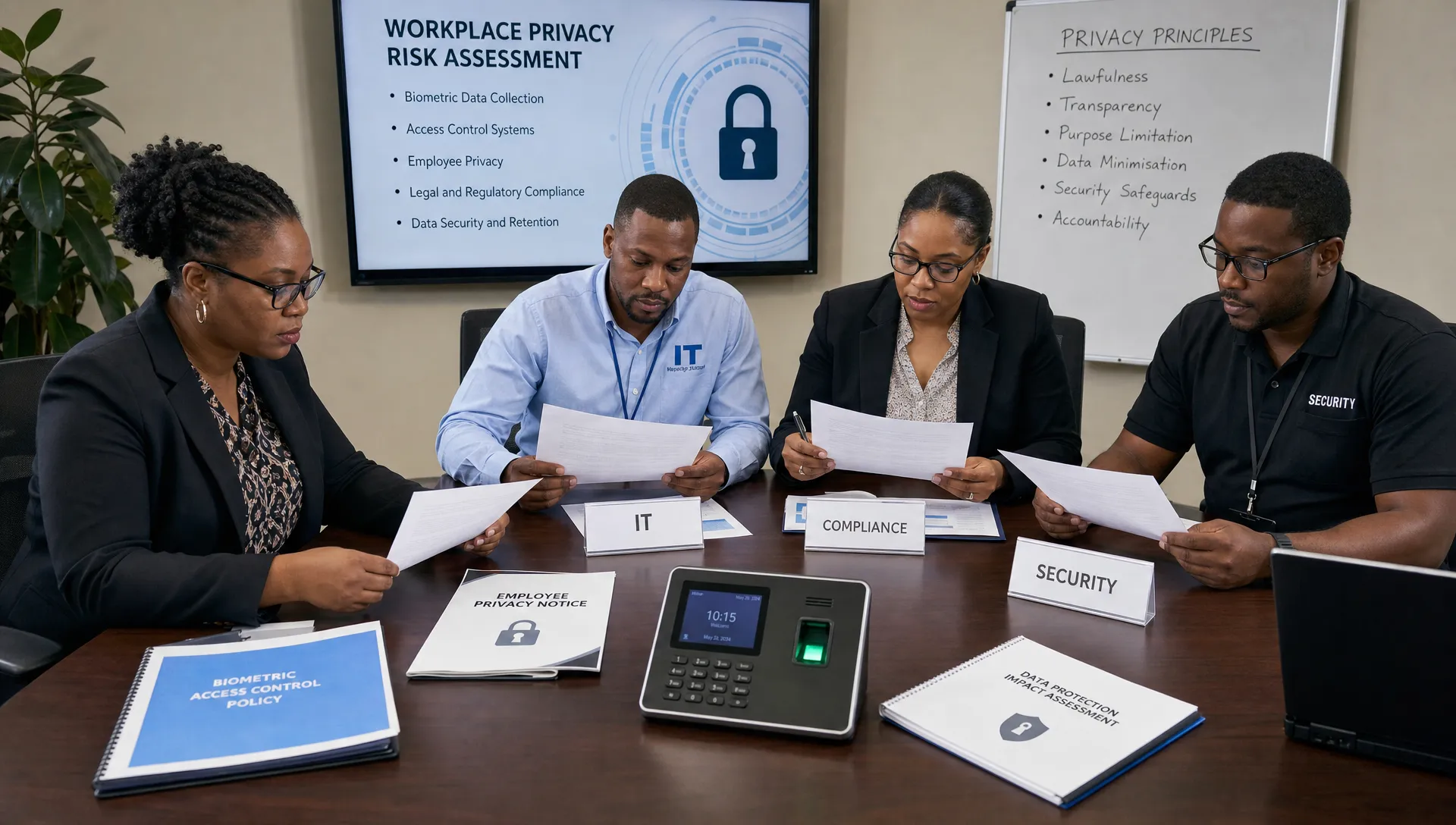
A biometric project should not begin with procurement. It should begin with risk assessment, involving HR, IT, legal, compliance, security, and employee representatives where appropriate. For a broader method, PLMC’s guide to conducting a data privacy risk assessment is a useful starting point.
Here are the main risk areas employers should document before deployment.
Risk area | Example workplace scenario | Why it matters |
Over-collection | Using facial recognition for a low-risk office where swipe cards would work | The processing may be disproportionate to the business need. |
Poor notice | Installing fingerprint readers before staff receive a clear privacy notice | Employees may be unable to understand or challenge the processing. |
Weak vendor contract | A timekeeping provider hosts templates but the contract is silent on deletion and breach reporting | The employer may lose control over sensitive data. |
Security failure | Templates are stored without encryption or strict access controls | A breach could expose data that cannot easily be replaced. |
Function creep | Attendance data is later used to profile staff productivity or movement patterns | A new purpose may be unfair or incompatible with the original purpose. |
Accuracy problems | A facial recognition system repeatedly fails for certain employees | Errors can lead to exclusion, pay disputes, or discriminatory impact. |
Excessive retention | Former employees’ templates remain in the system for years | Retaining sensitive data after it is needed increases breach and compliance risk. |
Questions employers should ask before using biometrics
Before introducing fingerprint, facial recognition, or voice authentication systems, employers should be able to answer a set of practical questions. If the organisation cannot answer them clearly, the project is not ready.
What specific problem are we trying to solve, such as fraud prevention, restricted area security, or safer authentication?
Is biometric processing necessary, or would a less intrusive method such as a card, PIN, token, supervisor approval, or manual exception process achieve the same purpose?
What exact data will be collected, including raw images, templates, timestamps, device IDs, and access logs?
Where will the data be stored, in Jamaica, on local servers, in vendor cloud systems, or in another jurisdiction?
Who can access the data, and how will access be logged, reviewed, and revoked?
How long will the biometric data be kept, and what triggers deletion?
What will happen if an employee refuses, cannot enrol, has a disability, has a temporary injury, or is incorrectly rejected by the system?
For HR-led systems, such as biometric clock-ins linked to payroll or disciplinary processes, employers should also map how the data moves across the full employment lifecycle. PLMC’s article on how to assess privacy risk in HR workflows explains why workflow mapping is essential before personal data risks can be properly understood.
Vendor risk is one of the biggest blind spots
Many employers do not build biometric systems themselves. They buy a time and attendance platform, access control solution, security camera package, or workforce management tool from a third party. That makes vendor due diligence critical.
A vendor may claim that its system is secure, compliant, or privacy-friendly. Employers should still verify the details. Ask whether the vendor stores raw biometric samples or templates, whether data is encrypted in transit and at rest, whether support staff can access records, whether sub-processors are used, and whether data is transferred overseas.
The contract should clearly address purpose limitation, confidentiality, information security, breach notification, deletion at the end of service, audit rights, sub-processor controls, and restrictions on secondary use. A vendor should not be free to reuse employee biometric data for product improvement, analytics, training algorithms, or unrelated services unless that use has been assessed and lawfully authorised.
Cross-border storage deserves special attention. If biometric data is hosted outside Jamaica, the employer should assess whether the transfer is permitted, what safeguards apply, and whether employees have been properly informed. Multinational organisations may also need to consider GDPR-style expectations where EU personal data or EU operations are involved, but Jamaican employers should not assume that GDPR compliance automatically satisfies Jamaica’s Data Protection Act.
Security controls should match the sensitivity of the data
Because biometric data is high impact, basic password protection is not enough. Employers should work with IT and cyber security teams to design controls before enrolment begins.
At minimum, consider encryption, role-based access, multi-factor administrator access, audit logs, secure deletion, vulnerability management, tested backup procedures, and incident response plans. Systems should be patched, administrator accounts should be tightly limited, and access should be reviewed when HR, security, or IT personnel change roles.
Employers should also separate biometric templates from ordinary HR records where possible. Attendance reports may be needed by payroll, but payroll staff usually do not need access to the biometric template itself. This separation reduces internal misuse and limits the impact of accidental disclosure.
The organisation should test the process for deleting a person’s biometric record. It is not enough to have a retention policy if no one knows how deletion works in the system. When an employee leaves, changes role, or no longer needs biometric access, the deletion process should be documented and verifiable.
Employee communication is not a formality
A biometric deployment can fail because of poor communication, even when the technical design is sound. Employees should receive a clear privacy notice before collection begins. The notice should explain the purpose, the type of biometric data collected, the lawful basis relied on, who receives the data, where it is stored, how long it is kept, and how employees can raise concerns.
Avoid vague language such as security purposes if the actual reason is attendance fraud prevention or restricted area access. Specificity builds trust and helps the organisation demonstrate transparency.
Training is also important. HR teams, supervisors, security officers, and IT administrators need to understand that biometric information is sensitive. They should know not to export reports casually, share access logs unnecessarily, or use biometric records for new purposes without approval. If your organisation is updating staff awareness programmes, PLMC’s guide to data privacy training topics employees need most can help connect policy requirements to day-to-day behaviour.
When biometrics may be difficult to justify
Biometrics are not automatically inappropriate. They may be easier to justify in higher-risk settings, such as access to a cash vault, server room, laboratory, critical infrastructure area, or environment where identity fraud creates serious safety or financial risk.
They are harder to justify where the workplace problem is minor, speculative, or easily solved by less intrusive means. For example, using facial recognition for every employee entering a standard office may be excessive if ordinary access cards and visitor controls would achieve the same objective. Similarly, using fingerprint clock-ins purely for convenience may be difficult to defend if the organisation has not considered alternatives.
A good test is proportionality. The more intrusive the system, the stronger the business need and safeguards must be. If the main benefit is administrative convenience, the organisation should pause and ask whether the privacy cost is too high.
Red flags that should pause a biometric project
Employers should slow down or stop deployment if any of these warning signs appear:
No written privacy risk assessment has been completed.
The vendor cannot explain whether it stores raw images or templates.
The system collects more data than the stated purpose requires.
Employees have not received a clear privacy notice before enrolment.
There is no alternative for employees who cannot or should not use the biometric system.
Retention and deletion rules are unclear or technically untested.
The system will be used for monitoring beyond the original purpose.
The contract does not address breach notification, sub-processors, deletion, and overseas storage.
These red flags do not always mean biometrics are impossible. They mean the governance work has not caught up with the technology.
A practical biometric data checklist for employers
Before going live, employers should be able to show evidence of the following:
Control | Evidence to keep |
Business justification | Written explanation of the problem, alternatives considered, and why biometrics are necessary. |
Privacy risk assessment | Documented analysis of legal, security, employee relations, and discrimination risks. |
Employee privacy notice | Clear notice issued before collection begins. |
Vendor due diligence | Security questionnaire, contract review, hosting details, and deletion commitments. |
Access controls | Role-based permissions, administrator approval process, and access logs. |
Retention schedule | Defined deletion trigger for leavers, role changes, and system replacement. |
Exception process | Alternative method for refusal, failed enrolment, disability, injury, or system error. |
Training records | Evidence that HR, IT, security, and managers understand handling rules. |
Review schedule | Periodic reassessment of necessity, accuracy, complaints, incidents, and vendor performance. |
This checklist helps move biometric governance from theory to evidence. In a regulatory review, board discussion, employee complaint, or breach investigation, evidence matters.
Frequently Asked Questions
Is a fingerprint clock-in system allowed under Jamaica’s Data Protection Act? It is not automatically prohibited, but employers should not treat it as a routine admin tool. They must assess necessity, proportionality, transparency, security, retention, employee rights, and vendor controls before collecting fingerprint data.
Can employers rely on employee consent for biometric data? Consent can be difficult in employment because staff may feel they have no real choice. If refusal creates disadvantage, consent may not be freely given. Employers should assess the appropriate lawful basis and consider genuine alternatives.
Are biometric templates safer than storing fingerprint or face images? Usually, templates reduce risk because they are not the same as raw images. However, they can still identify or authenticate a person, so they remain sensitive and require strong protection.
How long should employers keep biometric data? Biometric data should be kept only as long as necessary for the stated purpose. Employers should delete records when an employee leaves, when access is no longer required, or when the system is replaced, unless a lawful reason justifies limited retention.
What if a biometric vendor stores employee data overseas? The employer should assess cross-border transfer requirements, contractual safeguards, security controls, sub-processors, and employee notice obligations before allowing overseas storage or support access.
What should employees be told before enrolment? They should be told what biometric data is collected, why it is needed, how it is stored, who receives it, how long it is kept, what rights they have, and what alternative process exists if they cannot use the system.
Need help assessing biometric data risks?
Biometric technology can support security and accountability, but only when governance, privacy, and cyber security controls are built in from the start. For employers in Jamaica, the safest approach is to assess the risk before procurement, document the decision, train the people involved, and review the system after deployment.
Privacy & Legal Management Consultants Ltd. supports organisations with data protection implementation, risk assessments, training, cyber security, and governance, risk, and compliance integration. If your organisation is considering fingerprint, facial recognition, voice authentication, or another biometric system, you can contact PLMC for guidance before the risks become operational problems.
This article is general information and should not be treated as legal advice for a specific situation.