

Date of Data Protection Act in Jamaica: Timeline and Milestones

Many Jamaican organisations are asking one deceptively simple question: what is the date of the Data Protection Act in Jamaica? In practice, there is more than one “date” that matters.
The Act itself has a publication year, but your legal and operational deadlines usually hinge on commencement and transition milestones, including when particular sections take effect, when oversight functions become active, and when enforcement expectations tighten.
This guide breaks down the timeline in a way you can actually use, and shows you how to confirm the authoritative dates for your compliance planning.
What people mean by “date of the Data Protection Act” (and why it causes confusion)
When someone searches for the date of Data Protection Act in Jamaica, they are usually trying to pin down one of these:
The Act’s formal date and name: Jamaica’s law is commonly referred to as the Data Protection Act, 2020.
The commencement date: the date (or dates) when the Act, or specific parts of it, legally “switch on.”
The end of any transition period: the point at which organisations are expected to be fully operational, not just drafting policies.
The practical enforcement moment: when complaints, investigations, audits, and penalties become a real risk.
These dates can be different. Many laws are brought into force by an “appointed day” via an order or proclamation, and sometimes they commence in phases (for example, setting up the regulator first, then turning on broader obligations).
Jamaica’s Data Protection Act, 2020: the baseline milestone
At the highest level, Jamaica’s privacy framework is anchored by the Data Protection Act, 2020. For most organisations, what matters is not just that the Act exists, but that it creates ongoing obligations such as:
governance and accountability for how personal data is used
transparency to individuals (clear privacy notices)
controls around sharing and international transfers
security and breach readiness
processes to recognise and respond to individuals’ rights requests
If you want a practical overview of what the Act requires in day-to-day operations, PLMC has separate guides that go deeper into implementation:
This article stays focused on the timeline question: how to understand dates, sequence your work, and avoid misreading “in force” versus “fully compliant.”
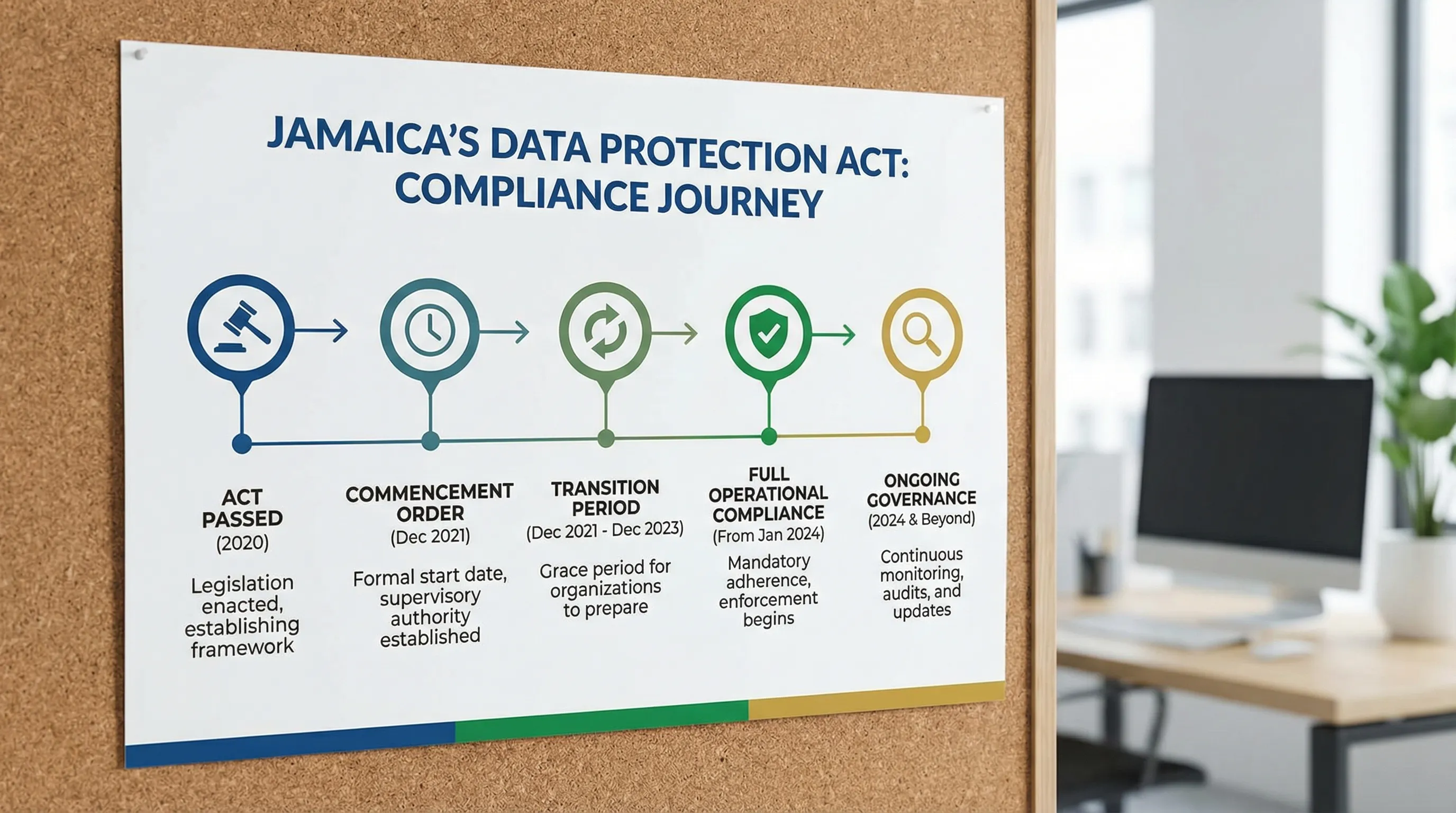
Timeline and milestones: a practical view for compliance planning
Because commencement and transition details can be updated through official instruments, the safest approach is to treat the timeline as a set of milestones to verify, rather than relying on a single social media post or a forwarded PDF.
Here is a business-friendly milestone map you can use for your programme plan.
Milestone | What it means for organisations | What to look up (authoritative source) | What you should do at this stage |
Data Protection Act, 2020 is published as an Act | Jamaica now has a formal data protection statute with defined duties, rights, and oversight structure. | The Act text on an official legislation repository (for example, Jamaica Laws Online). | Start your gap assessment, data inventory, and governance plan. Do not wait for “enforcement” to begin building your programme. |
Commencement (appointed day) is issued | The Act (or specific sections) becomes legally operational from a stated date. Some laws commence in phases. | A commencement order/proclamation and the updated version of the Act showing “in force” status. | Translate legal obligations into operating procedures: rights handling, vendor controls, retention, security, breach response. |
Regulatory oversight becomes functional | Oversight powers, complaint handling, guidance, and potential investigations become more active in practice. | Official announcements, guidance notes, and the regulator’s public communications. | Ensure evidence is ready: policies, records, training logs, risk assessments, and incident playbooks. |
Transition window closes (if applicable) | Organisations are expected to be operational and demonstrably compliant, not “working on it.” | The Act’s transitional provisions and any related orders or guidance. | Run internal testing: mock rights requests, vendor audits, breach tabletop exercises, and board reporting. |
Ongoing compliance and continuous improvement | Privacy becomes BAU (business as usual). Expect evolving expectations as guidance and casework develops. | Regulator guidance updates, industry standards, and internal audit results. | Maintain metrics, refresh training, update notices and vendor contracts, and re-run DPIAs/assessments for new projects. |
Why this table does not list a single “one true date”
A lot of Jamaican businesses want one date to put in a calendar invite. The reality is that:
the Act has a known baseline (it is the Data Protection Act, 2020)
the commencement date can be an appointed day, and different parts of an Act can commence at different times
the operational expectation often rises in steps (governance, then controls, then enforcement activity)
So the best compliance strategy is to plan around milestones and confirm the exact commencement details from official instruments.
How to confirm the exact commencement date (without guesswork)
If you need the authoritative answer to “what is the date of the Data Protection Act in Jamaica” for a board paper or audit file, document your verification method.
Step 1: Read the Act’s commencement clause
Most Acts include a short clause early on stating how the law comes into operation (for example, immediately on publication, or on an appointed day). This tells you whether you should be searching for a commencement order.
Step 2: Check for commencement orders or proclamations
If the Act is commenced by an appointed day, there is usually an accompanying instrument that states the effective date. Save a copy to your compliance evidence file.
Step 3: Confirm whether commencement is phased
If commencement is phased, you need to know:
which sections are active now
which sections activate later
whether any transitional allowances apply
This impacts what your organisation should prioritise first.
Step 4: Record the sources in your compliance register
For GRC purposes, treat “commencement date confirmed” as a control with evidence attached. That way, if a stakeholder challenges your dates later, your answer is auditable.
Milestones that matter operationally (what to do, not just what to know)
Knowing the date is not the same as being ready. The biggest risk we see is organisations that spend months debating the legal start date, while critical operational gaps remain.
Below are the milestones that typically separate “we have a policy” from “we can demonstrate compliance.”
Milestone: Your data inventory is complete (or at least decision-grade)
A data protection programme collapses quickly without visibility into:
what personal data you hold
why you hold it (purpose and lawful basis)
where it flows (vendors, affiliates, cross-border transfers)
how long you keep it
who can access it
If you already started this work, use 2026 to improve quality, especially around shadow systems (shared drives, spreadsheets, messaging apps used for customer support, and staff-managed tools).
Milestone: Rights requests can be handled end-to-end
It is common to draft a “rights procedure” and still be unprepared. A functional workflow requires:
intake channels (email, web form, in-person request handling)
identity verification steps that do not collect excessive new data
internal routing (HR, customer service, IT, legal)
response templates and tracking
an exception and refusal process that is consistent and documented
If you want a structured build plan, see PLMC’s Data Protection Jamaica: Compliance Roadmap for 2026.
Milestone: Vendors are controlled, not trusted
A major compliance failure pattern is outsourcing risk. If you are a controller using processors, or a processor supporting controllers, you need clarity on:
what the vendor is allowed to do with the data
security requirements
breach notification expectations
subcontractor rules
end-of-service return or deletion
A practical way to show progress is to maintain a vendor register with risk ratings and contract status.
Milestone: You can respond to a breach under pressure
Breach readiness is not only about cyber security tools. It is also about decision-making discipline: triage, containment, assessment, internal communications, and external notifications where required.
If you want your privacy programme to align with broader governance and risk, connect breach readiness to your incident management and business continuity processes.
Common misconceptions about the “date of the Data Protection Act”
“If the date is not clear, we can wait.”
Even where enforcement timing is debated internally, customers, staff, and partners are already evaluating your privacy posture. Many vendor due diligence questionnaires now ask for evidence of privacy governance regardless of local enforcement cycles.
“A privacy notice is compliance.”
Privacy notices matter, but they are only one control. Regulators and enterprise clients typically look for operational proof: records, training, risk assessments, and tested procedures.
“This is only an IT issue.”
Data protection is a governance programme. IT enables security controls, but HR, marketing, finance, customer operations, and procurement often create the highest day-to-day exposure.
A simple 2026 planning approach that aligns with the timeline
If you are using this article to brief leadership, here is a practical way to align workstreams to milestones (without overcomplicating it):
Confirm the authoritative dates: capture the Act version and any commencement instruments in your compliance evidence folder.
Build minimum viable governance: assign ownership, define escalation paths, and establish reporting.
Operationalise core controls: data inventory, privacy notices, vendor controls, rights workflow, retention, breach readiness.
Test and measure: run a mock rights request, do a tabletop breach exercise, and create simple KPIs (requests handled, training completion, vendor review coverage).
This approach works whether your organisation is a small service provider or a large regulated entity, because it focuses on evidence and repeatability.
When you should get help (and what to ask for)
If your team is stuck on dates, interpretations, or execution, it is usually a sign you need one of the following:
a scoped gap assessment with a realistic remediation plan
templates and workflows tailored to your operations
role-based training (executives, HR, customer support, IT, procurement)
vendor risk and contract remediation support
PLMC supports Jamaican organisations with data protection implementation, GRC integration, and training. If you want to sanity-check your timeline assumptions and prioritise the work that reduces real risk, you can request a consultation via Privacy & Legal Management Consultants Ltd..

Bringing it back to the original question
The Data Protection Act is commonly referenced as the Data Protection Act, 2020, but the compliance-critical “date” for your organisation is usually the commencement and transition milestone(s) that determine when specific obligations become operational and enforceable.
If you confirm those dates from official sources and then map your programme to the milestones above, you will be in a much stronger position than organisations that only chase a single headline date.