

Courses on Data Privacy: How to Choose the Right Format

Choosing from the many courses on data privacy can feel deceptively simple until you realise the “best” course is often the one delivered in the right format for your risks, your people, and your timeline.
In Jamaica, privacy training is not just a nice-to-have. Under the Data Protection Act, 2020, organisations need to be able to show accountability in how they handle personal data, including how staff are instructed and kept aware. That means selecting training that actually changes day-to-day behaviour, not just something that checks a box.
This guide breaks down the main privacy course formats, when each works best, and a practical way to choose.
Start with the outcome, not the platform
Before you compare in-person vs online, get clear on what success looks like. Most organisations need a mix of these outcomes:
Awareness: Staff can recognise personal data, follow basic rules, and escalate issues.
Operational competence: Teams can apply privacy requirements in real workflows (HR, marketing, IT, customer service, procurement).
Risk reduction: Fewer misdirected emails, fewer overshared files, improved vendor handling, faster incident reporting.
Evidence of accountability: Training records, assessments, attendance, and role-based coverage you can demonstrate if needed.
If you are still building your overall programme, it can help to align training with a broader plan like a phased compliance roadmap. (For context, see PLMC’s guide: Data Protection Jamaica: Compliance Roadmap for 2026.)
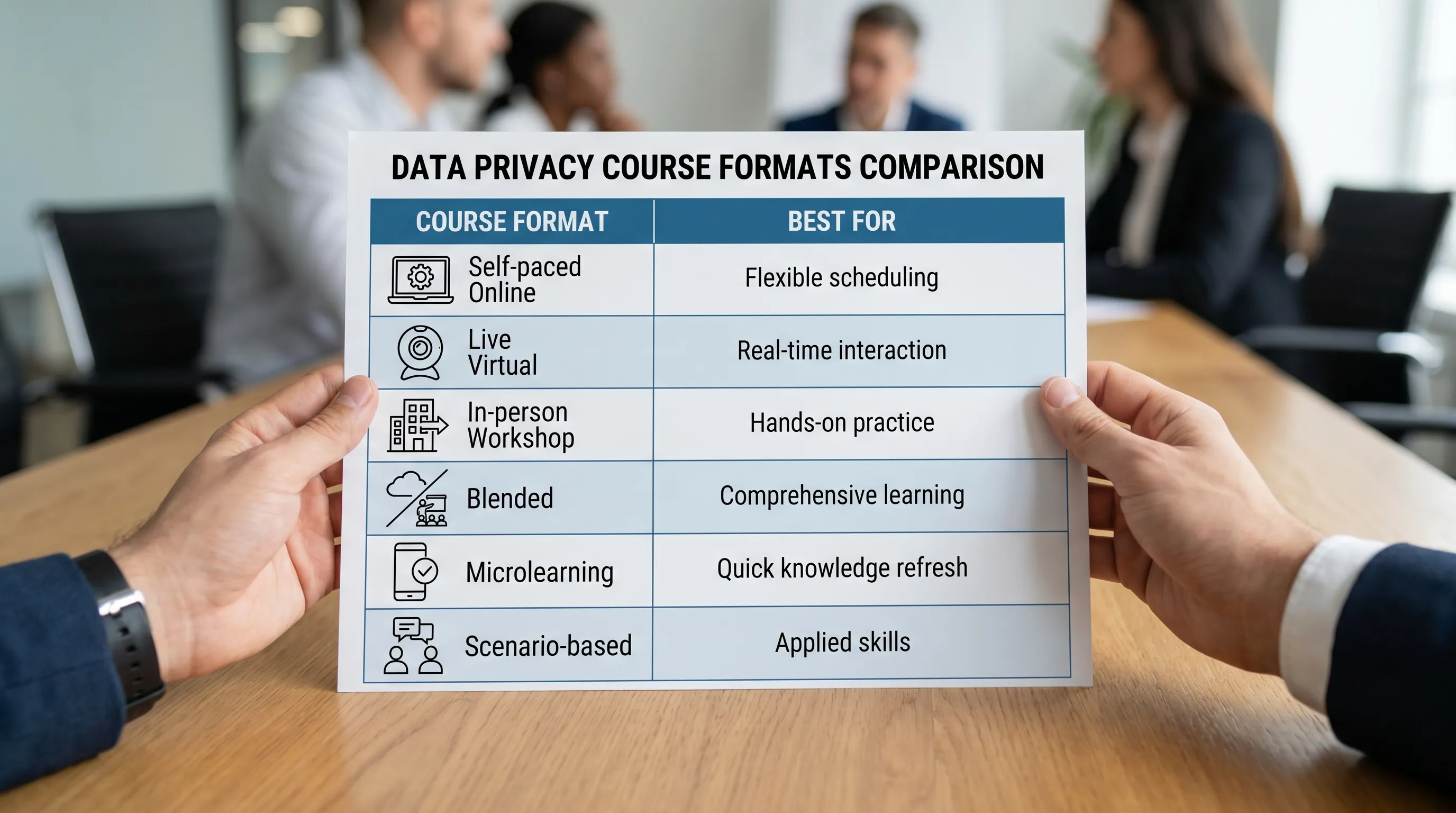
The main formats for courses on data privacy (and who they fit)
Most privacy training falls into a few core delivery styles. Each has trade-offs.
1) Self-paced online courses (asynchronous e-learning)
Best for: Baseline awareness across a large group, onboarding, annual refreshers.
Strengths:
Easy to roll out to many staff members
Consistent message and content
Works well for refresher cycles and new hires
Limitations:
Lower engagement if not reinforced by managers
Harder to tailor to your exact processes (unless customised)
Often weak on “how we do it here” scenarios
2) Live virtual courses (cohort-based online sessions)
Best for: Multi-location teams, interactive Q and A, faster rollout without travel.
Strengths:
Real-time questions and discussion
Can include scenarios and group exercises
Good middle ground between scale and engagement
Limitations:
Scheduling across shifts can be tricky
Attention drops if sessions are too long or too lecture-heavy
3) In-person workshops
Best for: High-risk teams, leadership groups, teams that need practical workflow changes.
Strengths:
Strong engagement and accountability
Easier to run hands-on activities (case studies, “fix this process” exercises)
Useful for building a shared standard across departments
Limitations:
Harder to scale quickly
Travel and time away from operations can increase cost
4) Blended programmes (online + live sessions + reinforcement)
Best for: Organisations that need both broad coverage and meaningful behaviour change.
Strengths:
Self-paced modules cover fundamentals, live sessions solve real problems
Better retention through spaced learning
Can be structured as role-based tracks
Limitations:
Requires planning (learning paths, completion tracking, internal comms)
5) Microlearning (short modules, tool-box talks, quick refreshers)
Best for: Continuous awareness, policy reminders, high-turnover environments.
Strengths:
Short and repeatable, fits busy teams
Helps keep privacy top-of-mind
Limitations:
Not enough on its own for complex roles (IT, HR, compliance)
Needs a calendar and ownership to stay consistent
6) Scenario-based training (table-top exercises, incident simulations)
Best for: Incident readiness, leadership decision-making, IT and security teams, customer-facing escalations.
Strengths:
Builds practical confidence under pressure
Reveals gaps in escalation paths, documentation, and decision rights
Strong evidence of readiness when properly documented
Limitations:
Works best after baseline training exists
Needs careful facilitation to stay realistic and productive
A practical way to choose the right format
Instead of debating formats in the abstract, use a few selection criteria tied to risk and operations.
Step 1: Match the format to your risk level and role complexity
Not every role needs the same depth.
Low complexity roles (general staff, basic handling): awareness plus simple do’s and don’ts can work well via self-paced or short live sessions.
Moderate complexity roles (customer service supervisors, marketing leads, records teams): live virtual or in-person workshops help because they need judgment and practical examples.
High complexity roles (HR, IT, security, compliance, procurement): blended learning and scenario-based exercises tend to perform best because these teams make higher-impact decisions.
Step 2: Decide what must be measurable
If you need to demonstrate accountability, look for formats that can produce evidence such as:
Attendance and completion records
Knowledge checks or short assessments
Role-based coverage (who trained on what)
Exercise outputs (for example, action items from a simulation)
Self-paced courses often provide completion tracking. Workshops and simulations can produce better evidence of operational decision-making, especially when documented.
Step 3: Consider time-to-competence (not just course length)
A two-hour session might “cover” privacy, but it may not produce competence for teams handling sensitive data daily.
Ask:
How quickly do we need baseline training completed?
Do we need behaviour change in a specific process (onboarding, CCTV, marketing lists, vendor contracting)?
Can we reinforce learning over weeks instead of trying to do everything in one session?
Step 4: Use a format-fit matrix
The table below is a quick way to align goals with the training approach.
Training goal | Best-fit format(s) | Why it fits |
Train everyone fast (baseline awareness) | Self-paced online, live virtual | Scales quickly, consistent core message |
Reduce common daily errors (misdirected email, oversharing) | Blended, microlearning | Repetition and reminders improve habits |
Improve role-based decision-making (HR, marketing, procurement) | Live virtual, in-person workshops | Q and A and realistic scenarios matter |
Strengthen incident readiness (breach reporting, escalation) | Scenario-based exercises, blended | Practice under realistic constraints |
Standardise processes across departments | In-person workshops, blended | Creates shared understanding and workflow alignment |
Provide defensible training records | Self-paced online, blended, documented workshops | Easier to track and evidence |
Recommended training pathways (by organisation size)
There is no single best path, but these patterns work well in practice.
If you are an SME building basics
Focus on speed, clarity, and practical minimums.
One baseline awareness session (live virtual or in-person)
A short follow-up for leadership on accountability and decision-making
Role-based mini-sessions for whoever handles HR data, customer data, and vendor contracting
PLMC’s articles on fundamentals can help you define the scope before training begins, for example: Data Protection Basics: What Jamaican Firms Must Know.
If you are a mid-sized organisation standardising operations
Prioritise consistency across departments.
Self-paced module for all staff (baseline)
Live virtual workshops for HR, marketing, IT, and customer support
Quarterly microlearning refreshers tied to your policies and common mistakes
If you are high-risk or highly regulated (finance, health, large datasets)
Go deeper and add realism.
Blended programme across the organisation
Scenario-based breach simulation for the incident response group
Role-based workshops for teams handling sensitive data and disclosures
What to look for in a data privacy course provider
Beyond “content coverage,” the provider should be able to train to your reality in Jamaica.
Jamaica relevance and legal alignment
A good course should clearly align with Jamaican requirements and terminology under the Data Protection Act, 2020. For primary legal reference, you can also review the Act via the Ministry of Justice (Jamaica).
Practical application (not just definitions)
Ask whether the course includes:
Examples drawn from common Jamaican business operations (HR files, customer databases, CCTV, WhatsApp usage, vendor relationships)
Guidance on transparency notices, retention, access control, and incident escalation
Simple checklists or templates participants can actually use after the session
(If you want a structured view of what “good” looks like operationally, PLMC’s Privacy and Data Protection: A Practical Checklist is a helpful benchmark.)
Role-based tailoring
A privacy course for frontline staff should not look like a privacy course for procurement or IT. Look for a provider that can split training into tracks, or at least include role-specific breakouts.
Assessment and reinforcement options
Retention improves when learners are tested (lightly) and reminded (regularly). Ask about:
Short quizzes or knowledge checks
Post-training job aids
Refreshers for high-risk roles
Confidentiality and safe discussion
In training, people often mention real incidents and weak points. The provider should set expectations for confidentiality and safe discussion so teams can learn without turning the session into blame.

Common mistakes when choosing a format (and how to avoid them)
Mistake 1: Choosing the cheapest format for the highest-risk teams
If HR, IT, or a customer-facing escalation team only gets a generic awareness video, errors will still happen because the training did not match the complexity of the work.
Better approach: baseline e-learning for everyone, then workshops or scenario sessions for high-impact roles.
Mistake 2: Treating training as a one-time event
People forget. Teams change. Systems change.
Better approach: plan refreshers, onboarding coverage, and short “what changed” updates when you introduce a new system, vendor, or policy.
Mistake 3: Not capturing evidence
Even good training is hard to defend if you cannot show who was trained, when, and on what.
Better approach: keep attendance, completion, and a simple training register by department and role.
Frequently Asked Questions
Are online courses on data privacy enough for compliance in Jamaica? Online courses can cover baseline awareness well, but high-risk roles usually need role-based training and practical exercises. Many organisations use a blended approach.
What format works best for HR teams? HR teams often benefit from live sessions (virtual or in-person) with scenarios, because they handle sensitive employee data, disclosures, retention, and access requests.
How often should staff take data privacy training? Many organisations refresh annually for general awareness, with additional refreshers when policies, systems, vendors, or risks change. High-risk teams often need more frequent touchpoints.
How do we prove that training happened? Keep completion records, attendance logs, and a role-based training register. If you run workshops or simulations, document objectives, attendees, and actions agreed.
What should we prioritise first if we have limited time? Start with organisation-wide awareness plus targeted sessions for the teams that collect the most data or make the most disclosures (often HR, customer service, IT, and procurement).
Build a training plan that fits your risks
If you are deciding between formats, or you want a role-based training plan aligned to the Data Protection Act, Privacy & Legal Management Consultants Ltd. (PLMC) can help you choose the right approach and deliver practical training for your team.
Explore PLMC resources at Privacy & Legal Management Consultants Ltd. or request a free consultation to map the best training format for your organisation.