

A Simple Privacy Governance Model for Growing Companies
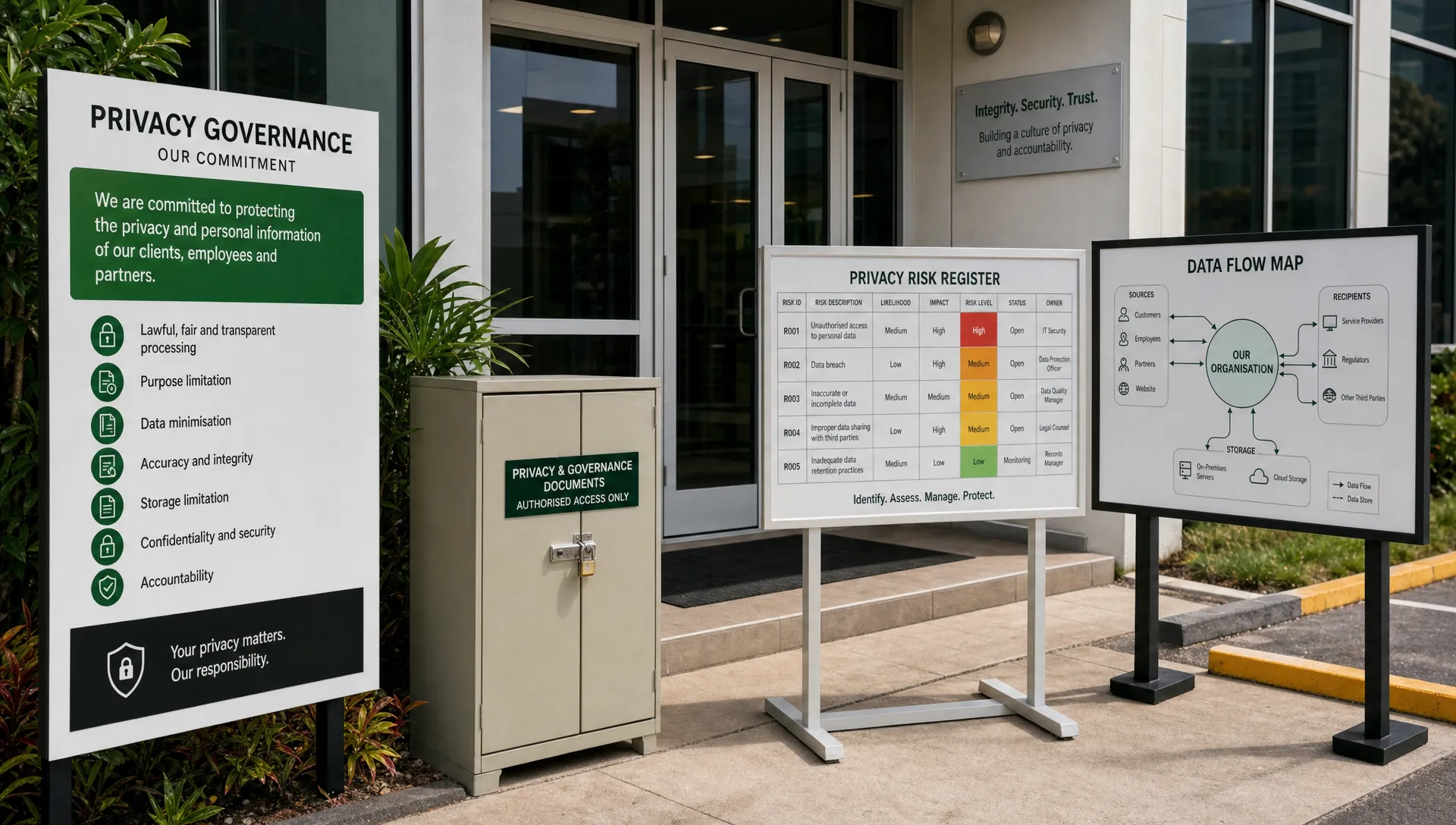
Growing companies often reach a point where privacy can no longer be managed by goodwill, scattered spreadsheets, or one person in Legal or IT answering every question. More customers are asking how their data is used. Regulators expect evidence. Vendors want security and privacy assurances. Employees need clear rules before they collect, share, store, or delete personal information.
A privacy governance model does not have to be complex to be effective. For many growing companies in Jamaica, the best model is practical, lightweight, and repeatable. It should help the organisation make better decisions, meet obligations under the Data Protection Act, 2020, and build trust without slowing down day-to-day operations.
Below is a simple model that can scale as your company grows.
What a privacy governance model should accomplish
Privacy governance is the system of people, processes, documents, and decision-making routines that keeps privacy from becoming an afterthought. It turns privacy from a policy on paper into a way of operating.
A good model should deliver three outcomes.
First, it should create accountability. Someone must be responsible for ensuring privacy risks are identified, discussed, and addressed. That does not mean one person owns every privacy task, but it does mean the organisation knows who is accountable for oversight.
Second, it should create visibility. Management should know what personal data the company collects, where it is stored, who has access to it, which vendors process it, and where the highest risks sit.
Third, it should create repeatable decisions. The business should not reinvent the wheel every time it launches a new system, signs a vendor, runs a campaign, or responds to a data subject request.
For Jamaican organisations, this matters because the Office of the Information Commissioner is responsible for overseeing compliance with the Data Protection Act, 2020. Companies need more than good intentions. They need evidence that privacy is being managed in a structured way.
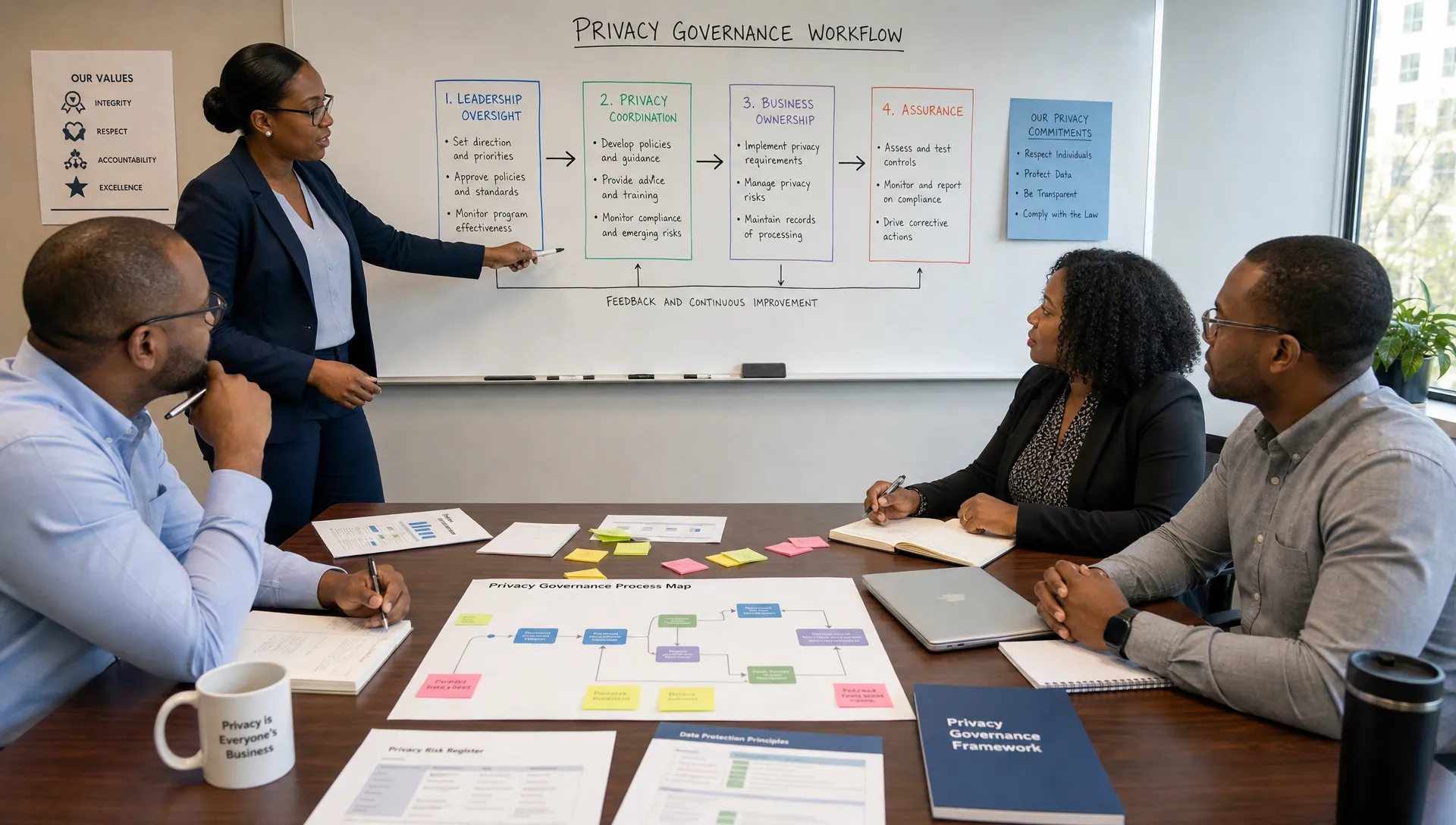
The simple model: four layers of privacy governance
A growing company does not need a large privacy department to start governing personal data well. It needs clear layers of responsibility.
Governance layer | Main role | Typical participants | Minimum routine |
Leadership oversight | Set direction, approve priorities, review risks | CEO, board, senior management, risk or compliance lead | Quarterly privacy risk review |
Privacy coordination | Manage the privacy programme and evidence | Privacy lead, compliance officer, legal, risk, or appointed coordinator | Monthly tracking and follow-up |
Business ownership | Control data use in daily operations | HR, finance, sales, marketing, IT, operations, customer service | Process-level reviews when activities change |
Assurance and improvement | Test whether controls work | Internal audit, risk, compliance, IT security, external advisers | Periodic assessments and action plans |
This model is simple enough for an SME but structured enough to support growth. It also avoids a common problem: placing privacy entirely with Legal, IT, or Compliance while the rest of the business continues to make data decisions without accountability.
If your organisation is still debating internal ownership, this is where a clear view of who owns privacy and compliance internally can help prevent confusion.
Layer 1: leadership oversight
Privacy governance starts at the top because management controls priorities, budgets, risk appetite, and accountability. If leaders treat privacy as a low-level administrative issue, the rest of the organisation will do the same.
For a growing company, leadership oversight can be straightforward. A senior leader or committee should review privacy risks on a regular schedule, approve important policies, and ensure privacy issues are not buried until an incident occurs.
Leadership does not need to review every consent form or vendor clause. Its role is to ask the right questions:
Are we collecting more personal data than we need?
Do we understand our highest-risk processing activities?
Are customer, employee, and vendor data handled consistently?
Do we have a process for data subject requests and privacy complaints?
Are privacy incidents escalated quickly enough?
Are employees trained for the types of personal data they handle?
This is especially important for companies in regulated or data-heavy sectors, such as financial services, healthcare, education, telecoms, professional services, and organisations with anti-money laundering or know-your-customer obligations. These businesses often collect identity documents, financial information, proof of address, transaction details, and other sensitive records that require stronger governance.
For a deeper board-level perspective, PLMC has also outlined how organisations can approach privacy governance, board oversight, and operating models.
Layer 2: a privacy lead who coordinates the programme
The privacy lead is the person who keeps the programme moving. In a small or growing business, this may be a compliance officer, legal officer, risk manager, operations manager, information security lead, or another capable employee with enough authority and access to the business.
The role does not always have to be full-time at the beginning. What matters is that it is recognised, documented, and supported.
The privacy lead should coordinate key activities such as data mapping, privacy notices, training, vendor reviews, incident escalation, records of decisions, and privacy risk assessments. They should also act as the internal point of contact when teams are unsure whether a new activity creates a privacy issue.
The privacy lead should not be expected to approve everything alone. Their role is to guide, challenge, escalate, and document. Business teams still own the data they collect and use.
A useful rule is this: the privacy lead owns the privacy programme, but business units own their processing activities.
Layer 3: business owners for each process
Most privacy risk is created in business processes, not in privacy policies. HR collects employee records. Marketing builds contact lists. Finance processes payment information. Customer service handles complaints. IT manages systems and access. Operations may coordinate deliveries, appointments, or service records.
Each major process should have a business owner who understands what personal data is collected, why it is needed, how long it is kept, and who receives it.
This is where privacy governance becomes practical. Instead of asking the privacy lead to know every operational detail, process owners maintain the facts for their area and involve the privacy lead when something changes.
Examples of changes that should trigger privacy review include a new customer onboarding process, a new HR platform, a new marketing database, a new surveillance system, a new analytics tool, a change in retention period, or a new vendor that will access personal data.
Layer 4: assurance and improvement
Privacy governance should not rely only on trust. The organisation needs a way to check whether controls are actually working.
For a growing company, assurance can start simply. The privacy lead or compliance team can run periodic spot checks. Internal audit can review selected controls if the organisation has that function. External advisers can assist with independent assessments, especially when the company is preparing for regulatory scrutiny, client due diligence, or expansion into higher-risk services.
Assurance activities may include reviewing whether privacy notices are current, checking whether user access is removed when employees leave, confirming that retention rules are followed, testing incident reporting procedures, or reviewing whether vendor contracts include appropriate privacy and security obligations.
The goal is not to catch people out. The goal is to find gaps early, correct them, and build evidence of continuous improvement.
The core privacy cycle every growing company needs
Once the roles are clear, the model needs a simple operating cycle. This is the repeatable rhythm that keeps privacy alive.
1. Know your data
You cannot govern what you cannot see. The first step is a living data inventory that records the major categories of personal data your company handles.
At a minimum, the inventory should capture the business process, data categories, purpose, system or location, access groups, vendors, retention period, and any cross-border transfer considerations.
The inventory does not need to be perfect on day one. It should start with the highest-risk areas: employee records, customer onboarding, payment data, identity verification, complaints, marketing lists, and vendor-managed systems.
2. Assess privacy risk before decisions are locked in
Privacy review should happen before a new process or technology is fully implemented. If privacy is reviewed only at the end, the business may have already signed a contract, configured a system, collected unnecessary data, or made promises that are hard to change.
A simple privacy risk assessment should ask whether the activity uses sensitive data, affects vulnerable individuals, involves monitoring, uses automated decisions, shares data with third parties, transfers data outside Jamaica, or increases the risk of unauthorised access.
Not every activity needs a complex assessment. But high-risk activities should receive deeper review and clear approval.
3. Apply controls that match the risk
Privacy controls should be proportionate. A low-risk internal contact list does not need the same level of governance as a customer identity verification process or a database containing health, financial, or disciplinary records.
Common controls include access restrictions, retention limits, privacy notices, consent management where appropriate, vendor due diligence, staff training, encryption, secure deletion, approval workflows, and incident escalation procedures.
For practical tools that support this type of programme, see PLMC’s guide to privacy governance tools that actually work.
4. Train people for their actual roles
Generic awareness is useful, but role-based training is more effective. HR needs to understand employee confidentiality, retention, and access controls. Marketing needs to understand fair collection, consent where applicable, opt-outs, and list management. IT needs to understand security safeguards, access management, logging, and incident support. Customer-facing teams need to recognise data subject requests and complaints.
Training should be refreshed regularly and updated when the law, systems, or business processes change.
5. Track issues and report progress
A privacy governance model should produce management information. This does not require a complex dashboard. A simple monthly or quarterly report can show open risks, overdue actions, training completion, incidents, vendor reviews, data subject requests, and upcoming assessments.
The key is consistency. If management sees the same categories each quarter, it can identify trends and make informed decisions.
A practical meeting rhythm
Privacy governance often fails because meetings are either too rare or too theoretical. Growing companies need a rhythm that is light but dependable.
A workable structure is:
Monthly privacy coordination meeting for the privacy lead, IT, compliance, and key process owners.
Quarterly management review for senior leaders to consider risks, incidents, and overdue actions.
Annual programme review to update policies, training, data inventories, and priorities.
The monthly meeting should be operational. It should focus on changes to systems or processes, open issues, vendor reviews, incidents, data subject requests, and training needs.
The quarterly review should be strategic. It should focus on risk themes, resourcing, major remediation items, regulatory developments, and whether privacy risks align with the company’s risk appetite.
The annual review should reset the programme. It should ask what changed in the business, what risks increased, what controls worked, and what needs improvement for the next year.
The documents you actually need
A privacy governance model should not create paperwork for its own sake. Documents should help people make decisions, prove compliance, and operate consistently.
For most growing companies, the core set includes:
Privacy policy or notice for customers, website users, employees, and other relevant individuals.
Data inventory showing the main processing activities and systems.
Data retention schedule explaining how long key records are kept.
Data subject request procedure for access, correction, deletion, and other applicable rights.
Incident response procedure that includes privacy escalation.
Vendor register showing third parties that process personal data.
Privacy risk assessment or DPIA template for higher-risk activities.
Training records showing who was trained and when.
These documents should be owned, reviewed, and used. A policy that is never updated or followed creates false comfort.
How the model scales as the company grows
The value of a simple privacy governance model is that it can start small and mature over time. The structure remains the same, but the formality increases as the organisation becomes larger, more regulated, or more data-intensive.
Growth stage | What governance should look like | Main focus |
Early growth | One privacy lead, basic inventory, simple policies, quarterly leadership check-in | Build visibility and assign ownership |
Scaling company | Privacy working group, vendor review process, risk assessments, role-based training | Make decisions repeatable across teams |
Regulated or data-heavy company | Formal committee reporting, assurance reviews, stronger evidence, deeper vendor governance | Demonstrate accountability and manage higher risk |
Multi-market organisation | Cross-border transfer review, alignment with international frameworks, local law mapping | Coordinate privacy across jurisdictions |
Companies that interact with overseas clients, platforms, or partners may also face contractual expectations influenced by GDPR or other privacy regimes. This does not mean every Jamaican company must become a GDPR programme, but it does mean privacy governance should be mature enough to answer client due diligence questions confidently.
Common mistakes to avoid
Many growing companies care about privacy but still struggle because the operating model is unclear. The most common mistakes are predictable.
One mistake is treating privacy as a one-time compliance project. Privacy is ongoing because systems, vendors, products, staff, and customer expectations keep changing.
Another mistake is making IT the sole owner of privacy. IT is critical for security, access, systems, and incident response, but privacy also involves legal basis, fairness, notices, retention, third-party sharing, training, and individual rights.
A third mistake is creating policies before understanding actual data flows. Policies should reflect reality. If the company does not know what data it collects and where it goes, the policy may be incomplete or misleading.
A fourth mistake is ignoring vendors. Many privacy risks sit outside the company’s direct environment, especially where cloud platforms, payroll providers, marketing tools, payment processors, call centres, or outsourced service providers are involved.
A final mistake is failing to keep evidence. If a regulator, client, auditor, or partner asks how privacy is governed, the organisation should be able to show records, not just explain intentions.
A 30-day starter plan
If your company does not yet have a privacy governance model, start with a focused 30-day plan.
Days 1 to 7: assign ownership
Name a senior sponsor and a privacy lead. Confirm which departments must participate in the working group. Document the roles so employees know where privacy questions should go.
Days 8 to 14: map your highest-risk data
Start with HR, customer onboarding, finance, marketing, and any process involving identity documents, financial records, health information, complaints, surveillance, or children’s data. Capture the basics rather than waiting for a perfect inventory.
Days 15 to 21: identify the top gaps
Review privacy notices, access controls, retention practices, vendor arrangements, training, and incident escalation. Focus on gaps that create real risk, not cosmetic issues.
Days 22 to 30: create the routine
Set a monthly working group meeting, a quarterly management review, and a simple issue tracker. Agree what will be reported and who will close each action.
By the end of 30 days, the company should have named owners, basic visibility, a risk list, and a repeatable cadence. That is the foundation of privacy governance.
Frequently Asked Questions
Does a growing company need a full-time privacy officer? Not always. Many growing companies start with an appointed privacy lead who coordinates the programme alongside other responsibilities. The key is that the role has authority, time, training, and access to leadership.
Is privacy governance only about complying with the Data Protection Act, 2020? No. Legal compliance is essential, but privacy governance also supports customer trust, better vendor management, stronger cyber security, improved corporate governance, and clearer internal accountability.
Who should attend privacy governance meetings? The privacy lead, IT or cyber security representative, compliance or legal representative, and owners from HR, finance, operations, marketing, and customer-facing teams should be involved where relevant. Senior leadership should review risk and progress at least quarterly.
How often should a data inventory be updated? A data inventory should be updated whenever a major process, system, vendor, or data use changes. At minimum, it should be reviewed periodically so it remains a living record rather than a one-time spreadsheet.
What is the first sign that a privacy governance model is working? A strong early sign is that teams begin asking privacy questions before decisions are final. When privacy is considered during planning, not after launch, the governance model is becoming part of business operations.
Build a model your company can actually follow
Privacy governance should not feel like a burden that sits outside the business. It should help your company make confident decisions, reduce risk, and show customers, regulators, partners, and employees that personal data is handled responsibly.
If your organisation needs support with data protection implementation, corporate governance, anti-money laundering compliance, cyber security, GRC integration, privacy training, or practical risk assessment, Privacy & Legal Management Consultants Ltd. can help you design a model that fits your size, sector, and risk profile.