

What Makes Data Protection Specialists Worth the Cost
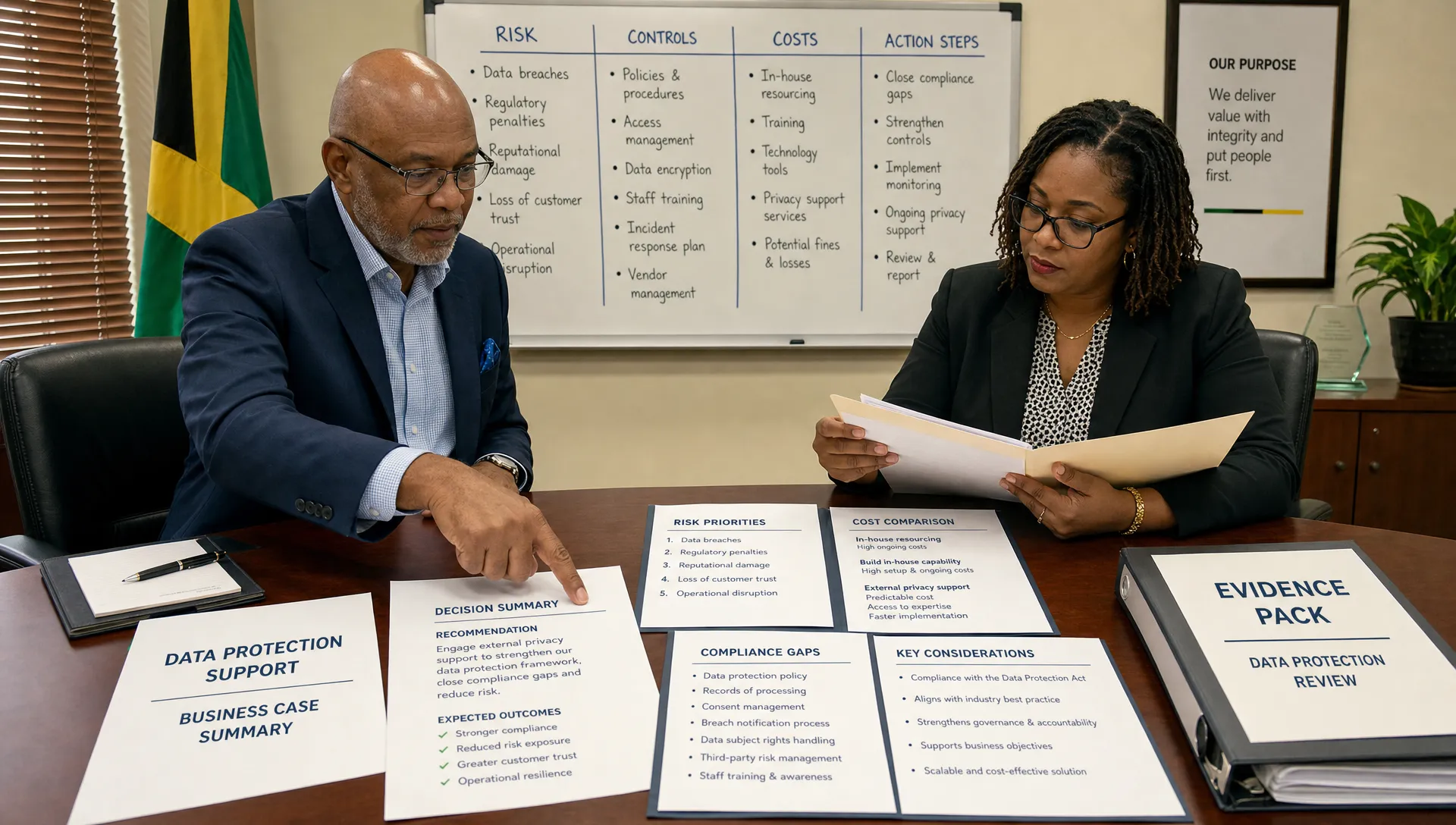
For many Jamaican organisations, hiring data protection specialists can feel like another professional fee competing with payroll, software, insurance, cyber security, and day-to-day operations. That concern is reasonable. Every business should ask whether a consultant, advisor, or outsourced privacy professional will deliver value that is greater than the cost.
The better question is not simply, “How much will this cost?” It is, “What risks, delays, fines, rework, and lost trust could this help us avoid?”
Under Jamaica’s Data Protection Act, 2020, privacy compliance is no longer a “nice to have” policy sitting in a folder. It affects how organisations collect customer details, manage employee records, share information with vendors, respond to access requests, retain files, train staff, and handle security incidents. Data protection specialists are worth the cost when they help leadership turn those legal duties into practical, repeatable business controls.
The real value is judgment, not paperwork
A low-cost template can produce a privacy notice. A generic checklist can tell you to “secure personal data” or “train employees.” What those tools cannot do is decide how the law applies to your organisation’s actual operations.
That judgment is where specialists earn their value.
A bank, medical practice, school, call centre, real estate agency, charity, retailer, and professional services firm may all collect names, addresses, IDs, payment details, and employee records. But the privacy risks are not identical. The lawful reason for collecting the data, the sensitivity of the information, the access controls, the retention period, the vendor arrangements, and the expectations of the individuals involved can vary significantly.
Good data protection specialists help you answer practical questions such as:
Which personal data is essential, and which information are we collecting out of habit?
Where are our highest-risk processing activities?
Which teams need immediate training because they handle sensitive or high-volume personal data?
Which vendor contracts create exposure for the business?
What evidence would we show if the regulator, a board member, a client, or an overseas partner asked how we manage privacy?
This is why privacy expertise cannot be judged only by the number of documents delivered. The value lies in making better decisions before problems become expensive.
If you want a more detailed view of the day-to-day work involved, PLMC’s guide on what data protection specialists actually do for your business breaks down the operational role in more detail.
They help you avoid the cost of non-compliance
Compliance failures rarely arrive as a single neat invoice. The costs usually appear in layers.
There may be the cost of investigating a complaint, locating records, correcting inaccurate data, responding to a data subject request, managing a breach, notifying affected individuals, dealing with reputational damage, or pausing a project until privacy issues are fixed. In more serious cases, organisations may face regulatory scrutiny, contractual disputes, or loss of customer confidence.
The Office of the Information Commissioner in Jamaica is the key local authority for the Data Protection Act framework. For Jamaican organisations, this means privacy governance should be treated as part of business risk management, not as an isolated legal exercise.
A specialist helps reduce non-compliance risk by identifying gaps early. For example, an organisation may believe it is compliant because it has a privacy policy on its website. But a privacy policy does not prove that staff know how to process personal data, that old records are being deleted on time, that vendors are contractually controlled, or that customer requests can be answered within required timeframes.
In other words, specialists help close the gap between what the organisation says and what the organisation can prove.
They stop you from spending money in the wrong places
One of the most overlooked benefits of data protection specialists is cost control. Without expert guidance, organisations often overcorrect in some areas and underinvest in others.
For instance, a company may spend heavily on cyber security software while ignoring retention schedules, privacy notices, consent practices, employee training, or third-party data sharing. Another organisation may pay for lengthy legal documents that no one implements. A third may train every employee with the same generic session, even though HR, IT, marketing, finance, and customer-facing teams have very different risk profiles.
Specialists help prioritise. That matters because most organisations do not have unlimited compliance budgets.
Cost pressure | How a specialist helps | Business value |
Unclear compliance priorities | Identifies high-risk data processing first | Budget goes where risk is greatest |
Generic policies | Adapts documents to actual operations | Policies become usable, not decorative |
Repeated staff mistakes | Designs role-based privacy training | Fewer incidents caused by human error |
Weak vendor oversight | Reviews data sharing and processor risks | Lower exposure from third parties |
Poor evidence of compliance | Builds practical records and accountability measures | Easier response to audits, clients, and regulators |
The point is not to spend more. The point is to spend more intelligently.
They connect privacy, security, governance, and operations
Data protection is often misunderstood as an IT issue. Security is essential, but it is only one part of the picture. A secure database can still be used unfairly. A locked filing cabinet can still contain records that should have been destroyed years ago. A password-protected spreadsheet can still be shared with the wrong vendor.
This is where specialist privacy expertise differs from general technical support. Data protection specialists look at the full lifecycle of personal data: collection, use, access, sharing, storage, retention, deletion, and accountability.
They also help different teams speak the same language. Senior management may think in terms of risk and reputation. IT may think in terms of access controls and systems. HR may think in terms of employee records. Customer service may think in terms of identity verification and complaints. Marketing may think in terms of consent and communications.
A strong specialist turns those separate concerns into one coherent programme.
They create assets your organisation can keep using
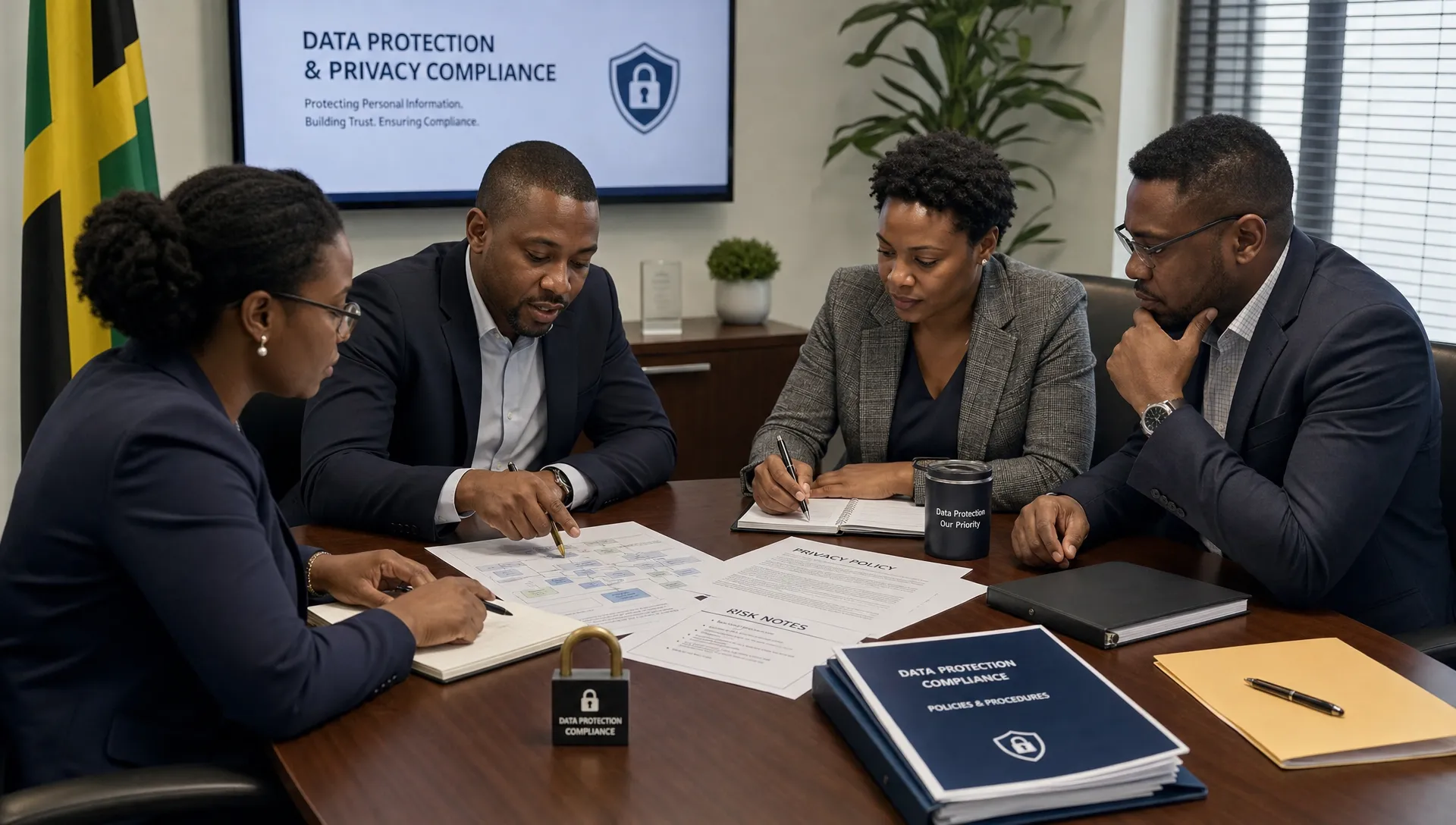
A worthwhile engagement should leave your organisation stronger after the consultant has left the room. You are not only paying for advice. You are paying for structure, capability, and repeatable processes.
Depending on your organisation’s needs, a mature data protection engagement may produce assets such as:
A personal data inventory or data mapping record that shows what information is collected, why it is used, where it is stored, and who receives it.
Practical privacy policies and notices that reflect real business activities.
Procedures for handling data subject rights requests, complaints, breaches, retention, and deletion.
Training materials tailored to the roles that create the most privacy risk.
Vendor due diligence questions and contract review points for data sharing arrangements.
A risk register or action plan that management can track over time.
These assets reduce dependency on one person’s memory. They also help with continuity when employees leave, systems change, or new projects begin.
This is especially important for SMEs. Smaller organisations may not have a large legal, compliance, or IT department, but they still handle employee, customer, supplier, and financial information. A specialist can help them build right-sized controls instead of copying complex frameworks designed for multinational companies.
They support trust with clients, partners, and boards
Privacy compliance is not only about avoiding penalties. It is also about showing that your organisation is safe to do business with.
Clients, insurers, lenders, partners, and overseas entities increasingly ask privacy-related questions before signing contracts or sharing data. Jamaican organisations that deal with international partners may also face expectations influenced by GDPR-style practices, even when their primary legal obligation is local. A weak privacy posture can slow down procurement, delay partnerships, or cause a potential client to choose a competitor.
Data protection specialists help prepare the organisation to answer those questions confidently. They can support management with clear explanations of how personal data is handled, what safeguards exist, how incidents are escalated, and what accountability measures are in place.
That confidence has commercial value. A business that can demonstrate responsible data handling is better positioned to win trust, especially in sectors where personal information is central to service delivery.
They reduce the burden on already busy staff
In many organisations, privacy compliance is assigned to someone who already has a full-time job. It may be the HR manager, IT lead, company secretary, operations manager, or legal officer. These individuals may be capable and committed, but they may not have the time or specialist background to build a complete compliance programme from scratch.
The result is often slow progress. Policies remain in draft. Data mapping gets postponed. Training happens once and is forgotten. Vendor reviews are handled only after a problem arises.
A specialist brings momentum. They know what questions to ask, what documents to review, which issues usually create the most risk, and how to translate the law into manageable tasks. This can save months of internal trial and error.
For some organisations, the right model may be outsourcing rather than hiring a full-time privacy professional. PLMC’s article on Data Protection Officer services and the hire-versus-outsource decision can help leadership compare those options.
They help leadership make defensible decisions
No privacy programme eliminates all risk. Even well-managed organisations can experience human error, system failures, or unexpected incidents. The goal is to make informed, defensible decisions and to show that the organisation took reasonable steps.
Data protection specialists help leaders document why decisions were made. That may include why certain data is collected, why a vendor was approved, why a retention period was chosen, why a project was assessed as high or low risk, or why a particular security control was prioritised.
This evidence matters. If a complaint, breach, audit, or board-level question arises, leadership will be in a stronger position if it can show a structured process rather than a series of informal assumptions.
The best specialists do not simply say “no” to business ideas. They help the organisation proceed in a safer way. That might mean redesigning a form to collect less data, tightening access to sensitive records, improving consent language, updating a vendor agreement, or adding staff guidance before launching a new initiative.
When the cost is probably worth it
A specialist becomes especially valuable when the organisation faces complexity, growth, or exposure. Examples include launching a new system, collecting sensitive personal data, working with multiple vendors, transferring data across borders, handling large customer databases, preparing for regulatory scrutiny, or trying to professionalise governance after years of informal processes.
The cost is also easier to justify when privacy failures would have serious consequences. In healthcare, finance, education, insurance, HR outsourcing, security services, professional services, and customer support environments, personal data is not peripheral. It is central to operations.
If your organisation is deciding whether a project needs specialist attention, the article on when to hire data protection specialists for a high-risk project offers useful scenarios to consider.
Warning signs that cheap privacy support may become expensive
Not every privacy service offers the same value. A lower upfront fee can become costly if the work is generic, incomplete, or disconnected from local obligations.
Be cautious if a provider offers only templates without understanding your business processes. Be equally cautious if the engagement focuses only on cyber security and ignores lawful processing, transparency, rights requests, retention, staff behaviour, and vendor management.
Other warning signs include vague deliverables, no clear action plan, limited knowledge of Jamaica’s Data Protection Act, no role-based training approach, and no method for helping management track progress.
A useful specialist should be able to explain what they will review, what outputs you will receive, what decisions management will need to make, and how the work will reduce risk. If those points are unclear, the price is not the only issue. The value is unclear too.
How to measure whether the investment paid off
The return on data protection work is not always measured in a single dramatic event avoided. Often, it shows up in smoother operations and fewer surprises.
Useful indicators include faster response to data subject requests, clearer ownership of privacy tasks, fewer staff mistakes, better vendor records, stronger board reporting, updated policies that staff actually use, and improved readiness for client or regulator questions.
Leadership can also measure progress by asking simple questions at regular intervals. Do we know what personal data we hold? Do we know why we hold it? Do we know who can access it? Do we know when it should be deleted? Do employees know what to do if something goes wrong? Can we prove any of this?
If the answer improves over time, the specialist has created value.
Frequently Asked Questions
Are data protection specialists only necessary for large companies? No. Smaller organisations often have fewer internal resources, which can make specialist support even more valuable. The right advisor should scale the work to the organisation’s size, risk, sector, and budget.
Is data protection the same as cyber security? No. Cyber security focuses on protecting systems and information from threats. Data protection also covers lawful, fair, transparent, and accountable use of personal data. Both are connected, but they are not the same discipline.
Can we just use online templates to comply with the Data Protection Act? Templates can help with structure, but they cannot assess your actual data flows, staff practices, vendor risks, retention habits, or operational gaps. They are usually not enough on their own.
How do data protection specialists save money? They help prioritise the highest risks, reduce rework, prevent avoidable mistakes, support better vendor decisions, and prepare the organisation for complaints, audits, incidents, and client due diligence.
Should we hire internally or outsource privacy support? It depends on your organisation’s size, risk level, budget, and need for ongoing support. Some organisations need a full-time internal role, while others benefit from outsourced specialist expertise.
Make the cost a business decision, not a guess
Data protection specialists are worth the cost when they help your organisation move from uncertainty to control. The right support gives management clearer priorities, stronger evidence, better staff behaviour, and more confidence under Jamaica’s Data Protection Act.
If your organisation is unsure where to begin, Privacy & Legal Management Consultants Ltd. provides privacy, data protection, governance, compliance, training, and risk-focused support for Jamaican organisations. A practical first step is to assess your current exposure, identify the highest-risk gaps, and decide what level of specialist help is proportionate for your business.