

Data Protection Officer Services: When to Outsource vs Hire

Choosing the right Data Protection Officer (DPO) model is one of the most practical decisions Jamaican organisations face as they work toward consistent compliance under the Data Protection Act. The question is not only “Do we need DPO coverage?”, it is also “Do we need it in-house, outsourced, or a hybrid?”.
This guide breaks down what DPO work looks like in reality, when it makes sense to hire versus outsource, and how to scope data protection officer services so you get usable governance, not a “paper DPO” arrangement.
What “DPO services” actually include (beyond a title)
In day-to-day operations, DPO responsibilities tend to cluster into a few repeatable areas. Whether you hire or outsource, you should be able to point to tangible outputs and evidence.
1) Governance and accountability
A DPO function typically helps the organisation establish and maintain:
Data protection governance (roles, reporting line, escalation paths)
Policies and procedures (retention, incident response, data handling)
A record of processing activities (or similar evidence set)
Metrics and reporting for senior leadership
2) Advisory support for projects and change
Most privacy risk is introduced through change, new systems, new vendors, new marketing campaigns, new HR initiatives, new AI tools, new CCTV deployments, and so on. A DPO function should support:
Privacy-by-design reviews
Risk assessments (and where applicable, DPIA-style assessments)
Decisions on lawful processing and transparency
(For a widely accepted benchmark of DPO expectations, see the UK ICO’s DPO guidance. While Jamaica’s law is distinct, the operating model is comparable.)
3) Data subject rights operations
Even well-run organisations struggle here, because rights requests are cross-functional. A DPO service often helps define and test:
Intake channels (web form, email, front desk, HR)
Verification steps
Search and retrieval workflows
Response templates and exception handling
Tracking and audit evidence
4) Vendor and third-party oversight
If you use payroll processors, HR platforms, cloud hosting, call centres, marketing agencies, fintech providers, or outsourced IT, DPO coverage should include:
Vendor risk screening (privacy and security)
Contract clauses and due diligence evidence
Oversight of international transfers where relevant
5) Breach readiness and incident coordination
A DPO is not your SOC, but the DPO function should be part of the breach playbook so that security response connects to legal and communications obligations. Good practice aligns with established incident response guidance such as NIST’s Computer Security Incident Handling Guide (SP 800-61).
6) Training and awareness
One-off training rarely changes behaviour. Effective DPO services usually include:
Role-based training (HR, customer service, IT, marketing)
Short refreshers and onboarding modules
Evidence of attendance and comprehension
Outsource vs hire, start with the real business drivers
Before you compare cost, start with the operational pressure points:
Volume and sensitivity of personal data (including health, financial, children’s data)
Rate of organisational change (new products, new branches, new systems)
Regulatory and reputational exposure (public-facing brands, regulated sectors)
Internal capability (legal, risk, IT security maturity)
Speed needed (how quickly you must stand up a credible programme)
If you already have a structured programme, an internal DPO can maintain momentum. If you are still building foundations, outsourcing can accelerate implementation while you decide on a long-term model.
When it makes sense to hire an in-house DPO
Hiring is usually the better choice when privacy needs to be “in the building” every day, not just reviewed periodically.
You should lean toward hiring if:
You have continuous privacy-impacting operations. Examples include large HR operations, high-volume customer support, constant marketing campaigns, always-on CCTV, or frequent data sharing.
You operate complex systems and integrations. If your organisation runs multiple platforms (CRM, ERP, HRIS, data warehouse, mobile apps), privacy oversight becomes a daily operational task.
You need strong internal authority and fast decision-making. An in-house DPO often has easier access to leadership, system owners, and process owners, and can move faster during an incident.
You need deep organisational context. Some privacy risks are highly specific to internal culture, legacy workflows, and “how things really get done.” Employees often disclose issues earlier to an internal leader they trust.
You can protect independence and avoid conflicts. A practical risk in small organisations is appointing someone whose primary job conflicts with DPO expectations (for example, a role that determines purposes and means of processing). If you can structure reporting and decision-making cleanly, in-house can work very well.
When it makes sense to outsource DPO services
Outsourcing is often the fastest way to obtain experienced coverage, especially where the need is urgent or the organisation is still building its programme.
You should lean toward outsourcing if:
You need immediate capability. An outsourced DPO service can often begin with assessments, priority remediation, and training without a lengthy recruitment cycle.
You need multi-disciplinary depth. Practical DPO work touches law, governance, process design, vendor management, and cyber security coordination. Outsourcing can provide access to broader expertise than one hire.
You want predictable cost and flexible coverage. Many organisations do not need a full-time DPO every week. Outsourcing can match resourcing to risk and workload.
You want stronger independence. A third-party DPO can sometimes deliver difficult messages more objectively, especially where internal politics can water down risk reporting.
You are an SME or growing organisation. For many teams, the best first step is to outsource while building internal ownership through a privacy champion or compliance lead.
Quick comparison table (outsourced vs in-house)
Use this as a reality check, not a strict rule.
Factor | Outsourced DPO services | In-house DPO hire |
Speed to start | Usually faster (subject to onboarding) | Slower (recruitment, notice periods) |
Breadth of expertise | Often broader (team-based exposure) | Deep internal context, may need support for specialist topics |
Independence | Often easier to demonstrate | Requires careful reporting line and role design |
Organisational knowledge | Must be built through onboarding | Naturally high over time |
Availability | Defined by contract and SLA | On-site, immediate access (subject to workload) |
Cost model | Predictable retainer or project-based | Salary, benefits, training, tools, back-up coverage |
Continuity risk | Depends on provider staffing and documentation | Depends on retention, succession planning |
A practical decision framework (questions that settle the debate)
Use these questions with your leadership team. If you answer “yes” often on the left, you likely need an in-house hire. If you answer “yes” often on the right, outsourcing is probably the better first move.
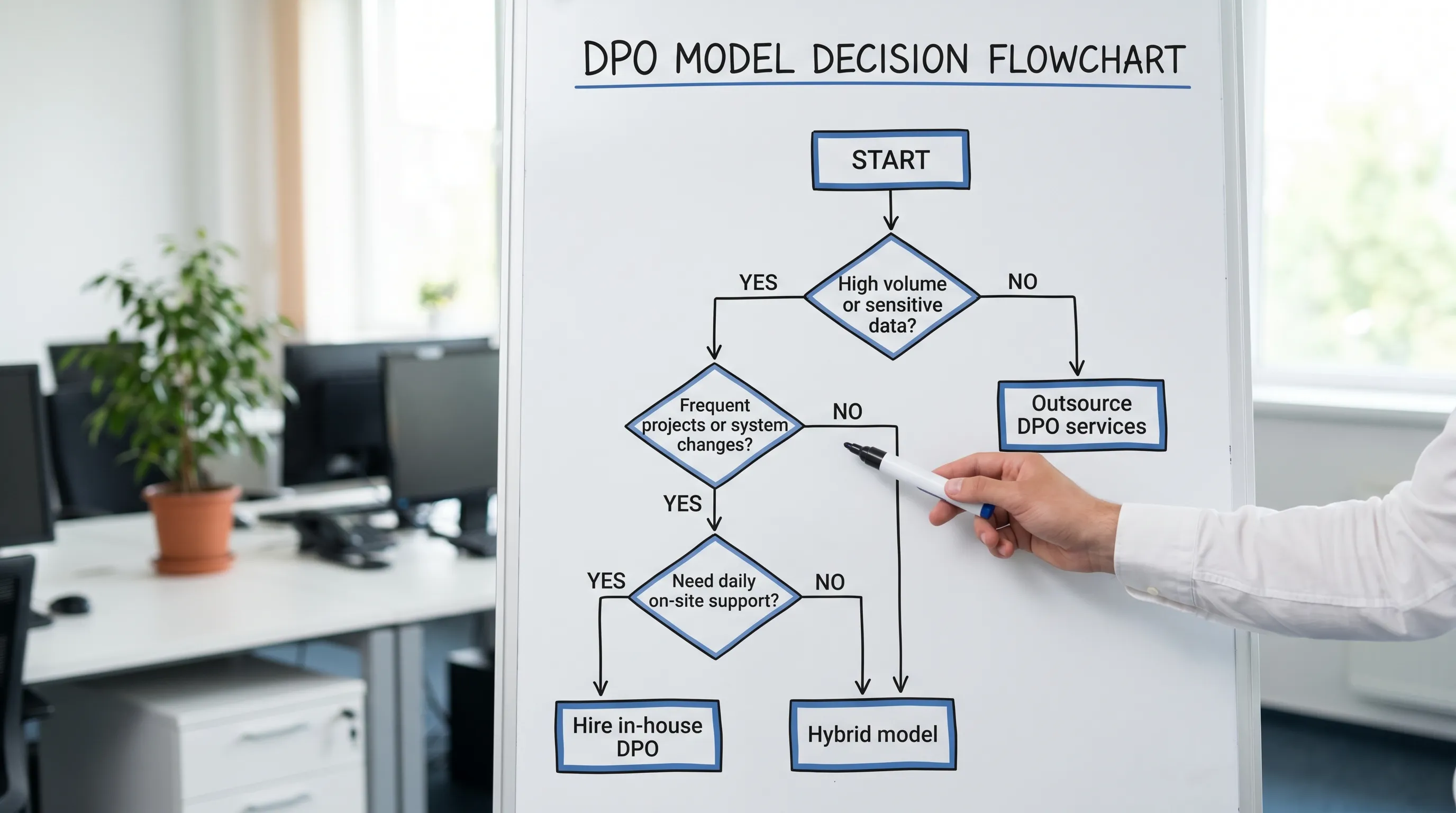
Signals that favour hiring
Do we have privacy-impacting decisions every week across multiple departments?
Do we expect frequent incidents, complaints, or rights requests?
Do we need someone embedded in projects from day one?
Can we provide a clear reporting line that supports independence?
Signals that favour outsourcing
Do we need to stand up governance quickly (policies, inventory, rights workflow)?
Do we lack internal privacy experience and need structured guidance?
Would a fractional service cover our actual workload today?
Do we need specialist input periodically (vendor contracts, security coordination, training)?
Consider the hybrid model (often the best option in practice)
Many organisations do best with:
An internal privacy lead or champion who owns day-to-day coordination, documentation, and follow-through
Outsourced DPO services providing oversight, independent reporting, specialist reviews, and escalation support
This model avoids a common failure mode, outsourcing a DPO but not assigning anyone internally to actually implement changes, chase evidence, and keep departments accountable.
If you outsource, scope DPO services carefully (what to put in the agreement)
Outsourced DPO arrangements succeed or fail based on scope clarity. At minimum, define:
Responsibilities and boundaries
Be explicit about what the provider will do versus what remains your responsibility (for example, policy ownership, approvals, implementation work, IT changes).
Access and reporting
Who is the executive sponsor?
How often will reporting occur (monthly, quarterly)?
Can the DPO function raise risks directly to senior leadership?
Service levels (especially for incidents)
Define expectations for:
Breach escalation response window
Support during investigations
Coordination with IT/security and communications
Deliverables and evidence
Request outputs that help you demonstrate accountability, such as:
A rolling workplan
Risk register entries and recommendations
Training plan and attendance evidence
Templates for rights handling and vendor due diligence
Confidentiality and conflicts
Confirm how conflicts are managed, especially if the provider serves multiple clients in the same sector.
If you hire, design the role so it can actually work
Even strong hires fail when the organisation sets them up as a “checkbox.” When recruiting, focus on structure as much as skills.
Reporting line and independence
Where possible, the DPO should have direct access to senior leadership and the ability to report risks without interference. Avoid placing the role where it is expected to approve its own work or defend decisions it helped create.
Skills mix to prioritise
A DPO does not need to be a cyber security engineer, but they do need enough literacy to coordinate effectively with IT and vendors. In practice, the most effective hires combine:
Privacy and data protection knowledge
Governance and risk management capability
Strong writing and training skills
Process design and stakeholder management
Back-up coverage
Plan for leave, turnover, and peak workload (for example, during a breach or major system rollout). “Single point of failure” is a common in-house weakness.
Common red flags (either model)
The DPO function has no access to senior leadership.
The “DPO” is assigned as a side task with no time allocation.
The organisation outsources, but never provides system access, process maps, or decision-makers for interviews.
There is no evidence trail (no workplan, no logs, no records of decisions).
The DPO function is treated as the person who “owns compliance,” instead of enabling the business to own and demonstrate compliance.
Frequently Asked Questions
Are DPO services legally required in Jamaica? Requirements depend on your circumstances, including what data you process and how you operate. Many organisations still benefit from DPO coverage as a practical accountability measure, even where appointment is not strictly mandatory.
Is an outsourced DPO acceptable, or must the DPO be an employee? Many organisations use outsourced DPO services successfully. The key is ensuring independence, access to leadership, and enough organisational knowledge to provide meaningful oversight.
What is the biggest risk of outsourcing DPO services? The most common risk is a “paper DPO” arrangement, where the provider is named but not integrated into projects, incident response, rights handling, and vendor governance.
What is the biggest risk of hiring a DPO? The most common risk is role conflict or lack of authority, for example, when the DPO is placed in a role that controls processing decisions or is not supported by leadership.
How do we start if we are not ready to hire? A practical approach is a hybrid model, assign an internal privacy lead and use outsourced DPO services for oversight, training, and programme build-out.
Need help choosing the right DPO model for your organisation?
Privacy & Legal Management Consultants Ltd. (PLMC) supports Jamaican organisations with data protection implementation, training, and governance-focused compliance support. If you are deciding whether to outsource or hire, a short scoping conversation can clarify your workload, risk profile, and the most cost-effective model for 2026.
Explore PLMC’s data protection services or request a free consultation through the contact options on the website to discuss your DPO coverage and compliance priorities.