

Training Privacy by Role: A Smarter Staff Learning Plan
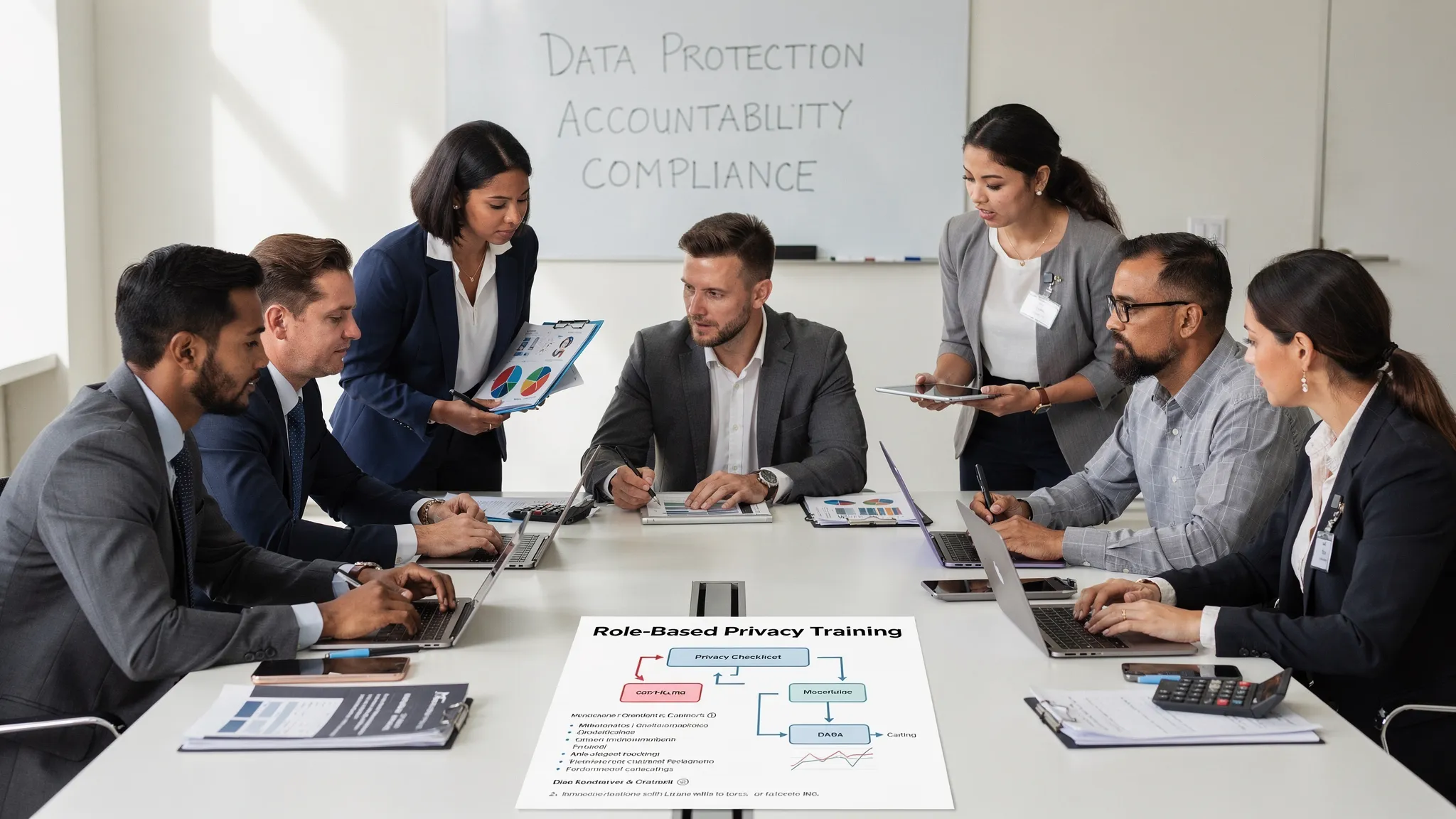
A privacy programme only works when staff can make the right decision at the exact moment personal data is collected, shared, stored, corrected, deleted, or reported as at risk. That is why a single annual slide deck is no longer enough for organisations handling customer, employee, student, patient, donor, or member information.
Training privacy by role means giving people the privacy knowledge that matches their actual work. A receptionist does not need the same depth of training as an IT administrator. A payroll officer faces different risks from a marketing manager. A board director needs to understand accountability, oversight, and risk appetite, while a customer service agent needs to know how to identify and route a data subject request.
For Jamaican organisations working to strengthen Data Protection Act compliance, role-based privacy training is a practical way to reduce human error, build evidence of accountability, and turn policy into daily behaviour.

Why role-based privacy training is smarter
Privacy incidents are often caused by ordinary decisions made under pressure. An employee sends a spreadsheet to the wrong recipient. A manager keeps old job applications longer than needed. A team starts using a new online tool without checking where the data is stored. A staff member receives an access request but treats it like a routine customer complaint.
These are not always technology failures. They are frequently process, awareness, and judgement failures.
The Verizon Data Breach Investigations Report has repeatedly highlighted the role of the human element in security incidents, including mistakes, misuse, and social engineering. Privacy risk follows a similar pattern. Even strong policies and technical controls can fail if people do not understand what is expected in their own role.
Under Jamaica’s Data Protection Act, organisations need to show that personal data is handled fairly, lawfully, securely, and only for appropriate purposes. The Office of the Information Commissioner Jamaica provides regulatory guidance and oversight, but the operational responsibility sits inside each organisation. Staff training is one of the clearest ways to demonstrate that privacy expectations have been communicated and embedded.
Role-based learning improves privacy outcomes because it is specific, memorable, and easier to apply. Instead of asking everyone to absorb every legal concept, it answers practical questions: What data do I touch? What can go wrong in my role? What must I do before I share, store, delete, or escalate personal data?
What “training privacy by role” means
Role-based privacy training is not simply splitting staff by department. It is a learning model based on privacy risk, data access, decision-making authority, and operational responsibility.
A good training plan starts with these questions:
What personal or sensitive personal data does this role access, collect, use, disclose, or store?
What systems, files, devices, vendors, or communication channels does this role use?
What privacy decisions does this role make without waiting for legal, compliance, or management approval?
What mistakes would create the greatest harm to individuals or the organisation?
What evidence should this role create or preserve to show compliance?
This approach helps organisations avoid two common problems. The first is under-training, where staff receive general awareness but not enough guidance to handle real situations. The second is over-training, where employees are overwhelmed with legal detail that does not apply to their duties.
The best privacy training sits between those extremes. It gives every employee a shared foundation, then adds targeted modules for higher-risk roles.
A practical role-based privacy training matrix
Use the following matrix as a starting point. It can be adapted for private companies, public bodies, financial institutions, schools, healthcare providers, charities, professional services firms, and other Jamaican organisations.
Role or team | Typical privacy risk | Training focus | Evidence to keep |
All staff | Accidental disclosure, phishing, poor handling of documents, weak escalation | Personal data basics, confidentiality, clean desk practices, secure email use, incident reporting | Attendance logs, quiz results, signed acknowledgements |
Customer service and front office | Mishandling access requests, identity verification errors, oversharing account information | Recognising rights requests, verifying identity, call and email disclosure rules, escalation routes | Scripts, escalation records, request handling logs |
Human resources | Employee records, medical information, disciplinary files, recruitment data | Sensitive data handling, retention, employee access requests, confidentiality, secure file sharing | HR retention schedule, access records, training certificates |
Finance and payroll | Salary data, banking information, tax records, supplier details | Secure transfers, access control, fraud awareness, retention, payment data confidentiality | Access reviews, payment approval records, secure transfer procedures |
Sales and marketing | Consent, direct marketing, profiling, customer lists, event registrations | Lawful use of contact data, unsubscribe handling, consent records, data minimisation | Consent logs, campaign review records, suppression lists |
IT and cyber security | System access, monitoring, backups, logs, breach containment | Privacy by design, access management, encryption, logging, incident response, vendor security | Access review reports, incident tests, control records |
Procurement and vendor owners | Sharing data with processors, cloud tools, cross-border services | Vendor due diligence, contract privacy clauses, transfer risks, service monitoring | Vendor assessments, contracts, risk approvals |
Managers and department heads | Local process decisions, staff oversight, policy enforcement | Privacy risk ownership, approval checkpoints, breach escalation, coaching staff | Team briefings, process approvals, issue logs |
Executives and board members | Governance failure, lack of resources, unmanaged compliance risk | Accountability, risk appetite, reporting, regulatory exposure, resourcing privacy programmes | Board minutes, risk reports, compliance updates |
Privacy leads or Data Protection Officers | Programme oversight, advice, monitoring, reporting | Data protection principles, DPIAs, rights handling, breach management, audit readiness | Training plan, compliance dashboard, audit trail |
This table should not be treated as a fixed template. A small business may combine several roles in one person. A larger organisation may need separate tracks for legal, compliance, call centre, records management, operations, project management, and data analytics.
Start with data touchpoints, not job titles
The smartest privacy training plans begin with a simple data map. Before writing modules, identify where personal data enters the organisation, who uses it, who approves sharing, where it is stored, and when it should be deleted.
For example, a Jamaican organisation may handle Taxpayer Registration Numbers, national identification documents, payroll records, health information, CCTV footage, customer complaints, loan applications, student files, or membership databases. Each data type creates different privacy risks.
A role that only sees business contact details may need basic awareness. A role that handles medical records, children’s information, financial data, biometrics, disciplinary records, or identity documents needs deeper training and stricter controls.
If your organisation is still building this foundation, PLMC’s guide on Data Privacy in Jamaica: Key Principles and Rights can help clarify the principles that should shape your training content.
Build a core module, then add specialist tracks
Every employee should receive a core privacy module. This creates a common vocabulary and baseline culture. It should explain what personal data is, why privacy matters, what the organisation’s policies require, and how to report concerns.
After that, create shorter specialist tracks for roles with higher exposure. A strong role-based structure may include the following modules:
Privacy fundamentals for all staff, including personal data, sensitive data, confidentiality, secure handling, and reporting channels.
Rights request handling for customer-facing teams, HR, records teams, and managers who may receive access, correction, objection, or deletion requests.
Secure data sharing for teams that send files, work with vendors, use cloud platforms, or exchange information with group companies or external partners.
Privacy and cyber security for IT, system administrators, and security teams responsible for access, monitoring, backups, and breach response.
Governance and accountability for executives, board members, compliance teams, and department heads.
The goal is not to create an academic course. The goal is to help each person act correctly in predictable situations.
Use scenarios people recognise
Privacy training becomes much more effective when staff can see themselves in the examples. Generic global examples can help, but local and sector-specific scenarios are usually more memorable.
A Jamaican role-based privacy session might ask staff what they would do if a customer requests all records held about them, an employee sends payroll information to a personal email account, a WhatsApp message includes a photo of an identification document, a vendor asks to upload customer data to a new platform, or a former employee’s system access remains active.
These examples turn abstract principles into decisions. They also help reveal gaps in procedures. If staff cannot agree on what should happen, the issue may not be training alone. The organisation may need clearer policies, better escalation routes, stronger system controls, or updated vendor procedures.
For broader implementation support, the Privacy and Data Protection: A Practical Checklist can help connect training to governance, records, vendor management, breach readiness, and evidence collection.
Set the right training rhythm
Privacy training should not be a one-time event. Staff turnover, new systems, new vendors, new products, and changing risk levels all affect how people handle data. A practical learning rhythm keeps privacy visible without overwhelming teams.
Training moment | Purpose | Best format |
Onboarding | Establish baseline expectations before staff access personal data | Short core module with acknowledgement |
Role assignment or promotion | Match training to new responsibilities and system access | Targeted module or live briefing |
Annual refresh | Reinforce key behaviours and update staff on changes | Scenario-based refresher |
Process or system change | Address new privacy risks before launch | Focused workshop or checklist review |
After an incident or near miss | Correct behaviour and close control gaps | Lessons-learned session |
Board or management cycle | Maintain accountability and resourcing | Governance briefing |
For many organisations, short and frequent training is more effective than one long annual presentation. A 20-minute scenario session for a high-risk team can create more behaviour change than a two-hour lecture delivered to everyone.
Make training measurable
Completion rates are useful, but they do not prove that training is working. A smarter privacy learning plan measures whether staff understand their responsibilities and whether privacy risks are reducing.
Useful measures include quiz scores, number of staff who can identify a rights request, time taken to escalate incidents, reduction in repeat errors, number of vendor reviews completed before data sharing, access review completion, and evidence that managers discuss privacy in team meetings.
Metric | What it shows | Why it matters |
Training completion by role | Whether targeted staff received the right module | Supports accountability and audit readiness |
Scenario pass rate | Whether staff can apply rules to real situations | Measures understanding, not just attendance |
Incident reporting time | How quickly staff escalate potential breaches | Improves containment and response |
Rights request routing accuracy | Whether requests reach the right owner | Reduces missed deadlines and poor responses |
Repeat error trends | Whether training is changing behaviour | Helps target follow-up coaching |
Manager briefing records | Whether leaders reinforce expectations | Embeds privacy into operations |
Good measurement also helps leadership make better decisions. If one department has repeated disclosure errors, the answer may be refresher training, but it may also be better templates, access restrictions, approval steps, or system changes.
Keep evidence of privacy training
In compliance, undocumented training is weak evidence. Organisations should maintain a clear record of who was trained, what they were trained on, when it occurred, how understanding was tested, and what follow-up actions were taken.
Evidence can include attendance registers, learning management system reports, signed policy acknowledgements, quiz results, copies of training materials, role matrices, refresher schedules, scenario exercises, and management reports.
This evidence matters because privacy compliance is not only about doing the right thing. It is also about being able to show that the organisation has taken reasonable and appropriate steps. If a breach, complaint, audit, client review, or regulator query occurs, training records can help demonstrate that privacy obligations were taken seriously.
Common mistakes to avoid
Even well-intentioned organisations can weaken their privacy training plan by making it too generic or too disconnected from daily operations.
Common mistakes include treating privacy training as a legal formality, using the same content for every role, failing to train managers, ignoring contractors and temporary staff, delivering training without testing understanding, and not updating materials after incidents or process changes.
Another mistake is separating privacy training from cyber security training completely. They are not the same discipline, but they overlap. Security training may teach staff how to avoid phishing, use strong passwords, and report suspicious activity. Privacy training explains why personal data must be limited, transparent, accurate, securely handled, retained only as needed, and shared only under appropriate controls.
The two should work together, especially for teams handling sensitive information or using digital systems. PLMC’s article on Privacy Security Controls That Strengthen Compliance explains how organisational and technical controls support a stronger privacy programme.
A simple 30-60-90 day rollout plan
A role-based training programme does not have to be complicated at the start. What matters is that it is risk-based, documented, and capable of improvement.
Timeframe | Priority | Output |
First 30 days | Identify roles, data touchpoints, and high-risk activities | Role-based training matrix and priority list |
Days 31 to 60 | Build or update core training and specialist modules | Training materials, scenarios, quiz questions |
Days 61 to 90 | Deliver priority sessions and collect evidence | Attendance records, test results, issue log |
After 90 days | Review gaps and refine the programme | Refresher plan, management report, updated controls |
This phased approach is especially useful for organisations preparing for stronger audit readiness in 2026. It connects staff learning to practical compliance work, rather than treating training as a separate HR exercise.
Frequently Asked Questions
Is privacy training required under Jamaica’s Data Protection Act? The Act expects organisations to handle personal data responsibly and apply appropriate organisational measures. Staff training is one of the most practical ways to show that privacy responsibilities have been communicated and operationalised.
How often should staff receive privacy training? Most organisations should train staff at onboarding, refresh training at least annually, and provide targeted updates when roles, systems, vendors, or legal requirements change. High-risk roles may need more frequent scenario-based sessions.
Should contractors and temporary workers receive privacy training? Yes. If contractors, consultants, interns, or temporary staff access personal data, they should receive training that matches their access and duties. Their obligations should also be supported by contracts and access controls.
What is the difference between privacy training and cyber security training? Cyber security training focuses on protecting systems and information from threats such as phishing, malware, and unauthorised access. Privacy training focuses on lawful, fair, transparent, limited, and accountable use of personal data. Strong organisations need both.
Can small businesses use role-based privacy training? Yes. Small businesses can keep it simple by grouping responsibilities into practical tracks, such as all staff, customer-facing staff, finance or HR, IT support, and management. The key is to match training to real data handling risks.
How do we know if privacy training is working? Look beyond attendance. Track scenario scores, incident reporting time, repeated mistakes, rights request routing, vendor review compliance, and manager follow-up. If behaviour is not improving, revise the training and the underlying process.
Make privacy training practical for every role
Role-based privacy training helps organisations move from policy awareness to operational readiness. It gives staff the confidence to handle personal data properly, gives managers a clearer way to supervise risk, and gives leadership better evidence that compliance is being embedded.
Privacy & Legal Management Consultants Ltd. supports Jamaican organisations with data protection implementation, privacy and compliance training, risk assessment, GRC integration, cyber security alignment, and practical governance support. If your organisation needs a smarter staff learning plan, contact PLMC to discuss role-based privacy training and practical next steps for your team.