
Risk of Data Security: Top Threats and How to Reduce Them

Data incidents rarely start with “advanced hacking.” Most begin with small, preventable weaknesses: a staff member clicking a convincing link, an unpatched system exposed to the internet, a shared mailbox with no multi-factor authentication, or a third-party vendor with too much access.
For Jamaican organisations working to meet obligations under the Data Protection Act (DPA), the risk of data security is not only an IT issue. It is a governance and compliance issue that can quickly become a reputation, operations, and legal exposure.
This guide breaks down the top threats driving data security risk and offers practical, organisation-ready steps to reduce them.
What “risk of data security” really means (and why it keeps rising)
In simple terms, the risk of data security is the likelihood that your organisation’s information (especially personal data) will be accessed, disclosed, altered, lost, or made unavailable in a way that harms people, disrupts operations, or breaches legal duties.
A few trends keep pushing risk upward in 2026:
More cloud services and remote access, often deployed quickly without consistent security standards.
More third parties handling data (payment processors, HR platforms, marketing tools, managed service providers).
More effective social engineering, including AI-assisted phishing.
More ransomware groups targeting organisations of all sizes.
Globally, breach impacts remain significant. IBM’s annual research continues to show that breaches are costly and time-consuming to contain, often involving business disruption beyond the initial incident. See IBM’s research via the Cost of a Data Breach Report.
Top data security threats organisations face today
Threats vary by sector, but the patterns are consistent across SMEs, financial services, healthcare, education, and professional services.
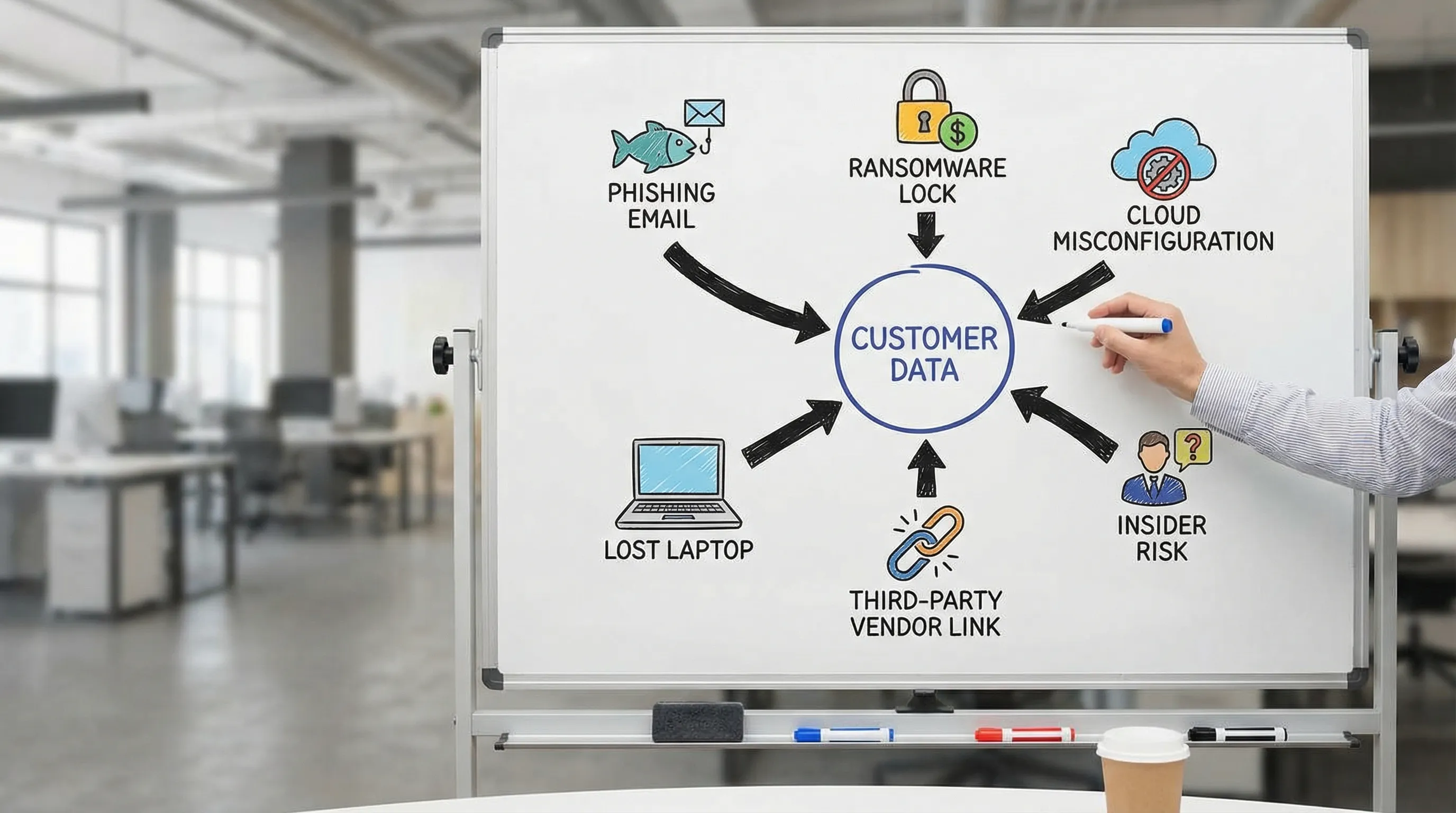
1) Phishing and business email compromise (BEC)
Phishing is still the most common entry point because it targets human decision-making, not just technology. In BEC, criminals impersonate executives, suppliers, or customers to trick staff into sending funds or disclosing sensitive information.
Common warning signs include:
“Urgent” payment requests that bypass normal approvals
“Invoice update” or “bank details changed” emails
Login links that lead to lookalike Microsoft 365 or Google pages
Risk reduction focus: identity security (MFA), payment verification controls, and staff training that is tested (not just delivered).
2) Ransomware and double extortion
Ransomware is no longer only about encrypting files. Many groups also steal data first and then threaten to publish it if the ransom is not paid.
This creates a direct privacy and compliance problem, especially where personal data is involved. Verizon’s breach research consistently highlights the role of stolen credentials, phishing, and vulnerability exploitation in major incidents. See the Verizon Data Breach Investigations Report (DBIR).
Risk reduction focus: patching, segmentation, offline backups, and incident readiness.
3) Weak authentication and stolen credentials
Passwords are frequently reused, shared, or exposed through prior breaches. Attackers buy credentials, then test them against email, VPNs, and cloud services.
Typical gaps:
No multi-factor authentication (or MFA only for some users)
Shared admin accounts
Former employees still active in systems
Risk reduction focus: MFA everywhere possible, least privilege, rapid offboarding, and strong access reviews.
4) Cloud misconfiguration and overexposed data
Cloud services can be secure, but misconfiguration is a major driver of accidental exposure. Examples include:
Storage buckets or shared folders set to “public”
Over-permissive sharing links
Inadequate logging, so you cannot confirm what happened
Risk reduction focus: baseline cloud configuration standards, routine access reviews, and logging.
5) Third-party and supply chain risk
If vendors process or host your data, your risk extends to their controls. Many incidents now spread through service providers (including managed IT providers).
Common issues:
No clear data processing terms in contracts
No security requirements or audit rights
Vendors holding more data than necessary, for longer than necessary
Risk reduction focus: vendor due diligence, contractual controls, and ongoing monitoring.
6) Insider risk (malicious or accidental)
Not all insiders are malicious. Many incidents come from simple mistakes:
Sending an email to the wrong recipient
Uploading sensitive files to personal storage
Losing a device without encryption
Risk reduction focus: role-based access, data handling rules, encryption, and practical awareness.
7) Unpatched systems and internet-facing vulnerabilities
Vulnerability exploitation remains a high-impact threat, especially for public-facing systems and remote access tools.
A strong patching process is not only “apply updates.” It includes knowing what you have, what is exposed, and what must be patched first.
Risk reduction focus: asset inventory, vulnerability scanning, patch SLAs, and secure configurations.
A practical threat-to-control map you can use
Use the table below as a quick way to connect threats to controls and the “evidence” you should be able to show (useful for governance, audits, and demonstrating DPA accountability).
Threat | What it looks like | Key controls to reduce risk | Evidence to keep |
Phishing/BEC | Fake login pages, urgent payment emails | MFA, email security controls, payment call-back verification, awareness drills | MFA enforcement screenshots, training records, payment SOP |
Ransomware | Encrypted files, extortion emails | Offline backups, patching, segmentation, EDR/AV, incident response plan | Backup test results, patch logs, IR tabletop notes |
Stolen credentials | Unusual logins, mailbox rules created | MFA, conditional access, password policy, access reviews | Access review reports, sign-in logs, offboarding checklist |
Cloud exposure | Public links, shared drives open | Secure baseline configs, least privilege, logging, DLP where feasible | Cloud configuration standard, audit logs, sharing reports |
Third-party risk | Vendor breach affects you | Due diligence, contract clauses, least data sharing, periodic review | Vendor assessments, DPAs/contracts, risk register |
Insider mistakes | Wrong recipient, lost laptop | Encryption, device management, clear handling rules, least privilege | Device encryption status, policies, exception approvals |
How to reduce the risk of data security: a step-by-step approach
The most effective programmes treat security as a cycle: identify, protect, detect, respond, and improve. A useful reference for structuring controls is the NIST Cybersecurity Framework.

Start with your data: what you hold, where it is, and who touches it
You cannot protect what you cannot see. Build (or refresh) a simple data and system inventory:
What personal data you collect (customer, employee, patient, student)
Where it is stored (email, shared drives, cloud apps, paper files)
Who can access it (roles, teams, vendors)
How it leaves the organisation (exports, email attachments, integrations)
This is also foundational for DPA compliance. If you need a structured checklist, PLMC’s resource on Privacy and Data Protection: A Practical Checklist aligns privacy governance with operational controls.
Implement the “big four” controls that prevent most common incidents
If you can only prioritise a few actions this quarter, focus on these.
Multi-factor authentication (MFA) for email and critical systems
Email is the control plane for password resets, invoices, and sensitive conversations. Enforce MFA for:
All staff email accounts
Admin accounts (with stronger methods where available)
Remote access (VPN, RDP gateways, cloud portals)
Least privilege and access reviews
Reduce “who can see what” and review access regularly, especially:
Finance systems and payment approvals
HR and payroll data
n- Shared drives and customer databases
A practical rule: staff should only access the data required for their job, and access should be removed promptly when roles change.
Patch and vulnerability management that matches your real exposure
A workable approach for many organisations:
Maintain an asset list (servers, laptops, network devices, key applications)
Patch internet-facing systems first
Set patch timelines based on risk (for example, critical vulnerabilities faster than routine updates)
Backups that are tested and protected
Backups reduce ransomware leverage only if they are:
Not easily reachable from compromised accounts (offline or immutable where possible)
Tested (restore drills, not just “backup succeeded” messages)
Matched to business needs (recovery time and recovery point expectations)
Build detection and response capability before you need it
When an incident happens, speed and coordination matter. At minimum, ensure you have:
A clear internal reporting path (staff know where to report suspicious activity)
Centralised logs for key systems (email, endpoints, servers, cloud)
An incident response plan with roles (IT, legal/compliance, HR, communications)
A breach decision process that considers legal reporting duties
Even a basic tabletop exercise twice a year will expose gaps in contacts, permissions, and decision-making.
Reduce third-party risk with practical governance
You do not need to “audit everyone,” but you should apply consistent minimum standards.
Focus on:
Knowing which vendors process personal data
Ensuring contracts define security and breach notification obligations
Confirming where data is stored and whether it is transferred cross-border
Reassessing vendors periodically, especially if services change
For Jamaica-specific compliance planning in 2026, see PLMC’s Data Protection Jamaica: Compliance Roadmap for 2026.
Make training specific to your real risks
Generic training is easy to ignore. Effective training uses your workflows:
Finance teams: invoice fraud, payment verification, executive impersonation
Customer service: identity verification, safe sharing of account details
HR: handling employee records, recruitment data retention
IT/admins: privileged access and change control
Measure training effectiveness with simple checks (phishing simulations, short quizzes, or scenario walk-throughs).
A 30-day plan to lower your data security risk (without boiling the ocean)
This is a realistic starter plan for many organisations that need traction quickly.
Week | Priority outcome | Practical deliverables |
Week 1 | Visibility | System and data inventory draft, list of key vendors, confirm who owns security and privacy decisions |
Week 2 | Access control | Enforce MFA for email, remove dormant accounts, review admin access |
Week 3 | Resilience | Confirm backup scope, run one restore test, patch critical internet-facing systems |
Week 4 | Readiness | Incident response contacts list, breach intake process, staff reporting channel, one short tabletop exercise |
Common mistakes that keep risk high (even with “security tools”)
Many organisations invest in tools but still face recurring incidents because of process gaps.
Treating security as only an IT responsibility
Data security risk touches procurement, HR, operations, and leadership. Without clear ownership and governance, controls become inconsistent.
Collecting too much data and keeping it too long
The more you hold, the more you can lose. Data minimisation and retention discipline reduce both breach impact and compliance exposure.
Not testing what you rely on
Backups, incident plans, and vendor assurances are only as good as the last test. Testing turns documents into capability.
Frequently Asked Questions
What is the biggest risk of data security for most organisations? For many organisations, the biggest drivers are phishing, weak authentication, and poor access control around email and cloud services. These issues enable account takeover, fraud, and data leakage.
Is cybersecurity the same as data protection under Jamaica’s Data Protection Act? They overlap, but they are not the same. Cybersecurity focuses on protecting systems and networks. Data protection focuses on lawful, fair handling of personal data, including security safeguards and accountability.
How can a small business reduce data security risk on a limited budget? Prioritise MFA, access control, patching, and tested backups. Add simple policies for data sharing and retention, and run short, role-based training focused on scams your staff actually face.
Do third-party vendors increase my organisation’s data security risk? Yes. If a vendor processes or hosts your personal data, weaknesses on their side can impact you. Vendor due diligence and clear contract clauses are key risk reducers.
What should we do first after suspecting a data breach? Preserve evidence, contain the issue (for example, disable compromised accounts), and activate your incident response process. Document decisions and assess whether personal data is involved and whether notification obligations may apply.
Need help reducing your data security risk in Jamaica?
If you are building or strengthening a privacy and compliance programme under the Data Protection Act, PLMC can support practical implementation, training, and risk-based improvements that fit your organisation.
Explore resources on Privacy & Legal Management Consultants Ltd. or request a free consultation to discuss your current risks and priority next steps.