

Privacy Safeguards for International Recruitment

International recruitment can help Jamaican organisations reach scarce skills, diaspora talent and remote professionals in other markets. It also means candidate data may move through recruiters, background screening providers, cloud platforms, immigration advisers and hiring managers across several jurisdictions. Strong privacy safeguards for international recruitment protect applicants while reducing the risk of delayed hiring, regulatory scrutiny and loss of trust.
The challenge is practical, not theoretical. A single hiring process can involve CVs, interview notes, identity documents, salary history, work permits, criminal record checks, medical information or references from overseas employers. Under Jamaica’s Data Protection Act, 2020, organisations need to collect and use personal data fairly, securely and for clear purposes. When candidates are based abroad, foreign privacy laws may also come into play.
Why international hiring creates higher privacy risk
Domestic recruitment already involves sensitive personal information. International recruitment adds extra layers because more parties, systems and laws are usually involved. A Jamaican company may receive applications from the United Kingdom, Canada, the United States or the Caribbean, store CVs in a cloud applicant tracking system and ask a foreign screening provider to verify qualifications.
Each extra step increases the chance of overcollection, unclear consent, unauthorised access or data being retained long after the role is filled. Privacy risk can also become a business risk if candidates complain, a client asks for evidence of controls or a regulator investigates how recruitment data is handled.
For employers, the best approach is to treat recruitment as a formal data processing activity, not just an HR task. That means mapping the workflow, assigning responsibility and building controls into each stage before applications begin.
Start with a recruitment data map
A data map shows what candidate data is collected, why it is needed, where it goes, who can access it and how long it is kept. Without this map, it is difficult to give candidates accurate privacy notices or assess whether a vendor is creating unnecessary risk.
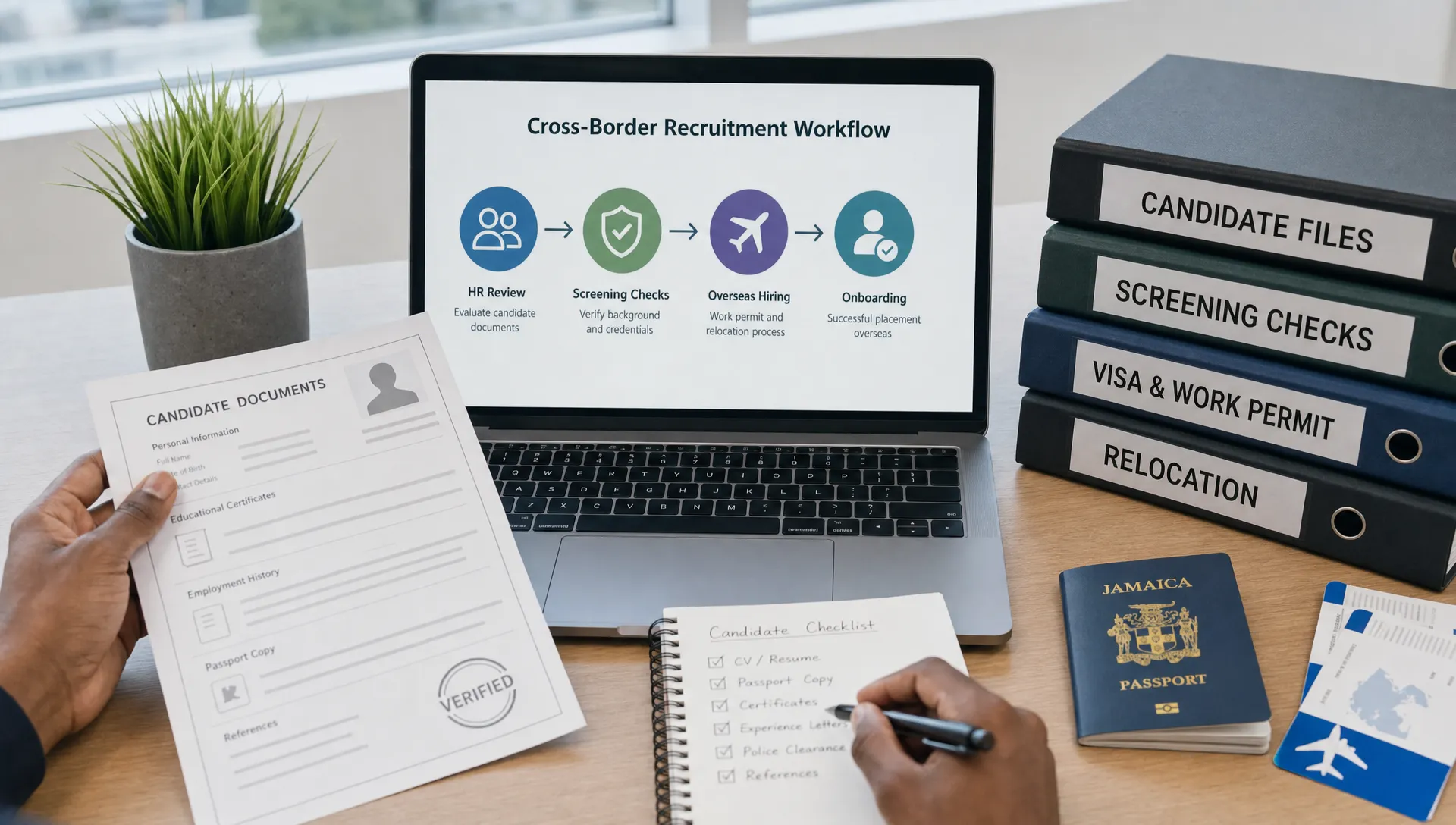
For international recruitment, the map should cover the full lifecycle from job advertisement to onboarding or rejection. It should include direct applications, referrals, recruitment agencies, video interviews, skills tests, background checks and immigration support.
A simple mapping exercise should answer these questions:
What personal data is collected at each recruitment stage?
Which information is mandatory and which is optional?
Which countries are involved in storage, access or screening?
Which vendors or agencies process candidate data?
What happens to unsuccessful candidate records?
PLMC has also discussed this broader discipline in the context of assessing privacy risk in HR workflows, which is a useful starting point for organisations that want a structured review before changing recruitment practices.
Privacy safeguards for international recruitment notices
A candidate privacy notice should be written for the person applying, not only for lawyers or compliance teams. Candidates should understand what information is being collected, why it is being used, who may receive it and whether their data may be transferred overseas.
The notice should be available before or at the point of collection. For example, it should appear on the careers page, in the application portal or in the first communication from a recruitment agency. If the organisation later adds a new screening step, such as a criminal record check or psychometric assessment, the candidate should receive clear information before that processing begins.
For international hiring, notices should be specific about cross-border handling. A vague statement that data may be shared “with partners” is usually not enough for good governance. Candidates should be told if their data may be shared with recruitment agencies, group companies, background check providers, cloud hosting vendors, immigration advisers or overseas hiring managers.
A strong recruitment notice should cover:
The identity and contact details of the hiring organisation
The categories of personal data collected
The purposes for recruitment processing
The legal basis or condition relied on where applicable
Recipients or categories of recipients
Countries involved in transfers or remote access
Retention periods for successful and unsuccessful applicants
Candidate rights and how to exercise them
Collect only what the role requires
Data minimisation is one of the most important safeguards in recruitment. It is easy for hiring teams to ask for more information than they need because “that is how we have always done it.” International hiring does not justify collecting passports, national identification numbers, medical details or family information at the first application stage unless there is a clear need.
A better approach is staged collection. At the CV stage, the organisation may only need contact details, work history, education, skills and eligibility to work. Identity verification, references and background screening can usually wait until later in the process, often after a conditional offer.
This approach reduces exposure if an application portal is compromised or if a candidate is not shortlisted. It also makes the process feel more respectful. Candidates are more likely to trust an organisation that asks for sensitive information only when the reason is clear.
Recruitment stage | Data commonly needed | Privacy safeguard |
Initial application | CV, contact details, role preferences | Avoid collecting ID documents too early |
Shortlisting | Skills, experience, interview notes | Limit access to the hiring panel |
Assessment | Test results, work samples, scoring criteria | Tell candidates how assessments are used |
Conditional offer | References, qualifications, identity checks | Collect only checks relevant to the role |
Onboarding | Work permit records, payroll details, emergency contact | Separate employee file from recruitment file |
Manage cross-border transfers before data moves
International recruitment often involves candidate data crossing borders even when the employer is based in Jamaica. Data may be stored in another country by an applicant tracking system, reviewed by a hiring manager abroad or sent to a screening provider in the candidate’s home country.
Before those transfers happen, organisations should assess whether the receiving party provides appropriate protection. This is especially important where the candidate is located in a jurisdiction with stronger privacy expectations or where overseas laws may apply to the Jamaican organisation.
A practical transfer review should look at the destination country, the type of data, the sensitivity of the information, the recipient’s security controls and the contract terms governing the transfer. If the organisation is unsure whether a foreign privacy law applies, it should assess the trigger points early. PLMC’s guidance on when overseas data laws apply to Jamaican companies explains common scenarios such as targeting overseas individuals or processing data for foreign clients.
Put proper contracts in place with agencies and vendors
Recruitment agencies, background screening companies, assessment platforms, HR software providers and immigration advisers may all handle candidate information. The hiring organisation should not rely on informal assurances that data is “kept confidential.” Privacy responsibilities need to be set out in writing.
Contracts should define each party’s role, the permitted purposes for processing, confidentiality obligations, security requirements, breach notification timelines and instructions for deletion or return of data. If a vendor uses subcontractors, the contract should explain when that is allowed and what protections must flow down to those subcontractors.
For international recruitment, contracts should also cover cross-border transfers and cooperation with candidate rights requests. If a candidate asks for access to their data or challenges an inaccurate screening result, the employer needs the vendor to respond quickly and preserve evidence of how the decision was made.
If overseas clients, parent companies or service providers are involved, privacy clauses should be aligned with the broader commercial relationship. PLMC’s article on privacy clauses for contracts with overseas clients offers a useful framework for thinking about roles, security and breach response in cross-border arrangements.
Control access inside the organisation
Recruitment data should not be visible to everyone in HR or management. Access should be based on role and need. A hiring manager may need the CV and interview notes, but not passport copies. A payroll officer may need onboarding details for the successful candidate, but not assessment notes for unsuccessful applicants.
Access controls matter even more when recruitment is international because teams may work across time zones, devices and locations. Remote access should be protected with strong authentication, secure devices and clear rules on downloading or forwarding candidate records.
Where possible, organisations should avoid sending candidate data through personal email or messaging apps. Files stored in shared drives should have restricted permissions and naming conventions that make retention easier. Interview panels should also be reminded that informal notes about candidates can become personal data if they are recorded and used in decision-making.
Treat background checks and screening as high risk
Background screening can be necessary for roles involving finance, children, vulnerable persons, regulated sectors, security or senior leadership. It can also become intrusive if the scope is too broad. International checks are especially sensitive because rules, records and cultural expectations differ from country to country.
Employers should define screening criteria before the process starts. A check should be connected to the role and proportionate to the risk. For example, anti-money laundering compliance roles may require more detailed integrity and sanctions screening than a general administrative position.
Candidates should be told what checks will be conducted, who will conduct them and how results may affect the hiring decision. If adverse information is found, the candidate should have a fair opportunity to respond, especially where records may be incomplete, outdated or related to a different person with a similar name.
Be careful with special category and highly sensitive data
International recruitment may involve data that deserves additional protection, including health information, biometric data, immigration documents, financial information, criminal records or equal opportunity monitoring data. Some of this information may be necessary at certain stages, but it should not be collected casually.
Health information should generally be limited to what is needed for workplace accommodation, fitness for a specific role or legal obligations. Biometric checks, such as facial recognition for remote identity verification, should be assessed carefully because they can create lasting risk if mishandled. Immigration documents should be stored securely and accessed only by people responsible for work authorisation or onboarding.
If a recruitment process uses artificial intelligence, automated scoring or psychometric profiling, the organisation should be able to explain how the tool supports decision-making. It should also check whether the tool creates discriminatory outcomes or collects more data than the employer needs.
Train hiring teams before the campaign starts
Privacy safeguards work only if recruiters, managers and interviewers understand them. Training does not need to be complicated, but it must be practical. The people involved in hiring should know what they may ask, what they should not record, how to store candidate notes and when to escalate a privacy concern.
Training should also cover security awareness. Phishing attacks often target HR teams because CVs, cover letters and identity documents are expected attachments. Recruiters should know how to recognise suspicious files, verify sender identities and avoid moving candidate data into unapproved tools.
For technical roles or teams involved in cyber security, cloud platforms or IT governance, certification readiness can strengthen the wider control environment. Structured resources such as certification exam prep and practice tests can support professionals building knowledge in areas like CompTIA, AWS, Azure and related technology disciplines.
Set retention rules for successful and unsuccessful candidates
Recruitment records should not be kept indefinitely. Retention periods should reflect the purpose of the record, legal requirements, limitation periods and the organisation’s legitimate business needs. The records of a successful candidate may move into an employee file, but not every interview note or application document needs to follow them.
For unsuccessful candidates, the organisation should decide whether records will be deleted after a defined period or kept in a talent pool with the candidate’s knowledge. If a talent pool is used, candidates should understand how long their information will be retained and how they can ask for removal.
Retention rules should be supported by systems. If the applicant tracking platform does not allow automated deletion or easy export, the organisation should create a manual review process. Privacy compliance often fails not because a policy is missing, but because nobody owns the deletion step.
A practical safeguard checklist for international recruitment
Organisations do not need to make the hiring process slow to make it privacy conscious. The aim is to build predictable safeguards into the workflow so recruiters can move quickly without improvising around personal data.
Safeguard | Why it matters | Owner |
Recruitment data map | Shows where candidate data moves and who touches it | HR with privacy lead |
Candidate privacy notice | Supports transparency and fair processing | HR and legal or compliance |
Vendor due diligence | Confirms agencies and platforms can protect data | Procurement and compliance |
Cross-border transfer review | Identifies foreign law and transfer risks | Privacy or legal team |
Role-based access | Limits internal misuse or accidental exposure | HR and IT |
Screening protocol | Keeps checks relevant and proportionate | HR and hiring manager |
Retention schedule | Prevents unnecessary long-term storage | HR records owner |
Incident response plan | Enables quick action if candidate data is compromised | Compliance, IT and management |
This checklist should be reviewed before a major recruitment campaign, especially where the role targets candidates in several jurisdictions or involves sensitive screening.
Governance turns recruitment privacy into a repeatable process
Privacy safeguards for international recruitment are most effective when they sit within a broader governance, risk and compliance framework. HR should not carry the burden alone. Legal, compliance, IT, procurement and senior management all have a role in making sure candidate data is handled responsibly.
For Jamaican organisations, the Data Protection Act, 2020 provides the local foundation, but international recruitment may require a wider view. A privacy-aware recruitment process can support regulatory compliance, strengthen candidate trust and reassure global partners that the organisation can manage personal data professionally.
The practical starting point is simple: know what you collect, explain it clearly, limit who receives it, protect it properly and delete it when it is no longer needed.
Frequently Asked Questions
Does Jamaica’s Data Protection Act, 2020 apply to recruitment records? Yes. Recruitment records usually contain personal data, including CVs, contact details, interview notes and screening results. Employers should handle that information in line with data protection principles such as fairness, purpose limitation, security and appropriate retention.
Can a Jamaican employer collect passport details from overseas candidates? It depends on the stage and purpose. Passport details may be needed for identity verification, immigration or onboarding, but collecting them from every applicant at the first stage is often excessive. A staged approach is usually safer.
What should be included in an international recruitment privacy notice? The notice should explain what data is collected, why it is collected, who receives it, whether it is transferred overseas, how long it is kept and how candidates can exercise their rights.
Are recruitment agencies responsible for data protection too? Yes. Agencies and vendors that handle candidate data should have their own controls and should be bound by clear contractual terms. The hiring organisation should conduct due diligence before sharing candidate information.
How long should unsuccessful candidate data be kept? There is no single period that fits every organisation. The retention period should be justified by legal, operational and risk considerations. If candidates are placed in a talent pool, they should be told and given a way to opt out or request deletion.
Strengthen your international recruitment privacy controls
International hiring should not expose your organisation to avoidable privacy, security or compliance risk. Privacy & Legal Management Consultants Ltd. helps organisations in Jamaica assess HR workflows, implement data protection controls, train staff and align recruitment practices with governance obligations.
If your organisation is planning an overseas hiring campaign, working with recruitment vendors or reviewing Data Protection Act readiness, consider booking a consultation with PLMC to identify practical safeguards before candidate data starts moving across borders.