

When Overseas Data Laws Apply to Jamaican Companies

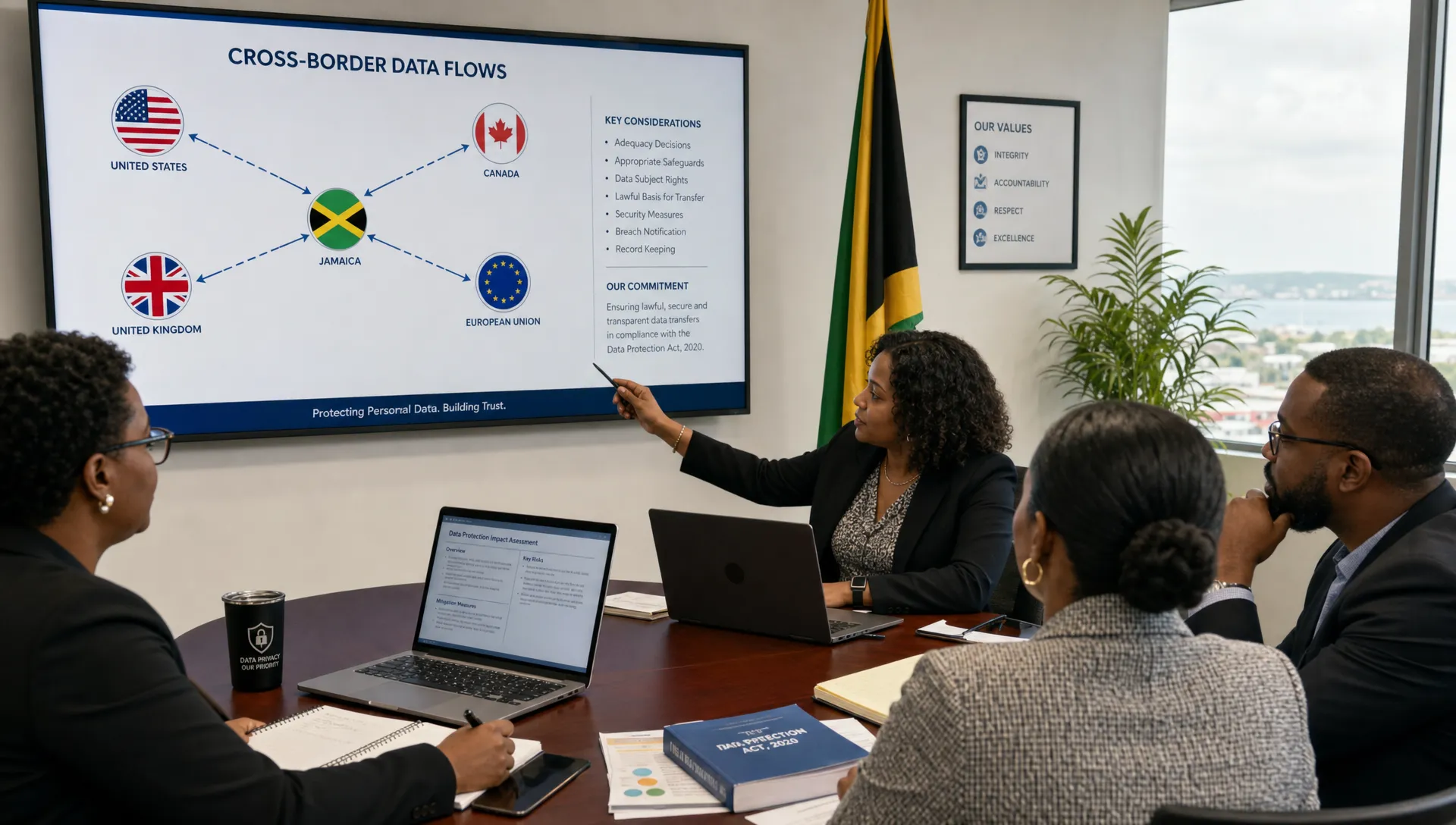
Jamaican companies increasingly sell services, host platforms, manage customer support, process payments and work with clients outside Jamaica. That creates a practical question for boards and managers: when does a law from another country apply to a company that is incorporated, staffed or managed in Jamaica?
The short answer is that location is only one part of the analysis. Overseas data laws can apply when a Jamaican company targets people abroad, monitors their behaviour, processes personal data for an overseas client, stores data in another country or handles regulated information under a foreign contract. The risk is not limited to large exporters. A small e-commerce business, hotel, call centre, fintech, professional services firm or software provider can all become subject to foreign privacy obligations.
Start with Jamaica's own data protection obligations
Before looking overseas, a Jamaican company should first understand its local baseline under the Data Protection Act 2020. The Act sets expectations for lawful processing, transparency, security, accountability and respect for individual rights. Those principles are also common in many international privacy regimes, which means strong Jamaica data privacy governance makes foreign compliance easier.
Local compliance does not automatically solve every overseas issue. A Jamaican privacy notice, consent form or security policy may need additional wording if the company handles EU, UK, Canadian, US or other foreign personal data. Still, a well implemented local programme gives management a practical foundation for cross-border controls.
If your organisation is still confirming its domestic obligations, it is worth reviewing who Jamaica's Data Protection Act applies to before assessing foreign laws. The overseas analysis should build on that baseline rather than replace it.
The main triggers that bring overseas data laws into scope
Overseas data laws usually apply because there is a legal connection, often called a nexus, between the Jamaican company and the foreign jurisdiction. That connection may be commercial, technical, contractual or behavioural.
Common triggers include:
Targeting overseas customers: Marketing, selling or providing services to individuals in another country can bring that country's privacy law into scope.
Monitoring people abroad: Tracking website behaviour, profiling users, running targeted ads or using analytics for foreign users may trigger foreign requirements.
Processing data for an overseas client: A Jamaican processor may be required to follow the client's privacy law through contract terms, even where direct regulation is less clear.
Having staff, agents or operations overseas: A branch, representative, remote team or local sales operation can create a stronger jurisdictional link.
Transferring data across borders: Moving personal data from one country to another can trigger transfer rules, safeguards and contractual controls.
Handling sector-specific data: Financial, health, children's, telecoms or payment data may fall under special overseas regimes.
The key point is that overseas privacy exposure often arises from what the company does with personal data, not only where the company is registered.
When overseas data laws apply by region
Different countries use different tests for territorial scope. Some focus on establishment, some on targeting residents, some on commercial thresholds and some on contracts. A Jamaican company should avoid assuming that all privacy laws operate like the GDPR or like the Data Protection Act 2020.
Region or framework | Common trigger for Jamaican companies | Practical impact |
EU GDPR | Offering goods or services to people in the EU/EEA or monitoring their behaviour | May require GDPR-compliant notices, lawful basis analysis, data subject rights processes, processor clauses and transfer safeguards |
UK GDPR | Offering goods or services to people in the UK or monitoring UK individuals | Similar to GDPR, with UK-specific regulator expectations and transfer rules |
US privacy and sector laws | Doing business with US residents, meeting state law thresholds or handling regulated data such as health, finance or children's data | May require notices, opt-out rights, vendor terms, security controls or sector-specific safeguards |
Canada privacy laws | Commercial handling of Canadian personal information or contracts with Canadian organisations | May require consent, openness, safeguards, access rights and breach response controls |
Brazil LGPD | Processing personal data of individuals in Brazil or offering goods or services there | May require legal basis, rights management, security measures and controller or processor governance |
Caribbean privacy laws | Serving individuals or entities in regional markets with local data protection rules | May require country-by-country review, especially for customer data shared across Caribbean borders |
EU and UK rules
For many Jamaican companies, the most familiar overseas issue is GDPR Jamaica compliance. The EU General Data Protection Regulation has express territorial scope provisions. In broad terms, it can apply to a non-EU organisation that offers goods or services to people in the EU or monitors their behaviour in the EU. The UK GDPR follows a similar approach for the United Kingdom.
A Jamaican hotel that markets packages directly to EU residents, prices services in euros, collects passport details and sends targeted remarketing emails may need a GDPR assessment. So might a Jamaican software company that monitors app usage by EU subscribers.
The analysis is fact-specific. A website that is merely accessible from Europe is not the same as actively targeting EU customers. Evidence such as advertising strategy, currency choices, language options, shipping or booking arrangements and customer support channels can matter.
US rules
The United States does not have one single federal privacy law equivalent to the GDPR. Jamaican companies may instead encounter a patchwork of state privacy laws and sector rules. These can matter when a company serves US consumers, processes data for a US business or handles regulated information.
For example, a Jamaican service provider working with a US healthcare, financial services or education client may face detailed contractual privacy and security duties. A company selling online to US residents may also need to examine whether any state privacy law applies based on thresholds, customer numbers, revenue or data-sharing practices.
US exposure is often driven by contract as much as statute. A Jamaican vendor may be required to meet audit, breach notice, security and data deletion obligations because the US client must impose those obligations on its service providers.
Canada, Latin America and the Caribbean
Canada, Brazil and several Caribbean jurisdictions also have data protection rules that can affect Jamaican businesses. These laws may apply when a company collects personal data from residents, provides services in that market or supports a local organisation as a processor.
Caribbean operations deserve special attention because regional business often feels informal. Shared customer databases, group marketing campaigns, inter-company transfers and centralised HR systems can create cross-border data protection compliance obligations even where the countries are geographically close.
Jamaican companies expanding beyond the island should treat each market as a separate compliance question. A useful starting point is to identify the people whose data is being collected, the entity deciding how the data is used and the country where the service is being offered.
Direct legal duty or contractual obligation?
A foreign law may affect a Jamaican company in two different ways. It may apply directly because the company meets the law's territorial scope test. Alternatively, it may apply indirectly because a client, partner or group company passes obligations down through a contract.
That distinction matters. Direct application can create regulatory exposure, including complaints, investigations or penalties in the foreign jurisdiction. Contractual application can create commercial exposure, including audit findings, indemnity claims, termination rights or loss of future business.
In practice, both routes often overlap. A Jamaican BPO provider supporting a European company may not only receive GDPR clauses in its service agreement, but also process EU personal data in a way that requires robust operational controls. A Jamaican cloud, payroll or marketing vendor may face similar expectations from overseas clients.
This is why contracts should not be treated as routine paperwork. Clear definitions of controller, processor, sub-processor, breach notice, audit rights, data return, deletion and cross-border transfers are essential. For more detail on this point, see PLMC's guidance on privacy clauses for contracts with overseas clients.
A practical test for Jamaican companies
A board, compliance officer or operations manager can begin with a structured screening exercise. If the answer is yes to any of the following questions, the company should assess the relevant overseas law before signing the contract, launching the service or expanding the campaign.
Do we market goods or services to individuals outside Jamaica?
Do we collect personal data from overseas website users, app users, guests, patients, donors, students or customers?
Do we track, profile or target people in another country through cookies, analytics or advertising tools?
Do we process personal data for a foreign client, parent company, franchise, partner or affiliate?
Do our contracts mention GDPR, UK GDPR, HIPAA, GLBA, CCPA, PIPEDA, LGPD or another overseas law?
Do we store, access or support personal data in systems hosted outside Jamaica?
Do we use overseas vendors for payroll, HR, CRM, marketing, cloud hosting, payments or customer support?
Do we handle sensitive information such as health data, financial records, biometric data, children's data or identity documents?
This screening is not a final legal opinion. It is a governance tool that helps management identify when specialist review is needed.
What compliance looks like when more than one law applies
Overlapping laws do not always mean a company needs separate privacy programmes for every country. Many organisations use a lead privacy framework and then add jurisdiction-specific controls where needed. For a Jamaican company, the Data Protection Act 2020 can serve as the local anchor, while higher or more specific overseas requirements are layered onto the programme.
Good multi-jurisdiction compliance usually includes data mapping, role analysis, a lawful basis or consent review, privacy notices, vendor due diligence, contract controls, security measures, breach response procedures and records of decisions. Training is also necessary because overseas obligations often fail at the operational level, especially in sales, HR, customer support and IT.
Evidence matters. If a client, regulator or auditor asks how the company manages GDPR, NIS2, DORA or similar obligations, policies alone may not be enough. Organisations with heavier overseas exposure may benefit from structured systems such as AuditReady 2.0's compliance evidence and audit pack tools, especially where they need to organise controls, risks, incidents, registers and accountability records across multiple frameworks.
For companies trying to understand the wider regulatory landscape, PLMC's overview of international privacy rules Jamaican businesses cannot ignore can help identify which regimes deserve closer review.
Examples of overseas data law risk
A Jamaican hotel serving international guests
A hotel in Montego Bay may collect booking details, payment information, passport data, dietary preferences and marketing consent from guests in the EU, UK, Canada and the US. If it actively markets to those guests before they arrive, uses targeted advertising or shares data with overseas booking platforms, foreign privacy rules may need to be assessed.
The hotel should review its privacy notice, booking terms, retention periods, marketing consent practices and vendor contracts. It should also consider how guest rights requests will be handled if a foreign customer asks for access, deletion or correction.
A BPO provider supporting a foreign client
A Jamaican BPO provider may process customer records, call recordings, identity details or complaint data on behalf of a Canadian, US or European company. Even where the overseas law does not clearly apply directly, the client will often impose privacy, security, audit and breach notification obligations by contract.
The BPO should know whether it is acting as a processor or service provider, which sub-contractors have access to the data and what breach notification timeline applies. Staff training, call handling procedures and access controls are critical.
An online retailer selling outside Jamaica
A Jamaican e-commerce business may ship goods overseas, collect billing and delivery information, use email marketing tools and track online behaviour. If it deliberately targets foreign markets, overseas data laws may apply. The risk increases where the business uses behavioural advertising, sells to children or shares customer data with advertising partners.
The retailer should review cookie practices, marketing permissions, data sharing, refund and account deletion workflows and cross-border vendor arrangements.
A fintech or professional services firm with overseas clients
Financial services, accounting, legal, consultancy and fintech businesses often handle sensitive information. Overseas clients may require stronger due diligence because privacy overlaps with corporate governance, anti-money laundering compliance, cybersecurity and broader GRC obligations.
For these firms, overseas data law is rarely just a privacy issue. It affects client onboarding, vendor management, document retention, risk assessments, incident response and board reporting.
Common mistakes to avoid
The first mistake is assuming that incorporation in Jamaica is the only factor. Foreign regulators and clients usually look at the people affected, the market being targeted, the data being processed and the location of related operations.
The second mistake is treating a privacy policy as the whole compliance programme. A policy is useful only if the underlying practices support it. If the company promises deletion within a certain period, the systems and vendors must be able to deliver that outcome.
The third mistake is ignoring vendor chains. A Jamaican company may comply internally but lose control when data is sent to a cloud provider, email platform, payroll vendor, analytics provider or offshore support partner. Overseas privacy rules often require transparency and controls over sub-processors or downstream vendors.
The fourth mistake is waiting for a contract signature before reviewing privacy obligations. By then, pricing, staffing, technology and service commitments may already be fixed. Privacy review should happen during business development, procurement, expansion planning and product design.
How PLMC can support Jamaican organisations
Privacy & Legal Management Consultants Ltd. supports organisations in Jamaica with data protection implementation, corporate governance, anti-money laundering compliance, cybersecurity, GRC integration, training and risk assessment. For companies with overseas clients or cross-border operations, the goal is not to create unnecessary complexity. The goal is to identify where foreign obligations genuinely apply and build controls that are practical, defensible and aligned with business operations.
A focused review can help answer questions such as which overseas laws are relevant, what contracts should say, whether current privacy notices are adequate, how staff should be trained and what evidence should be kept for audits or client due diligence.
Frequently Asked Questions
Can GDPR apply to a Jamaican company with no office in Europe? Yes. GDPR may apply if the Jamaican company offers goods or services to people in the EU or monitors their behaviour there. The analysis depends on the facts, including targeting, marketing, user tracking and the nature of the service.
Does having a foreign customer automatically make overseas privacy law apply? Not always. A one-off customer may not be enough in some regimes. The risk increases where the company actively targets that market, processes significant personal data, monitors users or agrees to foreign-law obligations in a contract.
If an overseas law does not apply directly, can a Jamaican company still be bound by it? Yes. A foreign client may require the Jamaican company to follow GDPR, UK GDPR, US sector rules or other requirements through contractual clauses. Breaching those clauses can create commercial liability even where regulator exposure is uncertain.
Should Jamaican companies follow the strictest privacy law by default? Not automatically. A strict baseline can be efficient, but it may also create unnecessary operational commitments. A better approach is to map data flows, identify applicable laws and apply stronger controls where the risk justifies them.
What should a company do before expanding overseas? It should map personal data, identify target markets, review contracts, assess data transfers, update privacy notices, check vendors and train staff. Early review helps avoid costly redesigns after launch.
Overseas data laws apply to Jamaican companies when their business activities create a meaningful connection with another jurisdiction. That connection may come through customers, contracts, employees, vendors, technology or regulated data. By treating cross-border privacy as a governance issue rather than a last-minute legal formality, Jamaican organisations can protect customers, satisfy overseas partners and reduce compliance risk as they grow.