

Privacy Due Diligence for International Partnerships
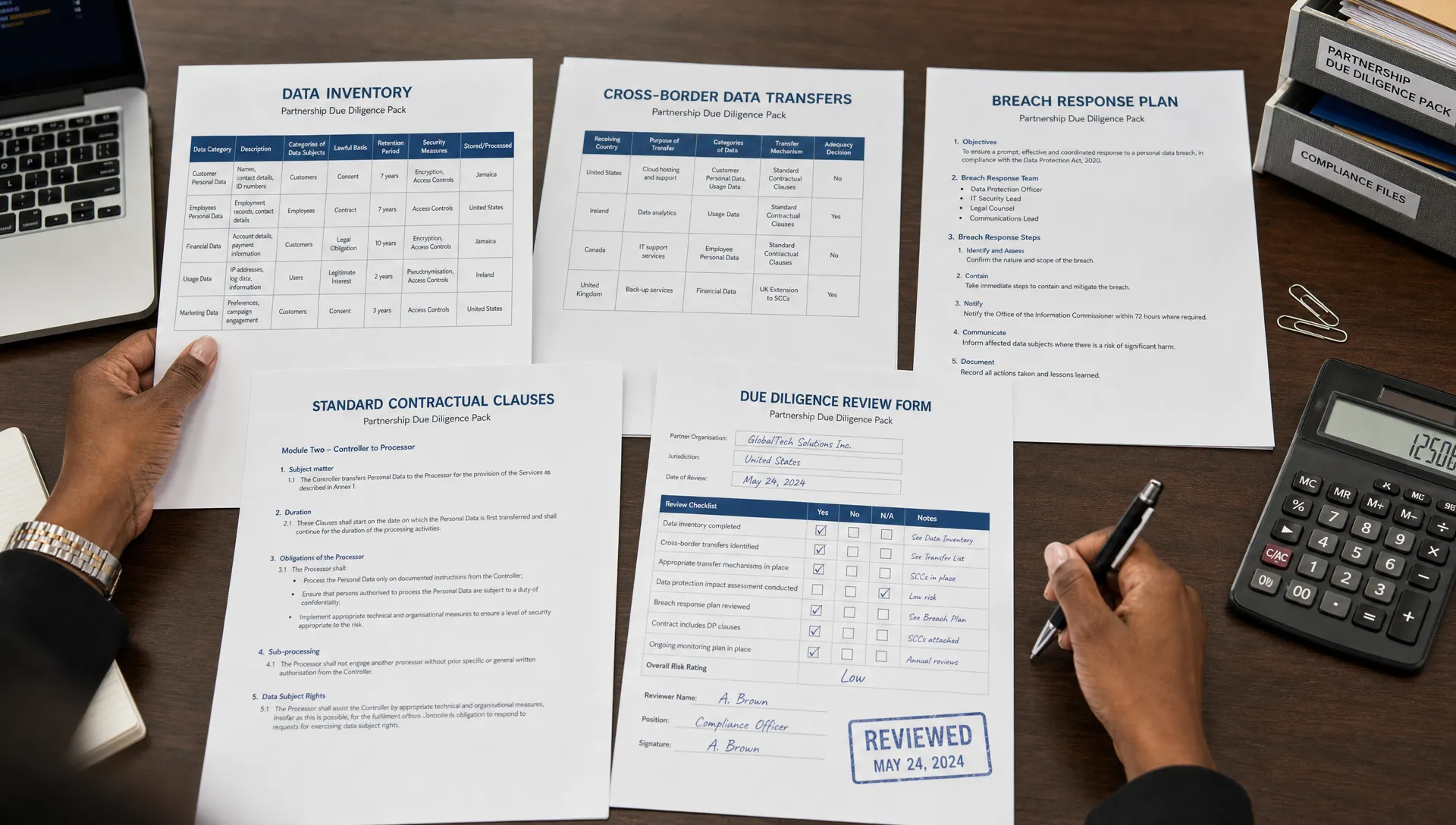
International partnerships can help Jamaican organisations access new markets, technology, funding, specialist services and global clients. They can also expose the business to privacy risks that are not obvious at the proposal stage. Privacy due diligence for international partnerships gives the board, legal team and compliance function a structured way to ask: what personal data will be shared, who controls it, which laws apply, how will it be protected and what happens if something goes wrong?
This is no longer a back-office issue. Under Jamaica’s Data Protection Act, 2020, organisations must be able to demonstrate responsible handling of personal data. When an overseas partner is involved, that responsibility can become more complex because foreign privacy laws, security expectations, sector rules and contractual audit rights may all apply at the same time.
Why privacy due diligence matters before you sign
A partnership can look commercially attractive while hiding privacy weaknesses that become expensive later. A university research collaboration may involve sensitive participant records. A fintech alliance may require customer onboarding data. A distribution arrangement may involve marketing databases. A business process outsourcing relationship may involve employee, customer or transaction data from multiple jurisdictions.
In each case, the Jamaican organisation should understand the privacy position before signing the memorandum of understanding, master services agreement, joint venture document or data sharing agreement. If that review is left until implementation, the business may already be committed to timelines, integrations or service levels that are hard to change.
By 2026, Jamaican organisations should treat data protection compliance as part of ordinary corporate governance. The Office of the Information Commissioner provides guidance and regulatory oversight for Jamaica’s privacy framework, and boards should expect management to identify privacy risk before entering arrangements that move personal data across borders.
Privacy due diligence is not the same as general vendor screening. It is broader than asking whether the other party has antivirus software or a privacy policy. It connects legal roles, data flows, transfer risks, cyber security, breach response, records management and accountability.
Privacy Due Diligence for International Partnerships: what to examine
A good review starts with the structure of the relationship. International partnerships can create several privacy arrangements, and the right obligations depend on how the parties actually behave.
One party may decide why and how personal data is processed. Another may process data only under instructions. In some cases, both parties independently use shared data for their own purposes. In other cases, the parties jointly decide the purpose of a project, such as a co-branded campaign or research initiative.
Those distinctions matter because privacy laws often attach different duties to controllers, processors, service providers or equivalent roles. Before the legal team drafts the agreement, the organisation should map the facts.
Data flows and data roles
Start by identifying the categories of personal data involved. This may include customer contact details, identification documents, employee records, financial information, health information, children’s data, geolocation data, complaint files or transaction histories. The review should also identify whether anonymised, pseudonymised or aggregated data will be shared, because those labels are sometimes used loosely.
A practical data map should show where data originates, where it will be stored, who can access it, which systems will process it and whether any onward transfers will occur. This is especially important when the partner uses cloud infrastructure, group companies or subcontractors in several countries.
For Jamaican organisations, the map should be compared against obligations under the Data Protection Act, 2020 and any foreign rules that may apply. If the partnership involves EU individuals, for example, the GDPR may be relevant. If the arrangement involves US consumers, sector-specific rules, state privacy laws or Federal Trade Commission expectations may also need review.
Lawful basis, notices and consent
A partnership may fail privacy due diligence if the data was never collected for the proposed use. For example, a customer database gathered for service delivery should not automatically be used for an overseas partner’s marketing campaign. Employee records collected for payroll should not be shared with a foreign analytics provider unless there is a clear purpose, lawful basis and transparency.
Review the privacy notices, consent language, terms of service and internal policies that applied when the data was collected. If the new partnership changes the purpose of processing, the organisation may need fresh notices, additional consent or a different legal justification. This is where Jamaica data privacy compliance intersects with customer trust: people should not be surprised by how their data is used.
Cross-border transfers and overseas laws
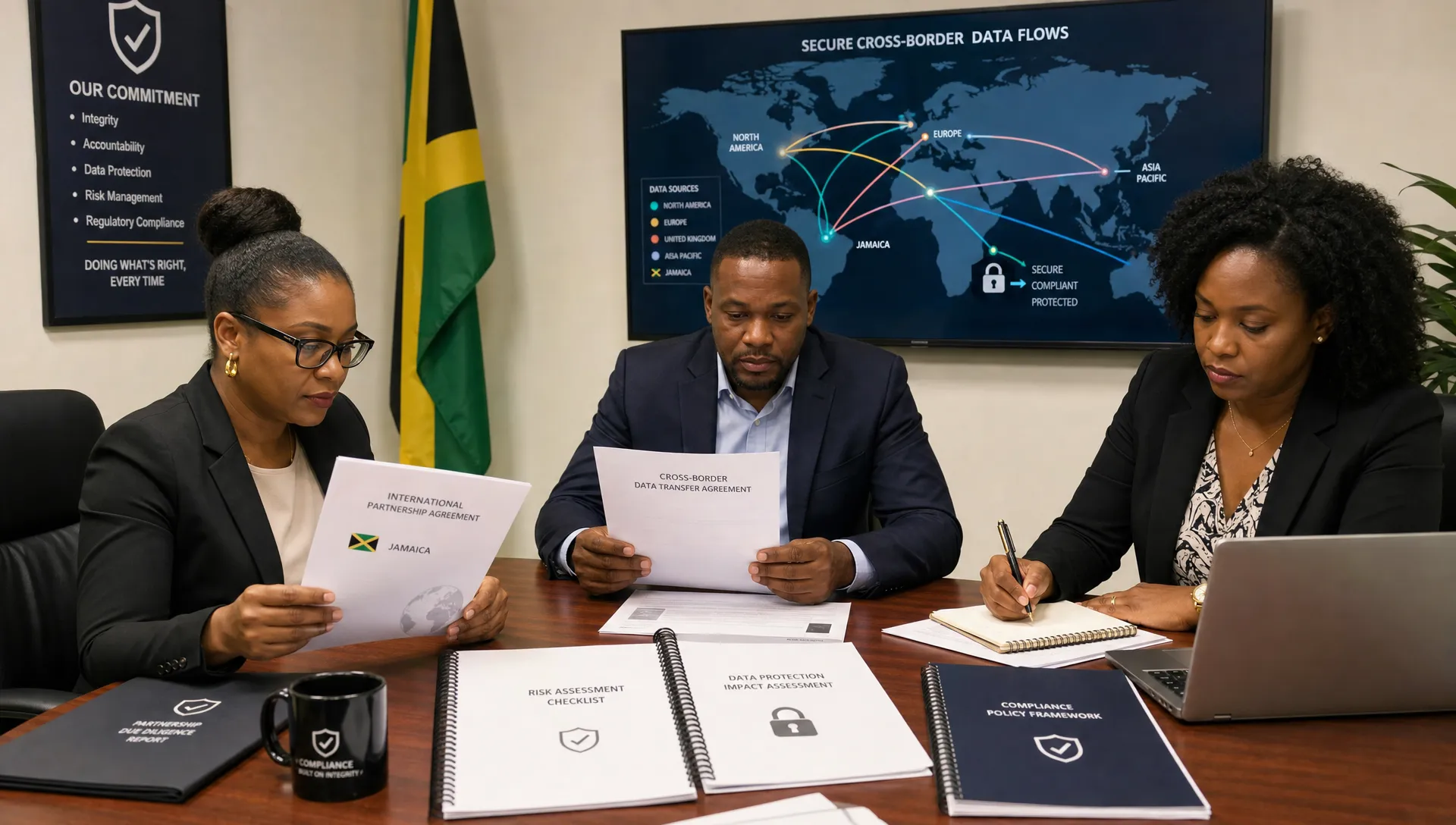
Cross-border privacy risk is not only about where the partner is incorporated. It is about where personal data can be accessed, stored, supported, backed up or disclosed. A partner in Canada may use a US cloud provider. A UK group company may route support tickets to India. A Caribbean partner may host its CRM in Europe.
The due diligence team should assess the transfer route and the applicable safeguards. If overseas privacy requirements are new to your organisation, PLMC’s guide on how to assess overseas privacy laws before expansion provides a useful companion framework for market entry reviews.
A cross-border review should not stop at legal adequacy. It should also consider government access risks, sector secrecy rules, data residency commitments, regulator expectations and contractual enforcement. These questions are especially important for financial services, health, telecommunications, education and public sector related partnerships.
A practical checklist for partnership privacy review
The following table can help compliance, legal and project teams organise privacy due diligence for international partnerships before negotiations are too advanced.
Review area | Key question | Evidence to request |
Data scope | What personal data will be shared or accessed? | Data inventory, sample data fields, processing description |
Purpose | Why is the data needed for the partnership? | Business case, project plan, purpose statement |
Legal roles | Who decides the purpose and means of processing? | Role matrix, draft data processing terms |
Transparency | Were individuals told about this type of use or sharing? | Privacy notices, consent records, customer terms |
Cross-border transfer | Which countries will access, store or support the data? | Hosting locations, support model, subcontractor list |
Security | How will data be protected in transit and at rest? | Security policy, encryption details, access control evidence |
Breach response | How will incidents be reported and managed? | Incident response plan, notification timelines, contact points |
Retention | How long will data be kept after the partnership ends? | Retention schedule, deletion or return procedure |
Audit rights | Can compliance be verified during the relationship? | Audit clause, assurance report, certification evidence |
Exit plan | What happens to data when the arrangement terminates? | Exit checklist, deletion certificate process, transition plan |
This table should be adapted to the risk level. A low-risk referral arrangement will not need the same depth as a joint analytics project involving financial records or special category data. The principle is proportionality, not paperwork for its own sake.
How to run the due diligence process
The most effective reviews are staged. If the team asks every question at once, the partner may become frustrated and the business team may see privacy as an obstacle. A staged approach helps separate deal-breakers from issues that can be managed through contract terms or operational controls.
Screen the partnership early
At concept stage, ask whether the partnership involves personal data, confidential business information, regulated data or access to systems. If the answer is yes, the project should be flagged for privacy and cyber review. The screening should also identify whether the arrangement involves high-risk individuals, such as children, patients, borrowers, employees or vulnerable customers.
This early screen helps avoid a common mistake: treating privacy review as a contract formality after the commercial terms are settled. By then, the business may have already promised data sharing, reporting dashboards, customer segmentation or offshore support without knowing whether those promises are compliant.
Request documents that prove maturity
A privacy questionnaire is useful, but answers should be supported by documents. Depending on risk, request privacy policies, data protection impact assessments, information security policies, breach response procedures, subcontractor registers, audit summaries, certifications, training records and sample contractual clauses.
The goal is not to collect documents for a file. The goal is to test whether the partner’s privacy programme operates in practice. A partner that cannot explain its data flows, retention periods or incident escalation process may create risk even if its website contains polished privacy language.
Score and escalate risks
Once the evidence is reviewed, the team should rate the partnership as low, medium or high risk. High-risk issues should be escalated to senior management, legal counsel, the data protection lead or the board committee responsible for risk.
Common escalation points include unclear data ownership, excessive data collection, weak security controls, broad onward sharing, refusal to accept breach notification duties, no deletion process and unexplained transfers to countries with unfamiliar privacy requirements.
A simple risk register can capture the issue, the likely impact, the proposed mitigation, the owner and the deadline. This connects privacy due diligence to wider corporate governance rather than leaving it as an isolated compliance exercise.
Red flags in international privacy partnerships
Some issues do not automatically prevent the partnership, but they should slow the process until the risk is understood. A partner that resists basic due diligence may not be ready to handle regulated data or meet global client expectations.
Look carefully at these warning signs:
The partner cannot identify where data will be hosted or accessed.
The partner wants broad rights to reuse personal data for its own analytics or marketing.
The draft contract has no breach notification timeline.
Subcontractors can be added without notice or objection rights.
The partner refuses reasonable audit or assurance requests.
The partner has no documented retention or deletion process.
Security claims are vague and unsupported by evidence.
The partner treats privacy as a legal formality rather than an operational responsibility.
Red flags should be documented and discussed with the business sponsor. Sometimes the solution is a narrower data set, stronger contract language, additional technical controls or a phased rollout. In other cases, the risk may outweigh the commercial benefit.
Contract terms should reflect the due diligence findings
Due diligence is only useful if the findings shape the final agreement. The contract should clearly describe the parties’ data roles, permitted purposes, security obligations, confidentiality duties, breach notification process, subcontractor controls, cross-border transfer safeguards, audit rights, retention rules and exit obligations.
If the partnership involves overseas clients or data moving from Jamaica to another jurisdiction, the contract should be more specific than a generic confidentiality clause. PLMC’s article on privacy clauses for contracts with overseas clients explains several contract areas that Jamaican businesses should consider when personal data crosses borders.
The agreement should also align with the operational reality. If support staff in another country will access data, the contract should say so. If the partner will use subcontractors, the approval mechanism should be clear. If personal data must be deleted within a set period after termination, the business team should confirm that deletion is technically possible.
Where privacy, AML and governance overlap
International partnerships often raise issues beyond data protection. In regulated sectors, privacy due diligence may sit alongside anti-money laundering checks, sanctions screening, fit and proper assessments, outsourcing reviews, cyber security reviews and financial crime controls.
These workstreams should not operate in silos. For example, AML compliance may require identity verification, transaction monitoring and record retention. Privacy compliance requires lawful, fair and secure processing of that same personal data. If the AML team retains records for a statutory purpose, the privacy team should understand and document that purpose rather than treating the data as ordinary customer information.
Corporate governance also matters. The board does not need to review every low-risk partnership, but it should approve the organisation’s risk appetite and expect management to report high-risk arrangements. Strong governance creates a record that the organisation considered privacy risk before the deal was signed.
For organisations trying to meet overseas expectations, PLMC’s guide on what global clients expect from your privacy controls can help benchmark the evidence a Jamaican company may be asked to provide.
Building a reusable partnership due diligence file
A single international partnership can create a lot of documentation. Rather than starting from scratch each time, organisations should build a reusable due diligence file that can be updated for future partners.
That file may include a data inventory, standard privacy questionnaire, approved contract clauses, security evidence pack, breach response contacts, training records, risk rating methodology, template data sharing agreement and board reporting format. Keeping these materials current can make future negotiations faster and more consistent.
Training is also essential. Business development teams, procurement officers, legal teams, project managers and executives should know when to involve privacy and compliance colleagues. Data privacy training Jamaica programmes should be practical, role-based and tied to the real decisions staff make when negotiating partnerships.
The strongest organisations do not treat privacy due diligence as a hurdle. They use it to negotiate better terms, protect customer trust, reassure global partners and reduce regulatory exposure.
Frequently Asked Questions
What is privacy due diligence for an international partnership? It is a structured review of how personal data will be collected, shared, accessed, stored, secured and deleted in a partnership involving an overseas party. It helps identify legal, operational, contractual and cyber risks before the organisation commits.
When should a Jamaican organisation conduct privacy due diligence? The review should start before signing any agreement that involves personal data, system access, customer records, employee data, financial information or cross-border processing. Early review gives the business more room to change the deal structure or add safeguards.
Does the Data Protection Act, 2020 apply if the partner is overseas? A Jamaican organisation may still have responsibilities under the Data Protection Act, 2020 if it controls or processes personal data in connection with the partnership. Overseas laws may also apply depending on the individuals involved, the markets targeted and where data is processed.
Is GDPR relevant to Jamaican businesses? GDPR can be relevant where a Jamaican organisation offers goods or services to people in the EU, monitors their behaviour or processes EU personal data on behalf of another organisation. This is why GDPR Jamaica questions should be assessed based on the facts of the partnership rather than assumptions.
What should be included in a partnership privacy clause? Key terms include data roles, permitted purposes, confidentiality, security controls, breach notification, subcontractor restrictions, cross-border transfer safeguards, audit rights, retention, deletion, return of data and cooperation with regulator or data subject requests.
Strengthen your next international partnership before you sign
International growth should not require guesswork about privacy, data protection or compliance. Privacy & Legal Management Consultants Ltd. supports Jamaican organisations with data protection implementation, corporate governance, anti-money laundering compliance, cyber security services, GRC integration, training and risk assessment support.
If your organisation is reviewing a cross-border partnership, joint venture or overseas client arrangement, engage privacy and compliance support early. Visit Privacy & Legal Management Consultants Ltd. to learn how PLMC can help you assess risks, prepare documentation and build stronger privacy controls before the agreement is signed.