

How to Assess Overseas Privacy Laws Before Expansion
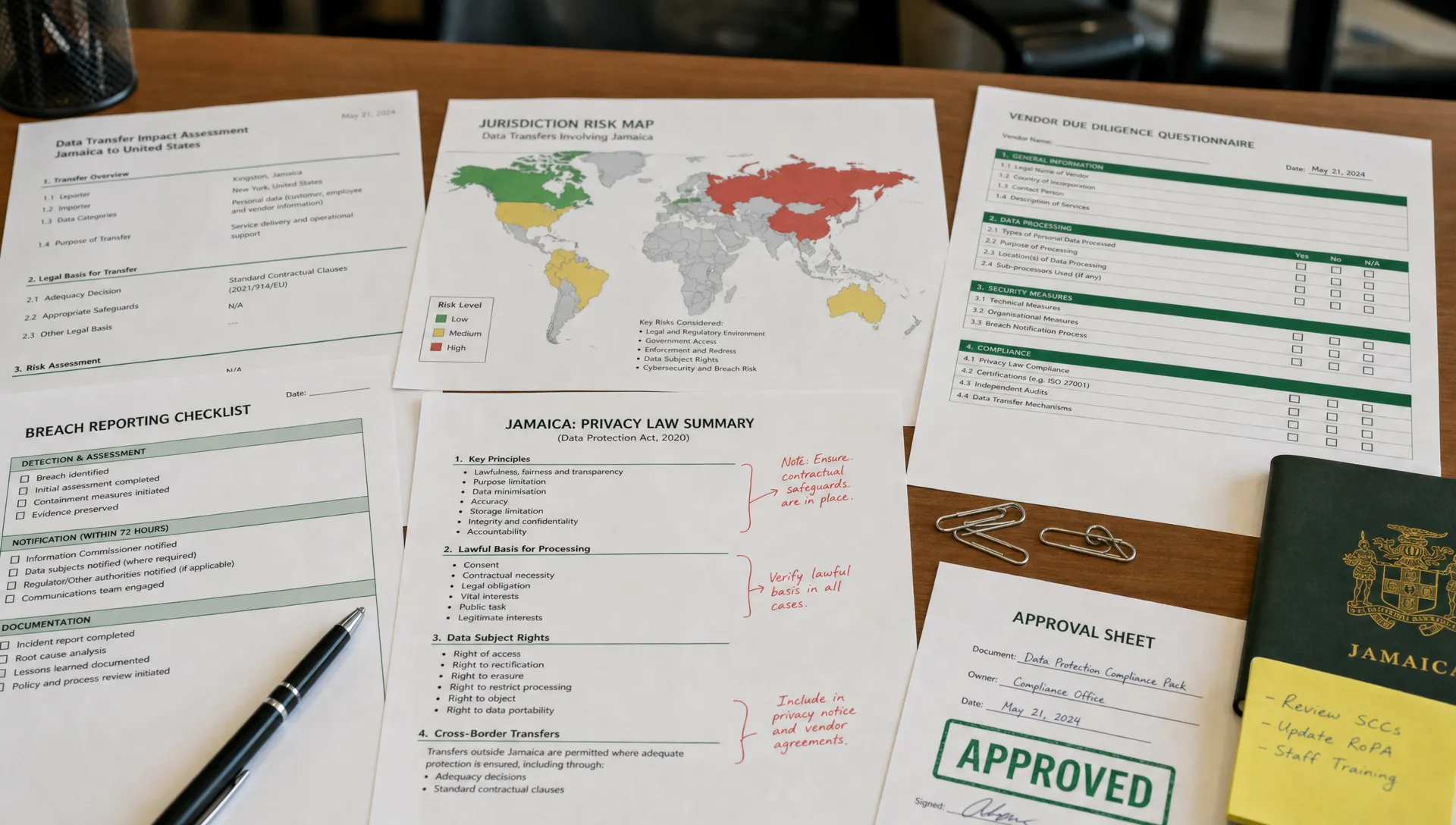
International expansion is rarely only a sales, tax or logistics decision. For Jamaican organisations, the moment a new market involves customer accounts, employee records, payment data, health details or digital identifiers, overseas privacy laws can change the launch plan. A disciplined assessment helps you decide where the data protection work is light, where legal advice is needed and where the risk is high enough to slow the rollout.
The goal is not to become an expert in every foreign statute. It is to ask the right questions early, compare the answers against Jamaica’s Data Protection Act 2020 and build a defensible record for management. That record can protect budgets, timelines, customer trust and corporate governance when expansion moves from idea to execution.
Start with the expansion model, not the statute book
The first privacy question is not which law applies. It is what the business will actually do in the new market. A company that only advertises brand content overseas faces a different risk profile from one that opens an e-commerce portal, hires local staff, uses a cloud provider abroad or processes identity documents for financial services.
Map the planned activity in practical terms. Identify the countries involved, the categories of people whose data will be handled, the systems that will receive the data and the third parties that will support the operation. This is the foundation for data protection compliance because foreign privacy laws usually attach to specific activities, not vague commercial ambition.
For example, overseas privacy laws may be triggered by selling to residents of a country, monitoring their behaviour online, hiring employees there, storing data on local infrastructure or using a vendor that processes data in that jurisdiction. The same expansion project can trigger several laws at once.
Build a map of overseas privacy laws before expansion
A privacy law map should show which countries are in scope and why. It does not need to be a 100-page legal memo at the first stage. It should be a working document that helps executives see the exposure clearly enough to make a decision.
Use a structured table so that legal, IT, marketing, HR and operations can work from the same facts. This avoids the common mistake of letting each department make its own assumptions about privacy risk.
Assessment item | What to confirm | Why it matters |
Target country | Where customers, employees or users are located | Many laws apply based on the individual’s location |
Business activity | Selling, marketing, hiring, analytics, support or outsourcing | Different activities create different legal triggers |
Data categories | Contact details, financial data, health data, biometrics or IDs | Sensitive data often attracts stricter controls |
Data flows | Where data is collected, stored, accessed and transferred | Cross-border transfers can require safeguards |
Local parties | Vendors, affiliates, agents or processors | Third parties can create shared compliance exposure |
Regulator | Which authority supervises privacy compliance | Enforcement style and reporting expectations vary |
If your business already operates across borders, it may help to compare this map with broader international privacy rules Jamaican businesses cannot ignore, then narrow the analysis to the specific market you plan to enter.
Compare new obligations with Jamaica’s baseline
Jamaican organisations should not treat overseas privacy laws as a separate universe. Start with your existing Jamaica data privacy programme, then identify the gaps between local obligations and the foreign requirements that may apply.
Under Jamaica’s Data Protection Act 2020, organisations should already be thinking about lawful processing, fairness, transparency, purpose limitation, security safeguards, data subject rights and accountability. Those concepts appear in many modern privacy regimes, although the terminology, timeframes and documentation requirements differ.
The comparison should answer a practical question: can your current controls support the new market without major redesign? If your organisation already maintains a data inventory, privacy notices, retention rules, security controls and vendor assessments, expansion is easier. If those controls are informal or incomplete, foreign obligations can expose weaknesses that were previously hidden.
This is also where corporate governance matters. Boards and senior management should see privacy as an expansion risk alongside tax, licensing, cyber security, anti-money laundering and operational resilience.
Questions to answer before launch approval
Before approving a new market, management should ask direct questions that produce evidence, not general comfort.
What personal data will be collected from people in the new market?
What lawful basis or legal permission will support each use of that data?
Will privacy notices need to be rewritten for local requirements?
Can individuals exercise access, correction, deletion, objection or similar rights?
Are there local breach reporting timelines or regulator notification rules?
Will any data be transferred back to Jamaica or to another country?
Which vendors will process personal data for the expansion project?
These questions are simple, but the answers often reveal whether the expansion timeline is realistic.
Check extraterritorial reach in your target markets
Some privacy laws can apply even if your company has no office in that country. This is known as extraterritorial reach. It is especially relevant for digital services, e-commerce, travel, finance, online education, health services, marketing technology and business process outsourcing.
The EU General Data Protection Regulation is a well-known example. The European Commission’s overview of EU data protection explains that GDPR protects individuals in the EU, and Article 3 extends its reach to some organisations outside the EU when they offer goods or services to people in the EU or monitor their behaviour.
In practice, the GDPR Jamaica question is not whether Jamaica is in Europe. It is whether a Jamaican business is targeting or monitoring people in Europe in a way that brings the GDPR into scope. The same logic can arise under UK privacy rules and under some US state privacy laws, although the tests and thresholds differ.
For the United States, privacy is often sectoral and state-based rather than a single national law. Jamaican firms that sell to US customers, support US clients or process US consumer data should review key US privacy rules for Jamaican firms as part of the assessment. The FTC’s business guidance on privacy and security is also a useful starting point for understanding US enforcement expectations around unfair or deceptive practices.
Review cross-border transfers, hosting and vendors
Expansion often changes where data travels. A company may collect data through a website, store it with a cloud provider, give access to a regional sales team and route customer support through a third-party platform. Each movement can create transfer risk.
Do not only ask where the headquarters of a vendor is located. Ask where data is stored, where support staff can access it, which sub-processors are used and whether data can be transferred for maintenance, analytics or backup. A vendor in one country may rely on infrastructure or support teams in several others.
Overseas privacy laws may require contractual safeguards, transfer impact assessments, local consent, regulator approval or restrictions on onward transfers. The exact requirement depends on the jurisdiction, the type of data and the role of each party. If third parties are central to your expansion, a risk-based vendor review should happen before signing. A practical starting point is to run a simple vendor privacy assessment before personal data is shared.

Create a country risk profile that management can use
A useful assessment should lead to a decision, not just a list of legal issues. Convert your findings into a country risk profile that management can understand. The profile should show whether the expansion can proceed, proceed with controls or pause for specialist advice.
Risk area | Low-risk indicator | Higher-risk indicator |
Scope of law | No targeted sales or monitoring in the country | Active targeting of residents or behavioural tracking |
Data sensitivity | Basic contact and account data | Health, biometric, financial, child or identity data |
Local operations | No employees or local premises | Local hiring, licensing or regulated activity |
Transfers | Data remains in approved systems with clear contracts | Multiple unknown vendors or unclear hosting locations |
Individual rights | Existing process can support requests | No workflow for foreign rights or language needs |
Enforcement exposure | Limited public-facing activity | Large customer base, complaints risk or regulator interest |
The risk profile should be reviewed by the project owner, compliance lead, IT security lead and senior management. If the expansion touches regulated financial services, anti-money laundering controls should also be reviewed because customer due diligence, sanctions screening and transaction monitoring often involve sensitive personal data.
Do not separate privacy from governance, AML and cyber security
Privacy risk becomes harder to manage when it is treated as a legal department issue only. Overseas expansion affects systems, people, contracts and controls. A proper assessment should therefore connect data protection with broader governance, risk and compliance work.
For corporate governance, the board should understand whether privacy risk has been identified, assigned to an accountable owner and tracked through a decision log. The organisation should also know whether policies, training, reporting lines and escalation processes are ready for the new market.
For cyber security, assess whether the technical controls match the sensitivity of the data and the expectations of the target jurisdiction. Foreign regulators often examine whether security measures were reasonable for the nature of the processing. Encryption, access controls, logging, vulnerability management, incident response and backup practices may become central evidence after a breach.
For anti-money laundering, privacy and compliance teams should coordinate rather than compete. AML rules may require collection and retention of identity data, but privacy rules still require lawful processing, transparency, security, access controls and appropriate retention management.
Document decisions before you spend on the market
A privacy assessment has little value if it is not documented. If management approves expansion, the organisation should be able to show what information was considered, which laws were screened, what risks were accepted and which controls were required before launch.
The record does not need to be overly complex. It should include the expansion summary, data map, applicable laws, key compliance gaps, vendor risks, transfer issues, recommended controls, accountable owners and target dates. If legal advice was obtained, the decision record should reference it without exposing privileged detail unnecessarily.
Documentation is also useful when plans change. Expansion projects rarely stay fixed. Marketing may add new tracking tools, HR may hire local staff faster than expected or operations may add a new processor. A living record makes it easier to reassess privacy risk before those changes become embedded.
The best time to assess overseas privacy laws is before contracts are signed, campaigns go live or customer data is collected. Waiting until after launch can turn a manageable gap into a remediation project with reputational and operational consequences.
When to get specialist support
Not every expansion requires extensive external advice. If the market is small, the data is limited and your existing controls are mature, an internal screening may be enough to decide the next steps. Specialist support becomes more valuable when the project involves sensitive data, regulated sectors, multiple jurisdictions, complex vendors, cross-border transfers or uncertainty about extraterritorial laws.
A consultant or legal adviser should help you translate legal requirements into operational controls. That means reviewing data flows, advising on governance, improving documentation, supporting training and helping teams understand what must change before launch. For organisations in Jamaica, this support should also fit local Data Protection Act, 2020 obligations rather than treating foreign law in isolation.
Frequently Asked Questions
Do Jamaican businesses need to comply with foreign privacy laws if they have no overseas office? Sometimes, yes. A foreign law may apply if the business targets people in that country, monitors their behaviour, hires local employees, processes local customer data or uses regulated data in connection with that market.
Is GDPR relevant to a Jamaican company? It can be. GDPR may apply where a Jamaican company offers goods or services to people in the EU or monitors their behaviour. A fact-specific assessment is needed before assuming it does or does not apply.
What should be assessed first before entering a new country? Start with the business model and data flows. Confirm whose data will be collected, what data will be used for, where it will be stored, which vendors are involved and whether data will be transferred across borders.
How often should an overseas privacy assessment be updated? Update it whenever the expansion model changes. New vendors, new marketing tools, new data categories, new countries, local hiring or a major regulatory change can all justify a reassessment.
Plan expansion with privacy built in
Assessing overseas privacy laws before expansion is not a box-ticking exercise. It is a practical way to protect customer trust, avoid avoidable delays and give management a clearer view of risk before entering a new market.
Privacy & Legal Management Consultants Ltd. supports organisations with data protection implementation, corporate governance, anti-money laundering compliance, cyber security, GRC integration and privacy training. If your organisation is planning cross-border growth, you can explore support through Privacy & Legal Management Consultants Ltd. and request guidance before personal data starts moving across borders.