

Presenting Incident Lessons at a Security and Privacy Conference
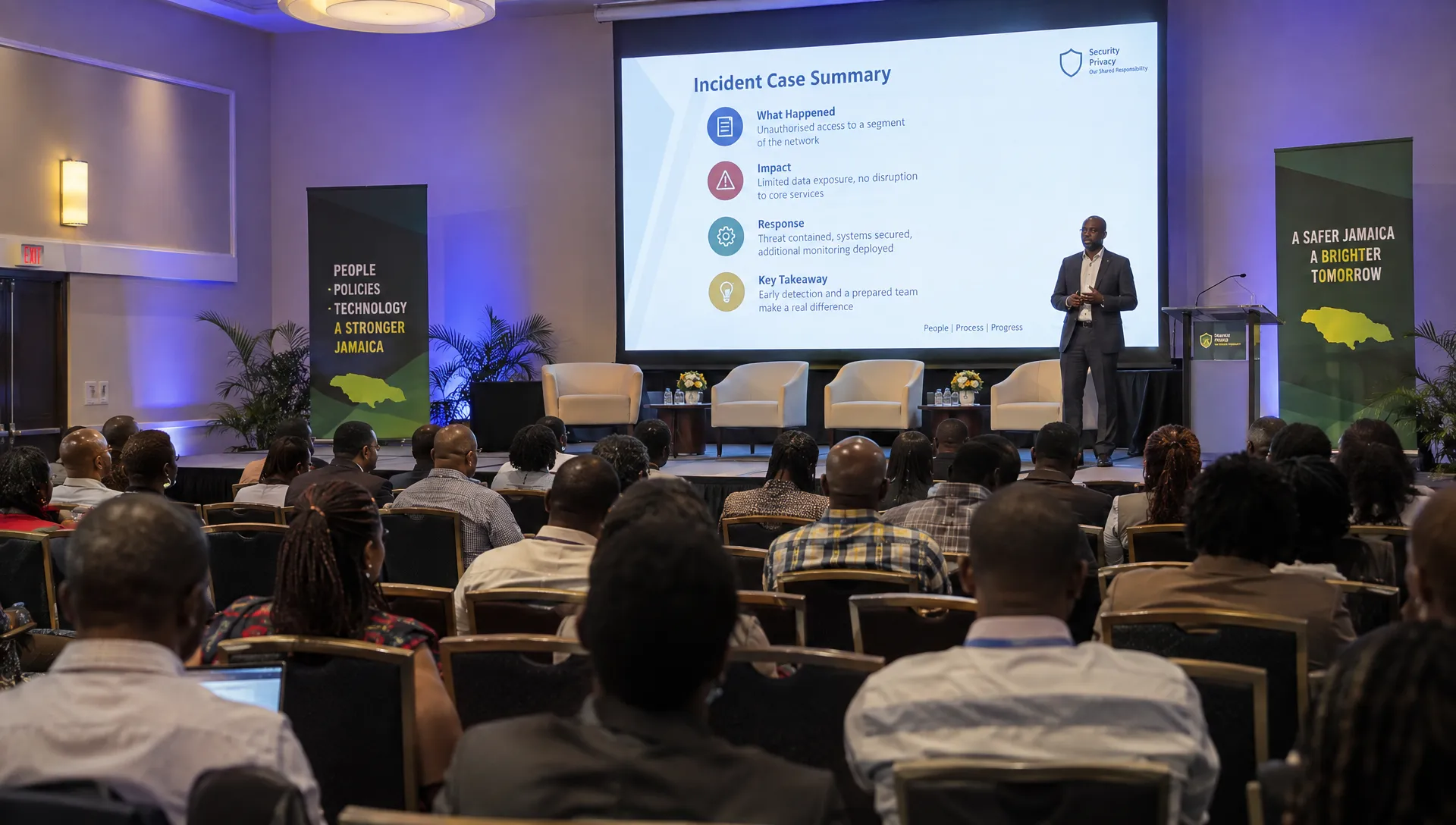
An incident presentation at a security and privacy conference should help other organisations make better decisions, not simply describe what went wrong. The strongest sessions explain what the team knew, which choices it faced, how people could be affected and what changed afterwards. They also protect personal data, confidential evidence and details that could expose unresolved weaknesses.
For Jamaican organisations, this means connecting cyber security response with obligations under the Data Protection Act, 2020, without turning the presentation into a legal opinion or a public investigation. Security practitioners, privacy officers and compliance leaders need a shared account of the incident, but they may draw different lessons from it.
This guide explains how to select a useful case, approve material for disclosure and build a presentation that gives the audience practical lessons without creating another risk.
Choose an incident with a transferable lesson
Start with the decision you want the audience to understand. At a security and privacy conference, a modest incident with a clear control failure can be more useful than a dramatic breach whose details cannot be shared.
Good subjects include an access permission that survived a role change, a misdirected disclosure, a supplier escalation that arrived too late or a response plan that did not identify who could authorise containment. Each offers a lesson that another organisation can apply without needing your entire technical environment.
Write one sentence defining the session’s purpose: “This case shows how unclear ownership delayed the restriction of inappropriate access.” If that sentence becomes a list of unrelated problems, narrow the presentation.
Then test whether the case is ready for public discussion. An ongoing investigation, disputed facts or an unresolved exposure may make a detailed case study unsuitable. You could instead discuss a clearly labelled hypothetical scenario or a control improvement without revealing the underlying incident.
Select for learning value, not publicity value. Avoid cases where the presentation depends on identifying an employee, criticising a supplier or revealing facts that affected people have not yet received through appropriate channels.
Set disclosure boundaries for a security and privacy conference
Treat the proposed presentation as a new disclosure of information. Permission to investigate an incident is not automatically permission to discuss it publicly.
Separate the internal incident record from the audience-facing case. The internal record may contain personal data, forensic evidence, legal advice and unresolved hypotheses. The presentation should contain only the information needed to explain the lesson.
Agree boundaries before drafting slides. These should address whether the organisation or supplier can be named, which findings are settled, what technical detail is safe and whether questions about regulatory engagement can be answered.
For Jamaican cases, check applicable requirements against guidance from the Office of the Information Commissioner and obtain legal advice where necessary. A conference presentation does not replace statutory reporting or communications with affected individuals where required. Do not assume a public session is appropriate simply because a notification has already been made.
Remove identifying detail, not just names
Preparing material for a security and privacy conference requires more than replacing names with “Employee A” or “Company B”. A location, job title, precise date and unusual transaction can identify someone when combined.
Review the case from the perspective of a colleague, customer or local industry participant who already knows part of the story. This is particularly relevant in smaller professional communities where contextual clues travel quickly.
Use relative time markers such as “during the first response period” when exact timestamps add no learning value. Generalise business units or data categories where the specific description could identify people. Explain any material changes so the audience understands that the case has been adapted for confidentiality.
Recreated examples are often safer than screenshots. Real screenshots can expose email addresses, browser tabs, file paths or credentials, even when the main subject has been blurred. Use synthetic data and label it clearly.
Work on presentation copies, preserving original evidence under the organisation’s retention and investigation procedures. If identifying detail is essential to understanding the case, reconsider whether public presentation is suitable.
Secure approval for the whole publication package
Approval for a security and privacy conference should cover more than the slide deck. Review the abstract, speaker notes, demonstrations, handouts and anticipated answers to difficult questions.
Involve the incident owner, privacy lead, security team and legal adviser as appropriate. Communications staff can help with consistency, but reputational review should not substitute for privacy or legal review. Publicly sharing privileged material can affect its protection, so have counsel assess that issue before disclosure.
Confirm how the organiser will use the content. A live session, downloadable deck and publicly available recording create different exposure. Ask whether audience photography is permitted and whether the organiser can publish excerpts.
A practical approval record should identify:
The approved version of the slides and supporting material.
The information that must not be disclosed.
Who authorised release and any conditions attached.
Whether recording, redistribution and demonstrations are permitted.
The route for handling questions outside the approved scope.
Make late edits subject to review. A final-minute screenshot can undo careful preparation.
Build the presentation around decisions
A useful case study follows a simple sequence: context, evidence, decisions, consequences and improvement. Keep technical detail only where it explains a choice or a control failure.
For a security and privacy conference, make the connection between system behaviour and potential consequences for people explicit. An incorrectly accessible folder is not just a permission problem. Its contents could expose financial circumstances, employment information or other personal details.
The following is a suggested structure for a 20-minute session, not a requirement imposed by conference organisers.
Segment | Suggested time | What to explain |
Context | 2 minutes | The relevant process, data and intended control |
Detection and evidence | 3 minutes | How the issue surfaced and what remained uncertain |
Key decisions | 4 minutes | Options, constraints and reasons for the chosen response |
Consequences | 4 minutes | Confirmed effects and potential harm, clearly distinguished |
Improvements | 4 minutes | Control changes, ownership and evidence of effectiveness |
Transferable lesson | 3 minutes | What the audience can test in its own organisation |
Spend less time on a minute-by-minute chronology than on the decisions it explains. A detailed timeline can be useful internally, but an audience rarely needs every meeting or message.
The NIST incident response recommendations provide a useful reference for connecting response with wider cyber security risk management. Use a framework to organise the lesson, not to replace the facts of the case.
Show improvement with evidence
Claims such as “we strengthened controls” leave the audience unable to judge what changed. Identify the failed condition, the corrective action and the evidence used to test it.
For example, if inappropriate access survived a department transfer, explain whether the improvement addressed role-change triggers, access ownership or permission inheritance. Then describe how the organisation checked that the revised process worked.
At a security and privacy conference, measured improvement is more credible than a claim that the organisation will never experience another incident. Useful measures might include elapsed time from a role change to access removal, the proportion of sampled accounts with an accountable owner or whether a repeat exercise reached the correct decision-maker.
Give the measurement period and limitations. A successful test in one department does not establish that every department is protected. Avoid unsupported savings estimates or invented comparisons.
The distinction between implementing a control and proving its operation is explored further in PLMC’s guidance on building data security and privacy controls with supporting evidence.
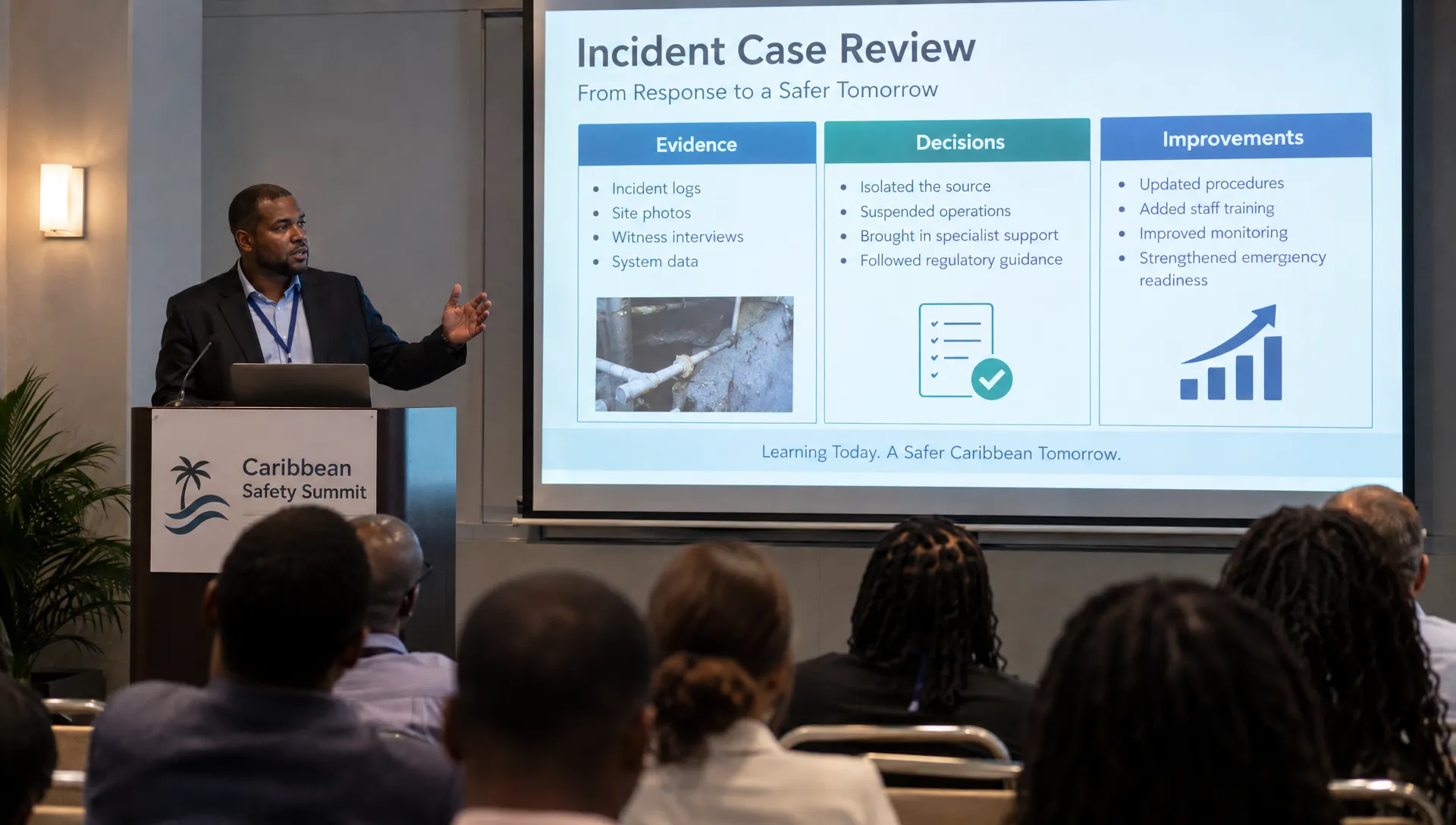
Use a case narrative that preserves uncertainty
Consider this hypothetical example, which is not a report of an actual organisation’s incident:
A team discovers that staff outside an authorised group can access a folder containing customer records. The folder inherits permissions from a parent location. Available logs do not establish whether every accessible file was viewed or copied.
A weak presentation would say: “An employee configured the folder incorrectly, so we fixed permissions and retrained staff.” That account assigns blame, compresses the investigation and implies that training addresses the whole problem.
A stronger account explains why the folder inherited access, who owned the permission decision, what evidence was available and how the team assessed potential consequences. It also distinguishes restricting future access from resolving uncertainty about earlier exposure.
When presenting this case at a security and privacy conference, preserve the distinction between “we found no evidence of access” and “we established that no access occurred”. Incomplete logging may support the first statement without supporting the second.
The improvement could include clearer permission ownership, a test for inherited access and a proportionate review of logging. The presentation should explain which changes were completed, which were tested and which remained planned. That makes the case useful without overstating certainty or disclosing exploitable detail.
Prepare for questions without expanding the disclosure
Questions can reveal information that the approved slides deliberately excluded. Rehearse answers about affected numbers, suppliers, notification decisions, attribution and unresolved vulnerabilities.
Use clear boundaries rather than evasive responses. For example: “We are not disclosing supplier identity. The transferable lesson is the need to define escalation responsibilities before an incident.” If a fact is unknown, say so rather than filling the gap with an estimate.
For a security and privacy conference, prepare two or three audience prompts that test decisions without requesting confidential information. One could be: “Who can authorise access restrictions when the usual system owner is unavailable?” Another could ask what evidence would distinguish a possible disclosure from a confirmed one.
Keep demonstrations within the approved scope. Do not use live production data or reveal credentials, attack paths or unresolved weaknesses merely to make the session more vivid.
After the event, convert suitable lessons into internal exercises. PLMC’s guidance on privacy awareness training topics staff remember can help translate the case into everyday behaviours. Public presentation and internal learning should reinforce each other, but they do not need to contain identical information.
Frequently asked questions
Can we present an incident that is still under investigation? Possibly, but detailed public discussion may be inappropriate. Obtain approval for the proposed scope, avoid unsettled claims and consider presenting a hypothetical scenario or a general control lesson instead.
Is removing names enough to anonymise the case? No. Dates, locations, roles and unusual circumstances can enable identification. Review combinations of details, not just direct identifiers, and do not describe material as anonymous unless that claim is justified.
How much technical detail belongs in a security and privacy conference presentation? Include enough to explain the control failure and response decision. Exclude detail that exposes personal data, confidential architecture or weaknesses that could enable misuse. The appropriate depth also depends on the audience and publication arrangements.
Should we discuss notification decisions? You can explain an approved decision-making process, including how evidence and applicable obligations were assessed. Do not present a case-specific decision as a universal legal rule or disclose confidential advice without legal review.
What should attendees leave with? One practical check they can perform, such as testing access removal after a role change or confirming incident escalation authority. A concise, approved takeaway is more useful than a large collection of internal documents.
Turn the lesson into a practical next step
Before submitting a session, confirm that it has one clear learning objective, approved disclosure boundaries and evidence supporting its conclusions. The audience should understand what changed and how to test a similar issue at home.
If your organisation needs help strengthening the controls or privacy awareness behind the case, Privacy & Legal Management Consultants Ltd. offers data protection implementation, cyber security services and training for Jamaican organisations. Request a free consultation to discuss your compliance and risk-management needs.