

Data Privacy Awareness: Training Topics Staff Actually Remember

Most staff do not wake up thinking about data protection law. They think about serving customers, closing tickets, processing payroll, sending invoices, helping patients, onboarding students, or approving a vendor. That is why effective data privacy awareness cannot feel like a legal lecture. It must translate privacy obligations into the small decisions employees make every day.
For Jamaican organisations, this matters now more than ever. Jamaica’s Data Protection Act created a clear expectation that personal data must be handled lawfully, fairly, securely, and accountably. The Office of the Information Commissioner has also helped raise the standard for how organisations think about privacy compliance. But policies alone do not protect data. People do.
Strong data privacy awareness training helps staff recognise risk in familiar moments: receiving a customer ID by WhatsApp, emailing a payroll spreadsheet, verifying someone on the phone, keeping old files, sharing CCTV footage, or using a new cloud tool without approval. The goal is not to make every employee a privacy lawyer. The goal is to help every employee pause, ask the right question, and escalate early.
Why staff forget privacy training
Many organisations treat privacy awareness as an annual slide deck followed by a quiz. Employees may pass the quiz, but a month later they still send attachments to the wrong recipient, store customer records on personal devices, or keep data long after it is needed.
The problem is usually not unwillingness. It is poor training design. Staff forget privacy training when it is too abstract, too legalistic, too long, or disconnected from their actual role. A generic session on data protection principles is useful for context, but it rarely changes behaviour unless employees can connect each principle to real workplace decisions.
There is also a risk dimension. The Verizon 2024 Data Breach Investigations Report found that the human element was involved in 68% of breaches, including errors, misuse, and social engineering. That does not mean employees are the problem. It means employees are a key control point. If they are trained well, they become an early warning system for privacy, cyber security, fraud, and governance risks.
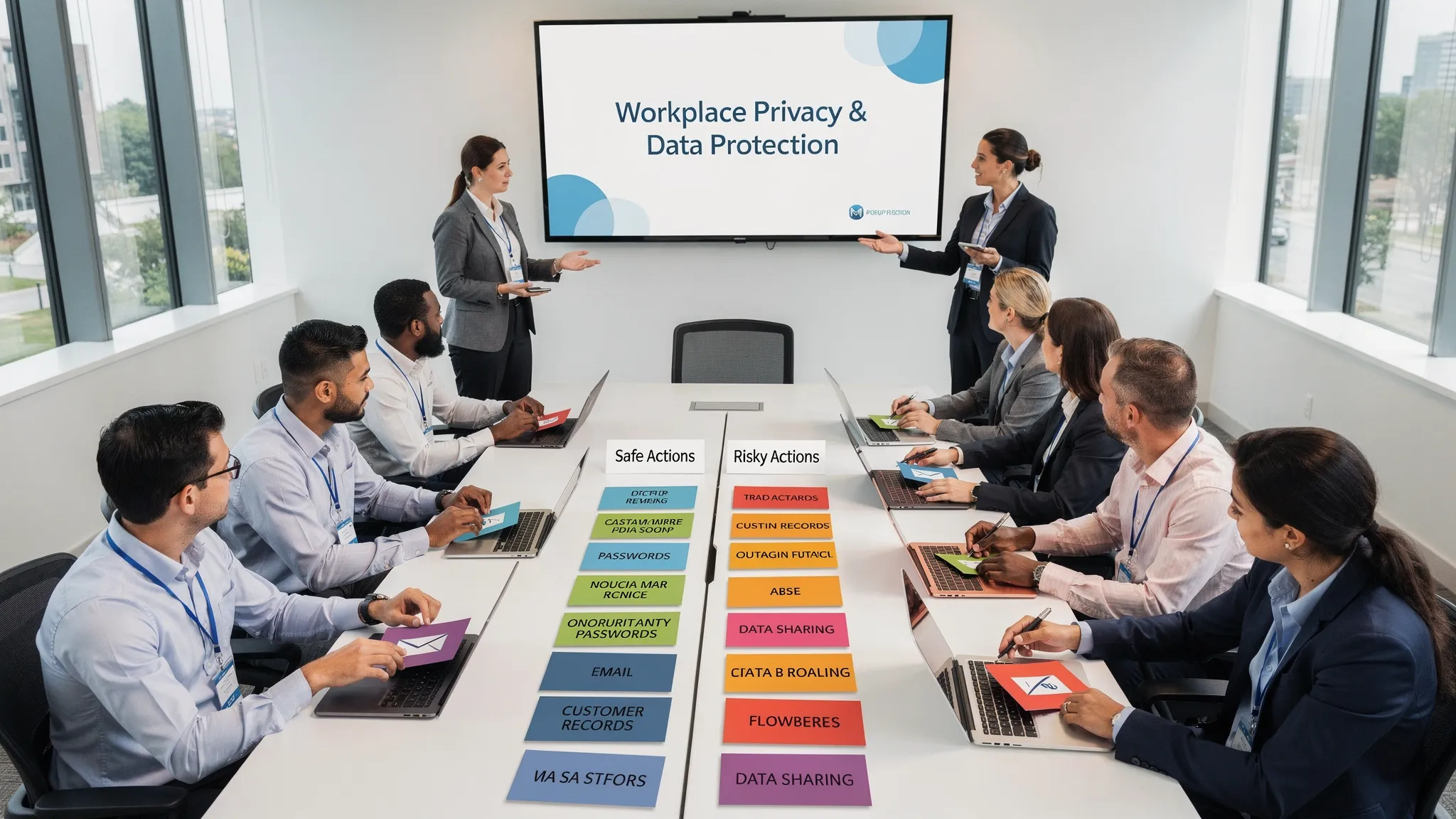
What makes data privacy awareness memorable
Memorable training is practical, repeated, and relevant. It gives staff simple mental shortcuts they can use under pressure. Instead of asking employees to memorise legislation, teach them to ask better questions before they collect, use, share, store, or delete personal data.
A strong privacy awareness programme usually has five qualities:
Role-specific examples: HR, customer service, finance, IT, marketing, and management each handle different privacy risks.
Short scenarios: Staff remember stories better than policy wording.
Clear escalation routes: Employees must know who to contact before a small issue becomes a breach.
Repetition over time: Short refreshers often work better than one long annual session.
Visible leadership support: Privacy becomes part of culture when managers model it.
This approach also supports accountability. The NIST Privacy Framework highlights the importance of identifying, governing, controlling, communicating, and protecting personal data. Training helps connect those governance objectives to daily employee behaviour.
If your organisation is still building its compliance foundation, you may also find PLMC’s guide on data privacy in Jamaica and key rights useful as a companion resource.
Training topics staff actually remember
The most effective topics are not always the most complex. They are the ones employees can recognise immediately in their work. The table below shows practical data privacy awareness topics and how to make each one stick.
Training topic | Staff-friendly question | Memorable exercise |
What counts as personal data | Could this identify a person directly or indirectly? | Ask teams to sort examples such as TRN, email address, CCTV image, health note, payroll file, and customer complaint. |
Sensitive personal data | Would harm be greater if this was exposed? | Compare a general contact list with medical, financial, biometric, or disciplinary records. |
Purpose limitation | Are we using this data for the reason we collected it? | Review a marketing idea and decide whether the original customer notice supports it. |
Data minimisation | Do we really need all of this information? | Redesign a form by removing unnecessary fields. |
Secure sharing | Is this the right person, right channel, and right attachment? | Run a wrong-recipient email scenario and ask staff what checks should happen before sending. |
Individual rights | What should I do if someone asks for their data? | Practise routing a data access or correction request to the correct internal contact. |
Incident reporting | What should I report, and how quickly? | Use examples of lost files, misdirected emails, stolen devices, and suspicious links. |
Retention and disposal | Are we keeping this because we need it, or because no one deletes anything? | Ask teams to identify records that should be archived, deleted, or retained. |
Vendors and cloud tools | Are we sharing data with a third party safely? | Review a proposed app or supplier and identify questions to ask before use. |
AI and new technologies | Should personal data be entered into this tool? | Discuss when staff must avoid uploading customer or employee data into unapproved tools. |
Topic 1: Spotting personal data in real life
Staff often think personal data means only obvious identifiers such as a name, phone number, or ID number. Training should broaden that understanding. Personal data can include anything that identifies, relates to, or can be linked to a living individual. In a Jamaican organisation, that may include customer account notes, TRN details, employee records, student files, patient information, CCTV footage, location data, call recordings, or complaint histories.
A memorable exercise is the spot the personal data game. Give employees examples from their own department and ask them to decide whether each item is personal data, sensitive data, business confidential information, or not personal data. The discussion matters more than the answer. It helps employees realise that privacy risk is present in ordinary documents, not only in major databases.
This topic should also address combinations of data. A first name alone may not identify someone in every context. A first name combined with a branch, job title, complaint, photograph, or transaction history may identify them very clearly. Staff remember this when examples come from their actual workflows.
Topic 2: Collect only what you need
Data minimisation is one of the easiest principles for employees to understand when it is taught through forms. Many organisations collect extra information because a legacy form asked for it, a spreadsheet template included it, or staff believe more information may be useful later.
A practical training activity is to show a real or sample form and ask: which fields are essential, which are optional, and which create unnecessary risk? For example, does a visitor log need a full ID number, or would name, company, time, and host be enough? Does a customer enquiry need a date of birth before the person becomes a client? Does a competition entry form need employment details?
This topic helps staff understand that privacy is not only about securing data after collection. It is also about reducing the amount of data that enters the organisation in the first place. Less unnecessary data means less exposure, simpler retention, and fewer headaches when responding to requests.
Topic 3: Share data safely, especially by email and messaging apps
One of the most common privacy risks is sending the right data to the wrong person. Staff should be trained to slow down before sharing personal data, particularly through email, messaging platforms, shared folders, and removable media.
A simple memory aid is the three-check rule: check the recipient, check the attachment, and check the channel. The recipient check confirms that the person is authorised to receive the information. The attachment check confirms that the file is correct and does not contain hidden tabs, extra records, or unrelated personal data. The channel check confirms that the method is approved for the sensitivity of the information.
This topic should be scenario-based. For example, what should an employee do if a manager asks for a full staff list by WhatsApp? What if a customer sends an ID document to a personal email address? What if a spreadsheet contains multiple customers but only one customer’s information is needed? These are the moments where data privacy awareness becomes behaviour.
Topic 4: Recognise rights requests and complaints
Employees do not need to process every data subject request themselves, but they must recognise one. A customer may not use legal language. They may say: I want to see what information you have on me, please correct my address, remove me from your mailing list, delete my account, or stop using my information for this purpose.
Training should give staff examples of rights-related language and a clear internal route for escalation. Customer-facing teams, HR teams, and branch staff need special attention because they are most likely to receive these requests first.
It is also important to teach staff not to ignore informal complaints. A complaint about receiving another person’s statement, being copied into an email chain, or seeing outdated information may indicate a deeper privacy issue. Early escalation helps the organisation respond consistently and preserve evidence.
Topic 5: Report incidents quickly, even if they seem small
A privacy incident is not limited to hacking. It may include a lost laptop, a stolen phone, a misdirected email, unauthorised access to a file, disposal of records in an insecure bin, or disclosure of information to someone who failed verification.
Staff often delay reporting because they fear blame or hope the issue will resolve itself. Training should make the opposite message clear: reporting early protects the customer, the employee, and the organisation. A small mistake that is reported quickly can usually be contained more effectively than one discovered days later.
Good awareness training explains what to report, who to contact, and what not to do. For example, staff should not delete evidence, contact affected individuals without approval, or try to investigate beyond their role. They should preserve relevant facts and escalate through the approved incident process.
Topic 6: Retention, disposal, and clean workspaces
Retention is rarely exciting, but it is one of the topics staff remember when linked to clutter and risk. Many organisations keep personal data indefinitely because deletion feels risky. In reality, keeping data too long can increase exposure and make it harder to respond to requests or incidents.
Training should explain that records must be kept for legitimate business, legal, regulatory, or operational reasons, but not forever by default. Staff need to understand the organisation’s retention schedule, where official records should be stored, and when duplicate working copies should be deleted.
Clean desk and secure disposal habits are also part of this topic. Printed customer forms, HR documents, loan files, medical notes, and signed contracts should not be left in open areas. Disposal should match sensitivity. Shredding, secure bins, and approved digital deletion processes are not administrative extras. They are privacy controls.
Topic 7: Privacy when using vendors, apps, and AI tools
Modern work depends on third parties. Payroll platforms, CRM systems, email marketing tools, cloud storage, outsourced IT providers, payment processors, and consultants may all handle personal data. Staff should know that using a new tool can create privacy obligations, even if the tool is convenient or free.
Training does not need to turn every employee into a procurement specialist. It should teach a clear rule: do not upload, transfer, or grant access to personal data through an unapproved vendor or platform. If a new tool is needed, staff should know the approval route.
AI tools deserve special attention in 2026. Employees may be tempted to paste customer complaints, employee reports, meeting notes, or contracts into generative AI systems. Awareness training should make clear when personal data, confidential information, or regulated records must not be entered into tools that have not been assessed and approved.
How to adapt topics by department
Baseline awareness should be organisation-wide, but role-based training is what makes the content memorable. Different teams need different scenarios.
Team | Privacy topics to emphasise | Scenario that usually resonates |
Customer service | Identity verification, rights requests, complaint handling, call notes | A caller asks for account information but cannot pass verification. |
HR and payroll | Employee records, medical notes, disciplinary files, retention, access controls | A manager requests an employee file for a purpose that is unclear. |
Finance and accounts | Payment details, invoices, fraud risk, anti-money laundering records where applicable | A supplier asks to change bank details by email. |
Marketing | Consent, preferences, mailing lists, purpose limitation, opt-outs | A team wants to reuse customer data for a new campaign. |
IT and cyber security | Access control, logging, incident response, vendor risk, secure configuration | A user requests broad access to a folder containing personal data. |
Senior management | Accountability, governance, risk appetite, breach decisions, resourcing | A privacy risk is identified but requires budget and ownership. |
This role-based approach is especially valuable for organisations building integrated governance, risk, and compliance programmes. Privacy, cyber security, corporate governance, and anti-money laundering controls often overlap. Training should help staff see those connections rather than treating each compliance topic as a separate silo.
A simple 60-minute awareness session staff will remember
A privacy session does not need to be long to be effective. In many cases, a focused one-hour workshop with realistic scenarios is more useful than a half-day lecture.
Time | Activity | Purpose |
0 to 10 minutes | Explain why privacy matters to customers, employees, regulators, and the organisation | Connect training to trust and accountability. |
10 to 20 minutes | Spot the personal data exercise | Build recognition using familiar examples. |
20 to 35 minutes | Email, WhatsApp, and wrong-recipient scenarios | Practise safe sharing decisions. |
35 to 45 minutes | Rights request and incident reporting role-play | Teach escalation routes. |
45 to 55 minutes | Department-specific discussion | Make the content relevant to daily work. |
55 to 60 minutes | Commitment and quick knowledge check | Reinforce one behaviour each person will apply. |
The strongest sessions end with a practical commitment. Ask each participant to write down one privacy habit they will change this week. Examples include checking attachments before sending, locking paper files away, using approved storage only, or reporting suspected incidents immediately.
How to measure whether awareness is working
Attendance records and quiz scores are useful, but they do not prove behaviour change by themselves. Better measurement combines completion data with operational indicators.
Useful privacy awareness metrics include:
Training completion by department and role.
Quiz results on high-risk topics such as sharing, incidents, and rights requests.
Number and quality of privacy incident reports.
Time taken to escalate suspected incidents.
Reduction in wrong-recipient emails or insecure storage findings.
Increase in early questions to privacy, compliance, legal, or IT teams.
Completion of department data clean-up or retention actions.
Do not treat every increase in incident reports as bad news. After training, reports may rise because staff finally recognise what should be escalated. That can be a sign that awareness is improving. Over time, the organisation should look for better reporting quality, faster escalation, fewer repeat mistakes, and stronger evidence of controls.
Common mistakes to avoid
The first mistake is making training too legal. The Data Protection Act matters, but employees need practical translation. Instead of explaining every legal term in detail, connect the law to the employee’s next action.
The second mistake is training everyone exactly the same way. A board member, receptionist, database administrator, marketing officer, and HR manager do not need identical scenarios. Everyone needs the same baseline principles, but the examples should change by role.
The third mistake is treating training as a one-time event. Data privacy awareness should be reinforced through onboarding, annual refreshers, team briefings, incident lessons, posters, short quizzes, and manager conversations. Privacy culture is built through repetition.
The fourth mistake is punishing honest reporting. If employees believe they will be embarrassed or disciplined for every mistake, they may hide incidents. Accountability is important, but a blame-heavy culture can make privacy risk worse. The message should be clear: report quickly, learn properly, and improve controls.
Frequently Asked Questions
How often should organisations run data privacy awareness training? Most organisations should provide privacy training during onboarding, refresh it at least annually, and reinforce it throughout the year with short reminders or role-based sessions. Higher-risk teams may need more frequent training.
Should every employee receive the same privacy training? No. Everyone should receive a baseline covering personal data, safe sharing, rights requests, incidents, and retention. Teams that handle higher-risk data should also receive role-specific scenarios.
What is the best way to make privacy training memorable? Use real workplace scenarios, short exercises, and clear decision rules. Staff remember privacy training when it helps them solve problems they actually face.
Is cyber security training the same as data privacy awareness? They are related, but not identical. Cyber security focuses on protecting systems and information from threats. Data privacy also covers lawful use, transparency, individual rights, minimisation, retention, and accountability.
How can we prove that privacy awareness training happened? Keep attendance records, training materials, quiz results, role-based content, refresher communications, and evidence of follow-up actions. These records help demonstrate accountability and continuous improvement.
Build privacy awareness that changes behaviour
Data privacy awareness works best when it is practical, local, and connected to the way staff actually work. The right training helps employees recognise personal data, reduce unnecessary collection, share information safely, escalate incidents early, and respect individual rights.
Privacy & Legal Management Consultants Ltd. supports organisations in Jamaica with data protection implementation, training sessions, risk assessment tools, cyber security services, corporate governance, anti-money laundering compliance, and wider governance, risk, and compliance integration.
If your organisation needs privacy training that staff will remember and apply, contact PLMC to discuss a practical data privacy awareness programme aligned with your operational risks and compliance obligations.