

Managing Customer Data Across Caribbean Borders

Managing customer data across Caribbean borders is now a daily issue for Jamaican organisations, not an occasional legal question. Tourism operators, financial institutions, BPO providers, online retailers, professional services firms and regional groups routinely move names, contact details, payment records, identity documents, support notes and marketing preferences between islands, cloud platforms and overseas service providers. The challenge is to keep that movement useful for business while meeting data protection, privacy and governance expectations under Jamaica’s Data Protection Act 2020 and the wider Caribbean regulatory landscape.
Why customer data across Caribbean borders needs a regional plan
Caribbean markets are connected by design. A hotel in Jamaica may serve guests from Barbados, store bookings in a US hosted platform, use a Trinidad based call centre and send loyalty promotions to customers across the region. A fintech may onboard customers in multiple islands, screen them for anti-money laundering purposes and share data with payment processors, banks, affiliates and regulators.
That reality creates two risks. The first is legal uncertainty, because privacy rules differ by jurisdiction and may apply based on where the customer lives, where the organisation is established, where the system is hosted or where services are targeted. The second is operational drift, where data moves because a department, vendor or affiliate finds it convenient, but no one has checked whether the transfer is necessary, secure and properly disclosed.
A regional plan reduces both risks. It gives management a clear view of where customer data goes, who is responsible for it, which laws may apply and what safeguards must travel with the information.
Start with the data map, not the legal opinion
Many organisations begin by asking, “Which Caribbean privacy law applies?” That question matters, but it is difficult to answer accurately without a data map. Before comparing laws, identify the customer data lifecycle from collection to deletion.
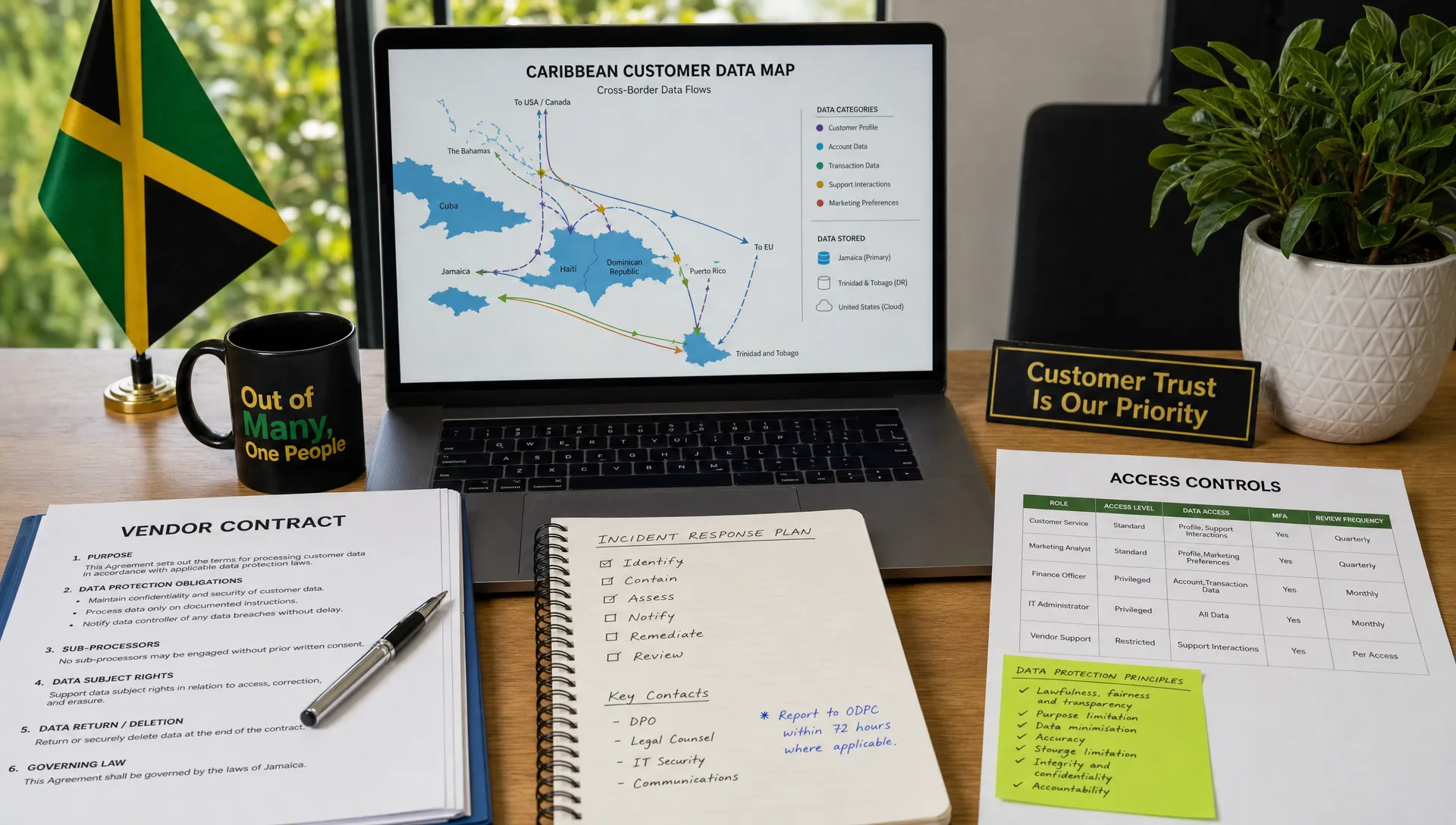
A practical data map should show the business purpose, the category of data, the source, the systems used, the countries involved and the third parties with access. This is especially important when teams use shared CRMs, booking engines, regional marketing databases, group email platforms, WhatsApp channels, cloud storage or outsourced customer support.
For Jamaican organisations building their privacy programme from the ground up, PLMC’s guidance on how to protect customer data end-to-end is a useful companion because cross-border management only works when the local lifecycle is already controlled.
Data flow question | Why it matters | Example evidence |
What customer data is collected? | Confirms whether personal or sensitive personal data is involved | Forms, CRM fields, onboarding records |
Why is it collected? | Links processing to a lawful and documented purpose | Privacy notices, service terms, internal policy |
Where is it stored or accessed? | Reveals cross-border transfers and remote access | System architecture, vendor list, access logs |
Who receives it? | Identifies controllers, processors, affiliates and sub-processors | Contracts, data sharing register, vendor due diligence |
How long is it retained? | Prevents indefinite storage across systems | Retention schedule, deletion records, archive policy |
Understand Jamaica’s baseline before looking outward
For Jamaican organisations, the Data Protection Act 2020 is the home base. The Act is built around core data protection standards, including fair and lawful processing, purpose limitation, data minimisation, accuracy, retention limits, security safeguards and respect for data subject rights. The Office of the Information Commissioner Jamaica provides regulatory guidance and is the authority organisations should monitor for local compliance expectations.
Cross-border transfers deserve particular attention. Jamaica’s framework restricts transfers of personal data outside Jamaica unless the receiving country or territory provides adequate protection, or another lawful basis and safeguard applies. In practice, this means an organisation should not treat a regional transfer as low risk simply because the destination is geographically close or commercially familiar.
Use Jamaica’s standard as your control floor
When customer data crosses Caribbean borders, the safest operating model is to use Jamaica’s requirements as the minimum internal standard, then layer on any stricter local obligation in the receiving or customer jurisdiction. This avoids creating separate, inconsistent practices for each island unless a specific law requires it.
For example, your privacy notice, vendor contract, access controls and breach response process should be robust enough to satisfy Jamaican expectations first. If Barbados, Cayman Islands, Bermuda, Trinidad and Tobago or The Bahamas adds a specific requirement for a particular activity, adjust the process rather than weakening the baseline.
Compare Caribbean privacy laws by risk trigger
Caribbean privacy laws are not uniform. Some jurisdictions have modern data protection regimes with concepts familiar from the EU GDPR. Others have laws that are older, partially commenced or developing through guidance and enforcement practice. The result is a patchwork that must be assessed by activity, not assumption.
The analysis should focus on triggers. Are you established in the jurisdiction? Are you targeting customers there? Do you monitor behaviour there? Are staff or vendors accessing the data from there? Are you transferring sensitive personal data, financial data or identity documents? The answers help determine whether local registration, notices, contracts, security measures or regulator engagement may be needed.
If your business is expanding beyond Jamaica, use a structured method to assess overseas privacy laws before expansion instead of relying on informal comparisons between countries.
Regional trigger | Compliance issue to check | Practical response |
Customers live in another Caribbean jurisdiction | Local privacy rights, notice language and complaint routes | Adapt notices and customer service scripts |
Vendor accesses data from another island | Processor obligations, confidentiality and security | Complete due diligence and sign data processing terms |
Data is hosted outside Jamaica | Transfer safeguards and incident response access | Review hosting location, backups and sub-processors |
Financial data is shared regionally | AML rules, retention duties and privacy limits | Document lawful purpose and restrict access |
Marketing targets multiple islands | Consent, opt-out rules and platform governance | Maintain preference records and suppression lists |
Build transfer controls into contracts
A verbal assurance from a regional partner is not enough. Contracts should define the role of each party, the purpose of the processing, the categories of customer data, the permitted locations of processing and the security measures expected.
For vendors and processors, the contract should also deal with confidentiality, sub-processors, assistance with data subject requests, breach notification, audit rights, deletion or return of data at the end of the service and restrictions on using customer data for the vendor’s own purposes. If a vendor will move the data to another country, that onward transfer should be disclosed and controlled.
For group companies, do not assume that common ownership removes the need for documentation. A regional affiliate can still create a transfer risk if it accesses customer data for sales, support, finance, analytics or shared administration. Intercompany agreements are often the cleanest way to show that privacy obligations follow the data.
When negotiating with overseas clients, suppliers or group partners, PLMC’s article on privacy clauses for contracts with overseas clients sets out the clauses that usually need attention.
Secure the data as it moves and after it arrives
Cross-border privacy compliance is not only about paperwork. Regulators, clients and customers will expect reasonable technical and organisational measures that match the sensitivity of the data and the harm that could result from misuse.
For customer data across Caribbean borders, security controls should cover transmission, storage, access, monitoring and disposal. This means encryption where appropriate, multi-factor authentication for administrative access, role-based permissions, secure file transfer rather than ad hoc email attachments, logging for critical systems, tested backups and clear offboarding for staff or vendors who no longer need access.
The controls should also account for practical Caribbean realities, including remote work, shared service centres, small teams wearing multiple hats, vendor concentration and the use of global cloud platforms. A small business may not need the same control environment as a bank, but it still needs a documented, proportionate and consistently applied approach.
Make privacy notices clear for regional customers
Customers should be able to understand what happens to their information without reading a legal textbook. A regional privacy notice should explain what data is collected, why it is used, who receives it, whether it is transferred outside Jamaica or the customer’s home jurisdiction, how long it is kept and how the customer can exercise privacy rights.
Avoid vague phrases such as “we may share your information with trusted partners” unless they are supported by meaningful detail. You do not need to name every low risk supplier in the main notice, but you should identify categories clearly enough for customers to understand the transfer. Examples include payment processors, booking platforms, customer support providers, logistics companies, professional advisers, regulators and group companies.
Consent also needs care. Consent may be appropriate for some marketing activity, optional services or sensitive uses, but it should not be used as a blanket cure for every transfer. If the organisation relies on contract necessity, legal obligation, legitimate business purposes or another lawful basis, the notice should reflect that accurately.
Coordinate data subject rights across jurisdictions
A customer in another Caribbean country should not have to navigate your internal structure to access, correct or question the use of their data. Build one intake process for privacy requests, then route the matter internally based on the relevant law, system and business owner.
A good workflow records the date received, verifies identity, identifies the systems involved, checks whether any exemption applies, confirms the response deadline and documents the outcome. If the request involves a regional vendor or affiliate, your contract should require their cooperation within a timeline that lets you meet your own obligations.
This becomes especially important where customer data is duplicated across systems. If the Jamaican office corrects an address but the regional marketing platform and call centre database remain unchanged, the organisation may still be using inaccurate data. Rights management should therefore connect to data quality and records management, not sit only with the legal team.
Prepare for regional incidents before they happen
A breach involving customer data across Caribbean borders can trigger several response obligations at once. The affected system may be hosted outside Jamaica, the customers may live across the region, the vendor may be in another jurisdiction and different regulators or contractual notice periods may apply.
Your incident response plan should answer practical questions in advance. Who decides whether an event is a privacy incident? Who contacts the vendor? Who preserves logs? Who assesses harm to customers? Who decides whether notifications are required? Who approves customer communications?
Create a breach matrix for your main operating countries and keep it current. The matrix should include regulator contacts, contractual notice deadlines, customer notification criteria, law enforcement considerations and internal escalation points. Test the process with tabletop exercises, especially for ransomware, misdirected email, lost devices, compromised credentials and accidental disclosure through shared folders.
Balance AML obligations with privacy discipline
Financial services, real estate, gaming, professional services and other regulated sectors may need to collect identity documents, source of funds information, beneficial ownership records and transaction details for anti-money laundering compliance. Those obligations can justify collecting and retaining certain customer data, but they do not remove privacy duties.
The better approach is to document the lawful basis for AML processing, collect only what is necessary for the risk and legal requirement, restrict access to trained staff, protect high risk documents and set retention rules that reflect both AML and privacy obligations. Regional sharing for group compliance, correspondent banking, screening tools or investigations should be mapped and controlled like any other transfer.
Where AML and privacy teams operate separately, cross-border data can fall between them. Governance should bring them together so that compliance with one legal regime does not create avoidable exposure under another.
Assign accountability at board and management level
Managing customer data across Caribbean borders is a governance issue, not just an IT or legal task. Senior management should know the main transfer routes, the highest risk vendors, the jurisdictions involved and the status of remediation actions.
A practical governance model includes a data protection lead, clear business owners for major systems, vendor management procedures, documented transfer assessments, board or committee reporting and periodic training for staff who handle customer information. Training should use realistic scenarios, such as sending customer lists to a regional partner, exporting CRM records for a campaign or responding to a request from an overseas affiliate.
The board does not need to approve every transfer, but it should set risk appetite and expect evidence. That evidence may include data maps, assessment templates, vendor registers, incident reports, policy attestations and audit findings.
A practical pre-transfer checklist
Before customer data moves to another Caribbean jurisdiction, pause long enough to answer the key questions. This checklist can be built into procurement, project approval, new market entry, vendor onboarding or group data sharing processes.
Confirm the business purpose and whether the transfer is necessary.
Identify the categories of customer data, including any sensitive personal data.
Check Jamaica’s Data Protection Act 2020 requirements and the receiving jurisdiction’s privacy rules.
Review whether the customer privacy notice adequately explains the transfer.
Complete vendor or affiliate due diligence before access is granted.
Put written privacy, security, breach and onward transfer clauses in place.
Limit access to the people and systems that need it.
Define retention, deletion and return of data at the end of the relationship.
Prepare a response plan for customer requests, complaints and incidents.
The checklist is not a substitute for legal analysis, but it creates discipline. It also helps prove that the organisation considered privacy risk before the data moved, rather than trying to justify the transfer after a complaint or incident.
Frequently Asked Questions
Does Jamaica’s Data Protection Act 2020 apply if customer data is stored in another Caribbean country? It can still be relevant if the Jamaican organisation controls the purpose and means of processing. Storage outside Jamaica may also create a cross-border transfer issue, so the organisation should assess safeguards, contracts and the receiving jurisdiction’s protections.
Is sharing data with a Caribbean affiliate treated differently from sharing it with an unrelated vendor? Common ownership does not automatically remove privacy obligations. If an affiliate accesses or uses customer data, the organisation should define roles, purposes, permitted uses, security duties and onward transfer limits in an intercompany arrangement.
Do Caribbean businesses need to consider GDPR? Sometimes. The EU GDPR may apply where an organisation offers goods or services to individuals in the European Economic Area or monitors their behaviour. A Jamaican or Caribbean business should assess GDPR triggers separately from local Caribbean laws.
What is the biggest mistake organisations make with regional customer data? The most common mistake is allowing data to move through vendors, cloud tools or group companies before mapping the flow and assigning responsibility. Once data is copied across systems, it becomes harder to secure, correct, delete and explain.
How often should cross-border data transfers be reviewed? Review them when launching a new market, onboarding a vendor, changing systems, introducing a new use of customer data or after a material legal or security change. A periodic annual review is also sensible for higher risk transfers.
Need support with Caribbean data privacy compliance?
PLMC helps Jamaican organisations strengthen data protection, corporate governance, AML compliance, cyber security and broader GRC practices. If your organisation is expanding regionally, using overseas vendors or reviewing customer data flows, a structured privacy assessment can help you identify gaps before they become regulatory, contractual or reputational problems.
For tailored guidance, training or a consultation, visit Privacy & Legal Management Consultants Ltd. and start building a cross-border data programme that is practical, documented and ready for regional growth.