

How to Prevent Business Email Compromise in Finance Teams
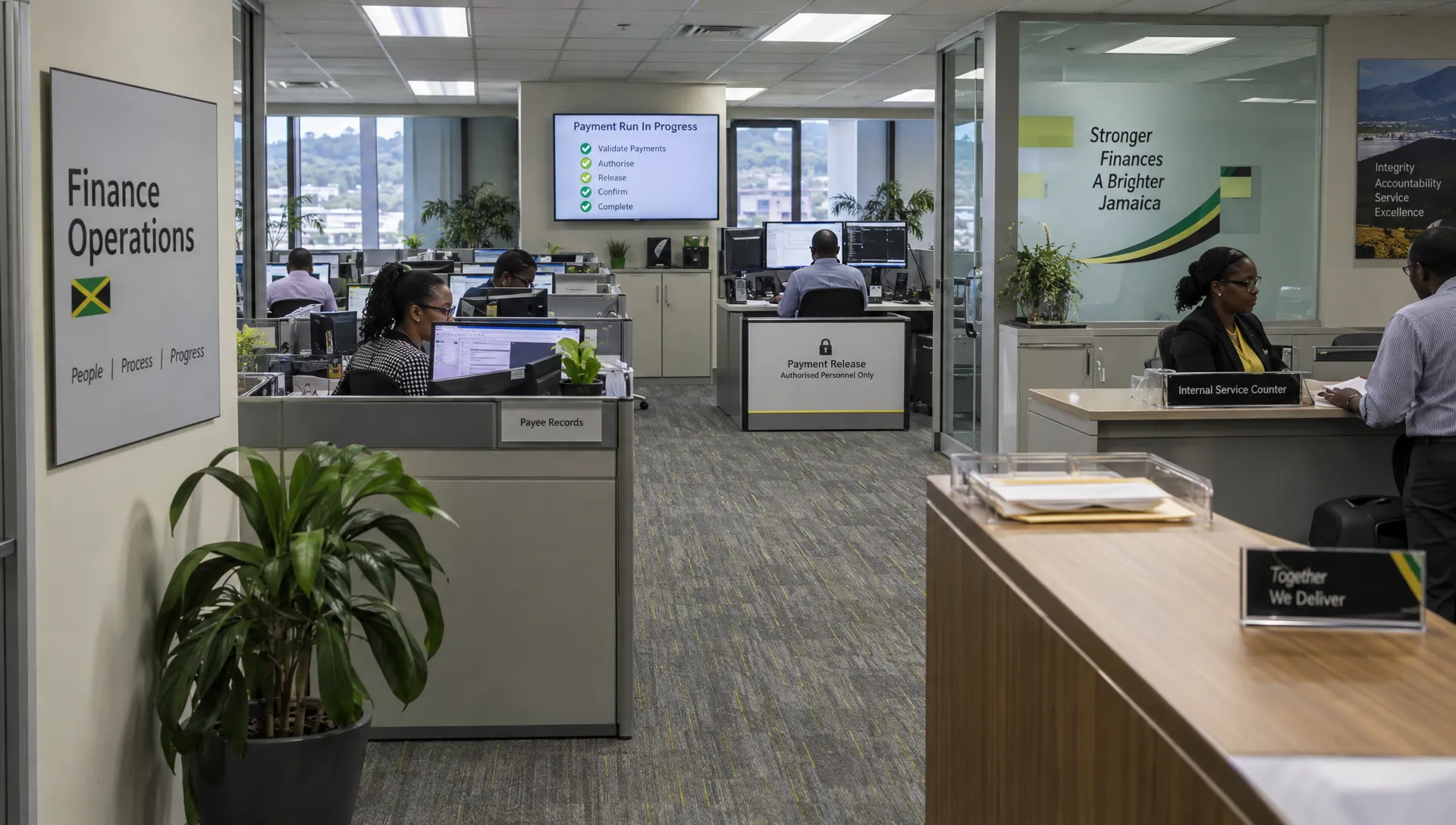
Business email compromise can turn an ordinary invoice, payroll update or urgent request from a director into a fraudulent payment. For finance teams in Jamaica, preventing it requires more than spotting suspicious spelling. The strongest protection is a payment process that does not treat email as proof of identity or authority. Independently verify changes, separate key responsibilities and make it acceptable to pause a transaction, even when the request appears to come from the managing director.
This guide explains how to put those safeguards into everyday finance work and what to do if a payment has already gone out.
How business email compromise targets finance teams
Business email compromise (BEC) is fraud in which an attacker impersonates a trusted business contact or takes over a genuine account to persuade someone to transfer money or disclose information. The FBI’s guidance on business email compromise describes schemes involving familiar suppliers, executives and other apparently legitimate contacts.
Common finance-team scenarios include:
Supplier bank-detail changes: A convincing message asks accounts payable to send the next payment to a different account.
Executive impersonation: A supposed director requests an urgent, confidential transfer and discourages normal checks.
Payroll diversion: Someone impersonates an employee and requests a change to their salary account.
Altered invoices: An attacker inserts fraudulent payment details into a genuine invoice or ongoing email conversation.
A message can come from a real supplier’s compromised mailbox and contain accurate invoice numbers, names and payment dates. Familiarity is not authentication. Good grammar, a familiar signature and an existing email thread do not establish that a payment instruction is genuine.
Verify payment changes outside the email conversation
The most useful rule is straightforward: never change payment details solely because an email requests it. Apply that rule to suppliers, employees, executives and professional advisers, regardless of seniority or transaction size.
Establish a trusted callback process
Call an authorised contact using a number independently verified before the request arrived. Do not use a telephone number supplied in the change request, its attachment or a new email signature. A fresh web search alone is also not a reliable substitute for an established contact record.
During verification, confirm the requested change, the intended account holder and the relevant account details through the approved process. For a new supplier, establish and verify authorised contacts during onboarding, before processing the first payment.
A useful opening is: “We received a request to change your payment details. Our policy requires independent verification before we update our records.”
Record who performed the check, whom they contacted, which trusted contact record they used and the outcome. Store any necessary supporting evidence securely without collecting unnecessary personal information.
If the contact cannot be reached, leave the change pending. A genuine deadline should trigger escalation to an authorised manager, not removal of the verification requirement.
Apply the same rule to payroll and executive requests
Payroll changes should go through an approved HR or payroll process with independent identity checks. A personal email address, signature image or message from an employee’s work account should not be enough on its own.
For urgent executive requests, verify both the requester’s identity and their authority to approve that transaction. A telephone conversation does not replace the organisation’s approval limits.
Agree these rules with leadership in advance. Staff should not have to negotiate whether a director is exempt while facing a supposedly confidential payment deadline.
Build controls into the payment workflow
Business email compromise succeeds when one persuasive message can trigger an entire payment. Separate changes to payee records from payment approval and release wherever staffing allows.
Activity | Suggested responsibility | Evidence to retain |
Receive a bank-detail change | Accounts payable or payroll officer | Original request and relevant invoice or employee reference |
Independently verify the change | Authorised employee using a trusted contact record | Verification date, contact and outcome |
Approve the record update | Separate authorised reviewer | Approval and change history |
Prepare the payment | Payment preparer | Payment batch and supporting documents |
Release the payment | Authorised approver separate from preparation | Approval against the verified payee record |
Two approvals only help if the second person checks independently. Two employees reading the same fraudulent email does not provide meaningful assurance.
Before releasing a payment, the approver should check whether the beneficiary details changed recently, whether verification evidence exists and whether the payment matches the approved invoice. Review the actual bank details, not just the supplier name displayed in the accounting system.
Restrict access to vendor master data and log changes. Protect the trusted contact directory as well: if an attacker can replace a supplier’s callback number, they can undermine the verification process.
Smaller organisations may not have enough staff to separate every activity. An owner or manager can provide an independent check, provided they use trusted information rather than simply approving a forwarded email. Document any unavoidable overlaps and the additional review used to manage them.
A waiting period after a bank-detail change can create time to detect fraud, but it is an additional safeguard, not a replacement for verification.
Secure the mailboxes that support finance
Process controls and technical security address different parts of the problem. Independent verification helps stop fraudulent instructions, while mailbox security reduces the chance that attackers can send convincing requests or monitor payment conversations.
Use phishing-resistant multi-factor authentication where supported, such as FIDO security keys or appropriately implemented passkeys. CISA’s guidance on phishing-resistant MFA explains why these methods provide stronger protection against credential phishing than many traditional authentication methods.
Give staff individual accounts rather than shared passwords. Where shared finance mailboxes are necessary, manage access through named users and review permissions when responsibilities change or employees leave. Disable legacy authentication where feasible and remove unnecessary access.
Ask the IT team or provider to configure and monitor SPF, DKIM and DMARC for the organisation’s email domains. These controls help address domain spoofing, but they do not stop every lookalike domain or messages sent from a genuinely compromised supplier account.
Monitor unexpected forwarding rules, changes to recovery details, suspicious application permissions and unusual sign-ins. Finance staff should have a clear route to report unexpected MFA prompts or account changes.
For invoices and supporting documents containing personal information, apply secure file-sharing rules for teams and external partners. Reducing unnecessary exposure of payment records also limits the information attackers can use to make their requests convincing.
Rehearse a realistic payment-diversion scenario
Training should test the payment process, not just whether someone recognises a suspicious subject line.
Use a fictional scenario: a long-standing supplier emails shortly before the payment run, explains that its bank account has changed and attaches a revised invoice. The message uses the correct contact name and refers to a real type of service your organisation buys.
Ask the team to demonstrate how they would locate a trusted telephone number, verify the request, record the result and obtain approval. Include the colleague who releases payments, not only the person monitoring the inbox.
Then introduce an obstacle: the contact is unavailable or a manager asks staff to proceed anyway. The exercise should establish how to pause and escalate without losing control of the payment deadline.
Short, repeated exercises can fit into existing data protection awareness training. Use fictional or properly sanitised records so the exercise does not expose real employee or supplier information.

What to do if a suspicious payment has already been sent
Treat suspected business email compromise as an urgent financial incident. Do not wait for complete certainty or a finished internal investigation before contacting the bank.
Contact the bank immediately: Use an established, trusted number and ask for its fraud response process. Request a recall or other available action and provide transaction references, beneficiary details, amounts and times. Recovery is not guaranteed.
Stop related payments: Pause pending transfers to the suspect beneficiary and review recent payee changes. Check whether other invoices, salary payments or payment batches may be affected.
Alert the response team: Notify the finance lead, IT or security team and the designated incident owner. Involve the privacy lead or Data Protection Officer where personal data may be involved.
Preserve evidence: Retain original messages with full headers, attachments, approval records, change logs and bank confirmations. Avoid deleting suspicious messages or wiping affected devices before evidence is preserved.
Contain account compromise: Have IT revoke affected sessions, secure accounts, remove malicious forwarding rules and review delegated access and application permissions. A password change alone may not remove all access.
Make appropriate reports: Follow the bank’s reporting requirements, consider relevant police reporting and check any cyber-insurance notification conditions promptly.
Use a trusted communication channel for the response. Continuing the investigation inside a compromised email thread can reveal your actions to the attacker.
Notify an affected supplier through a verified contact route, particularly if their account may be compromised. Keep a timeline of decisions and actions, including unsuccessful attempts to stop or recover the payment.
Assess the Jamaican data protection implications
A fraudulent transfer is not automatically a personal data breach. However, the same incident may involve unauthorised access to employee bank details, customer records, identification documents or other personal information held in a mailbox.
Under Jamaica’s Data Protection Act, 2020, organisations must consider their obligations concerning the security of personal data and the handling of breaches. The privacy lead should assess what information was accessible, whose information was involved and whether it was viewed, copied, altered or disclosed.
Check applicable notification requirements and deadlines promptly against the Act and guidance from Jamaica’s Office of the Information Commissioner. Do not assume that recovering the money resolves the privacy incident, or that the absence of proven downloads rules out unauthorised access.
The assessment should distinguish confirmed facts from uncertainties. Preserve relevant access logs and document the reasons for notification decisions. Avoid circulating complete payroll files or identity documents widely during the investigation when a limited description will do.
Put the controls in place over the next 30 days
Start by examining one recent supplier bank-detail change from request to payment. Check whether someone independently verified it, whether the evidence is available and whether the payment approver reviewed the changed details. Repeat the exercise for a payroll account update.
Next, agree a written verification rule, name the people authorised to maintain payee records and establish a fallback when the usual verifier is absent. Confirm that executives understand that urgency does not override the rule.
Have IT review finance mailbox access, MFA coverage and forwarding arrangements. Then run the payment-diversion exercise with accounts payable, payroll and payment approvers.
Measure whether controls are being followed, not just whether staff completed training. Useful indicators include the proportion of bank-detail changes with documented independent verification and the number of payments released with unresolved exceptions. Review those exceptions with management as part of corporate governance oversight.
Frequently asked questions
Does multi-factor authentication prevent business email compromise? It reduces the risk of account takeover, especially when phishing-resistant methods are used. It cannot prevent every impersonation attempt or protect you from all messages sent through a supplier’s compromised account. Payment verification is still necessary.
Is replying to the supplier’s existing email thread enough? No. An attacker may control the mailbox or have inserted themselves into the conversation. Verify payment changes through an independently trusted contact route rather than relying on the thread.
Should we verify changes for small payments too? Yes. Apply the verification requirement consistently to bank-detail changes. You can scale approval levels to transaction risk, but a small payment should not establish unverified details that could later receive larger transfers.
Can a finance team rely on the beneficiary name matching? No. Use any name-checking facility available through your bank as an additional check, not proof that the instruction is genuine. Availability and operation vary by bank and payment route.
Review your finance controls before the next payment run
Effective prevention connects payment controls, cyber security and privacy responsibilities. Privacy & Legal Management Consultants Ltd. offers cyber security services, training, risk assessment tools and data protection implementation support for Jamaican organisations. Request a free consultation to discuss gaps in your finance processes and the controls most relevant to your organisation.