

How to Prepare for a Data Protection Audit in Jamaica

Preparing for a data protection audit in Jamaica is less about producing a thick binder at the last minute and more about proving that your privacy programme works in practice. An auditor will want to see not only what your policy says, but how personal data is collected, used, shared, secured, retained and deleted across HR, customer service, marketing, IT, procurement, finance and operations.
In 2026, audit readiness should be treated as business assurance. Jamaican organisations are increasingly expected to show evidence of compliance with the Data Protection Act, 2020, whether the request comes from a regulator, board, bank, insurer, client, parent company or international partner.
The goal is not perfection on day one. The goal is demonstrable control: clear accountability, reliable records, trained people, tested processes and a remediation plan for gaps. Use this guide to prepare your team before a data protection audit in Jamaica, reduce surprises and make your compliance evidence easier to defend.
What a data protection audit is meant to prove
Jamaica's Data Protection Act, 2020 sets out standards for how personal data should be processed. The Office of the Information Commissioner of Jamaica is the relevant authority for the administration of the Act, and organisations should stay close to official guidance, registration requirements and compliance expectations.
A data protection audit typically asks one practical question: can your organisation prove that it handles personal data responsibly and lawfully? That proof usually falls under the Act's core data protection standards.
Data protection focus | Audit preparation question |
Fair and lawful processing | Can you explain the legal condition or lawful basis for each major processing activity? |
Purpose limitation | Is personal data collected for clear, specific and legitimate purposes? |
Data minimisation | Are you collecting only the personal data you actually need? |
Accuracy | Do you have a process to keep personal data accurate and correct errors? |
Retention limitation | Can you show that personal data is not kept longer than necessary? |
Data subject rights | Can people access, correct or challenge processing where applicable? |
Security | Are appropriate technical and organisational safeguards in place? |
International transfers | Are transfers outside Jamaica assessed and protected appropriately? |
An audit may be broad, covering the full organisation, or narrow, focusing on one high-risk area such as employee records, customer onboarding, a new digital platform, a vendor relationship or cross-border processing. Either way, preparation starts with scope.
1. Define the audit scope and ownership early
An audit without a defined scope can quickly become confusing. Before collecting documents, confirm what the audit is intended to assess. Is it an internal readiness review, a regulator-facing exercise, a client due diligence request, a board assurance review or a review linked to a new system implementation?
Your scope should answer these questions:
Which legal entities, branches or business units are included?
Which processes are in scope, such as HR, marketing, customer service, finance or operations?
Which systems and databases hold personal data?
Which categories of personal data and sensitive personal data are involved?
Which period will be reviewed, such as the last 12 months or the current financial year?
Which standards, policies or contractual obligations will the audit use as criteria?
Name a senior sponsor and an audit coordinator. The sponsor should be able to secure cooperation across departments. The coordinator should manage evidence requests, meetings, document versions and follow-up actions.
Do not leave the audit only with IT or legal. Data protection is operational. HR may hold sensitive employee records, marketing may manage consent and communications, procurement may own vendor contracts, finance may process payment information, and IT may control access, logging and security tools. The audit team should reflect that reality.
2. Build an evidence room before anyone asks
Auditors rely on evidence. A verbal explanation may help, but it will rarely be enough on its own. Create a secure audit evidence room with controlled access, a simple folder structure and a tracker that records document owner, approval date, version and status.
The best evidence is current, approved and used. A policy drafted three years ago but never communicated is weak evidence. A procedure with training records, logs and management review is much stronger.
Audit question | Strong evidence to prepare | Typical owner |
Who is accountable for privacy? | Governance structure, role descriptions, board or committee minutes, privacy risk register | Executive sponsor, compliance or legal |
What personal data do you process? | Data inventory, data flow maps, system list, records of processing activities | Privacy lead, business process owners, IT |
Why do you process it? | Lawful basis assessment, consent records where used, privacy notices, forms and scripts | Legal, compliance, marketing, HR |
How do you handle rights requests? | Request log, templates, escalation process, response records, staff guidance | Privacy lead, customer service, HR |
How do you secure data? | Access reviews, security policies, incident logs, vulnerability summaries, backup test records | IT, cyber security, operations |
How do you manage vendors? | Supplier register, due diligence records, data processing clauses, service agreements | Procurement, legal, business owner |
How do you control retention? | Retention schedule, disposal records, archive rules, deletion approvals | Records management, IT, department heads |
How do staff know what to do? | Training materials, attendance records, role-based briefings, awareness communications | HR, compliance, department managers |
For a more detailed evidence tracker, PLMC's audit-ready data privacy checklist for Jamaican firms can help your team compare what auditors commonly ask for against what you already have.
When building the evidence room, avoid creating new privacy risks. Do not upload unnecessary personal data simply to prove a process exists. Use redacted samples where appropriate, restrict access and keep a record of who can view audit files.
3. Reconcile your data inventory with reality
A data inventory is one of the most important audit documents, but it is only useful if it reflects what actually happens. Many Jamaican organisations discover gaps in legacy spreadsheets, shared drives, outsourced payroll files, customer exports, archived paper records or data held by third-party service providers.
Walk through each major data lifecycle from collection to deletion. For example, follow a job applicant from application form to interview notes to background screening to retention or deletion. Follow a customer from website enquiry to account creation, service delivery, billing, marketing communications and account closure.
For each process, confirm the source of the data, the purpose, the lawful basis or legal condition, the system used, who has access, who receives the data, where it is stored, how long it is kept and what happens at the end of the retention period.
This exercise often reveals practical weaknesses. A form may collect more information than needed. A privacy notice may not mention a new analytics tool. A department may be retaining records indefinitely because no one owns deletion. These findings are useful because they allow you to fix real risk before the formal audit begins.
4. Review policies, then test whether people follow them
Policies are necessary, but policies alone do not prove compliance. Auditors usually want to know whether your procedures are embedded into everyday work.
Start with your core documents: data protection policy, privacy notices, data subject rights procedure, breach response procedure, retention schedule, information security policy, acceptable use policy, vendor management procedure and employee confidentiality guidance. If you need to strengthen your documentation, PLMC's guide to audit-ready data protection policies and procedures explains how Jamaican organisations can align documents with practical audit evidence.
Then test a sample. If the procedure says rights requests must be logged promptly, ask to see the log. If the retention schedule says unsuccessful job applications are deleted after a defined period, ask for deletion evidence. If the breach procedure says incidents must be escalated through a specific channel, check whether staff know that channel.
Do not manufacture evidence for an audit. If a process is missing, record the gap, assign an owner and create a remediation plan. A transparent gap with a credible action plan is better than an unsupported claim.
5. Confirm lawful processing, consent and privacy notices
Every high-volume or high-risk processing activity should have a documented lawful basis or legal condition. Consent may be appropriate in some cases, but it is not the only route. Depending on the context, processing may be linked to a contract, legal obligation, vital interest, public function or legitimate interest where applicable. Sensitive personal data needs additional care and stricter handling.
Your audit preparation should check whether privacy notices match actual processing. Notices should be clear, accessible and consistent with the data inventory. They should explain what data is collected, why it is used, who it may be shared with, how long it may be kept and how individuals can exercise their rights.
Pay special attention to job applications, employee files, CCTV, customer onboarding, website forms, loyalty programmes, financial records and health-related information. These are common areas where organisations collect more information than they realise or fail to update notices after operational changes.
6. Test rights requests, complaints and breach response
A strong audit file should show that the organisation can respond when individuals exercise their rights or raise privacy concerns. Prepare a rights request log, response templates, identity verification steps, escalation rules and evidence of completed responses.
Run at least one tabletop exercise before the audit. Simulate a data subject access request, a correction request or a complaint about marketing communications. Track how the request is received, who owns it, how information is gathered, how exemptions or limitations are considered and how the final response is approved.
Do the same for a suspected data breach. Your team should know how to identify an incident, preserve evidence, escalate quickly, assess risk, involve legal and cyber security resources, and determine whether notifications are required. Keep records of decisions, including why a matter was or was not escalated.
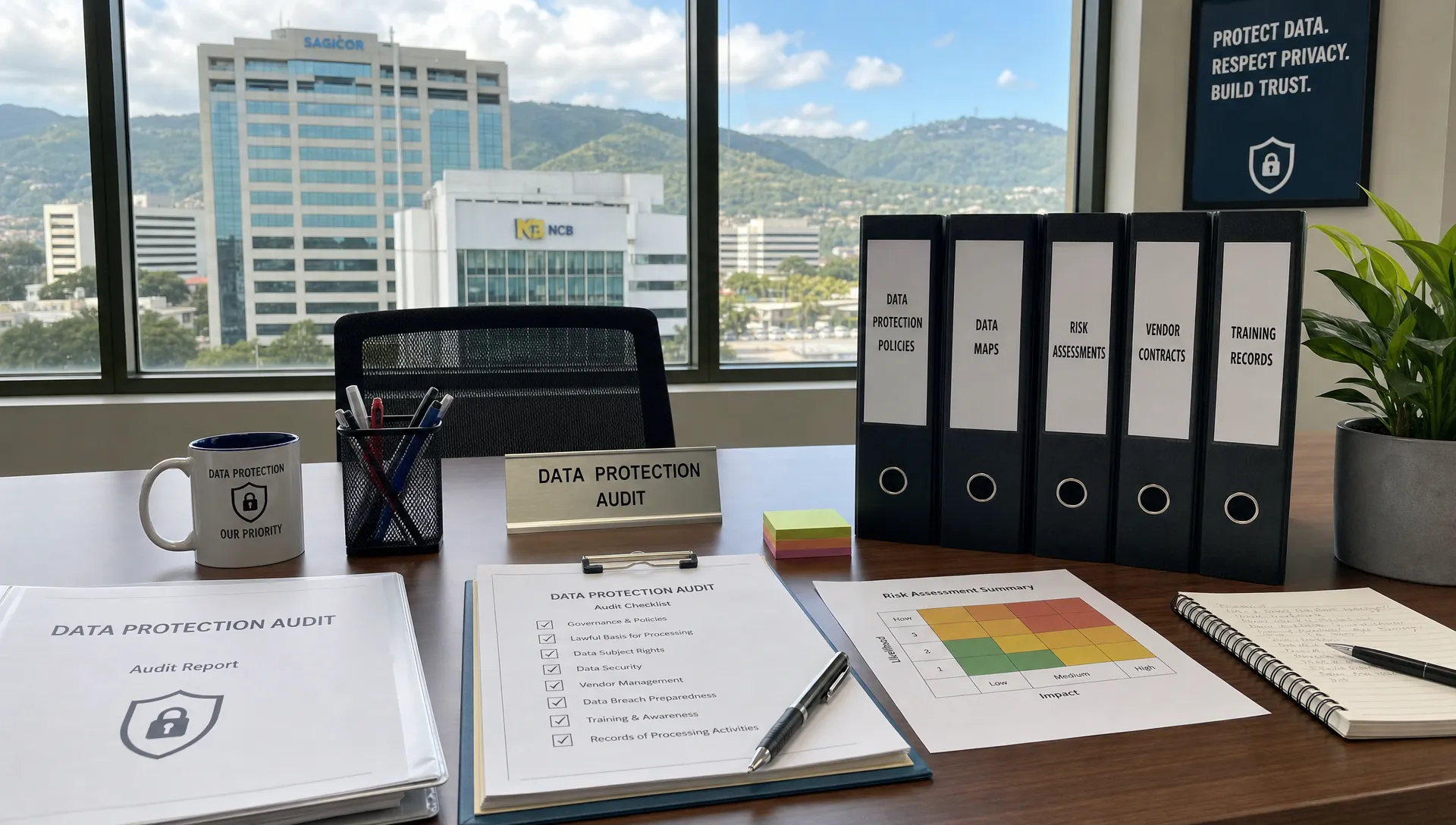
7. Strengthen processor, outsourcing and cross-border controls
Many data protection audit findings come from third-party relationships. Jamaican organisations commonly use outsourced payroll providers, cloud software, marketing agencies, payment processors, call centres, IT support providers, auditors, consultants and professional advisers. Each relationship should be assessed based on the personal data involved and the level of risk.
Prepare a supplier register that identifies which vendors process personal data, what data they receive, where they store it, whether they use sub-processors and what security controls they have in place. Contracts should include appropriate data protection terms, including processing instructions, confidentiality, security measures, breach notification obligations, return or deletion of data and limits on unauthorised use.
Transfers of personal data outside Jamaica require particular attention. If data is stored or accessed overseas, confirm the destination, the vendor's safeguards and the contractual protections in place. If your organisation also falls under GDPR or other international privacy laws, keep that analysis aligned but separate. A GDPR compliance file does not automatically prove compliance with Jamaica's Data Protection Act.
8. Link data protection to cyber security and records management
Privacy and cyber security are closely connected. An auditor may not expect your privacy team to run security tools, but they will expect the organisation to show that personal data is protected against unauthorised access, accidental loss, destruction or damage.
Prepare evidence of access controls, password and multi-factor authentication rules, user access reviews, encryption where appropriate, backup testing, patching, vulnerability management, endpoint protection, physical file security and secure disposal. Also check whether former employees, contractors or vendors still have access to systems containing personal data.
Records management is equally important. Retention schedules should be practical, not aspirational. If the schedule says a record should be deleted after a defined period, the organisation should be able to show how deletion occurs and who approves exceptions. Where another law requires retention, such as obligations related to employment, tax, financial services or anti-money laundering compliance, document that legal reason and the retention trigger.
For a deeper look at reducing real privacy risk through security measures, PLMC's guide to data protection and cyber security controls highlights practical controls that support compliance.
9. Run a mock audit before the real one
A mock audit is one of the best ways to find weaknesses while there is still time to fix them. Treat it like a real engagement. Hold an opening meeting, issue a document request list, interview process owners, test samples, record findings and close with a management action plan.
Ask practical questions rather than theoretical ones. Can HR show how employee medical information is restricted? Can marketing prove how consent or opt-outs are managed? Can procurement identify which suppliers process personal data? Can IT show recent access reviews? Can customer service explain what to do if someone requests a copy of their personal data?
The mock audit should test both design and operating effectiveness. A well-designed control exists on paper. An effective control operates consistently. For example, an access review policy is only design evidence. Completed quarterly access reviews with exceptions resolved are operating evidence.
10. Use a 30-day readiness sprint if the audit is close
If an audit is approaching quickly, focus on the highest-risk and highest-evidence areas first. The following 30-day sprint can help structure urgent preparation.
Timing | Priority | Expected output |
Week 1 | Confirm scope, owners, evidence room and document tracker | Audit plan, responsibility matrix, evidence index |
Week 2 | Validate data inventory, privacy notices, lawful basis records and rights procedures | Updated processing records, notice gap list, rights request log |
Week 3 | Review vendors, cyber controls, retention evidence and breach response | Supplier risk list, security evidence pack, retention action list |
Week 4 | Run mock audit, prioritise gaps and brief management | Findings report, remediation plan, board or executive summary |
If major gaps appear, prioritise based on risk. Focus first on sensitive personal data, large datasets, external sharing, weak access controls, unclear retention and processes that directly affect individuals' rights.
Common findings to fix before audit day
The most common readiness issues are usually practical, not obscure. They include outdated policies, incomplete data inventories, privacy notices that do not match current practice, vendor contracts without data protection clauses, poor evidence of staff training, informal handling of rights requests, unclear breach escalation, and retention schedules with no proof of deletion.
Another frequent issue is fragmented accountability. One department may assume IT owns privacy because systems are involved. IT may assume legal owns privacy because the Act is legal. Legal may assume business units own privacy because they collect the data. A good audit preparation process removes that uncertainty by assigning clear owners to each control.
After the audit: turn findings into assurance
The audit report should not sit in a folder. Convert findings into a remediation plan with risk rating, root cause, owner, target date, required resources and evidence needed for closure. Senior management should receive a clear summary of high-risk findings, overdue actions and decisions required.
Keep proof of remediation. If a policy is updated, show approval and communication. If training is completed, keep attendance and content records. If a vendor contract is amended, store the signed version. If access rights are cleaned up, keep the review record and closure evidence.
A mature privacy programme treats audits as part of continuous improvement. The point is not simply to pass one review. The point is to build a repeatable system that can withstand scrutiny at any time.
Frequently Asked Questions
Is a data protection audit mandatory in Jamaica? The Data Protection Act, 2020 requires organisations to comply with data protection standards, and organisations should be able to demonstrate that compliance. Whether a specific audit is required will depend on your regulator, sector, contracts and risk profile, but internal audits are a strong governance practice.
Who should lead data protection audit preparation? A privacy lead, compliance officer, legal officer or designated data protection owner can coordinate the audit, but ownership must be cross-functional. HR, IT, procurement, marketing, finance and operations should all provide evidence for the data they handle.
What documents should be ready for a data protection audit? Core documents include a data inventory, privacy notices, lawful basis records, rights request procedure and log, breach response procedure, security evidence, vendor contracts, retention schedule, training records, risk register and governance minutes.
How long does preparation take? A basic readiness sprint can be completed in 30 days if the organisation already has documents and owners in place. A deeper remediation programme may take 60 to 90 days or longer, especially where data inventories, vendor contracts or security controls need significant work.
What should we do if we find gaps before the audit? Record the gap honestly, assess the risk, assign an owner, set a deadline and begin remediation. Auditors generally expect continuous improvement. Unsupported claims are more damaging than a well-managed action plan.
Does GDPR compliance mean we are ready for a Jamaica data protection audit? Not necessarily. GDPR work can be useful, especially for multinational organisations, but Jamaica's Data Protection Act has its own requirements, regulator and local expectations. Your audit file should show compliance with Jamaican law, not only international frameworks.
Prepare with confidence
A data protection audit in Jamaica is easier when your evidence is organised, your people understand their roles and your controls are tested before audit day. If your organisation needs independent support, Privacy & Legal Management Consultants Ltd. can assist with data protection implementation, audit readiness, training, risk assessment, cyber security alignment and broader GRC integration.
To identify gaps before they become findings, request a consultation with Privacy & Legal Management Consultants Ltd. and start building an audit-ready privacy programme that your organisation can defend.