

How to Manage Consent Across Web Forms and Campaigns
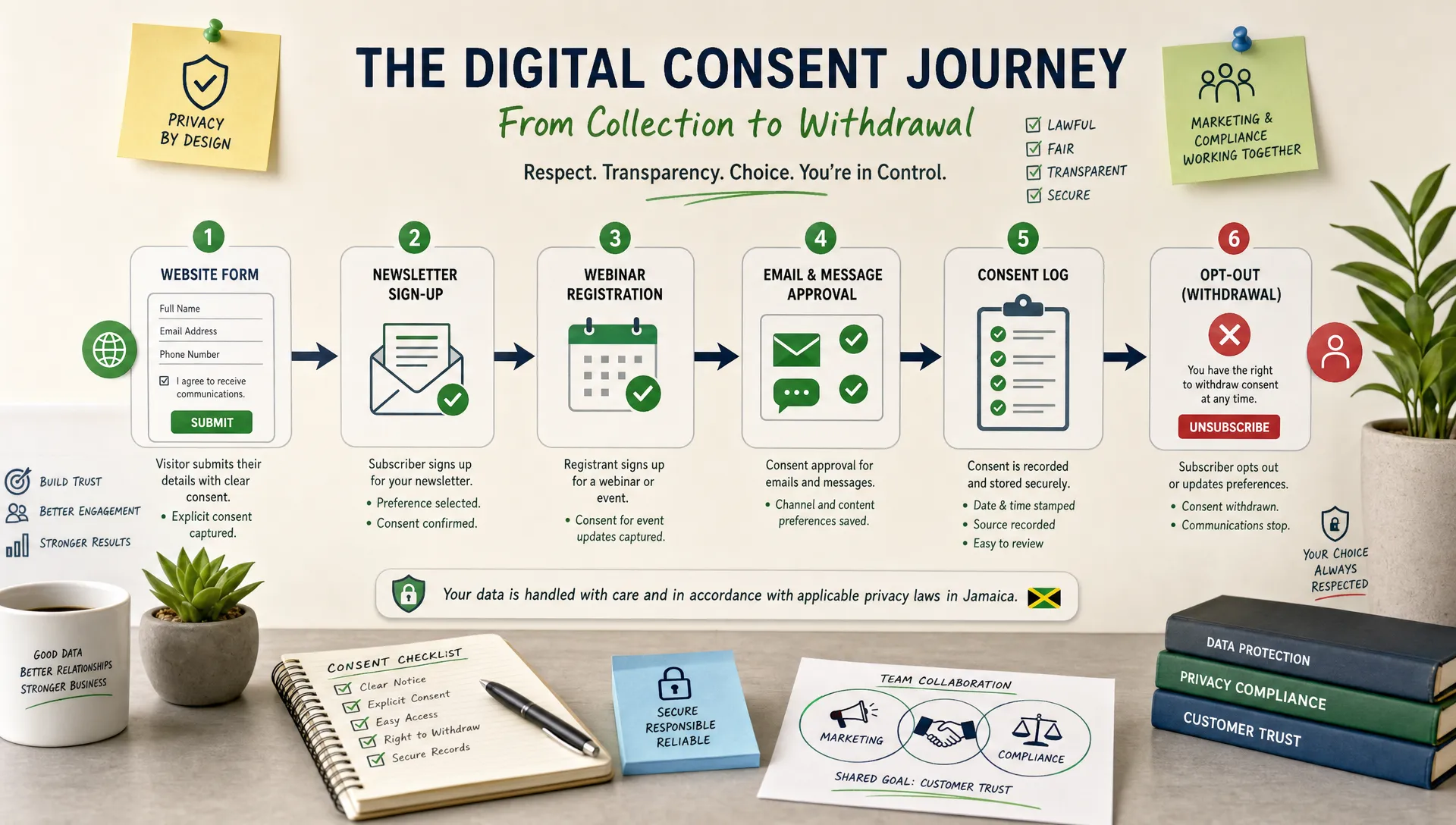
Consent is one of the easiest privacy topics to underestimate. A visitor ticks a box on a website, a prospect registers for a webinar, a customer joins a mailing list, and the campaign begins. But if your organisation cannot show what the person agreed to, when they agreed, which channel they chose, and how they can withdraw, consent becomes a compliance weakness rather than a marketing asset.
For Jamaican organisations, consent management now needs to be treated as an operational process under the Data Protection Act, 2020, not just a line of text at the bottom of a form. It affects marketing teams, IT, sales, customer service, compliance, and any third-party platform used to collect or send personal data.
This guide explains how to manage consent across web forms and campaigns in a practical way, so your organisation can run effective outreach while respecting privacy, reducing risk, and building trust.
Start with the right consent mindset
Consent is not a magic fix for every data protection issue. In privacy management, the first question is not, “Can we add a checkbox?” The better question is, “What personal data are we collecting, why are we collecting it, and what lawful condition are we relying on?”
Some processing may be necessary to provide a service, meet a legal obligation, manage a contract, or protect legitimate organisational interests. Other processing, especially promotional messaging, optional profiling, newsletter sign-ups, event follow-ups, and cross-selling campaigns, often depends heavily on clear permission.
Under Jamaica’s Data Protection Act, 2020, organisations must process personal data fairly, transparently, securely, and for defined purposes. The Office of the Information Commissioner in Jamaica is the key local regulator and source of guidance for organisations working toward compliance. If your organisation also markets to people in the European Union or United Kingdom, GDPR-style expectations may also become relevant, especially around consent records, withdrawal, cookies, and direct marketing.
A strong consent process should be:
Specific: People know exactly what they are agreeing to.
Informed: The form explains who is collecting the data, why, and how it will be used.
Freely given: Consent is not forced as a condition for something unrelated.
Clear and affirmative: The person takes a clear action, such as ticking an unchecked box.
Recorded: The organisation can prove what happened later.
Easy to withdraw: Opting out is not harder than opting in.
The UK Information Commissioner’s Office offers useful practical guidance on valid consent that is often referenced internationally, even where local law must be applied separately.
Map every place where consent is collected
Before rewriting form copy or changing your email footer, map the full consent journey. Most consent failures happen because organisations collect permissions in several places but do not connect them properly.
Common consent collection points include contact forms, newsletter sign-up boxes, landing pages, event registration forms, gated downloads, quote request forms, customer onboarding forms, surveys, mobile forms, social media lead forms, WhatsApp sign-ups, SMS campaigns, point-of-sale forms, and manual spreadsheet imports.
For each collection point, identify the purpose of the form, the fields collected, the system where the data is stored, the campaign tools that receive the data, and the person or team responsible for maintaining it. This exercise often reveals duplicate forms, outdated privacy wording, old campaign lists, and tools that are still collecting personal data long after a campaign has ended.
If you need a wider framework for assigning responsibilities and keeping privacy work active over time, PLMC’s guide on building a privacy management program that sticks provides a useful starting point.
Write consent language people can actually understand
Good consent language is plain, short, and specific. It should not sound like a legal trap. If a person needs to read a long paragraph to understand whether they are joining a mailing list, the form is doing too much work in the wrong place.
A consent statement should tell the person:
Who is collecting the data.
What type of communication they will receive.
Which channel will be used, such as email, SMS, phone, or WhatsApp.
Whether their data will be used for optional marketing, profiling, or event follow-up.
How they can withdraw or change preferences.
Where they can read the full privacy notice.
For example, a clear newsletter checkbox might say: I agree to receive email updates about privacy, compliance, training, and related services from [Organisation Name]. I can unsubscribe at any time.
That wording is much stronger than a vague statement such as: I agree to receive communications. It also avoids bundling consent into unrelated terms and conditions. Your terms of service and your marketing consent should not be treated as the same thing.
For higher-risk uses, such as sharing information with partners, using personal data for profiling, or collecting sensitive information, the wording should be even more specific and may require legal review.
Design web forms with privacy built in
Web forms are often the front door of your marketing and sales funnel. They are also one of the most visible signs of whether your organisation takes privacy seriously.
Start by separating required fields from optional fields. If the person only needs to download a report, do you really need their job title, phone number, industry, company size, and preferred budget? Data minimisation is not just a compliance principle, it also improves user experience and can increase completion rates.
Use unchecked boxes for optional marketing consent. Avoid pre-ticked checkboxes, implied consent, or statements that say a person agrees simply by submitting a form. If the form submission is necessary to respond to an enquiry, that is different from using the same data to send future promotional campaigns.
A simple form structure may look like this:
Form element | Good practice | Risk to avoid |
Contact details | Ask only for what is needed for the stated purpose | Collecting excessive data “just in case” |
Privacy notice link | Place it near the submit button in plain language | Hiding it in a footer only |
Marketing checkbox | Use an unchecked, purpose-specific option | Using one bundled checkbox for all purposes |
Channel preferences | Let users choose email, SMS, phone, or WhatsApp where relevant | Assuming permission for every channel |
Consent record | Store timestamp, source, wording version, and preference | Keeping only the email address with no evidence |
If you use campaign tracking pixels, analytics cookies, or remarketing tags on landing pages, make sure your cookie and tracking practices align with your privacy notice and consent approach. A person who signs up for a webinar should not be surprised that their behaviour is being tracked for unrelated advertising if that was never explained.
Keep campaigns aligned with the original purpose
Consent does not give your organisation unlimited permission to use personal data forever. The campaign must stay aligned with what the person agreed to.
If a prospect signs up for a data protection webinar, it may be reasonable to send event reminders and post-event materials. But adding that person to every promotional list, sharing their details with unrelated partners, or sending messages about services they did not ask about may create compliance and trust issues.
Marketing teams should define the purpose of each list before launching a campaign. A newsletter list, webinar list, customer update list, abandoned cart list, and re-engagement list may all require different wording, retention rules, and opt-out handling.
This is especially important across departments. Marketing may see a lead, sales may see a prospect, finance may see a payer, and compliance may see a data subject with rights. For a broader view of how privacy obligations affect business functions, see PLMC’s article on how data laws affect marketing, HR, and finance.
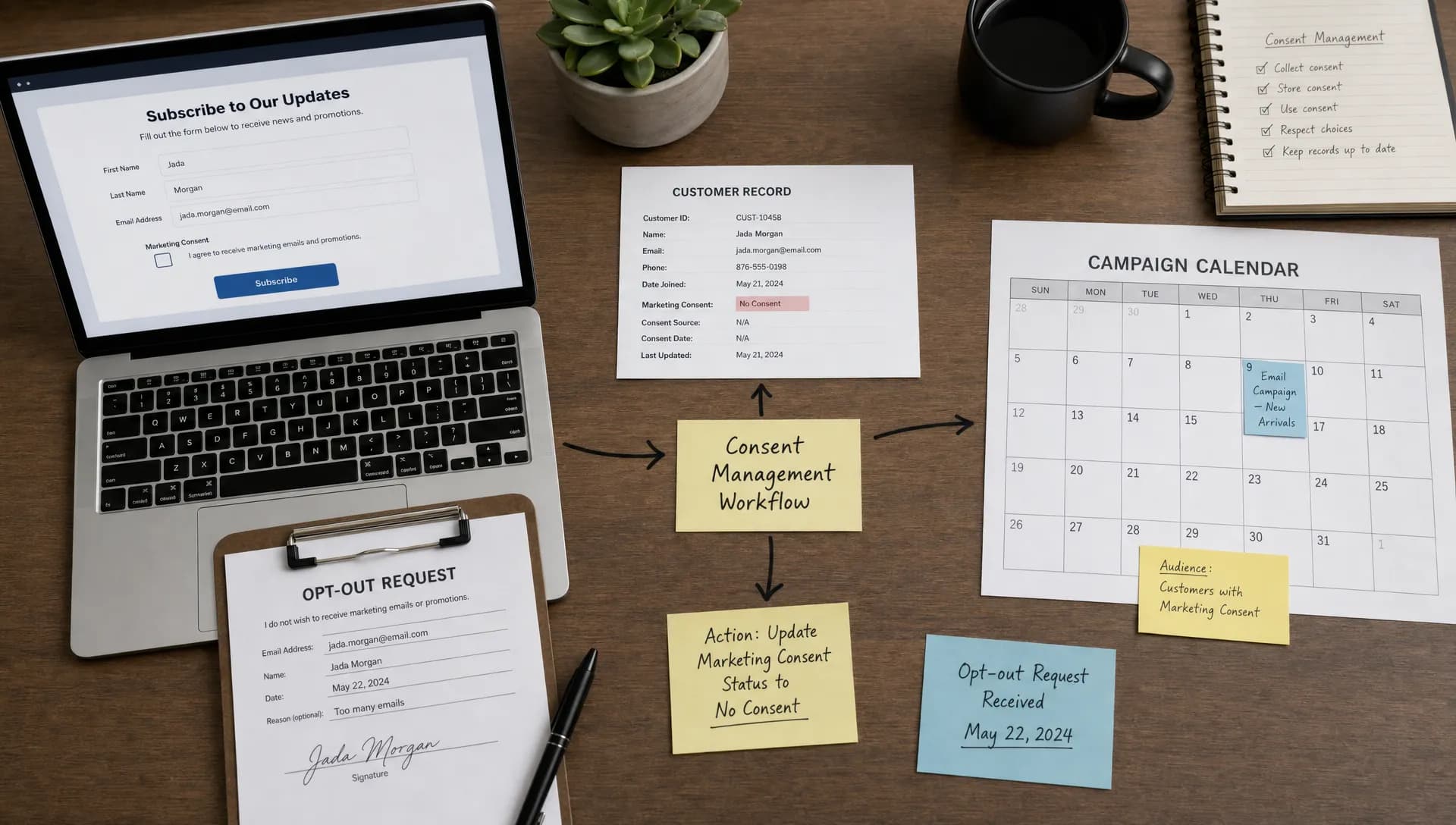
Build a central consent record
A consent record is the evidence that connects a person, a purpose, a channel, and a point in time. Without it, your organisation may struggle to answer basic questions during an audit, complaint, or internal review.
A central record does not always mean buying a complex consent management platform. Smaller organisations may begin with a well-controlled CRM field structure, a secure database, or a managed register. The key is to make one source authoritative, rather than allowing every tool to hold a different version of the truth.
Your consent record should capture enough information to show what happened without collecting unnecessary data.
Consent record field | Why it matters |
Individual identifier | Connects consent to the correct person, such as email or customer ID |
Consent purpose | Shows what the person agreed to receive or allow |
Channel | Records whether consent applies to email, SMS, phone, WhatsApp, or another channel |
Source form or campaign | Shows where consent was collected |
Date and time | Creates an audit trail |
Privacy notice version | Shows what information was available at the time |
Consent wording version | Proves the exact permission statement used |
Status | Shows whether consent is active, withdrawn, expired, or pending confirmation |
Withdrawal date | Records when opt-out was requested and actioned |
Be careful with IP addresses and device data. They can be useful for security and evidence, but they may also be personal data. Collect and retain them only where there is a clear purpose.
Sync consent across your tools
Most organisations do not manage consent in one system. A website form may feed a CRM, which then feeds an email marketing platform, which then exports a list for a webinar, which then creates a sales follow-up task. Every handoff creates the risk of outdated consent.
To reduce that risk, define how systems sync consent changes. If a person unsubscribes from an email campaign, does the CRM update automatically? If a sales representative manually adds a contact, is consent status required before marketing emails can be sent? If a person changes their preference from email to WhatsApp, does the old email permission remain active or is it replaced?
Create clear rules for common scenarios:
New form submissions should update consent status only for the specific purpose and channel selected.
Withdrawals should override older consent records for that purpose and channel.
Imported lists should not be used until the source and consent basis are verified.
Duplicate records should be merged carefully so an old permission does not overwrite a newer withdrawal.
Campaign tools should receive only the contacts they are authorised to contact.
If you use vendors for email marketing, CRM, analytics, landing pages, SMS, or event registration, include consent management in your vendor review. Ask how the platform stores consent records, handles unsubscribes, secures personal data, supports exports, and assists with deletion or access requests. PLMC’s guide on running a simple vendor privacy assessment can help you structure that review.
Make withdrawal simple and reliable
Consent is only meaningful if withdrawal works. Every marketing email should include a functional unsubscribe option. SMS and WhatsApp campaigns should give people a simple way to opt out. Web forms should tell people how they can change preferences later.
Do not make people log in, call during office hours, or explain why they want to unsubscribe unless that is truly necessary. A withdrawal process that creates friction can turn a minor annoyance into a complaint.
It is also important to distinguish between deletion and suppression. If a person unsubscribes from marketing, deleting them from the email platform alone may not be enough. The same address might be imported again from a spreadsheet or CRM list. A suppression record, kept to the minimum necessary, helps ensure the organisation does not contact that person again for the same purpose.
Operationally, define who monitors opt-outs, how quickly systems are updated, and how exceptions are handled. If your organisation runs frequent campaigns, manual unsubscribe processing is risky. Automation or a controlled workflow is usually safer.
Treat bought lists and shared lists as high risk
Purchased lists, partner lists, event sponsor lists, and scraped contacts are common sources of consent problems. The fact that a third party gives you a list does not automatically mean your organisation has permission to use it.
Before using any external list, ask for evidence of how the data was collected, what the person was told, whether your organisation or category of organisation was named, what channel was permitted, and whether the list has been screened for opt-outs. If those answers are unclear, the safest decision may be not to use the list.
A good campaign is not just measured by open rates or leads generated. It should also be measured by whether it protects the organisation’s reputation and respects the expectations of the people contacted.
Audit consent before each major campaign
Consent management should not be a one-time clean-up project. Before launching a major campaign, run a short consent audit. Confirm that the target list matches the campaign purpose, the channel is authorised, the unsubscribe process works, the privacy notice is current, and the campaign platform has the latest suppression list.
After the campaign, review complaints, unsubscribes, bounce rates, and any signs that people were surprised by the message. High unsubscribe rates do not always mean a legal breach, but they can signal that your consent wording, list source, or campaign targeting needs attention.
A simple quarterly review can also help identify old forms, inactive lists, outdated language, and campaign tools that are no longer needed. This is where privacy and marketing can work together rather than against each other.
Common consent mistakes to fix quickly
The following issues are common in web forms and campaigns. They are also relatively practical to fix once the organisation decides who owns the process.
Mistake | Why it creates risk | Better approach |
One checkbox for everything | The person cannot tell what they agreed to | Use separate consent options for distinct purposes |
Pre-ticked marketing boxes | Consent may not be clearly affirmative | Use unchecked boxes that require active choice |
No record of wording | The organisation cannot prove what was agreed | Store the consent statement version used at the time |
Unsubscribes handled in one tool only | The person may be contacted again from another system | Sync withdrawals to the central record or suppression list |
Old lists reused for new campaigns | Original consent may not cover the new purpose | Re-check purpose, source, date, and channel before use |
Privacy notice hidden from the form | People may not be properly informed | Place a clear privacy notice link near the point of collection |
Manual spreadsheet imports | Consent status can be lost or overwritten | Require source verification before import |
A practical 30-day consent improvement plan
You do not need to fix every system in one week. A structured 30-day plan can make consent management more realistic.
In the first week, identify all active web forms, landing pages, and campaign lists. Note the owner, purpose, fields collected, consent wording, and connected tools.
In the second week, prioritise high-risk areas. Focus first on promotional campaigns, purchased or shared lists, SMS and WhatsApp outreach, forms collecting sensitive information, and any campaign aimed at children or vulnerable groups.
In the third week, standardise your consent language and form design. Update the highest-traffic forms, remove unnecessary fields, replace vague wording, and ensure the privacy notice is easy to find.
In the fourth week, create or improve your consent register. Decide where consent status lives, how withdrawals are synced, who reviews imports, and how campaign teams prove that a list is authorised before sending.
Finally, brief the relevant teams. Marketing, sales, IT, customer service, and compliance should all understand the difference between service communications, promotional campaigns, consent, opt-out, and suppression. Without staff awareness, even the best form design will fail in daily practice.
Frequently Asked Questions
Do we need consent for every web form? Not always. Some forms collect data because the organisation needs it to answer an enquiry, provide a service, or manage a contract. However, optional marketing, newsletters, profiling, and unrelated follow-up campaigns often require clear permission or another carefully assessed lawful basis.
Can we use one checkbox for email, SMS, phone, and WhatsApp? It is better to separate channels where possible. A person who agrees to email updates may not expect SMS or WhatsApp messages. Granular choices reduce complaints and make your consent record more reliable.
Is double opt-in required for email campaigns? Double opt-in is not always legally required, but it can be a useful evidence and quality-control measure. It helps confirm that the email address belongs to the person and that the subscription was intentional.
What should we do with old mailing lists? Review the source, date, wording, purpose, and channel permissions before using them. If you cannot show how people joined the list or what they agreed to, consider running a compliant re-permission campaign or retiring the list.
How quickly should we honour an unsubscribe request? Treat withdrawal as urgent and process it promptly. If your tools sync automatically, the update should happen quickly. If manual steps are involved, assign ownership and monitor completion so people are not contacted again by mistake.
What if a campaign platform stores consent differently from our CRM? Decide which system is authoritative and create syncing rules. The safest approach is to ensure withdrawals override older permissions and that no campaign list is sent without checking the latest consent status.
Strengthen consent before your next campaign
Consent management is not just a compliance task. It is part of how your organisation earns trust with customers, prospects, members, and the public. Clear forms, accurate records, reliable opt-outs, and disciplined campaign workflows help your teams market responsibly under Jamaica’s data protection environment.
If your organisation needs help reviewing web forms, campaign workflows, consent records, or broader data protection compliance, Privacy & Legal Management Consultants Ltd. can support your next steps with practical guidance, training, and governance-focused privacy support. Consider starting with a free consultation before your next major campaign goes live.