

How to Handle Data Rights Requests From Overseas
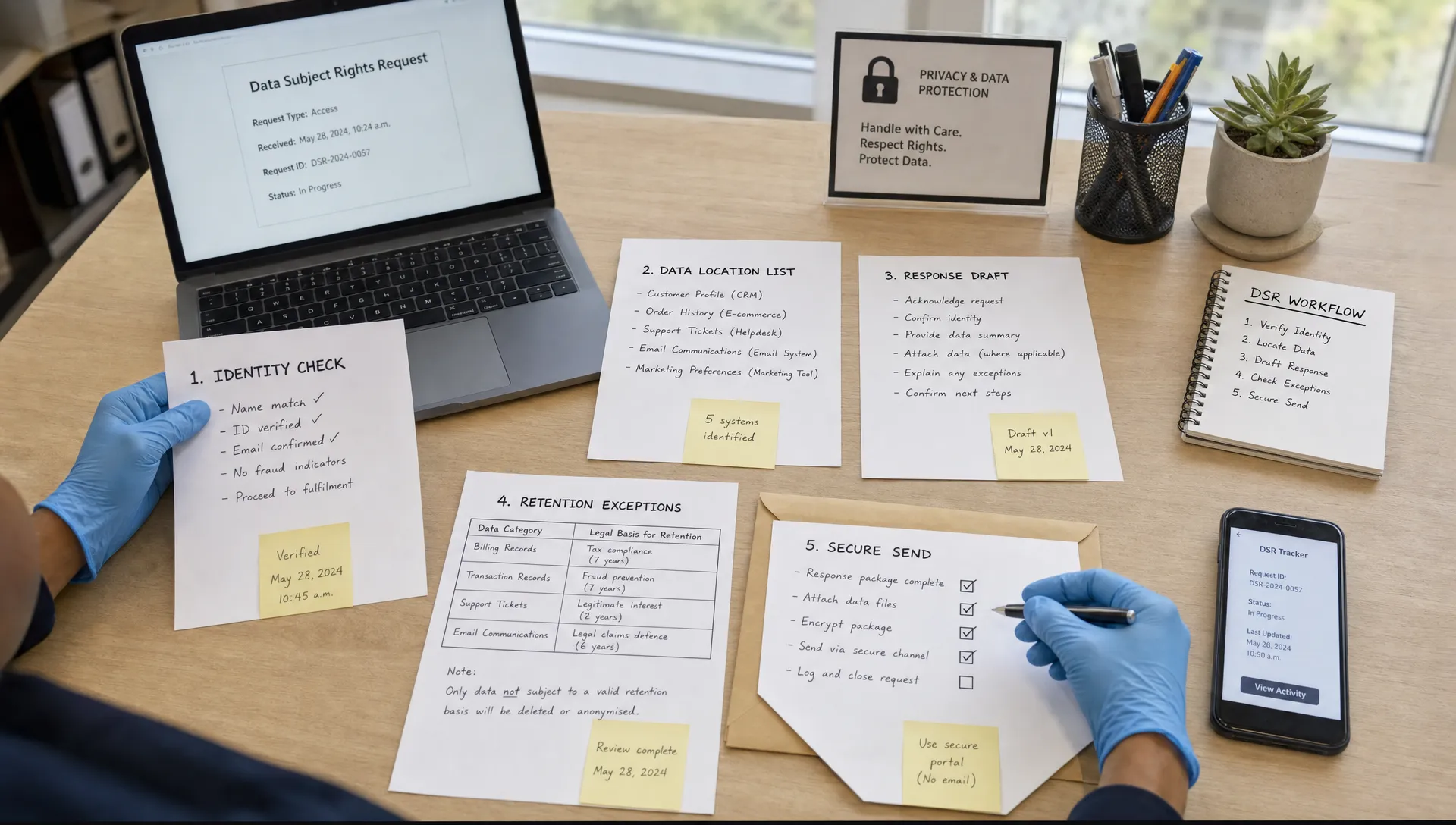
A data rights request from overseas can look deceptively simple: a customer in the United Kingdom asks for a copy of their account data, a former contractor in Trinidad asks you to delete old records, or a European prospect opts out of profiling. For a Jamaican organisation, the safest starting point is not “they are overseas, so this is not our issue.” The better approach is to verify the requester, identify which law or contract applies, locate the relevant personal data and respond through a controlled data protection process.
Handled well, overseas requests can strengthen trust and reduce regulatory risk. Handled casually, they can lead to missed deadlines, unlawful disclosures, poor audit trails or conflict between Jamaica’s Data Protection Act 2020, foreign privacy laws and commercial contract obligations.
What counts as a data rights request from overseas?
A data rights request is any request by an individual to exercise control over personal data that an organisation holds about them. It may come from a customer, employee, website user, job applicant, supplier contact or authorised representative.
The request is “from overseas” when the individual is located outside Jamaica, uses foreign contact details, refers to a foreign law, or is connected to a non-Jamaican customer, group company or client. The request does not need to use formal legal language. A simple email saying “send me all the information you have about me” may still require action.
Common request types include:
Access to personal data held by the organisation
Correction of inaccurate or incomplete records
Deletion or erasure where retention is no longer justified
Objection to direct marketing or certain processing activities
Restriction or suspension of processing in specific circumstances
Portability requests where a foreign law gives that right
Questions about automated decisions or profiling
The key is to treat the substance of the message seriously, even if the person has cited the wrong law or sent the request to the wrong inbox.
Why overseas requests matter for Jamaican organisations
Jamaican organisations should assess overseas data rights requests through three lenses: Jamaican law, foreign law and contractual obligations.
First, the Data Protection Act 2020 creates duties for data controllers that process personal data. Those duties do not disappear merely because the individual is outside Jamaica. If your organisation is the controller responsible for the data, you should have a consistent process for receiving, verifying and responding to rights requests.
Second, overseas privacy laws can sometimes apply to Jamaican businesses. This is especially relevant where the organisation targets people in another jurisdiction, monitors their behaviour online, handles data for an overseas client or operates through group companies abroad. If you need to assess those triggers in more detail, PLMC has a separate guide on when overseas data laws apply to Jamaican companies.
Third, contracts may require a response even where a foreign law does not apply directly. For example, a Jamaican service provider processing customer data for a Canadian, UK or EU client may have agreed to assist that client with data subject requests within a set timeframe.
A practical workflow for handling overseas requests
The best response process is structured, repeatable and documented. It should help staff move quickly without disclosing information to the wrong person or deleting records that must be retained for legal, tax, employment, regulatory or anti-money laundering purposes.
Step | What to do | Why it matters |
Log the request | Record the date, channel, requester details, request type and deadline | Creates an audit trail and prevents missed deadlines |
Verify identity | Confirm the requester is the data subject or an authorised representative | Reduces the risk of unauthorised disclosure |
Identify the role | Decide whether you are controller, joint controller or processor | Determines who should respond and who should be notified |
Assess applicable rules | Check Jamaican law, foreign law and contract terms | Helps set the correct response standard and deadline |
Locate the data | Search relevant systems, archives, vendors and transfer records | Ensures the response is complete and defensible |
Review exemptions | Consider retention duties, legal privilege, third-party data and security risks | Avoids over-disclosure or unlawful deletion |
Respond securely | Provide the outcome in clear language through a safe channel | Protects the individual and the organisation |
Document closure | Keep evidence of decisions, searches, approvals and communications | Supports compliance if the response is challenged |
Step 1: Log the request immediately
A request should be logged as soon as it is identified. Do not wait until the privacy officer, legal team or compliance lead has completed the legal analysis. The clock may already be running under the relevant law or contract.
Your log should capture the requester’s name, contact details, location, relationship with the organisation, date received, staff member who received it, requested action and any law cited by the individual. If the request came through social media, a branch location, customer service chat or a personal email address, move it into your formal process without asking the individual to restart unnecessarily.
Step 2: Verify identity without over-collecting
Identity verification is essential, but it must be proportionate. A bank, insurer or regulated financial business may need stronger checks than a newsletter publisher handling only an email address and marketing preferences.
Ask for enough information to confirm the person’s identity in context. Avoid collecting passports, national IDs or utility bills by default if a lower-risk method will work. For example, you may confirm identity through an existing customer portal, known email address, account security questions or a signed authority from a representative.
If the request comes from a lawyer, parent, executor or agent, verify both the requester’s identity and their authority to act for the individual.
Step 3: Decide your legal role before responding
Many mistakes happen because the organisation responds before deciding whether it is a controller or processor. A controller decides why and how personal data is processed. A processor handles personal data on behalf of a controller, usually under contract.
If you are the controller, you may need to respond directly. If you are only the processor, you may need to notify the overseas client or controller promptly and follow the contract. Do not independently disclose, delete or amend data controlled by a client unless your agreement authorises you to do so.
This role analysis should be part of your wider data protection compliance framework, not an improvised decision made under pressure.

How to decide which law or deadline applies
There is no single answer for every overseas request. The deadline and response standard may depend on where the requester is located, where your organisation operates, what your privacy notice says, what contracts apply and which law governs the specific processing activity.
For example, the EU General Data Protection Regulation generally requires controllers to respond to data subject requests within one month, with limited extensions for complex requests. California privacy rules, where applicable, use different response periods. Caribbean jurisdictions may have their own statutory language and regulatory expectations.
For Jamaican organisations, a practical rule is to identify all plausible obligations and work to the shortest applicable deadline where feasible. This reduces the risk of complying with one regime while missing another.
If your organisation regularly receives requests from foreign customers or clients, maintain a simple matrix showing applicable laws, request types, deadlines, approval points and escalation contacts. That matrix should be reviewed whenever the business enters a new market or signs a major overseas contract.
Finding the personal data across borders
A complete response depends on knowing where personal data sits. Overseas requests are often difficult because the data is scattered across cloud platforms, offshore vendors, shared drives, CRM systems, payment processors, email archives and regional business units.
A data map or record of processing activities will help you identify the systems to search. A cross-border transfer register is especially useful because it shows where personal data leaves Jamaica, who receives it, why it is transferred and what safeguards apply. If your organisation does not yet have one, use PLMC’s guide on creating a cross-border data transfer register as a starting point.
Do not limit your search to the most obvious system. If the individual is a customer, relevant information may also appear in call recordings, support tickets, marketing tools, billing records and fraud prevention notes. If the individual is an employee or contractor, records may exist in HR, payroll, access control, email and performance management systems.
At the same time, avoid uncontrolled searches that expose personal data to staff who do not need access. Assign responsibility, define search locations and use secure collection methods.
Handling common request types from overseas
Different rights require different decisions. A standard acknowledgement template is useful, but the substance of the response must match the request.
Access requests
For access requests, confirm what personal data the organisation holds about the individual and provide the required information in a clear format. Review the material before disclosure to remove or protect third-party personal data, legally privileged information, trade secrets or security-sensitive details where an exemption applies.
Avoid sending raw system exports without review. They may contain internal notes, other individuals’ data or codes the requester cannot understand. A curated response is usually safer and more useful.
Correction requests
If an overseas individual says their data is inaccurate, ask for the correct information and supporting evidence where appropriate. Update active systems, notify relevant processors or business units and record the change.
If the organisation disagrees with the correction, document the reason and consider whether a note should be added to the record showing that the individual disputes the accuracy.
Deletion requests
Deletion is not automatic. The organisation may have legitimate reasons or legal duties to retain certain records, such as tax, employment, litigation, anti-money laundering, fraud prevention or regulatory records.
The response should explain what has been deleted, what has been retained and why. Where full deletion is not possible, consider restricting access, suppressing the data from marketing use or applying retention controls until the lawful retention period ends.
Marketing opt-outs
Marketing objections should usually be actioned quickly. Remove the person from promotional lists, suppress their details to prevent re-uploading and notify relevant marketing vendors where necessary.
Keep a minimal suppression record so the organisation does not accidentally add the person back to a campaign. This is not the same as continuing to market to them.
Portability and profiling questions
Some overseas laws give individuals rights to receive data in a portable format or obtain information about automated decisions. If such a law applies, confirm the scope carefully. These rights may not apply to every type of data or every business process.
Even where the legal right does not strictly apply, a transparent explanation of data use can reduce complaints and improve customer trust.
Communicating with the requester
Good communication lowers risk. Acknowledge the request promptly, explain any identity checks and tell the requester when they can expect a response. If the request is broad, ask for clarification, but do not use clarification as a tactic to delay.
Use plain language. If you refuse all or part of a request, explain the reason without exposing confidential legal analysis or security details. Where appropriate, tell the individual how they can complain, escalate internally or contact the relevant regulator.
Security also matters. Do not send sensitive files by ordinary email without safeguards. Consider encrypted attachments, secure portals, password-protected files sent separately or verified account access, depending on the sensitivity of the data.
Working with overseas clients, vendors and group companies
Overseas requests often involve multiple organisations. A Jamaican company may rely on a US cloud provider, support a UK client or share data with a Caribbean affiliate. Your response process should define who does what before a request arrives.
Contracts should cover notification deadlines, assistance with searches, deletion instructions, audit evidence, security standards and responsibility for responding to individuals. If your business is negotiating or updating cross-border service agreements, review the practical points in PLMC’s article on privacy clauses for contracts with overseas clients.
For group companies, avoid assuming that access can be granted informally because everyone is part of the same corporate family. Each entity should understand its role, lawful basis, transfer safeguards and authority to respond.
Mistakes to avoid
The most common failures are operational rather than technical. Organisations often know that privacy rights exist, but they lack a process that staff can follow under real-world pressure.
Avoid these mistakes:
Ignoring the request because it cites a foreign law
Disclosing data before verifying identity
Treating every requester as if the same law applies
Deleting records that must be retained for regulatory reasons
Forgetting to search email, archived systems or vendor platforms
Responding as a processor without notifying the controller
Missing contract deadlines with overseas clients
Sending sensitive data through insecure channels
Failing to record the reasoning behind exemptions or refusals
A defensible process does not require panic or over-engineering. It requires clear ownership, trained staff, reliable records and proportionate controls.
Build readiness before the first overseas request
The best time to prepare is before a customer, employee or regulator asks questions. Jamaican organisations that operate across borders should maintain a data rights procedure that covers local and international scenarios.
At minimum, the organisation should have a request intake channel, staff training, identity verification rules, role assessment guidance, response templates, a data inventory, a retention schedule, vendor escalation contacts and an approval process for complex cases.
Training is especially important for frontline teams. Customer service, HR, sales, marketing, IT and finance may all receive privacy requests before the legal or compliance team knows about them. A short data privacy training Jamaica programme can help staff recognise requests and escalate them properly.
PLMC supports organisations with data protection implementation, corporate governance, anti-money laundering compliance, cyber security services, GRC integration, training and risk assessment tools. If your organisation handles personal data across borders, a structured review can help you align your request process with Jamaica’s Data Protection Act 2020 and relevant overseas expectations.
Frequently Asked Questions
Does a Jamaican company have to answer a request from someone overseas? Often, yes. If the organisation controls or processes that individual’s personal data, the request should be assessed under Jamaican law, any applicable foreign law and relevant contracts. The person’s overseas location is not a reason to ignore the request.
What if the requester mentions GDPR but my company is in Jamaica? Do not dismiss the request automatically. First assess whether the GDPR applies to the activity, such as targeting people in the EU or monitoring their behaviour. Even if GDPR does not apply, Jamaica data privacy obligations or client contract terms may still require a response.
Can we ask for identification before providing data? Yes, where verification is needed. The request should be proportionate to the risk. Do not collect excessive identity documents if you can verify the person through safer or simpler means.
Do we have to delete all personal data when asked? Not always. Some records may need to be retained for legal, tax, employment, regulatory, anti-money laundering or dispute purposes. The response should explain what can be deleted, what must be retained and any restrictions applied.
Who should respond if we process data for an overseas client? If your organisation is acting as a processor, notify the client or controller according to the contract and follow their instructions. Do not respond independently unless your agreement authorises it or the law requires it.
Need support with overseas data rights requests?
Overseas requests require more than a template email. They require a practical system that connects privacy, governance, records management, cyber security, vendor management and legal risk.
If your organisation needs help building or testing that system, Privacy & Legal Management Consultants Ltd. can support your data protection compliance programme with implementation guidance, training and risk-based advisory services for the Jamaican business environment.