

How to Create a Cross-Border Data Transfer Register
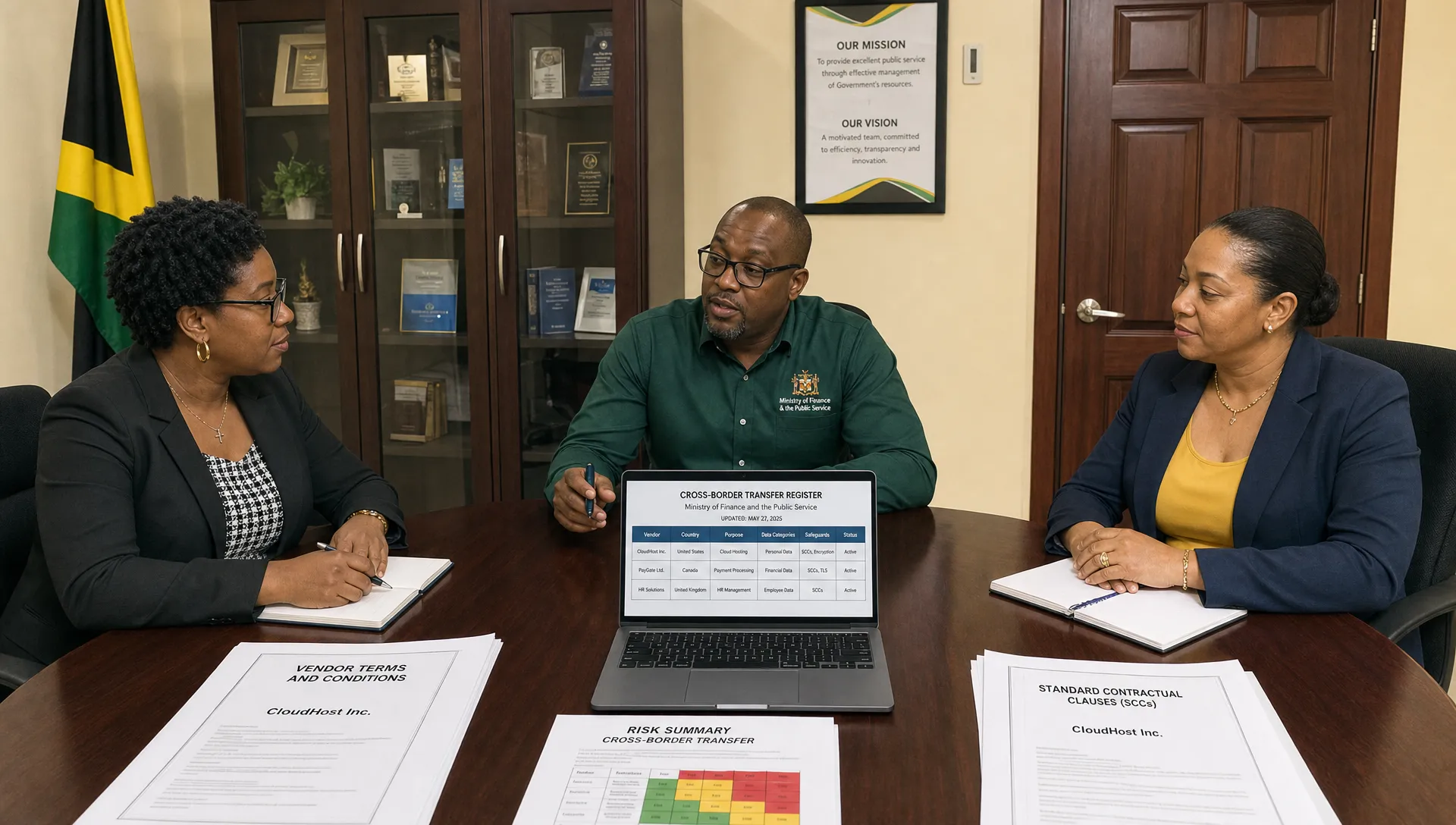
A cross-border data transfer register gives your organisation a clear, auditable record of where personal data leaves Jamaica, who receives it and what safeguards protect it. For Jamaican businesses, public bodies and non-profits, it is also a practical way to demonstrate data protection accountability under the Data Protection Act 2020, especially when cloud services, overseas vendors, regional offices or international payment platforms are part of daily operations.
The register does not need to be complicated at first. It does need to be accurate, maintained and useful to the people who make decisions about privacy, procurement, IT security, corporate governance and risk.
Why a cross-border data transfer register matters
A transfer register helps you move from assumption to evidence. Many organisations know they use overseas systems, but they cannot quickly answer basic questions such as which customer records are hosted abroad, whether a processor can use sub-processors or what security controls apply when staff outside Jamaica access files.
Under the Data Protection Act 2020, organisations must handle personal data in line with data protection standards, including restrictions and safeguards around overseas transfers. The Office of the Information Commissioner in Jamaica is the key local authority for data protection oversight, and organisations should monitor its guidance as compliance expectations mature.
A well-kept register supports more than privacy. It helps with vendor due diligence, cyber security planning, breach response, anti-money laundering compliance, audit readiness and board-level risk reporting. If your organisation is part of a regional group, you may also find PLMC’s guidance on managing customer data across Caribbean borders useful alongside this register-building process.
What counts as a cross-border data transfer?
A cross-border transfer happens when personal data is sent, hosted, accessed or otherwise made available outside Jamaica. It is not limited to emailing a spreadsheet overseas. In modern operations, transfers often occur silently through cloud infrastructure, outsourced support and software platforms.
Common examples include overseas payroll processing, customer relationship management systems hosted abroad, international payment gateways, offshore call centres, regional group reporting, overseas legal or audit advisers, remote technical support and cloud backup services. A transfer can also occur when a person in another country remotely accesses data stored on a Jamaican server.
The register should capture both routine transfers and occasional transfers. A one-time disclosure to an overseas regulator or external investigator may carry a different risk profile from an ongoing cloud hosting arrangement, but both should be assessed and recorded if personal data is involved.
How to create a cross-border data transfer register
Start with a simple principle: record each transfer in a way that allows someone independent of the project to understand the data flow, the reason for it and the controls in place. If the register is too vague, it will not help during an audit, breach investigation or vendor review.
Your first version can be a controlled spreadsheet, GRC platform entry or privacy management tool. The format matters less than ownership, completeness and review discipline. For many Jamaican organisations, a spreadsheet is acceptable at the beginning if it has version control, restricted access and a named owner.
Define the scope before collecting entries
Before asking teams for information, decide what the register will cover. At minimum, it should include transfers of personal data relating to customers, employees, contractors, suppliers, website users, beneficial owners, applicants and any other identifiable individuals.
You should also decide whether to include anonymised, pseudonymised and aggregated data. Truly anonymised data may fall outside privacy rules because an individual is no longer identifiable. Pseudonymised data should usually remain in scope because re-identification may still be possible, especially where another party holds the key.
Set a clear threshold for inclusion. If a vendor stores names, contact details, identification documents, bank details, health data, employee records, login credentials or transaction histories outside Jamaica, the transfer should be logged.
Identify the systems and processes that move data
The fastest way to build the first register is to start with your business processes, not your contracts. Contracts are important, but they rarely reveal every operational data flow.
Speak with process owners in human resources, finance, compliance, sales, marketing, customer service, IT, procurement and legal. Ask where their systems are hosted, who supports them, which third parties can access personal data and whether reports are sent to regional or international stakeholders.
Useful discovery sources include software inventories, vendor lists, data maps, records of processing activities, cyber security asset registers, procurement files, privacy notices, data processing agreements and incident response logs. Where possible, validate answers with IT because business users may not know whether a platform is hosted in the United States, Canada, the United Kingdom, the European Union or another jurisdiction.
Record the minimum fields that make the register useful
A cross-border data transfer register should be detailed enough to support compliance decisions without becoming impossible to maintain. The table below sets out practical fields that work well for Jamaican organisations building a register from scratch.
Register field | Why it matters | Example entry |
Transfer ID | Creates a stable reference for audits and updates | CBT-004 |
Business owner | Identifies who is accountable for the process | Head of Human Resources |
System or process | Shows where the transfer occurs | Payroll platform |
Data subjects | Identifies whose data is affected | Employees and contractors |
Data categories | Helps assess sensitivity and risk | Name, TRN, salary, bank account details |
Destination country or territory | Shows where the data goes or can be accessed | Barbados, United States |
Recipient name and role | Clarifies whether the party is a controller, processor or adviser | Payroll service provider, processor |
Purpose of transfer | Explains the business reason | Salary processing and statutory reporting support |
Transfer frequency | Distinguishes one-off from continuous transfers | Monthly |
Legal basis or processing condition | Links the transfer to lawful processing | Employment administration, contractual necessity |
Safeguards | Records contractual, organisational and technical controls | Data processing agreement, encryption, access controls |
Sub-processors or onward transfers | Reveals whether data moves beyond the first recipient | Cloud hosting provider in the United States |
Retention period | Confirms how long data remains with the recipient | Seven years after employment ends |
Risk rating | Helps prioritise remediation | Medium |
Review date | Keeps the register current | 30 June 2027 |
This table can be adapted to your sector. A financial institution may need more detail on anti-money laundering records and beneficial ownership data, while a healthcare provider may need stronger fields for sensitive personal data and clinical confidentiality.
Assess the legal and compliance position
Once the initial inventory is complete, assess whether each transfer has a lawful basis and suitable safeguards. This is where the register becomes more than a list. It becomes a decision-making tool for data protection compliance.
For Jamaica data privacy purposes, your review should consider the Data Protection Act 2020, sector-specific obligations, confidentiality duties, contractual obligations and any foreign laws that may apply. If your organisation handles personal data of individuals in the European Union or offers goods or services to them, GDPR may also be relevant. Many searches for GDPR Jamaica guidance come from organisations trying to understand this overlap.
Do not assume that a popular cloud provider, regional affiliate or long-standing vendor automatically satisfies your obligations. The transfer should be assessed based on the nature of the data, the country involved, the recipient’s controls, contractual restrictions, onward transfers and the rights available to individuals.

Check the destination and recipient risk
Not every international transfer presents the same level of risk. A transfer of general business contact details to a low-risk vendor is different from sending customer identification documents, transaction alerts or employee medical information to a provider with weak security controls.
When assessing destination and recipient risk, look at the country where the data is hosted, the country where support staff can access it and any onward transfer locations. Also review the recipient’s security certifications, breach history if known, incident notification terms, data deletion commitments, audit rights and use of sub-processors.
This review should be proportionate. You do not need a 40-page assessment for every low-risk software tool, but you do need enough evidence to show that the organisation considered the risk and selected appropriate safeguards.
Document the safeguards clearly
The safeguards column is often where registers become weak. Entries such as “contract in place” or “vendor is secure” are not enough. Record the actual controls that reduce risk.
Examples of useful safeguards include written data processing terms, confidentiality obligations, encryption in transit and at rest, multi-factor authentication, role-based access, audit logging, incident notification timelines, deletion or return of data at contract end, sub-processor approval controls, staff training and periodic vendor reviews.
Where EU GDPR applies, you may need to consider specific GDPR transfer mechanisms and transfer impact assessments. Where Jamaican law is the primary regime, the same discipline is still useful because it gives your organisation evidence that the transfer was reviewed rather than ignored.
Assign ownership and governance
A register will fail if everyone assumes someone else is maintaining it. Assign a single owner, usually the data protection officer, privacy lead, compliance function or GRC owner. That person should coordinate input from IT, procurement, legal, information security and the business units.
The owner should not be expected to discover every transfer alone. Business process owners must be responsible for notifying the privacy or compliance team when they buy new software, change vendors, add a new overseas support team or expand a system into another country.
A practical governance model should answer four questions: who can add an entry, who approves the risk assessment, who signs off on high-risk transfers and how often the register is reviewed. For significant transfers, approval may need to involve senior management, legal counsel, cyber security and corporate governance stakeholders.
Build the register into procurement and change management
The easiest way to keep the register current is to connect it to procurement and IT change management. If a new vendor will process personal data, the procurement workflow should ask whether data will be stored, accessed or supported outside Jamaica.
The same principle applies to system changes. A vendor may initially host data in one country, then add a new support centre, analytics tool or cloud region later. Your contract management process should require vendors to notify you of material changes, especially new sub-processors or onward transfers.
This is also where data privacy training in Jamaica becomes practical. Staff do not need to become lawyers, but they should know when to escalate a new tool, overseas disclosure or unusual request for customer or employee information.
Prioritise remediation by risk
After building the first version of the register, you will likely find gaps. Some vendors may not have clear data processing terms. Some systems may have uncertain hosting locations. Some business teams may be sharing reports overseas without a documented assessment.
Do not try to fix everything at once. Prioritise transfers involving sensitive personal data, financial crime records, identification documents, children’s data, employee disciplinary records, large customer datasets or systems that are critical to operations.
A simple risk scale can help management understand what requires urgent action.
Risk level | Typical indicators | Suggested action |
Low | Limited personal data, trusted recipient, clear contract and basic security controls | Record and review annually |
Medium | Regular transfer, moderate volume, some uncertainty about sub-processors or retention | Strengthen documentation and complete vendor review |
High | Sensitive data, large volume, weak contract, unclear onward transfers or poor security evidence | Escalate, remediate before continuing or obtain senior approval |
Critical | Serious legal uncertainty, high-impact data, no adequate safeguards or unresolved security concerns | Pause transfer where possible and seek legal or specialist advice |
This risk-based approach supports better governance. It gives executives a clear view of exposure and allows resources to be directed where harm is most likely.
Common mistakes to avoid
Many organisations create a register once, then allow it to become outdated. That is risky because cross-border transfers change quickly as vendors update infrastructure, teams adopt new tools or regional reporting requirements expand.
Another common mistake is recording only formal data exports. Overseas access through support portals, shared drives, admin accounts and cloud dashboards can also be transfers. If a person outside Jamaica can view or extract personal data, the data flow belongs in your assessment.
A third mistake is treating contracts as a complete safeguard. Contracts matter, but they must be supported by operational controls. If access rights are not monitored, encryption is not enabled or staff are not trained, the paper protection may not match the real risk.
Finally, avoid using the register as a privacy-only document that no one else sees. It should inform vendor management, cyber security reviews, internal audit, business continuity planning and corporate governance reporting.
A practical maintenance schedule
The register should be reviewed at least annually, but higher-risk transfers need more frequent attention. Trigger-based reviews are just as important as scheduled reviews.
Update the register when your organisation signs a new vendor, changes cloud hosting regions, adds a new overseas office, outsources a function, launches a new digital product, receives a new regulatory requirement or changes the categories of personal data being processed.
For high-risk vendors, consider quarterly or semi-annual checks. For lower-risk vendors, an annual attestation may be enough if there are no material changes. Keep evidence of the review, including who reviewed the entry, what changed and what actions were agreed.
Cross-border data transfer register checklist
Before treating your register as complete, test it against a short checklist. This helps reveal whether it can stand up to management scrutiny, regulator questions or an internal audit.
The register includes all known overseas hosting, access, support and disclosure arrangements.
Each entry identifies the business owner, recipient, destination, purpose, data categories and affected individuals.
High-risk transfers have documented safeguards, not just general statements.
Vendor contracts and data processing terms are linked or referenced.
Onward transfers and sub-processors are recorded where known.
Review dates, risk ratings and remediation actions are assigned.
Procurement, IT and business teams know when to notify the register owner of changes.
A register that meets these points is not automatically perfect, but it gives your organisation a strong operational foundation for privacy accountability.
Frequently Asked Questions
Is a cross-border data transfer register legally required in Jamaica? The Data Protection Act 2020 requires organisations to comply with data protection standards and manage overseas transfers responsibly. The Act may not use the exact phrase “cross-border data transfer register”, but keeping one is a practical way to evidence accountability, risk assessment and compliance decisions.
Who should own the register? Ownership usually sits with the data protection officer, privacy lead, compliance team or GRC function. Input should come from IT, procurement, legal, cyber security and business process owners because no single team sees every transfer.
Should cloud software be included? Yes. If personal data is hosted, accessed, backed up or supported outside Jamaica through a cloud provider, it should be assessed and recorded. This includes software used for HR, payroll, finance, marketing, customer service, document storage and analytics.
How often should the register be updated? Review it at least annually and update it whenever a new vendor, system, hosting location, sub-processor, data category or business process changes. High-risk transfers should be reviewed more often.
What is the difference between a data map and a transfer register? A data map shows how personal data moves through the organisation overall. A transfer register focuses specifically on transfers outside Jamaica, including destination countries, recipients, safeguards, risk ratings and review actions.
Get practical support with data protection compliance
Creating a cross-border data transfer register is a manageable project when it is approached systematically, but it should not sit in isolation. It works best as part of a wider privacy, corporate governance, cyber security and risk management programme.
Privacy & Legal Management Consultants Ltd. supports organisations in Jamaica with data protection implementation, GRC integration, privacy awareness, risk assessment and compliance training. If your organisation needs help identifying overseas data flows, reviewing safeguards or preparing teams for Data Protection Act 2020 obligations, you can start with a consultation through PLMC’s website.