

How to Combine GRC Controls Without Duplicating Work

When governance, risk and compliance teams work separately, the same manager can receive three requests for the same access report, supplier assessment or training record. Combining GRC controls reduces that duplication, but only if you distinguish shared operational work from obligations that still need separate treatment.
The practical approach is to operate a common control once, map it to the requirements it supports and reuse its evidence where the scope and testing criteria genuinely match. Keep distinct legal duties, approval decisions and reporting deadlines visible. For Jamaican organisations, this can bring data protection, corporate governance, cybersecurity and applicable anti-money laundering requirements into one operating model without treating them as interchangeable.
What combining GRC controls actually means
A requirement describes what an organisation must achieve. A control is the activity used to manage a risk or meet that requirement. Evidence demonstrates what happened. Keeping those three concepts separate prevents a common mistake: merging documents and assuming the underlying work has been integrated.
For example, removing a departing employee’s system access can support confidentiality, cybersecurity and internal governance objectives. Three departments do not need to operate three separate removal processes. They do need to agree on the systems covered, the removal deadline, the responsible owner and the evidence needed to verify completion.
By contrast, a security incident workflow cannot make every legal notification obligation identical. Different obligations may have different triggers, recipients and deadlines.
Combine the activity where it is genuinely shared, not the obligations simply because they sound similar. A common process can contain separate decision points without becoming three disconnected processes.
Start with applicable obligations, not policy titles
Before merging anything, identify what each existing control is intended to address. Similar names do not prove duplication, and different names can conceal the same activity.
For each requirement, record its source, applicability, affected business process and expected outcome. Distinguish legislation and regulatory requirements from contractual commitments, internal policies and voluntary frameworks. They do not carry the same authority.
For Jamaican data protection work, check the Data Protection Act, 2020 and relevant guidance from the Office of the Information Commissioner. Anti-money laundering requirements should be mapped according to the organisation’s activities and applicable regulatory obligations, rather than applied indiscriminately across every business.
A framework such as the NIST Cybersecurity Framework can provide a useful vocabulary for security outcomes. It does not replace the need to identify the organisation’s legal duties.
This initial review should also expose conflicts. A privacy retention rule and a legally required recordkeeping period may require different treatment for different records. Resolve that at the record-category level before consolidating deletion controls. Choosing the longest period for everything is not a sound integration strategy.
Build one reusable control register
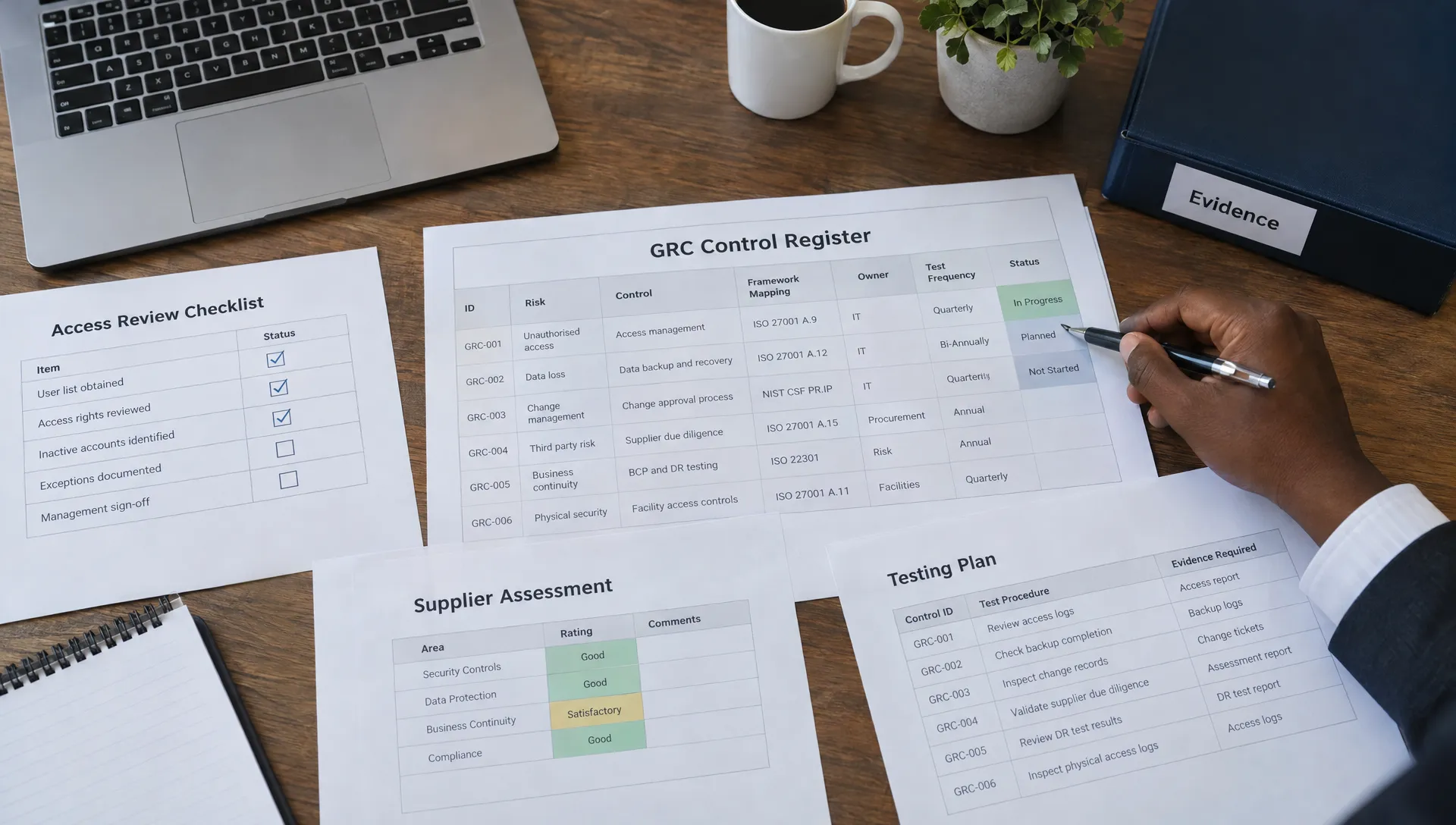
A shared control register gives each operational activity a stable identity. Instead of maintaining separate privacy, security and compliance versions of the same control, maintain one authoritative description with links to the requirements it supports.
The register can begin in a controlled spreadsheet. Software becomes useful when complexity warrants it, but buying a platform does not resolve unclear ownership or inconsistent scope.
Include these essential fields:
Control ID and objective: A unique reference and the risk or outcome the activity addresses.
Owner and operator: The person accountable for the control and the team performing it.
Scope and timing: The entities, systems, records or transactions covered, together with frequency or triggering events.
Operating method: What must happen, including approvals and exception handling.
Evidence and testing: The records retained, test criteria, assessment period and evidence location.
Requirement mappings: Links to applicable obligations, including any conditions or gaps in coverage.
Use a separate mapping table if one control supports many requirements. That keeps the control description readable while preserving traceability.
Write descriptions so another person could perform the activity consistently. “Access is managed appropriately” is not enough. A usable description explains who authorises access, how changes are actioned and how completion is verified.
Decide what to merge, link or retain separately
Not every overlap deserves the same treatment. Some controls can become one activity. Others should share an intake process or evidence source while retaining separate assessments.
The following examples illustrate the distinction. They are design patterns, not statements that a particular control satisfies every applicable legal requirement.
Control area | Work that can be shared | What must remain distinct |
Employee access lifecycle | Authorised requests, account changes and removal evidence | System-specific privileges, deadlines and approval requirements |
Supplier assessment | Supplier identity, service description and baseline security information | Privacy responsibilities, relevant contractual terms and any applicable AML assessment |
Incident management | Intake, initial facts, escalation records and investigation chronology | Legal notification decisions, recipients and deadlines |
Record retention | Record inventory, storage locations and disposal workflow | Category-specific retention periods, legal holds and deletion conditions |
Consider employee departures. HR provides a departure record, IT removes access and an authorised reviewer checks completion. Privacy and security teams may both rely on that process rather than requesting separate removal exercises.
However, the shared process must cover the relevant systems. A control that removes access to email but overlooks a customer database is not equivalent to an organisation-wide access-removal control.
Record any limitation against the requirement mapping. “Supports this requirement” does not automatically mean “fully satisfies this requirement”. That distinction keeps a useful cross-reference from becoming an unsupported compliance claim.
Consolidate testing without weakening assurance
Duplicate testing often survives after controls have been consolidated. Each function continues using its old checklist, so the control owner still answers the same questions several times.
Create a shared test plan that identifies the control objective, population, period, evidence and pass criteria. Agree which functions can rely on the results and what additional work each needs.
Match the scope before reusing a test
Suppose an access-removal test covers employees at one subsidiary. It cannot automatically support an assurance conclusion about contractors across the entire group. Similarly, reviewing an approved policy does not demonstrate that staff followed it throughout the year.
Reuse is appropriate only where the test is relevant to the receiving team’s objective. Check population coverage, assessment period, sampling approach and evidence quality. Where only part of the work matches, reuse that part and test the gap.
Preserve different frequencies and independence
A monthly review of privileged accounts and a quarterly review of ordinary accounts can share methods and evidence storage without forcing every account into a monthly review. Applying the shortest interval everywhere may create unnecessary work rather than remove it.
Management monitoring can also inform internal audit, but internal audit must assess whether reliance is appropriate and retain its independence. Consolidating evidence collection should not turn the control operator’s self-check into independent assurance.
Reuse evidence without creating a new privacy risk
A shared evidence library should reduce repeated requests, not give every reviewer unrestricted access to sensitive material.
Store an authoritative evidence item once where practical, then link it to the relevant controls and assessments. Record its owner, collection date, coverage period and version. If reviewers need a fixed assessment record, preserve an approved snapshot rather than relying on a live document that changes later.
Access should reflect the information involved. An AML file, employee record or incident report may contain details that another assurance team does not need. A restricted source record and a suitable redacted extract can support reuse without exposing the entire file.
PLMC’s guidance on building controls and audit-ready evidence provides further context on connecting operational activity with reliable proof.
Agree evidence acceptance criteria before collection begins. Otherwise, one team may request screenshots while another asks for exports that demonstrate exactly the same event.
Give shared controls clear ownership
A shared control still needs an accountable owner. Assigning it to “compliance, IT and HR” collectively makes it difficult to resolve failures or approve changes.
The owner should coordinate the control’s design and operation. Requirement specialists remain responsible for explaining their obligations and assessing whether the control provides adequate coverage. Assurance teams assess effectiveness within their mandates.
For a practical approach to these boundaries, use clear governance roles and responsibility assignments rather than creating another committee for each overlapping requirement.
When one shared control fails, create a coordinated remediation record with a responsible owner and due date. Link the affected obligations and risks to it. Separate remediation actions may still be necessary, but copying the same finding into several trackers often produces conflicting closure dates and repeated follow-ups.
Report the full impact without presenting one failure as several unrelated events.
Run a small pilot before consolidating everything
Choose a process with obvious overlap, such as employee departures or supplier onboarding. Avoid starting with the organisation’s most disputed legal interpretation or its most complex cross-border process.
A suggested four-week pilot can make the work manageable, provided it fits the organisation’s resources and approval arrangements.
Week 1: Trace the duplication. Gather existing control descriptions, evidence requests and test plans. Identify which requests cover the same activity and which only appear similar.
Week 2: Agree the common design. Establish one control owner, a clear scope and a mapping to relevant requirements. Document exceptions and secure agreement from the teams that will rely on it.
Week 3: Trial collection and testing. Collect evidence through one coordinated request. Check whether each participating function can use it and record any additional information needed.
Week 4: Review and adjust. Compare the pilot with the previous approach. Measure repeated requests avoided, staff time spent responding, uncovered scope gaps and unresolved exceptions.
Do not judge success solely by a lower control count. A smaller register is not an improvement if requirements have disappeared from view. Look for less repeated work alongside equal or better coverage.
Frequently asked questions
Can one control support several compliance requirements? Yes. One well-defined activity can support several requirements when its scope, timing and operating criteria match their needs. Each mapping should explain the coverage provided and identify any remaining gap.
Do we need GRC software to combine controls? No. A controlled register, requirement map and evidence index can support an initial programme. Software may help manage scale and workflows, but the control design and ownership must be settled first.
Should we replace separate policies with one GRC policy? Not necessarily. Policies communicate responsibilities and rules to different audiences. You can consolidate the operational controls beneath them without forcing all policy content into a single document.
Will shared evidence satisfy every auditor or regulator? Not automatically. Acceptance depends on the applicable requirement, scope, evidence quality and reviewer’s assessment. Agree reuse where possible while preserving any additional testing or submission requirements.
Start with one shared process
The aim is not to make every obligation look the same. It is to stop teams repeating work where one properly designed activity can serve several purposes.
PLMC supports Jamaican organisations with GRC integration, data protection implementation, corporate governance and risk assessment. To discuss where your existing controls could be combined, contact Privacy & Legal Management Consultants Ltd. for a free consultation.