

How to Handle Employee Data Without Creating Risk
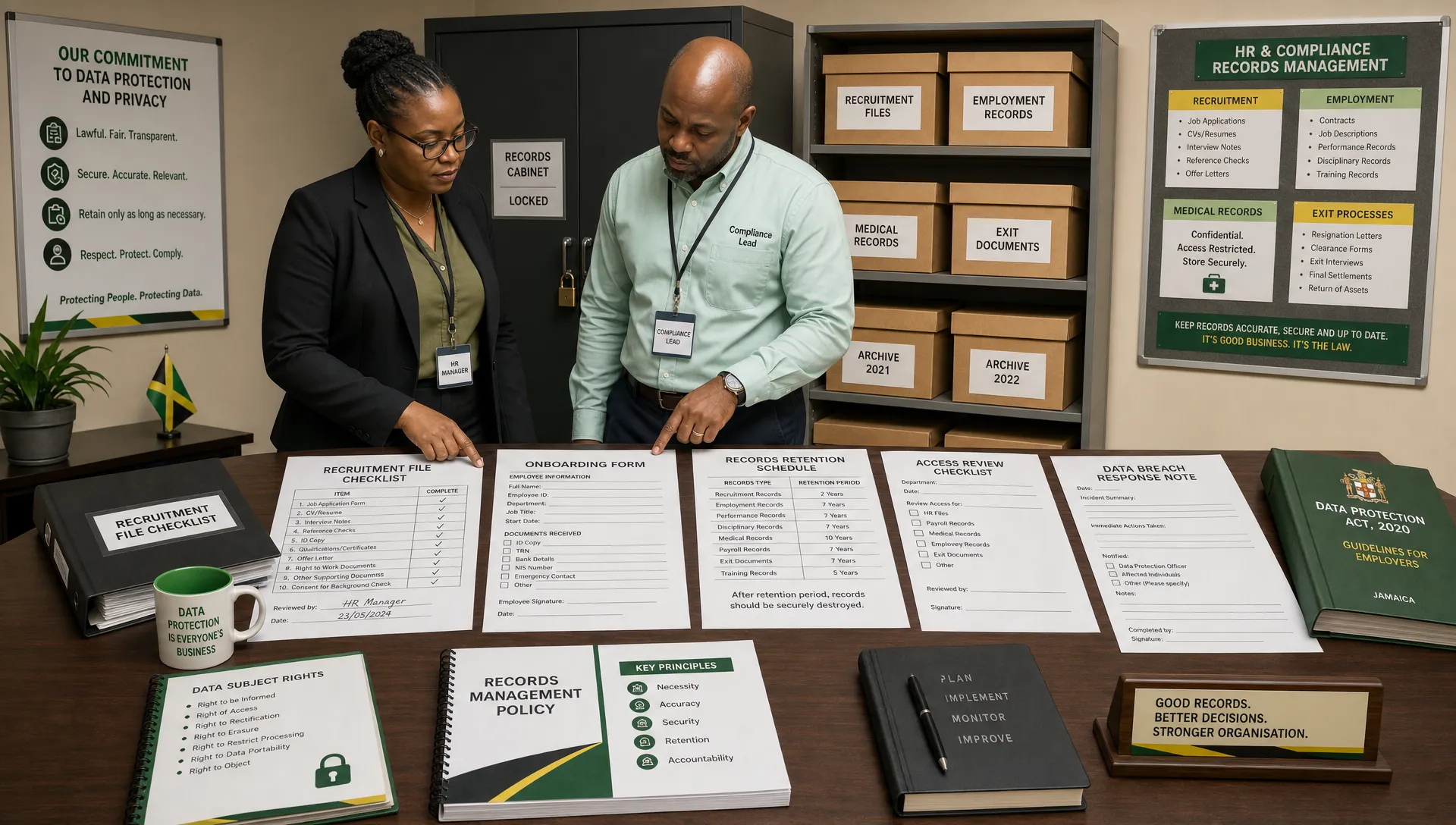
Employee data is not just an HR administration issue. It includes some of the most sensitive information an organisation holds, from tax numbers and bank details to medical notes, disciplinary records, performance reviews, background checks and emergency contacts.
For Jamaican organisations, the stakes are higher now that data protection compliance is an active governance obligation under the Data Protection Act 2020. Employee data must be handled fairly, securely and for clear purposes. A casual spreadsheet, an overbroad access folder or an old recruitment file can create legal, operational and reputational risk.
The good news is that reducing risk does not require making HR work complicated. It requires clear rules, documented decisions and consistent habits across the employee lifecycle.
Why employee data creates unique risk
Employee data is different from many customer records because of the relationship behind it. Employees and job applicants may feel they have little choice when asked to provide information. That makes fairness, transparency and proportionality especially important.
Under Jamaica’s Data Protection Act 2020, organisations that decide why and how personal data is processed have controller responsibilities. The Office of the Information Commissioner provides guidance and oversight for data protection matters in Jamaica, and employers should treat workforce data as part of their wider compliance programme, not as a private HR-only file.
Risk usually appears in everyday situations: a manager downloads a disciplinary letter to a personal laptop, payroll data is emailed to the wrong supplier, old applicant CVs remain in a shared folder, or a supervisor discusses an employee’s medical absence too widely. None of these examples require malicious intent. Most employee data incidents happen because processes are unclear.
Start with the employee data lifecycle
Before you can control employee data, you need to know where it appears. A lifecycle view helps HR, IT, finance, legal and line managers see how data moves from recruitment to offboarding.
Employee stage | Common data handled | Typical risk | Practical control |
Recruitment | CVs, interview notes, references, background checks | Keeping unsuccessful applicant data indefinitely or sharing notes too widely | Use a recruitment retention period and restrict access to hiring teams |
Onboarding | Identification, TRN, bank details, contracts, emergency contacts | Collecting more information than needed or storing copies insecurely | Use a standard onboarding checklist and secure HR storage |
Employment | Payroll, leave, performance, training, benefits, disciplinary records | Excessive access by managers or informal copies outside HR systems | Apply role-based access and document who may see what |
Monitoring and security | CCTV, access logs, device activity, location data | Intrusive monitoring without clear notice or proportionality | Provide transparent notices and assess necessity before use |
Health and safety | Medical certificates, workplace injury records, accommodation requests | Mishandling sensitive personal data | Limit access to designated personnel and store separately where possible |
Exit and post-employment | Final pay, references, exit notes, legal claims, access removal | Former employees retaining system access or records being kept forever | Use an offboarding checklist and retention schedule |
If your organisation is growing quickly, employee data should be included in your wider approach to data protection risk management for SMEs, especially when new systems, locations or service providers are added.
Collect only what you can justify
A low-risk employee data programme starts before the first record is collected. HR teams should be able to explain why each category of information is needed, how it will be used and how long it will be kept.
Before requesting employee information, ask:
Is this data necessary for recruitment, employment, payroll, benefits, safety, compliance or another legitimate purpose?
Is there a less intrusive way to achieve the same objective?
Who genuinely needs access to the information?
How long will the organisation need to retain it?
This prevents “just in case” collection. For example, asking for banking information is usually necessary for payroll once a candidate is hired, but not at the early interview stage. Medical information may be necessary for sick leave administration or workplace accommodation, but broad details should not be circulated to line managers unless there is a specific operational need.
Be cautious about relying on employee consent as the default reason for processing. In an employment context, consent may not always feel freely given because of the power imbalance between employer and employee. Where processing is required for contract administration, legal obligations, workplace safety, disciplinary processes or legitimate business operations, document the real purpose and handle the data fairly.
Control access by role, not convenience
Employee data risk rises sharply when access is based on convenience. Payroll staff, HR officers, IT administrators and line managers do not need the same level of visibility.
A practical access model should define who can view, edit, export and approve employee records. Access should be reviewed when employees change roles, when managers leave departments and when HR or finance staff resign. Shared passwords and informal folder permissions are particularly risky because they make it difficult to know who accessed or changed a record.
Managers also need simple handling rules. They may legitimately need information about attendance, performance and workplace conduct, but they usually do not need full medical files, bank details or identity documents. Staff should be trained to treat personal information as confidential business information and to use approved systems instead of personal email, messaging apps or local downloads.
For practical workplace guidance, PLMC’s article on personal information privacy handling rules for staff is a useful companion to this topic.
Secure storage, transfer and remote access
Security controls should match the sensitivity of the data. Employee records often contain enough information for identity theft, financial fraud or social engineering. Bank details, tax identifiers, identification documents and health information deserve stronger protection than general internal communications.
At a minimum, organisations should use approved HR or document management systems, strong passwords, multi-factor authentication where available, restricted folders, secure backup processes and controlled export permissions. Payroll files should not be sent as unprotected email attachments. If spreadsheets must be used, they should be encrypted, access-limited and deleted when no longer needed.
Remote and hybrid work create additional risk. HR and managers should avoid saving employee records to personal devices or cloud accounts. Where remote access is required, organisations should use secure channels, device controls and clear rules for printing, downloading and disposal.
The NIST Cybersecurity Framework is a helpful reference for structuring security controls around identify, protect, detect, respond and recover activities. Even small organisations can apply those principles in a proportionate way.
Keep retention from becoming a hidden liability
Many organisations focus on collecting and securing employee data, but forget to delete it. Retention risk grows quietly. Old CVs, outdated medical documents, historic disciplinary records and duplicated payroll files can sit in inboxes and shared drives for years.
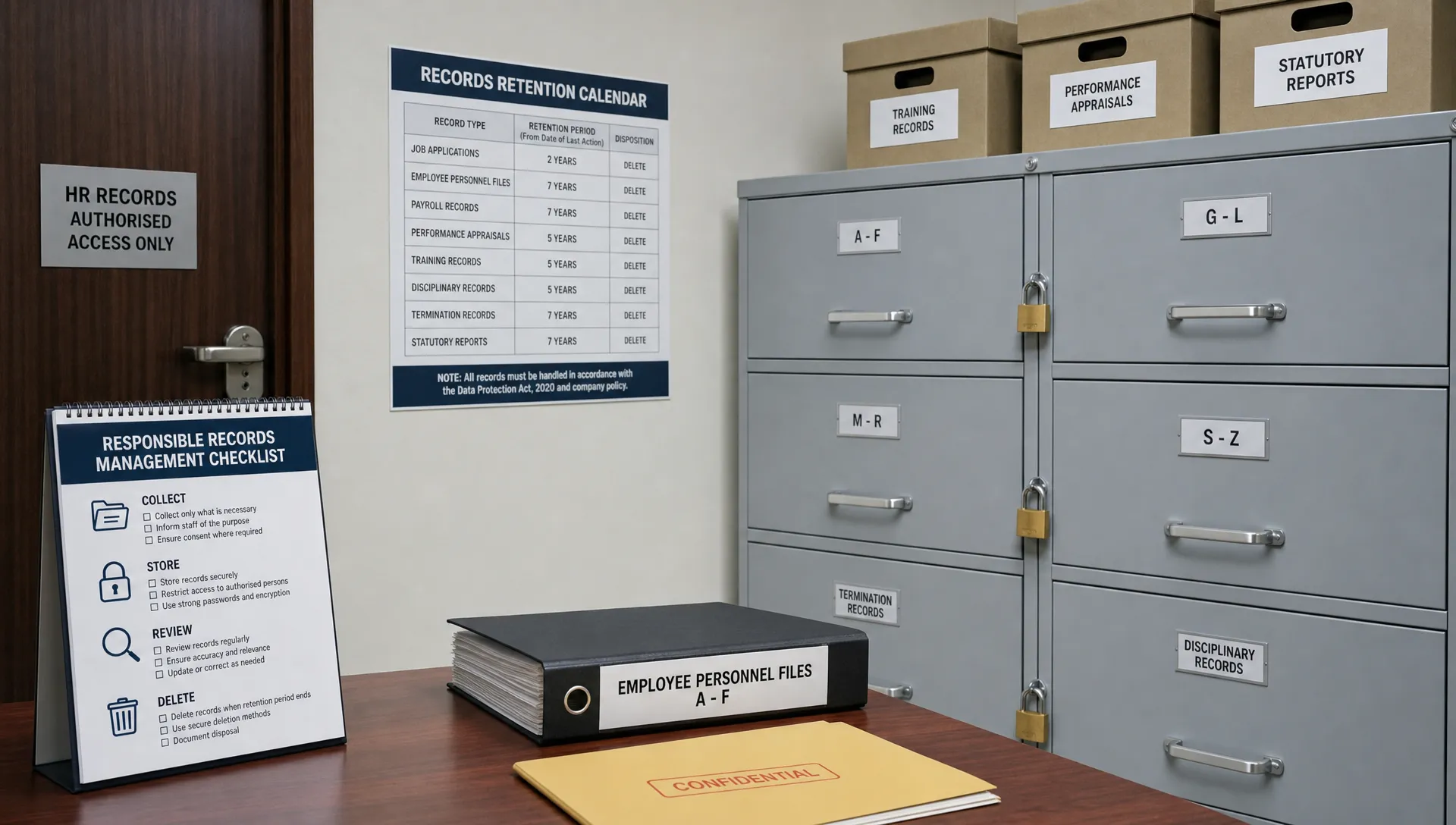
A retention schedule should identify record categories, the reason for keeping them, the department responsible and the disposal method. Retention periods should reflect Jamaican legal obligations, tax and accounting requirements, employment obligations, contractual needs, anti-money laundering obligations where relevant and possible disputes. The point is not to delete records prematurely. The point is to stop keeping everything forever.
Record category | Why it may be needed | Risk if unmanaged | Better practice |
Recruitment files | Hiring decisions, complaints, audit trail | Unsuccessful applicant data kept indefinitely | Set a defined retention period for unsuccessful candidates |
Payroll records | Salary administration, tax and audit obligations | Excessive copies in finance inboxes | Store in approved systems and limit exports |
Medical and leave records | Sick leave, accommodation, health and safety | Sensitive data exposed to unnecessary staff | Restrict access and keep only relevant details |
Disciplinary records | Workplace management, legal defence, fairness | Old records used unfairly or disclosed widely | Review based on policy and applicable legal requirements |
Access logs and monitoring data | Security, investigations, compliance | Over-monitoring or unclear retention | Define purpose, retention and authorised reviewers |
Deletion should be documented. Where records cannot be deleted because of a legal hold, investigation, audit or dispute, that exception should be recorded and reviewed.
Manage vendors and third parties carefully
Employee data often leaves the organisation. Payroll providers, benefits administrators, insurers, recruitment platforms, background screening firms, IT vendors, cloud storage providers and external consultants may all process staff information.
Every third-party relationship should answer three basic questions: what data is shared, why it is shared and what safeguards apply. Written agreements should address confidentiality, security, authorised use, breach reporting, subcontracting, return or deletion of data and support for employee rights requests.
Cross-border transfers deserve particular attention. If employee data is stored or accessed outside Jamaica, the organisation should understand where it goes, what protections apply and whether the transfer is consistent with its obligations under the Data Protection Act 2020. Do not assume that a popular platform is automatically appropriate for sensitive HR records.
This is also important for regulated sectors. Where anti-money laundering compliance requires employee screening, fit-and-proper checks or internal investigations, the organisation should document the compliance reason, limit access and avoid using the information for unrelated purposes.
Be transparent with employees and job applicants
Employees should not have to guess how their data is used. A clear employee privacy notice should explain what information is collected, the purposes of processing, who may receive it, how long it is kept, whether it may be transferred overseas and how employees can raise questions or exercise their rights.
Transparency is especially important for monitoring. CCTV, access cards, email security tools, vehicle tracking, productivity tools and biometric systems can all affect employee privacy. Before introducing monitoring, leadership should assess whether the measure is necessary, proportionate and clearly communicated.
A privacy notice should be written in plain language. If staff cannot understand it, it will not build trust or support compliance. HR should also make sure the notice matches actual practice. A notice that says one thing while managers do another creates risk.
Prepare for employee data incidents
A data incident involving employee records can happen quickly. A payslip may be sent to the wrong person, a laptop may be stolen, a spreadsheet may be exposed, or a former employee may retain access to an HR folder.
Incident response should not be improvised. Organisations should have a documented process to identify the incident, contain it, assess the type and volume of data involved, determine who is affected, preserve evidence, decide whether notification is required and prevent recurrence.
The response should include HR, IT, legal, compliance and senior management where appropriate. Employee communications should be accurate and respectful. Avoid blaming individuals before the facts are known. The goal is to protect affected persons, meet legal obligations and fix the control gap.
Make employee data protection part of governance
Employee data protection should sit within corporate governance, not just HR administration. Senior management should know the main workforce data risks, approve key policies and receive updates on incidents, training completion, access reviews and vendor issues.
Training is a major control because many risks come from routine behaviour. HR teams need deeper guidance on recruitment files, medical records, references and disciplinary documents. IT teams need to understand access, logs, backups and secure disposal. Managers need to know what they may ask for, what they may share and when to involve HR or compliance.
Role-specific training is more effective than generic policy reading. PLMC’s guidance on data protection training for HR, IT and customer teams explains why different functions need different privacy scenarios and controls.
Quick checklist for handling employee data safely
Use this checklist to test whether your organisation is managing employee data in a controlled way.
Control area | Question to ask |
Data inventory | Do we know what employee data we hold and where it is stored? |
Purpose limitation | Can we explain why each category of employee data is collected? |
Access control | Is access limited by role and reviewed when people change jobs? |
Security | Are sensitive HR and payroll files protected from unauthorised access? |
Retention | Do we have a schedule for deleting or archiving records lawfully? |
Vendors | Do third-party providers have clear contractual and security obligations? |
Transparency | Do employees and applicants receive a clear privacy notice? |
Incident response | Do staff know how to report a suspected employee data breach? |
Training | Do HR, IT, finance and managers receive role-based data protection training? |
Frequently Asked Questions
Can employers in Jamaica process employee data without consent? Yes, in many cases employee data is processed for employment administration, legal obligations, workplace safety, payroll or legitimate business purposes. Consent should not be treated as the default where employees may not feel free to refuse. The organisation should document the appropriate basis and handle the data fairly and transparently.
Does the Data Protection Act 2020 apply to job applicants? Yes. Applicant information is personal data, even if the person is never hired. CVs, interview notes, references and background checks should be collected for clear recruitment purposes, shared only with authorised persons and retained only for an appropriate period.
Are medical certificates and sick leave records sensitive employee data? Yes. Health-related information should be treated as sensitive personal data and protected with stricter access controls. Managers usually need to know practical work implications, such as absence dates or accommodation needs, not unnecessary medical details.
How long should employee records be kept? There is no single retention period for every record type. Retention should be based on the purpose of the record, applicable Jamaican legal and tax obligations, employment requirements, regulatory needs and possible disputes. The key is to document the schedule and apply it consistently.
Can managers keep their own copies of employee documents? Only where there is a legitimate business need and the storage location is approved. Uncontrolled copies in personal drives, inboxes or printed folders create unnecessary risk and may undermine access, retention and security controls.
Need help reducing employee data risk?
Employee data protection is easier to manage when HR, IT, compliance, legal and leadership work from the same playbook. Privacy & Legal Management Consultants Ltd. supports organisations in Jamaica with data protection implementation, governance, cybersecurity, compliance training and practical risk management.
If you want to strengthen your employee data handling practices under Jamaica’s Data Protection Act 2020, you can contact PLMC to discuss a free consultation.