

Data Protection Policy Purpose: What It Must Achieve

A data protection policy is one of the first documents regulators, auditors, enterprise customers, and your own staff will look for when they ask, “How do you handle personal data?” But its real value is not the document itself. The value is what the policy does inside the organisation.
Under Jamaica’s Data Protection Act, a policy is a key way to demonstrate accountability, align decisions across teams, and reduce avoidable privacy incidents. If it only exists as a PDF on a shared drive, it is not achieving its purpose.
What a data protection policy is (and what it is not)
A data protection policy is your organisation’s internal rulebook for handling personal data across the full lifecycle, from collection to disposal. It translates legal requirements into clear expectations for staff, managers, and third parties.
It is not the same thing as:
A privacy notice (customer facing transparency statement about what you collect and why).
An information security policy (focused on confidentiality, integrity, availability, often broader than personal data).
A retention schedule (a record of how long you keep specific record types).
A template copied from another jurisdiction without matching your operations.
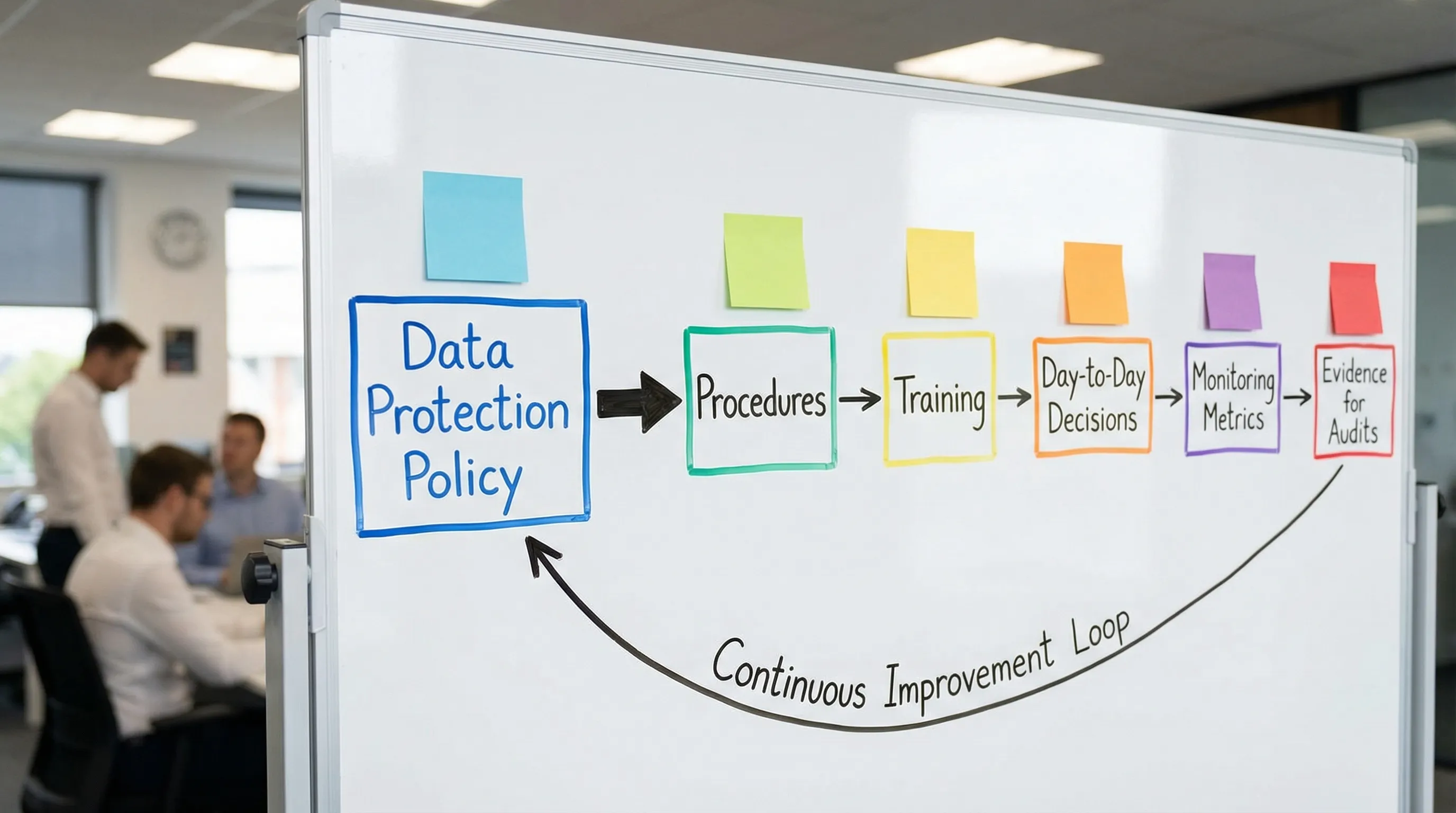
A good data protection policy connects these elements, so they work together.
Data protection policy purpose: what it must achieve
To match the intent of the Data Protection Act (and to hold up in real operational use), your policy should achieve outcomes that are practical and verifiable.
The table below frames the policy purpose in terms executives and compliance teams can test.
What the policy must achieve | Why it matters | What “good” looks like in practice | Evidence you can show |
Accountability and ownership | Compliance fails when “everyone” owns it | Named roles for decisions, escalation paths, and approvals | Org chart excerpts, role descriptions, governance minutes |
Consistent, lawful decision-making | Staff need repeatable rules, not guesswork | Clear rules for lawful bases, purpose limitation, minimisation, and sensitive data handling | Completed forms, approvals, documented rationales |
Transparent processing | Trust depends on clarity and fairness | Policy requires accurate privacy notices and aligns internal practice to what notices say | Notices, change logs, comms approvals |
Operational rights handling | Individuals have rights, operations must deliver | A workable intake and response process, with timelines, identity checks, exemptions handling, and recordkeeping | Request logs, response templates, training records |
Security and incident readiness | Breaches become crises when plans are vague | Defined minimum controls, access rules, and a breach response path that is rehearsed | Incident plan, test results, access reviews |
Vendor and sharing control | Many risks sit in processors and partners | Rules for due diligence, contracting, oversight, and cross-border considerations where applicable | DPAs/contract clauses, vendor reviews |
Retention and disposal discipline | “Keep everything” increases risk and cost | Retention rules exist and are actually executed, including secure disposal | Retention schedule, disposal certificates, audits |
A culture of privacy | Policies fail if staff do not understand them | Role-based training and practical examples, not a once-a-year slideshow | Training completion rates, assessments |
Continuous improvement | Compliance is not a one-time project | Review cadence, metrics, and feedback loops | Policy review logs, KPIs, audit findings |
If your policy does not drive these outcomes, it may look compliant on paper but remain weak in execution.
The “must-have” building blocks that make the purpose real
A policy becomes useful when it answers the questions employees actually face. The sections below are the components that typically make the difference between a policy that is cited, and a policy that is used.
1) Scope, definitions, and who it applies to
A common gap is unclear scope. Your policy should state:
Which parts of the organisation it covers (subsidiaries, branches, business units).
Whether it includes contractors, interns, and temporary staff.
What counts as personal data in your context (customer files, employee records, CCTV, call recordings, device identifiers, and so on).
This reduces “grey area” arguments later.
2) Governance: roles, authority, and escalation
A policy’s purpose includes making accountability visible. Clarify at minimum:
Who owns the policy.
Who approves exceptions.
Who signs off new high-risk processing.
Who coordinates incident response.
In many Jamaican organisations, privacy responsibilities sit across HR, IT, Legal, Compliance, and Operations. Your policy should prevent hand-offs from becoming dead ends.
3) Rules for collecting and using personal data
This is where the policy translates legal principles into practical direction.
A strong policy sets rules such as:
Only collect what is needed for a defined purpose.
Do not reuse data for unrelated purposes without proper justification.
Keep records accurate and provide a way to correct errors.
Apply additional care for sensitive data and children’s data where relevant.
If your teams routinely launch new forms, new apps, or new onboarding processes, add a requirement that data collection changes must be reviewed before they go live.
4) Transparency and privacy notices (alignment, not just publication)
Publishing a privacy notice is not enough if day-to-day processing drifts away from what the notice says.
Your policy should require:
A single owner for maintaining notices.
A process to update notices when processing changes.
A check that marketing, HR, customer service, and IT practices align with the notice.
This reduces the risk of “we said X, but we do Y” situations.
5) Individual rights: an operational workflow, not an email inbox
The purpose of the policy is to make rights real and consistent. Many organisations have an inbox like privacy@company.com and hope for the best.
Instead, your policy should define:
How requests are received (web form, email, in person) and how they are logged.
How identity is verified.
Who investigates, who approves, and who responds.
How to handle requests involving third-party systems and processors.
What gets documented, so you can prove your process later.
If you need practical guidance for building this into a working operating model in 2026, PLMC’s roadmap article can help you align deliverables and evidence across the year: Data Protection Jamaica: Compliance Roadmap for 2026.
6) Security expectations and incident response alignment
The Data Protection Act expects appropriate safeguards. Your data protection policy should not duplicate your cyber security documentation, but it must set privacy-relevant expectations and link to the right procedures.
At minimum, the policy should address:
Access control principles (least privilege, joiner-mover-leaver processes).
Acceptable use rules for devices and removable media.
Secure sharing (email, messaging, cloud links) and prohibition of ad hoc practices.
Breach reporting: what staff must do immediately, and who to contact.
If your organisation already has a cyber security programme, make sure the privacy policy references it clearly and closes the gaps that are specific to personal data handling.
7) Vendor management, data sharing, and contracts
A frequent real-world failure is a vendor relationship that was procured quickly, without privacy due diligence, then becomes embedded.
Your policy should require:
Vendor risk screening for services that touch personal data.
Contract clauses or agreements that cover confidentiality, security, sub-processing, incident notification, and deletion/return.
A process for periodic vendor reviews.
This is especially important for payroll providers, cloud systems, call-centre services, marketing platforms, and outsourced IT support.
8) Retention and disposal: the policy must prevent “forever storage”
Retention is where purpose limitation becomes measurable. Your policy should:
Reference a retention schedule and require business owners to maintain it.
Define disposal expectations (secure shredding, secure deletion, and logs).
Address backups and archives, not just live systems.
If retention is inconsistent across departments, the policy should force a single method for defining, approving, and auditing retention periods.
9) Training and awareness tied to real job roles
A policy’s purpose includes behaviour change. That only happens when training matches what employees actually do.
Role-based training often means separating content for:
Frontline customer service (verification, disclosures, rights intake).
HR teams (employee data, medical information, recruitment data).
IT and security (access controls, logging, incident response).
Marketing and sales (communications rules, consent where applicable, data sources).
Leadership (risk appetite, governance, reporting).
PLMC provides training sessions and privacy awareness support, which can be used to turn a policy into a functioning programme: Privacy & Legal Management Consultants Ltd..
How to tell if your policy is achieving its purpose (simple tests)
A practical way to evaluate a data protection policy is to test it against real scenarios. Ask:
Can a staff member find the rule within 2 minutes and apply it correctly?
Do managers know who approves exceptions?
Can you produce evidence that the policy is followed, not just distributed?
You can also track a small set of metrics that reflect whether the policy is working:
Policy outcome | Example metric to track | What improvement looks like |
Rights handling works | Average time to acknowledge and close requests | Faster cycle times with fewer escalations |
Data minimisation improves | Number of forms/processes reviewed and reduced | Fewer unnecessary fields collected |
Vendor controls strengthen | % of key vendors with appropriate data clauses and reviews | Coverage increases quarter over quarter |
Incident readiness improves | Time from incident discovery to internal reporting | Faster reporting and clearer triage |
Training is meaningful | Assessment scores by role | Higher scores, fewer repeat errors |
If you cannot measure anything, the policy may be too abstract.
Common mistakes that weaken the purpose of a data protection policy
Mistake 1: Writing for legal completeness, not operational clarity
If the policy reads like legislation, it will not be used. Keep legal accuracy, but write in plain language, with “what you must do” statements.
Mistake 2: No linkage between policy and procedures
A policy should point to the procedures that make it executable (rights request process, breach response plan, retention schedule, vendor due diligence steps). If those procedures do not exist yet, the policy should explicitly assign responsibility and deadlines to create them.
Mistake 3: Treating the policy as IT’s job
Privacy is cross-functional. The policy should assign responsibilities to HR, Operations, Finance, Marketing, Customer Service, and Procurement, not only IT.
Mistake 4: Ignoring the data you actually process
A generic policy that does not reflect your business model creates risk. For example, organisations handling health-related information, financial information, or employee records need more detailed controls and tighter escalation paths.
Mistake 5: No review cycle
Your processing changes. Vendors change. Systems change. If the policy is not reviewed, it becomes incorrect, and then it becomes dangerous.
A practical way to draft or refresh your policy (without over-engineering)
You do not need a 40-page document to achieve the policy purpose. You need a policy that covers the decisions your staff make every week.
A simple approach is:
Start with processing reality: use your data inventory (or build a basic one) so the policy reflects how data moves through your organisation.
Agree governance first: define ownership, approvals, and escalation early, because everything else depends on it.
Write rules that map to moments: onboarding, verification, sharing, marketing, HR handling, vendor onboarding, incident reporting, and disposal.
Attach the “how”: link to forms, logs, and procedures. Where they do not exist, create minimal versions.
Pilot the policy: test it with customer service, HR, and IT, then revise based on questions and mistakes.
Implement evidence habits: logging requests, documenting approvals, recording training, and capturing vendor reviews.
For organisations that want a broader set of controls to confirm readiness, PLMC’s checklist-style guide can be used alongside your policy work: Privacy and Data Protection: A Practical Checklist.
Where this fits in a broader governance, risk, and compliance (GRC) programme
A data protection policy should not sit alone. Its purpose is also to integrate with governance and risk management, so privacy risk is visible at leadership level.
In practice, this means:
Privacy risks are captured in the organisation’s risk register.
The board or leadership receives periodic reporting (even if lightweight).
Internal audits or reviews test policy compliance.
Projects and new initiatives include privacy considerations early (privacy by design).
If your organisation is building this capability now, it helps to align terminology and responsibilities across legal, compliance, and cyber security functions. PLMC works across data protection implementation, cyber security services, corporate governance, and GRC integration, which can reduce duplication and make compliance easier to sustain.
Getting your policy to the standard regulators and business partners expect
In 2026, most organisations are past the stage of “we are working on it.” Customers and partners increasingly ask for proof of controls, not promises. A well-written policy supports that conversation, but only if it is backed by procedures, training, and evidence.
If you want an independent review of your current policy against the practical outcomes above, you can request a consultation with Privacy & Legal Management Consultants Ltd. and identify the highest-impact fixes before you invest in heavier compliance work.