

Data Protection Legislations: How Jamaica Compares Globally

Jamaican organisations rarely operate in a purely local bubble anymore. Your HR system may be hosted in the cloud, your marketing tools may track website visitors from overseas, your customers may be tourists, and your vendors may sit in multiple jurisdictions. That reality is why data protection legislations are no longer “legal-only” concerns. They shape contracts, cross-border data transfers, cyber incident response, and ultimately trust.
This article explains how Jamaica’s Data Protection Act fits into the global privacy landscape, what Jamaica broadly aligns with (and where approaches differ internationally), and what that means for Jamaican businesses that handle data across borders.
The global direction: privacy laws are converging, but not identical
Over the last decade, many countries have moved toward a shared set of privacy building blocks:
Clear rules for processing personal data (often framed as principles)
Enforceable rights for individuals (access, correction, deletion, objection, etc.)
Stronger accountability requirements (governance, documentation, vendor controls)
Expectations for security and incident readiness
Rules for transferring data across borders
A major driver of this convergence is the influence of the EU General Data Protection Regulation (GDPR), which has become a reference point for many modern laws globally. You can read the GDPR text via the EU’s official portal: General Data Protection Regulation (GDPR).
At the same time, there is no single global law. The United States remains more sector-based, several countries have unique registration or localisation approaches, and enforcement maturity varies widely.
Where Jamaica sits: a “modern comprehensive” data protection model
Jamaica’s Data Protection Act, 2020 is generally understood as part of the global trend toward comprehensive, rights-based privacy regulation. In practical terms, it is closer in spirit to “GDPR-style” legislation than to sector-only approaches.
That matters because “comprehensive” frameworks tend to require organisations to do more than publish a privacy notice. They expect a functioning privacy management programme, including policies, governance roles, risk assessment, security controls, and vendor oversight.
If you are building or refreshing your programme, PLMC’s Jamaica-focused resources may help you connect the legal requirements to day-to-day operations, for example: Data Privacy in Jamaica: Key Principles and Rights.
A useful comparison framework: 8 questions that distinguish privacy laws globally
Instead of comparing laws only by names (GDPR, POPIA, LGPD, etc.), it is more useful to compare them by how they answer the questions below.
1) Who and what is covered (scope)
Most modern laws apply to organisations that determine why and how personal data is used (often called “controllers”) and those that process data for others (“processors”).
Global differences often show up in:
Extra-territorial reach (whether the law applies to overseas organisations that target local residents)
Employee data coverage (some laws treat HR data differently)
Small entity exemptions (some jurisdictions exempt small businesses in specific cases)
How Jamaica compares: Jamaica’s approach is aligned with the “broad coverage” direction seen internationally, meaning many ordinary business processes (HR, customer service, marketing, vendor management) fall within scope.
2) The legal grounds for using personal data
A common global split is:
Consent-heavy models (more reliance on explicit permission)
Multi-basis models (a set of permitted grounds, such as contract necessity, legal obligation, legitimate interests, public task, vital interests, plus consent)
The GDPR is the best-known example of a multi-basis model.
How Jamaica compares: Jamaica’s framework is broadly consistent with a modern model where organisations must be able to justify processing, not simply collect data by default.
3) The “principles” behind compliance
Many laws are built around recognisable principles such as fairness, transparency, purpose limitation, data minimisation, accuracy, storage limitation, security, and accountability.
These principles are more than theory. Regulators often use them to judge whether an organisation’s real-world practices are defensible.
How Jamaica compares: Jamaica’s approach is consistent with this principle-driven structure that is common in the UK/EU and increasingly reflected across many jurisdictions.
4) Individual rights (and the operational burden of fulfilling them)
Individual rights are now central globally. Common rights include:
Access to personal data
Correction/rectification
Deletion/erasure in defined circumstances
Objection to certain processing
Restrictions on certain uses (including some marketing contexts)
Where countries differ is in the detail: timelines, exceptions, identity verification standards, and whether a right to portability exists and how it is implemented.
How Jamaica compares: Jamaican organisations should plan for rights handling as an operational workflow, not a one-off legal task. This is consistent with how GDPR-governed organisations operate.
5) Security expectations and breach response
Nearly all modern data protection laws require “appropriate” security measures, but they vary on:
Whether breach notification is mandatory in all cases or only when risk thresholds are met
Who must be notified (regulator, affected individuals, both)
Statutory timeframes (for example, GDPR includes a well-known 72-hour benchmark for notifying the supervisory authority in certain cases)
For reference, the UK’s GDPR-aligned approach is described by the UK ICO here: Personal data breaches.
How Jamaica compares: Jamaica is aligned with the modern expectation that organisations must be breach-ready, with documented procedures, decision-making criteria, and evidence of actions taken.
6) Cross-border transfers (the biggest practical “global” friction point)
Cross-border transfers are where global privacy differences become expensive. Many organisations in Jamaica use:
Overseas payroll and HR platforms
US-based marketing and analytics tools
Regional shared-service centres
Offshore call centres or customer support tools
The GDPR has one of the strictest and most developed cross-border transfer systems (adequacy decisions, standard contractual clauses, transfer impact assessments in some contexts).
The EU’s adequacy mechanism is documented here: Adequacy decisions.
How Jamaica compares: Jamaica is part of a global trend toward requiring safeguards for international transfers. Practically, Jamaican organisations that serve EU/UK clients, or process EU/UK personal data, often need to align with GDPR/UK GDPR transfer expectations in contracts and vendor due diligence.
7) Governance requirements (DPOs, documentation, and accountability)
Globally, privacy governance increasingly includes:
Assigned responsibility (sometimes a required Data Protection Officer role in defined cases)
Documented policies and procedures
Records of processing activities (or equivalent)
Vendor and outsourcing governance
Privacy risk assessments for high-risk processing
How Jamaica compares: Jamaica aligns with the accountability trend. If your organisation cannot show evidence of governance (not just intentions), it becomes difficult to demonstrate compliance after an incident, complaint, or audit.
8) Enforcement style and regulatory maturity
Countries vary in:
Regulator powers (investigations, orders, fines)
Enforcement appetite (education-first vs enforcement-first)
Availability of guidance and precedent
How Jamaica compares: Jamaica is developing within a global environment where privacy enforcement is increasingly real. For Jamaican boards and executives, the practical point is simple: privacy risk now belongs in the broader governance, risk, and compliance agenda, alongside cyber risk and operational risk.
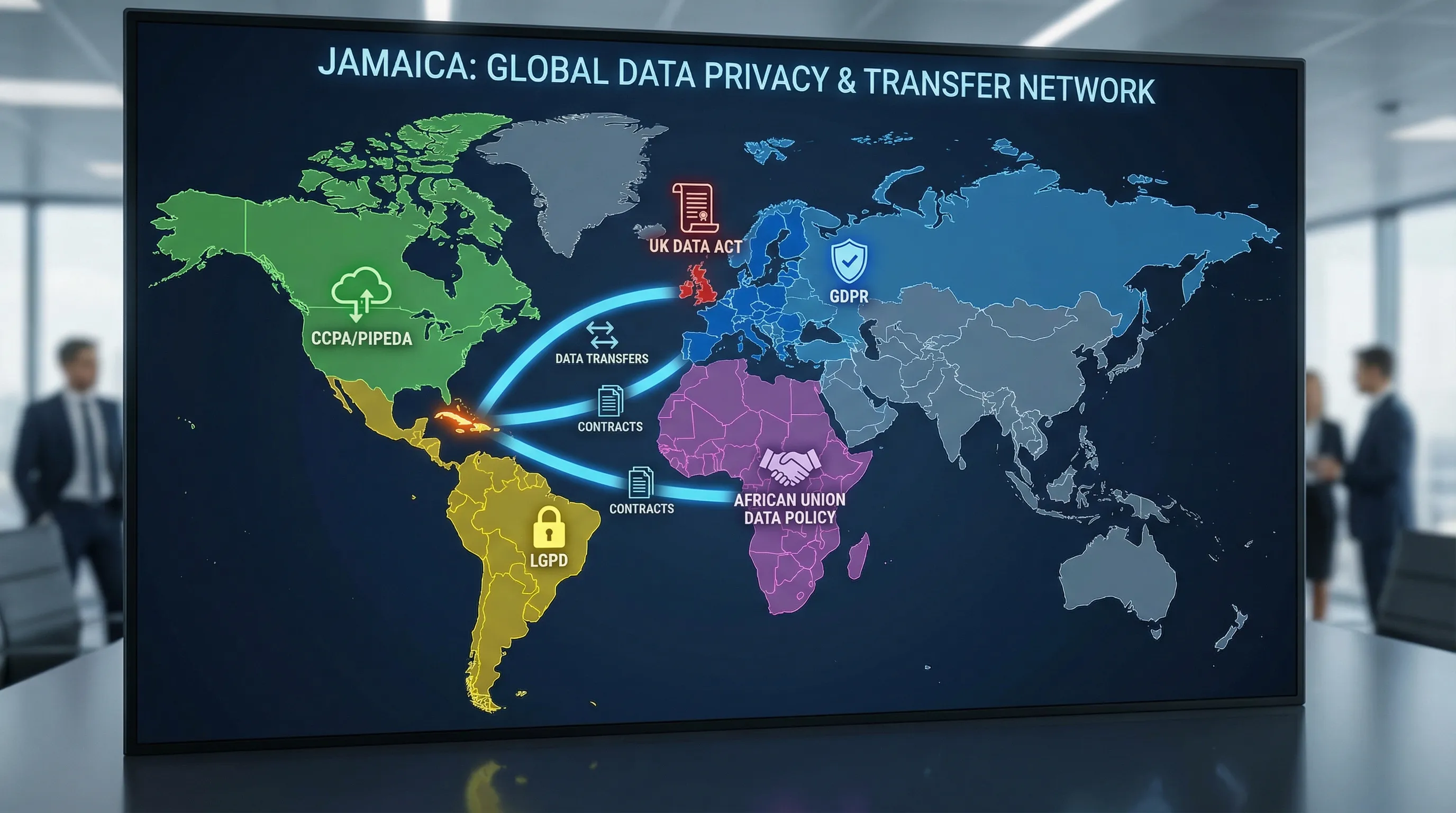
Jamaica vs key global regimes: a high-level map
The table below summarises how major privacy “models” commonly differ. It is not a substitute for legal advice, but it is useful for understanding why multinational clients and vendors ask for particular controls.
Jurisdiction / model | Common structure | Cross-border transfers | Enforcement pattern (typical) | What Jamaican organisations feel in practice |
European Union (GDPR) | Comprehensive, principles + lawful bases + strong rights | Strict, highly formalised mechanisms | Active regulators, significant fines possible | Often becomes the “contract standard” for global vendors |
United Kingdom (UK GDPR + DPA 2018) | GDPR-aligned with UK regulator guidance | Similar to GDPR, UK-specific tools | Active regulator (ICO) | Common when serving UK tourists, clients, or partners |
Canada (PIPEDA model) | Comprehensive private-sector baseline with accountability focus | Transfer permitted with contractual safeguards and transparency | Enforcement has evolved over time | Often influences vendor questionnaires and privacy policies |
United States (sectoral + state laws) | Patchwork (health, finance, children, state privacy laws) | Less centralised as a single transfer regime | Enforcement varies by sector and state | Vendor contracts often emphasise security and breach terms |
Brazil (LGPD) | GDPR-influenced comprehensive framework | Transfer rules exist, details depend on mechanisms | Growing enforcement maturity | Relevant for LATAM-facing operations and vendors |
South Africa (POPIA) | Comprehensive, condition-based processing | Transfer restrictions based on adequacy/safeguards | Enforcement is increasing | Often relevant for regional groups and cross-border services |
Caribbean (emerging mix) | Several jurisdictions now have comprehensive laws | Transfer rules vary widely | Maturity varies by country | Regional clients increasingly expect “GDPR-like” controls |
For primary texts and official sources, see:
EU: GDPR
UK regulator guidance: ICO
OECD privacy baseline concepts: OECD Privacy Guidelines
What global comparisons mean for Jamaican organisations in 2026
A global comparison is only useful if it changes decisions. Here are the main business implications Jamaican organisations typically encounter.
Jamaican firms increasingly need “exportable compliance”
Even if your customers are local, your vendors may not be. And if your customers are international, they may require you to prove governance.
Common triggers include:
Procurement questionnaires asking about DPOs, DPIAs, breach notification, and retention
Contract clauses requiring GDPR-aligned processing terms
Requests for evidence (policies, training records, vendor lists, incident response plans)
Cross-border data flows require proactive design
If your organisation uses overseas cloud services, the privacy question becomes: can you show that transfers are controlled, documented, and transparent?
This usually means:
Knowing where data is stored and accessed
Tight vendor contracts and security expectations
Clear privacy notices that reflect real international data flows
Privacy and cyber security are converging in audits
Regulators and clients increasingly assess privacy and security together. A strong cyber security programme supports privacy compliance, but it does not automatically satisfy it. Privacy also covers purpose limitation, minimisation, transparency, retention, and rights handling.
A “globally compatible” privacy programme: what to prioritise
If you want your programme to stand up both locally and internationally, focus on the controls that tend to be universal across modern laws.
Build evidence of accountability (not just documents)
Policies matter, but evidence matters more. Internationally, organisations are often assessed on whether they can demonstrate:
Who owns privacy risk
How decisions are made for new projects
How vendor onboarding works
How incidents are handled and learned from
Operationalise rights requests
Rights requests become painful when they are handled ad hoc.
A workable approach usually includes:
A single intake channel (email/webform) and a tracking log
Identity verification rules appropriate to risk
A repeatable process across HR, customer, and marketing systems
Standardise vendor and outsourcing controls
Across data protection legislations worldwide, third-party processing is a major source of incidents.
Key foundations include:
Clear data processing terms in contracts
Minimum security requirements
n- A review process for high-risk vendors
Treat cross-border transfers as a design constraint
If you serve EU/UK clients, or process EU/UK data, align early to the strictest expectations you face. This prevents rework later.
How PLMC can help
Privacy programmes succeed when they are practical, proportionate, and auditable.
Privacy & Legal Management Consultants Ltd. (PLMC) supports Jamaican organisations with data protection implementation, training, risk assessment tools, and broader GRC integration. If you are trying to align Jamaica’s requirements with global expectations from clients or vendors, a structured gap assessment and implementation plan can reduce risk and avoid costly rework.
You can also explore PLMC’s practical, Jamaica-focused resources, including: Privacy and Data Protection: A Practical Checklist.