

Data Protection Clauses for Commercial Contracts
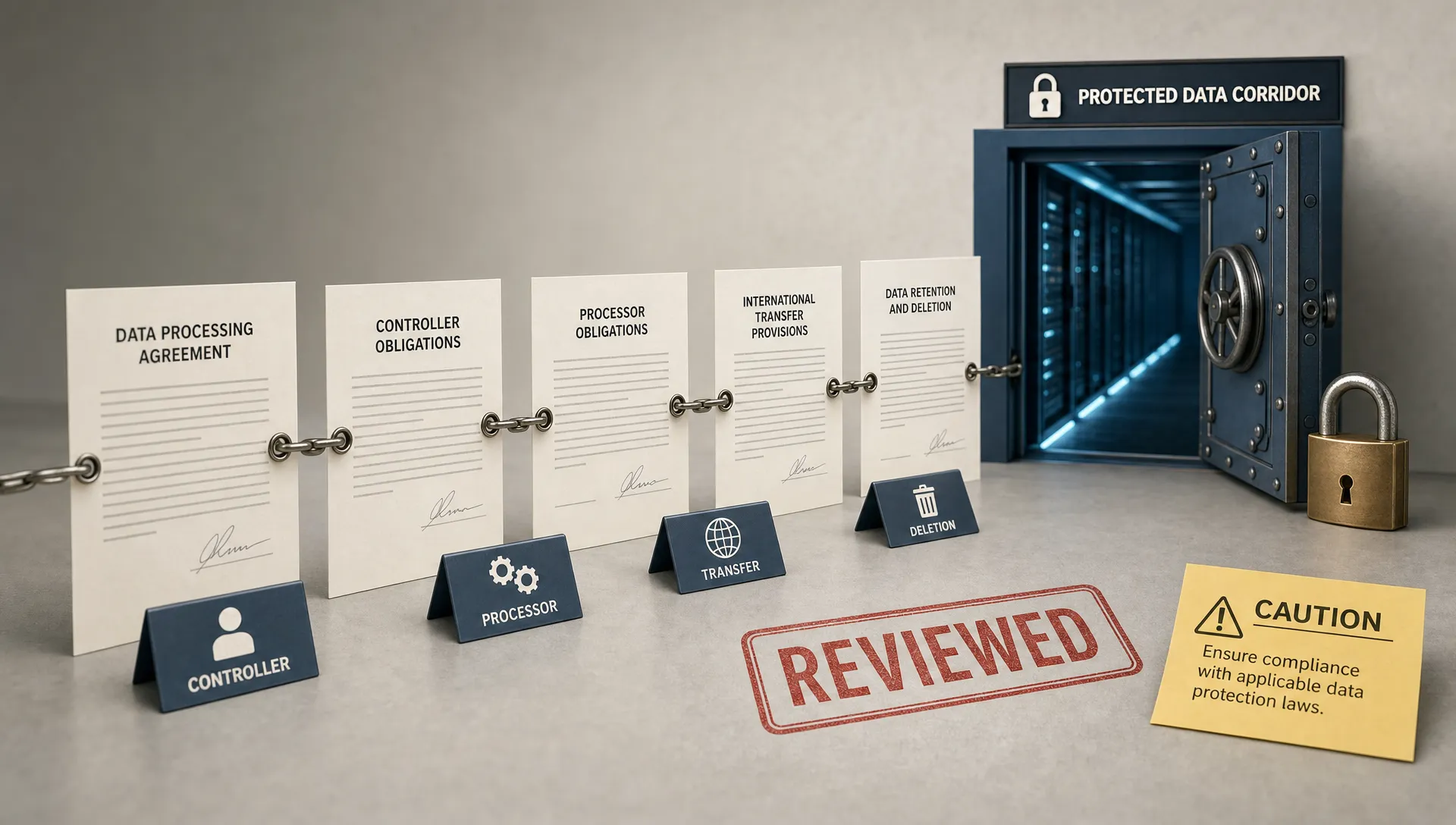
Commercial contracts are no longer only about price, deliverables, payment terms and termination. If a supplier, customer, technology provider, consultant or outsourced service partner touches personal data, the contract also becomes part of your data protection compliance framework.
For Jamaican organisations, this matters because the Data Protection Act, 2020 places duties on data controllers and data processors around how personal data is collected, used, stored, shared, secured and deleted. A well drafted commercial agreement helps turn those legal duties into practical obligations between the parties.
This article focuses on the clauses that should be considered when personal data is processed under a commercial contract. It is written for business owners, directors, in-house counsel, procurement teams, compliance officers, privacy leads and operational managers who need contracts that support compliance, not just transactions.
Why data protection clauses matter in commercial contracts
A privacy policy tells individuals how their personal data is handled. An internal data protection policy tells staff what rules to follow. A commercial contract does something different: it allocates responsibility between organisations.
That allocation is critical when one party processes personal data for another. Common examples include payroll providers, HR software platforms, cloud hosting companies, marketing agencies, payment processors, debt collectors, security companies, call centres, consultants and professional advisers.
Without clear data protection clauses, the parties may disagree about basic issues such as:
Who decides the purpose and method of processing
Whether the supplier may use personal data for its own purposes
What security standard applies
How quickly a breach must be reported
Whether subcontractors can access personal data
What happens to the data when the contract ends
The contract should not simply say that both parties will “comply with applicable law”. That phrase is useful, but it is too general on its own. Good drafting converts compliance principles into operational duties that can be monitored, audited and enforced.
For broader organisational context, PLMC’s guide on policies for data protection explains how contract clauses should sit within a wider privacy governance framework.
Start with the role of each party
Before drafting data protection clauses for commercial contracts, identify the role each party plays. In privacy terms, the question is not only who owns the customer relationship or who pays the invoice. The key issue is who determines why and how personal data is processed.
In many service arrangements, one party acts as the data controller because it decides the purpose of processing, while the service provider acts as a data processor because it handles data on the controller’s instructions. In other arrangements, both parties may be independent controllers, for example where each uses shared information for its own regulatory, tax, risk management or business purposes.
Getting this wrong creates real contract risk. A processor-style clause may be too restrictive for an independent controller. A controller-to-controller clause may be too loose where the supplier is supposed to act only on instructions.
A simple pre-contract assessment should confirm:
What personal data will be shared or accessed
Whether sensitive personal data is involved
The business purpose for the processing
Which party decides the purpose of processing
Which systems, locations and subcontractors are involved
Whether cross-border transfers may occur
How long the data will be retained
If vendors are involved, a structured review before signing can prevent problems later. PLMC’s article on how to run a simple vendor privacy assessment offers a practical approach for screening suppliers before data is shared.
Core data protection clauses to include
The right clauses will depend on the transaction, sector, data sensitivity and bargaining power of the parties. A small catering contract will not need the same level of detail as a cloud services agreement involving employee records or customer identity documents. Still, the following clauses form a strong baseline.
1. Definitions and scope of personal data
The contract should define key privacy terms or incorporate definitions from the applicable data protection law. This reduces ambiguity and keeps the clause aligned with legal requirements.
The scope clause should describe the personal data covered by the agreement. It does not always need to list every field, but it should be specific enough to avoid uncertainty. For higher risk processing, include categories such as customer contact details, employee records, financial information, identification documents, health information, login credentials or complaint records.
A good scope clause also states whether the supplier will process personal data only for the contract services or whether any wider use is permitted. If the supplier wants to use data for analytics, service improvement, benchmarking or product development, that use should be addressed expressly.
2. Roles and processing instructions
Where one party is a processor, the agreement should state that the processor may process personal data only on documented instructions from the controller, unless required by law.
This clause should cover the nature, purpose, duration and subject matter of processing. It should also require the processor to notify the controller if an instruction appears to conflict with applicable data protection law.
For controller-to-controller sharing, the clause should instead require each party to comply with its own data protection obligations, use the data only for agreed purposes and maintain appropriate notices, lawful bases and safeguards.
3. Lawful purpose and use limitation
Contracts should limit personal data use to the purposes agreed between the parties. This is especially important where commercial data and personal data are mixed, such as customer databases, employee lists, sales leads or transaction records.
A strong use limitation clause can prohibit:
Sale of personal data to third parties
Use of personal data for unrelated marketing
Combining the data with other datasets for unauthorised profiling
Access by staff who do not need the data for the services
Retention after the purpose has ended, unless legally required
This clause should also require the parties to cooperate where a privacy notice, consent language or customer communication is needed. For website-facing arrangements, PLMC’s guidance on privacy policy data clauses may help align public notices with behind-the-scenes contracts.
4. Security measures
Security is one of the most important parts of a data protection clause. The contract should require appropriate technical and organisational measures, proportionate to the risk.
For lower risk data, general safeguards may be enough. For sensitive data, financial data or large datasets, the contract should be more detailed.
Relevant measures may include access controls, password standards, multi-factor authentication, encryption, secure backups, network monitoring, staff training, physical security, incident response procedures, secure disposal, vulnerability management and segregation of client data.
The contract should avoid vague wording such as “reasonable security” without context. A better approach is to require safeguards appropriate to the volume, sensitivity and nature of the personal data, then attach a schedule with minimum controls.
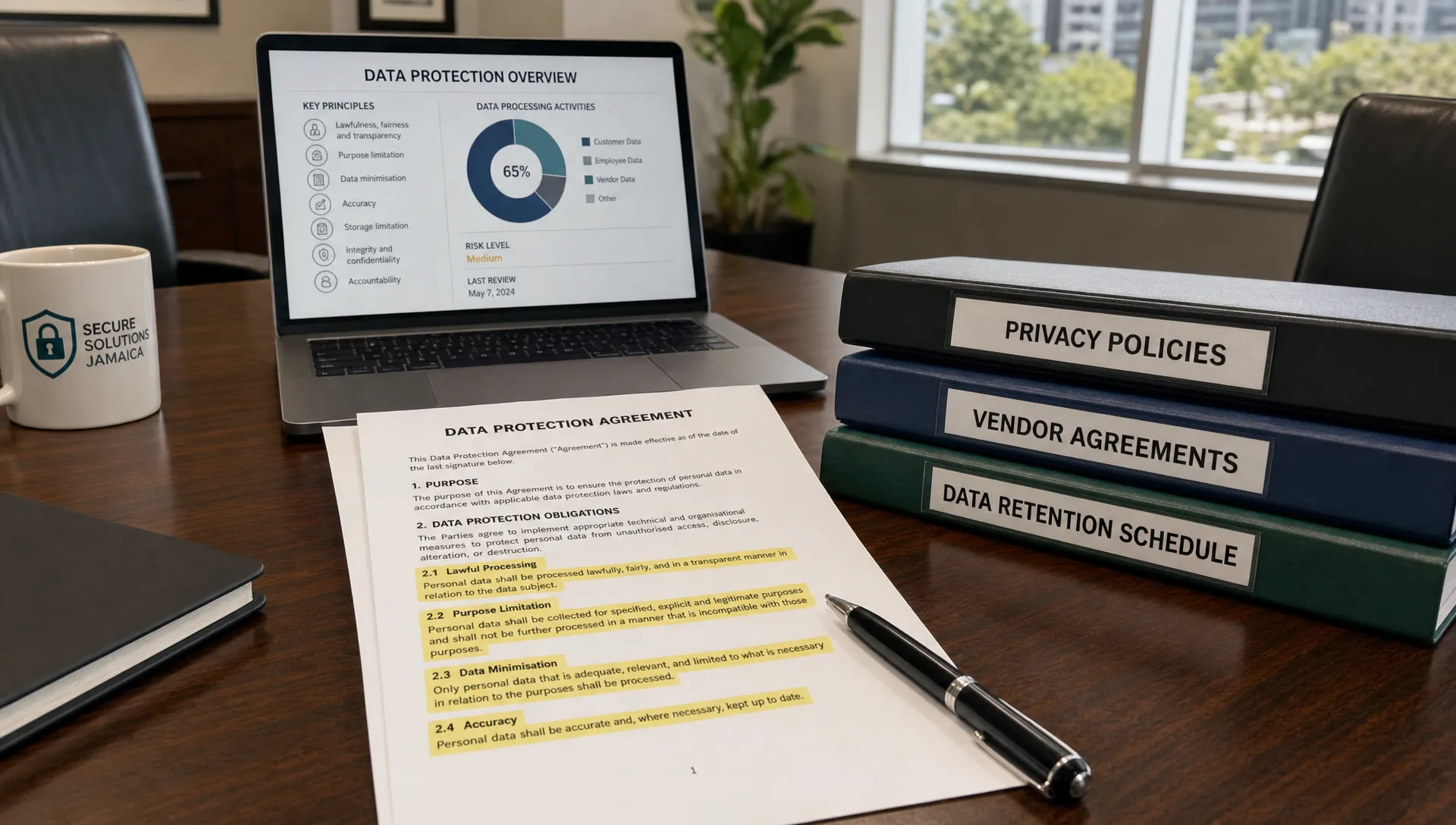
5. Confidentiality and staff access
Data protection and confidentiality overlap, but they are not the same. A confidentiality clause protects business information. A data protection clause protects personal data and the rights of individuals.
The contract should require personnel with access to personal data to be bound by confidentiality obligations. It should also require access to be limited to staff, contractors or agents who need it to perform the services.
For higher risk engagements, consider requiring privacy and security training for staff who handle personal data. This is particularly relevant for customer support, HR, finance, health, education, financial services and compliance functions.
6. Subcontractors and onward sharing
Many suppliers rely on subcontractors, cloud platforms, payment gateways, IT support firms and offshore service centres. If personal data can move beyond the original supplier, the contract must control onward sharing.
A subcontractor clause should state whether prior written approval is required before a subcontractor is engaged. It should also require the supplier to impose equivalent data protection obligations on approved subcontractors.
The main supplier should remain responsible for the acts and omissions of its subcontractors. Otherwise, the customer may find itself with no practical remedy when a downstream provider causes a breach.
7. Personal data breach notification
A breach notification clause should be clear, practical and fast enough to allow the organisation to meet its legal and regulatory obligations.
The clause should define what counts as a personal data breach, require prompt notification, specify the information to be provided and require ongoing cooperation as the investigation develops.
Information to request includes:
The nature of the incident
Categories and approximate volume of personal data affected, where known
Categories of individuals affected, where known
Likely consequences of the breach
Steps taken or proposed to contain and remediate the incident
Contact details for the supplier’s incident lead
Avoid clauses that allow a supplier to wait until an investigation is complete before notifying the customer. In many cases, early notice is necessary even when all facts are not yet known.
8. Assistance with data subject rights and regulator enquiries
Individuals may have rights under applicable data protection law, including rights connected to access, correction, objection, deletion or other statutory protections. A controller may need help from a supplier to locate, export, correct or delete personal data.
The contract should require the supplier to assist promptly and not respond directly to individuals or regulators on the controller’s behalf unless authorised. It should also require the supplier to preserve relevant records where a complaint, investigation or dispute arises.
Jamaican organisations should monitor guidance from the Office of the Information Commissioner as the regulatory framework continues to mature.
9. Cross-border transfers
Commercial contracts often involve data leaving Jamaica, even when the business relationship appears local. Cloud hosting, offshore customer support, regional group companies and international software vendors can all create cross-border transfer issues.
The contract should identify where personal data may be stored, accessed or transferred. It should also require the supplier to notify the customer before changing processing locations in a way that creates new legal risk.
Where a contract involves EU or UK personal data, or a multinational group uses GDPR-based standards, additional transfer mechanisms may be needed. For example, the European Commission provides information on standard contractual clauses for certain international transfers under the GDPR. Jamaican organisations should not copy international clauses blindly, but they can be relevant in cross-border transactions involving foreign counterparties.
10. Retention, return and deletion
A contract should not leave personal data sitting indefinitely in a supplier’s systems after the business purpose has ended. The agreement should state what happens to personal data during the contract, at termination and after any transition period.
Common options include returning the data, deleting it, securely destroying physical records or retaining limited copies where required by law. If backup deletion cannot occur immediately, the supplier should explain the backup cycle and ensure the data is isolated from routine use.
The contract should also require written confirmation of deletion or return, especially for sensitive or regulated data.
11. Audit rights and evidence of compliance
An audit clause allows the customer to verify whether the supplier is meeting its privacy and security obligations. That does not always mean an on-site inspection. Depending on risk, evidence may include security questionnaires, policies, certifications, test summaries, independent audit reports, training records or access logs.
The clause should balance accountability with practicality. Suppliers may resist broad audit rights that disrupt operations or expose confidential information from other clients. A risk-based audit clause can allow reasonable audits on notice, additional review after a material incident and protection for the supplier’s confidential information.
12. Liability, indemnity and insurance
Data protection failures can lead to regulatory exposure, business interruption, investigation costs, customer complaints, remediation costs and reputational harm. Commercial contracts should address who bears those risks.
Some customers seek uncapped liability for data breaches. Some suppliers try to cap all liability at a low amount, even where they mishandle sensitive personal data. The fair position depends on the bargaining power, contract value, data risk and fault involved.
At minimum, the parties should consider whether the general liability cap is appropriate for privacy and security breaches. Cyber insurance, professional indemnity insurance and contractual indemnities may also be relevant, but they should be reviewed carefully against the actual risk.
Practical clause matrix for commercial contracts
The following table summarises common data protection clauses and the commercial risk each one helps manage.
Clause | Why it matters | Practical drafting point |
Roles of the parties | Clarifies whether the parties act as controller, processor or independent controllers | Match the clause to the actual processing relationship |
Processing purpose | Prevents unauthorised secondary use of personal data | Define permitted use in plain operational language |
Security measures | Reduces the risk of unauthorised access, loss or misuse | Attach minimum security controls for higher risk contracts |
Subcontractors | Controls onward sharing and hidden vendors | Require approval, equivalent obligations and supplier accountability |
Breach notification | Allows timely investigation and regulatory response | Set a prompt notice duty and require ongoing updates |
Data subject rights | Helps controllers respond to access, correction or deletion requests | Require assistance within agreed timelines |
Cross-border transfers | Manages legal and operational transfer risk | Identify locations and require notice before material changes |
Retention and deletion | Prevents indefinite storage after the purpose ends | Include return, deletion and confirmation requirements |
Audit and evidence | Allows verification of compliance | Use risk-based review rights and evidence requests |
Liability and indemnity | Allocates financial responsibility for failures | Review caps carefully for privacy and security incidents |
Drafting tips for Jamaican businesses
Data protection clauses should be tailored to the deal. A template can help, but copying clauses from a foreign agreement without adapting them can create gaps. Jamaican organisations should ensure that contracts reflect Jamaica’s Data Protection Act, 2020, the nature of the services and any sector-specific obligations that apply.
A practical drafting process should include legal, procurement, IT, information security and operations. Legal may draft the clause, but IT will understand system access, security controls and hosting locations. Operations will know whether the supplier really needs the data requested.
It is also wise to keep privacy clauses consistent across related documents. The master services agreement, statement of work, data processing addendum, security schedule, service level agreement and privacy notice should not contradict each other.
Red flags to watch for during negotiation
Some contract language should prompt closer review before signing. These red flags do not always mean the contract must be rejected, but they should be discussed and corrected where possible.
Watch for clauses that allow the supplier to use personal data for broad “business purposes” without explanation. Be cautious where the supplier can appoint subcontractors without notice, store data in unspecified countries or delay breach notice until it decides an incident is material. Also review any clause that disclaims all responsibility for data loss, excludes security obligations from service commitments or requires the customer to accept all privacy risk even when the supplier controls the system.
If the supplier says its standard terms cannot be changed, ask for supporting evidence such as security documentation, audit reports or a data processing addendum. A refusal to negotiate is less concerning when strong controls are already documented. A refusal to negotiate combined with weak evidence is a risk signal.
Data protection clauses are only effective if they are managed
A signed contract is not the end of compliance. Organisations should keep a register of suppliers that process personal data, track renewal dates, monitor changes in services and revisit high risk vendors periodically.
Contract owners should know what the privacy clauses require. For example, if a supplier must notify the customer before appointing a new subcontractor, someone must be responsible for receiving and reviewing those notices. If the contract allows annual evidence requests, the business should diarise that review.
Training also matters. Procurement teams should know when to flag privacy issues. Business units should understand that sharing a spreadsheet with a vendor can trigger data protection obligations. Executives should understand that privacy risk is a governance issue, not only a legal drafting issue.
Frequently Asked Questions
Are data protection clauses required in every commercial contract? Not every contract needs detailed privacy language. The need depends on whether personal data is shared, accessed, hosted or otherwise processed. If no personal data is involved, a short compliance clause may be enough. If personal data is involved, more specific clauses are usually appropriate.
What is the difference between a privacy policy and data protection clauses in a contract? A privacy policy explains to individuals how their data is handled. Data protection clauses in a contract allocate duties between organisations, such as security, breach reporting, subcontracting, retention and deletion.
Can we use GDPR clauses in a Jamaican commercial contract? GDPR clauses can be useful where EU or UK data is involved, or where a multinational group applies GDPR-based standards. However, they should be adapted to the Jamaican legal and commercial context rather than copied without review.
Who should review data protection clauses before signing? Legal or compliance should review the clauses, but IT, information security, procurement and the relevant business owner should also be involved. Each team sees a different part of the risk.
What is the most important clause for supplier contracts? The most important clause depends on the arrangement, but supplier contracts usually need clear provisions on processing instructions, security measures, breach notification, subcontractors, cross-border transfers and deletion at termination.
Strengthen your contracts before personal data is shared
Commercial contracts are one of the most practical tools for data protection compliance. They help ensure that privacy expectations are not left to assumptions, informal emails or supplier promises.
Privacy & Legal Management Consultants Ltd. supports organisations in Jamaica with data protection implementation, governance, compliance training, cyber security awareness and practical contract readiness. If your organisation is reviewing vendor agreements, customer contracts or data processing terms, you can visit Privacy & Legal Management Consultants Ltd. to learn more or request support before the next contract is signed.