
Policies for Data Protection: What to Include and How to Enforce

A data protection programme is only as strong as the policies that run it, and the day-to-day behaviours those policies actually change. Many organisations can point to a “privacy policy” in a folder, but cannot show who approved it, how staff were trained, what controls enforce it, or what happens when someone breaks it.
This guide explains policies for data protection in practical terms: what documents you need, what each one should include, and how to enforce them in a way that stands up to scrutiny (including under Jamaica’s Data Protection Act) without creating paperwork nobody follows.
What “data protection policy” really means (and why most sets fail)
In most organisations, “policy” gets used to describe everything from a one-page statement to a 30-page procedure. That causes gaps.
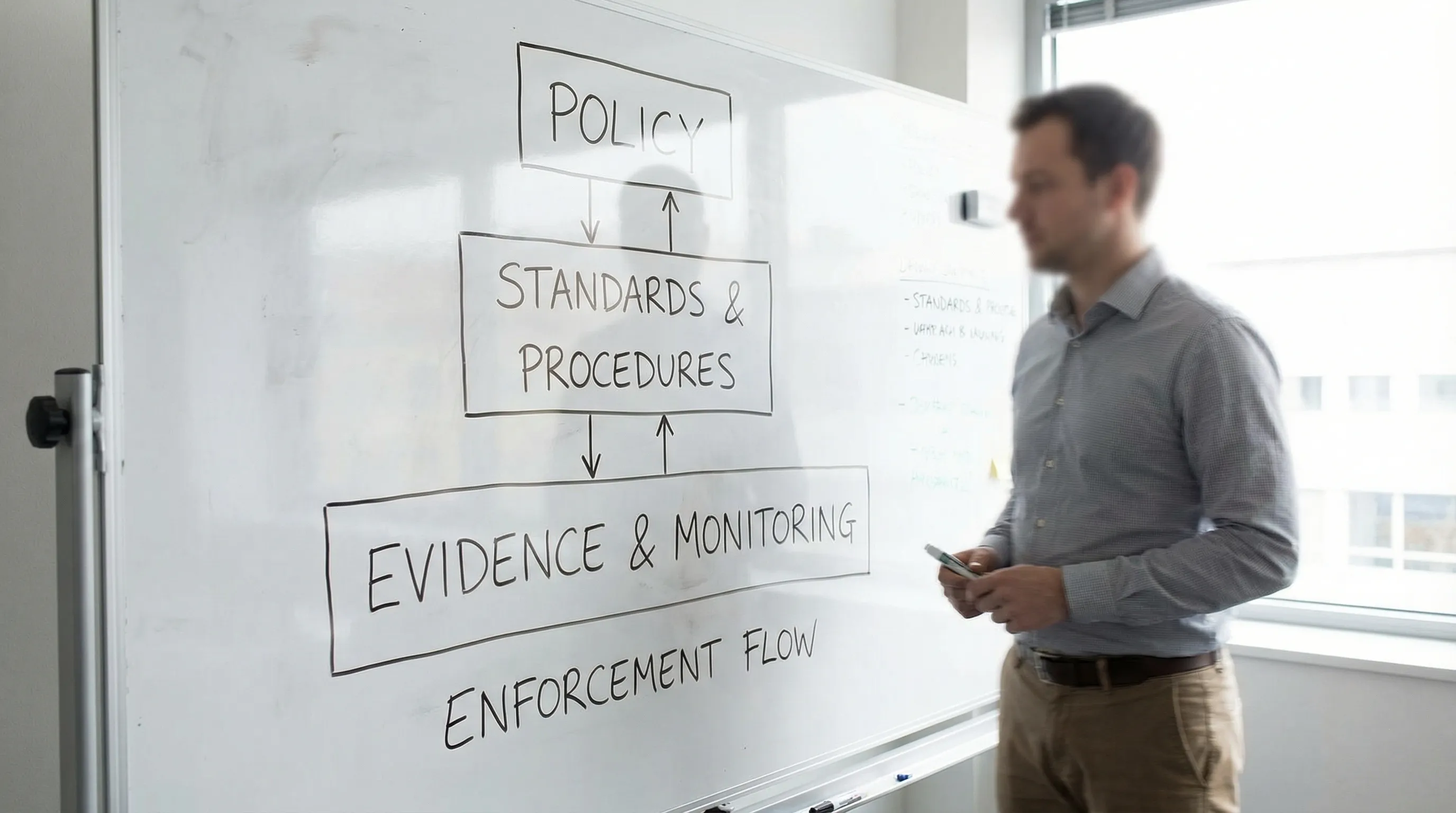
A workable structure is:
Policy: the non-negotiable rule set (what must be done, and who is accountable).
Standard: measurable requirements (for example, password length, encryption rules, log retention).
Procedure: step-by-step execution (how the service desk resets access, how HR handles employee data requests).
Guideline: recommended good practice (optional, context-dependent).
Records/evidence: proof you did it (logs, approvals, training completion, risk assessments).
If you only publish “policies” but do not define the standards, procedures, and evidence, enforcement becomes subjective, and audits become painful.
The core set of policies for data protection (what most Jamaican organisations need)
You do not need 40 documents to start, but you do need coverage for the main risk areas: governance, lawful use, security, retention, third parties, and incidents.
Below is a practical policy set that maps well to common regulatory expectations and recognised frameworks like the NIST Privacy Framework and ISO privacy/security management standards.
1) Data Protection (Privacy) Policy (the umbrella)
This is the anchor document that states your organisation’s commitment and assigns accountability.
What to include
Purpose and scope (business units, subsidiaries, systems, and whether it covers employee, customer, and vendor data).
Definitions (personal data, sensitive data, controller/processor concepts, breach, anonymisation/pseudonymisation).
Governance and roles (board/senior management oversight, privacy lead, IT security, HR, legal, procurement, incident response).
High-level principles (lawfulness/fairness, purpose limitation, minimisation, accuracy, storage limitation, security, accountability).
Required “supporting” policies (retention, access control, incident response, vendor management, etc.).
Enforcement and consequences (how compliance is monitored, disciplinary pathway, escalation).
Review cycle (at least annually, and after major change or incident).
Enforcement tip: If this policy does not name owners and consequences, it is a statement, not a control.
2) Data Classification and Handling Policy
This policy turns “protect data” into practical handling rules.
What to include
Classification levels (for example: Public, Internal, Confidential, Restricted) and examples for your business.
Handling rules per level (where it can be stored, encryption requirements, who can share it, printing rules).
Labelling expectations (file naming, email banners, document headers).
Minimum controls for Restricted data (MFA, encryption, access logging, limited sharing).
Enforcement tip: Classification only works if it is integrated into tools people use (DLP rules, SharePoint/Google Drive labels, email warnings), not just a PDF.
3) Access Control Policy (Identity and Privileged Access)
A large portion of data incidents involve inappropriate access, excessive privileges, shared accounts, or weak authentication.
What to include
Access principles (least privilege, need-to-know, segregation of duties).
Joiner-mover-leaver rules (how access is granted, changed, and removed).
Authentication minimums (MFA requirements, password policy, session timeouts).
Privileged access management expectations (admin accounts, logging, approvals, break-glass).
Periodic access reviews (how often, who signs off, evidence required).
Credible reference: ISO/IEC 27001 and related controls are widely used benchmarks for access governance. See ISO/IEC 27001 overview.
4) Records Retention and Secure Disposal Policy
Retention is a privacy issue and a risk issue. Keeping personal data “just in case” increases breach impact and complicates legal compliance.
What to include
Retention principles (keep only what is needed for the stated purpose, legal obligations, or legitimate business needs).
A retention schedule by record type (customer records, HR files, CCTV, marketing lists, call recordings, support tickets).
Disposal methods (secure wipe, shredding, certified disposal vendors, deletion from backups where feasible).
Litigation hold / investigation hold rules (when deletion must pause).
Enforcement tip: Retention policies fail when they do not include system owners, deletion triggers, and a cadence for clean-up.
5) Data Subject Rights (DSR) Handling Policy
Even if you have strong security, your programme will struggle if you cannot consistently handle access, correction, deletion, and objection-type requests.
What to include
Intake channels (email, web form, in person) and identity verification rules.
Case triage (what is a DSR versus a customer service request).
Search process (which systems must be checked, who owns each system).
Response approvals (legal review, exemptions, redactions).
Timelines and escalation.
Recordkeeping (request log, decisions, communications).
Enforcement tip: Tie this policy to a simple request register that shows dates, actions taken, and outcomes.
6) Incident and Personal Data Breach Response Policy
A breach plan is not only a cyber security issue. It must cover legal, communications, operational recovery, and documentation.
What to include
What counts as a suspected incident and what counts as a breach.
Roles (incident commander, IT lead, legal/privacy, HR, communications, business owner).
Containment steps and evidence preservation.
Decision-making for notifications (and who signs off).
Post-incident review (root cause, corrective actions, training updates).
Credible reference: The UK ICO breach guidance is a useful practical benchmark for structuring response and documentation, even outside the UK.
7) Third-Party and Vendor Data Processing Policy
If vendors handle personal data, your policy should set contracting and oversight expectations (not just procurement preferences).
What to include
When a vendor assessment is mandatory (cloud hosting, payroll, CRM, call centres, marketing platforms).
Minimum due diligence checks (security controls, breach history, sub-processors, location of data, certifications).
Contract requirements (confidentiality, breach notification, audit rights, deletion/return on termination).
Ongoing monitoring (annual review, reassessment on material change).
Enforcement tip: Make vendor onboarding impossible to complete without privacy and security sign-off.
8) Remote Work and BYOD Policy (where relevant)
Hybrid work increases the surface area for data exposure, especially in small and medium-sized organisations.
What to include
Approved devices and minimum configurations.
Rules for personal devices (MDM requirement, encryption, screen lock, no shared family use).
Handling of Restricted data offsite.
Secure Wi-Fi and VPN requirements.
Lost device reporting.
9) Privacy by Design / DPIA Policy (risk assessment for high-risk processing)
This policy defines when a privacy impact assessment is needed and how projects get approved.
What to include
Triggers (new systems, biometrics, large-scale profiling, new data sharing, new surveillance/CCTV locations, AI use on personal data).
Required assessment sections (purpose, data flows, risks, mitigations, residual risk sign-off).
Gatekeeping (projects cannot go live without DPIA closure when triggered).
What each policy should contain (a checklist that prevents “pretty PDFs”)
Regardless of policy type, strong policies share the same building blocks.
Policy element | Why it matters | What “good” looks like in practice |
Owner and approver | Ensures accountability | Named role(s) responsible for updates and enforcement; senior approval recorded |
Scope and applicability | Prevents loopholes | Covers business units, contractors, interns, systems, and third parties where relevant |
Definitions | Reduces misunderstandings | Uses consistent definitions aligned to your legal and operational context |
Clear requirements | Makes enforcement possible | “Must” statements, measurable where possible, avoids vague language |
Procedures/linked SOPs | Enables execution | Links to step-by-step processes and forms (access requests, DSR log, incident form) |
Evidence and records | Supports audits and investigations | Specifies what evidence is kept, where, and for how long |
Exceptions process | Handles reality safely | Documented exception approval with expiry date and compensating controls |
Consequences | Drives behaviour | Disciplinary and contractual consequences aligned to HR and vendor contracts |
Review cadence | Keeps it current | Annual review minimum, plus change after incidents, system changes, or law updates |
How to enforce data protection policies (so people actually follow them)
Enforcement is not about “catching people out.” It is about designing a system where compliant behaviour is the default.
Start with governance that has teeth
Policies should be owned by the business, not parked with one person.
Practical governance mechanisms:
Assign an executive sponsor (privacy is an organisational risk, not only an IT issue).
Create a small privacy and security working group (IT, HR, operations, procurement, legal/compliance).
Define decision rights (who can accept risk, who can approve exceptions, who must be consulted).
If your organisation uses a broader GRC model, embed privacy policies into that same reporting structure (risk registers, internal controls, audit plans).
Convert “policy statements” into control points
A policy becomes enforceable when it is reflected in operational gates and technical controls.
Examples:
Access control policy enforced by HR offboarding checklists, IAM workflows, and quarterly access recertification.
Vendor policy enforced by procurement workflow, mandatory security questionnaire, and contract templates.
Retention policy enforced by system retention settings, mailbox limits, scheduled deletion jobs, and archival rules.
If the business process allows someone to bypass the policy to “get the job done,” the bypass will become the norm.
Require training, but design it for roles
One annual slide deck rarely changes behaviour. Effective training is:
Short, scenario-based, and role-specific (front desk, HR, marketing, IT admins, managers).
Reinforced at key moments (onboarding, promotions to people-manager roles, system go-lives).
Tracked with completion records and follow-up for non-compliance.
PLMC provides training sessions and educational resources, which can be adapted to different teams and maturity levels.
Use attestations and acknowledgements
For high-impact policies (acceptable use, access control, confidentiality, incident reporting), use staff acknowledgements.
To avoid “click-through compliance,” pair acknowledgement with:
A short scenario quiz.
A manager conversation prompt (especially for teams that handle sensitive data).
Monitor compliance with simple metrics
You do not need complex dashboards to start. Pick a handful of indicators that show if the policy is working.
Policy area | Simple metric | What it reveals |
Access control | % of users with MFA enabled | Whether authentication requirements are real |
Access reviews | % of critical systems reviewed on time | Whether governance is operating |
Vendor management | % of critical vendors assessed and contracted correctly | Whether third-party risk is controlled |
DSR handling | Average days to close a request | Whether rights handling is organised |
Incident response | Time from detection to internal escalation | Whether staff recognise and report incidents |
Retention | % of systems with documented retention rules implemented | Whether the organisation is reducing exposure |
Audit and test, do not just “review”
A policy review checks wording. A policy test checks reality.
Good testing includes:
Sampling: pick 10 terminated staff and verify access was removed everywhere.
Walkthroughs: simulate a DSR request and track how long it takes.
Tabletop exercises: run a breach scenario with IT, legal, HR, and leadership.
Document findings and corrective actions. That documentation becomes part of your compliance evidence.
Apply consequences consistently
If policy breaches have no consistent outcome, the policy becomes optional.
Consistency means:
HR and compliance agree in advance on what constitutes minor versus serious breaches.
Managers are trained not to “handle it quietly” when the issue has privacy impact.
Vendor breaches trigger contractual remedies and reassessment.
This is especially important for repeated issues like unauthorised sharing of spreadsheets, use of personal email for work data, or bypassing approval steps.
Tailoring policies to Jamaica’s Data Protection Act (without overcomplicating them)
For Jamaican organisations, your policy language should reflect the realities of the Data Protection Act environment and the kinds of questions regulators, customers, and partners will ask.
Practical alignment steps:
Include a clear statement of accountability for personal data handling (who is responsible for compliance internally).
Ensure your policies support transparency (privacy notices), purpose limitation, minimisation, security, retention, and rights handling.
Address cross-border processing in your vendor and cloud approach (where data is stored and who can access it).
Make breach response and documentation explicit, including internal escalation and decision-making.
If you need a baseline understanding, PLMC already covers the operational implications in its guidance on the Act. This article builds on that foundation by showing how to turn obligations into enforceable internal rules.
A practical “policy rollout” plan you can complete in weeks
To avoid the common trap of writing everything at once and implementing nothing, roll out policies in a sequence that reduces risk early.
Phase 1: Establish control over the biggest risks
Publish and implement:
Data Protection (Privacy) Policy
Access Control Policy
Incident and Breach Response Policy
Then immediately enforce:
MFA for key systems
Offboarding controls
A simple incident reporting channel and escalation process
Phase 2: Reduce exposure and fix information sprawl
Add:
Data Classification and Handling
Records Retention and Secure Disposal
Implement:
Basic classification labels
Retention schedule ownership
A clean-up plan for shared drives and email archives
Phase 3: Control third-party risk and operationalise rights
Add:
Vendor/Third-Party Processing
Data Subject Rights Handling
Privacy by Design / DPIA
Implement:
Vendor due diligence and contract clauses
A rights request log
A project gate that triggers DPIAs

What “good” looks like: evidence you should be able to produce
When policies are enforceable, you can show proof quickly. Aim to be able to produce:
Current versions of policies with approval dates and owners.
Training completion records by department.
Access review sign-offs for critical systems.
Vendor assessments and signed data processing terms.
A retention schedule, plus proof that key systems enforce retention.
Incident response records (even if the incidents were minor), including lessons learned.
This is how you shift from “we have a policy” to “we run a controlled process.”
When to get help (and what to ask for)
If you are building policies for the first time, or you suspect your current set is not enforceable, consider targeted support. The highest-impact assistance is usually:
A gap assessment of your current policy set against your actual data flows and systems.
Policy drafting that includes standards, procedures, and evidence requirements, not just generic templates.
Implementation support to embed policies into HR, procurement, IT, and incident response workflows.
Role-based training that matches how your staff actually handle data.
PLMC supports Jamaican organisations with data protection implementation, GRC integration, cyber security services, and training sessions. If you want a second opinion on whether your policies are enforceable (not just well written), you can request a free consultation via Privacy & Legal Management Consultants Ltd..