
Data and Privacy Act Basics for Jamaican Organisations
In 2026, Jamaican organisations can no longer treat privacy compliance as a future project or a policy sitting on a shared drive. Personal data moves through every part of the business: HR files, customer databases, CCTV footage, email marketing lists, payment records, health information, supplier portals, cloud tools and paper forms.
Many leaders search for the “Data and Privacy Act” because they want a simple answer to a practical question: what must our organisation do with personal information to stay compliant and maintain trust? In Jamaica, the law most organisations need to focus on is the Data Protection Act, 2020. It sets standards for how personal data should be collected, used, stored, shared, secured and eventually disposed of.
This guide explains the basics in plain English. It is general educational information, not legal advice. For official updates, organisations should also consult the Office of the Information Commissioner and seek professional guidance where needed.
What people mean by the Data and Privacy Act in Jamaica
Jamaica does not usually refer to the law as the “Data and Privacy Act” in formal legal language. The correct name is the Data Protection Act, 2020. However, the phrase is understandable because the law connects two ideas that organisations must manage together.
Data protection is about the controls, processes and safeguards used to protect personal data. Privacy is about respecting people’s rights, expectations and choices in relation to how their information is used. A secure database can still create a privacy problem if the organisation collected too much data, used it for an undisclosed purpose, retained it for too long or shared it without proper controls.

The Data Protection Act applies beyond cyber security and beyond large corporations. If your organisation decides why and how personal data is processed, it may be acting as a data controller. If it processes personal data on behalf of another organisation, it may be acting as a processor. Many businesses do both, depending on the activity.
The core question: can you justify the whole data journey?
A useful way to understand the Data Protection Act is to follow the life of personal data from start to finish. Compliance is not only about preventing hackers from accessing files. It is about being able to explain why you collected the information, how you used it, who accessed it, how long you kept it and what rights the individual has.
Data moment | Basic question to ask | Practical example |
Collection | Are we collecting only what we need for a clear purpose? | A website form should not request a TRN unless there is a legitimate need for it. |
Use | Are we using the data for the purpose people were told about? | Customer delivery details should not be quietly repurposed for unrelated marketing. |
Access | Can only authorised persons see or change the data? | Payroll files should be limited to staff who genuinely need access. |
Sharing | Do we control what vendors, partners or group companies can do with the data? | A cloud provider or outsourced HR vendor should have clear contractual and security obligations. |
Retention | Do we know when the data should be archived, deleted or securely destroyed? | Old job applications should not remain indefinitely in inboxes and folders. |
Rights | Can individuals ask about, correct or challenge the use of their data? | A customer or employee should know where to send a privacy request. |
Incidents | Can we identify, contain and document a privacy or security incident? | A misdirected email containing personal data should trigger a response process, not an informal fix. |
This lifecycle view helps teams move beyond generic privacy statements. It also helps management see privacy as an operating model, not only a legal document.
Key terms every organisation should understand
Privacy compliance becomes easier when everyone uses the same language. These terms appear frequently in data protection discussions and should be understood by directors, managers, HR, IT, finance, marketing and customer-facing teams.
Term | Plain-English meaning | Why it matters |
Personal data | Information relating to an identifiable living individual. | Names, ID numbers, contact details, images, account records and employment files may all be personal data. |
Sensitive personal data | Higher-risk personal data, such as health information, religious beliefs, political opinions or other protected categories. | This usually requires stronger justification, tighter access and greater care. |
Data subject | The individual the personal data is about. | Customers, employees, patients, students, members and contractors can all be data subjects. |
Data controller | The organisation that determines why and how personal data is processed. | Controllers carry key accountability duties under the Act. |
Data processor | A person or organisation that processes personal data on behalf of a controller. | Processors need clear instructions, security controls and contract terms. |
Processing | Almost any action involving personal data. | Collection, storage, viewing, sharing, analysis, deletion and archiving may all count. |
Privacy lead or DPO | The person responsible for coordinating privacy governance and compliance activities. | Organisations need clear ownership, even where duties are shared across departments. |
One of the biggest mistakes is assuming that personal data means only highly confidential files. In reality, routine business data can be regulated if it identifies a person directly or indirectly.
The eight data protection standards in plain English
Jamaica’s Data Protection Act is built around data protection standards. These standards are the backbone of compliance because they shape what organisations should be able to prove.
Standard in practical terms | What it means for daily operations | Evidence organisations should keep |
Process data fairly and lawfully | Have a lawful condition or basis before collecting and using personal data. | Lawful basis records, consent records where consent is used, privacy notices. |
Use data for specified purposes | Tell people why data is collected and do not use it for incompatible purposes. | Data inventory, purpose statements, change review records. |
Collect only what is adequate, relevant and not excessive | Do not ask for more information than the organisation genuinely needs. | Form reviews, data minimisation checks, approved data fields. |
Keep data accurate and up to date | Correct inaccurate records and avoid relying on outdated information. | Correction logs, update processes, data quality checks. |
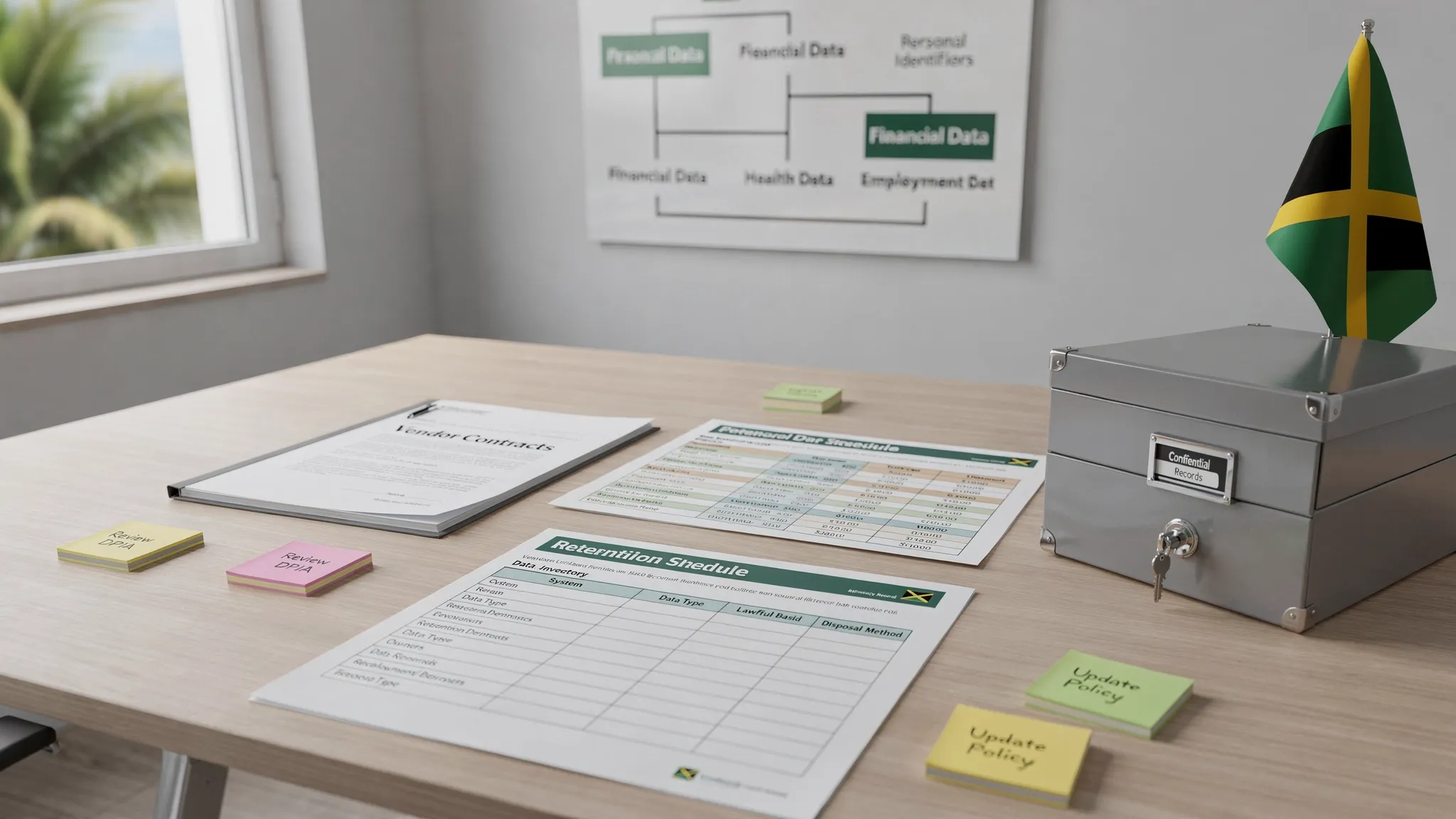
Keep data only as long as necessary | Set retention periods and securely dispose of records when they are no longer needed. | Retention schedule, disposal logs, archive rules. |
Respect data subject rights | Enable people to access, correct or object to certain uses of their information where applicable. | Rights request procedure, request log, response templates. |
Use appropriate security measures | Apply technical and organisational safeguards based on risk. | Access reviews, MFA records, incident logs, backup tests, training records. |
Control overseas transfers | Ensure personal data sent outside Jamaica has appropriate protection. | Vendor due diligence, transfer assessment, contract clauses, cloud review. |
The standards are not intended to sit separately from operations. They should influence procurement, HR onboarding, marketing campaigns, new software, customer service scripts, data analytics, CCTV use and document storage.
What Jamaican organisations should put in place first
The first step is governance. Senior management should know who owns the privacy programme, who reports on progress and how unresolved risks are escalated. Privacy cannot be left only to IT, legal or administration. Those teams are important, but the organisation as a whole remains accountable for how personal data is handled.
The second step is a data inventory. Before you can comply with the Data Protection Act, you need to know what personal data you hold, where it came from, why you use it, where it is stored, who receives it and how long it is kept. This does not need to begin as a complex technology project. A structured spreadsheet or workshop can reveal many of the highest-risk activities quickly.
The third step is lawful use and transparency. Organisations should be able to explain the lawful condition or basis for key processing activities. They should also provide clear privacy notices for customers, employees, website users and other relevant groups. A privacy notice should not be a vague statement that “we respect your privacy.” It should explain what data is collected, why, who it may be shared with, how long it is kept and how people can exercise their rights.
The fourth step is operational control. Staff need procedures for handling access requests, correction requests, complaints, misdirected emails, lost devices, suspicious vendor behaviour and unusual data requests. A policy is useful only if people know what to do when a real situation occurs.
Security is also essential. Appropriate measures may include role-based access, multi-factor authentication, secure backups, encryption where suitable, patching, logging, password controls, physical file security and tested incident response. The right level of control depends on the sensitivity of the data and the harm that could result if it is misused or exposed.
Vendors require special attention. Payroll platforms, IT support providers, cloud storage, email marketing tools, payment processors, recruiters and professional advisers may all touch personal data. Organisations should understand whether each vendor is a processor, what safeguards are in place, whether data leaves Jamaica and what happens if there is an incident.
For a deeper operational checklist, see PLMC’s guide to privacy and data protection practical controls.
How the basics change by organisation type
The same legal principles apply across sectors, but the risk profile changes depending on the kind of data handled and the expectations of the people affected.
Organisation type | Common personal data risks | First priorities |
Employers and HR teams | Employee files, payroll data, disciplinary records, medical certificates, background checks. | Limit access, define retention, update employee privacy notices, secure HR folders. |
Retail and ecommerce businesses | Customer contact details, delivery addresses, payment-related data, marketing lists. | Review website privacy notices, marketing consent, vendor contracts and customer service scripts. |
Schools and training providers | Student records, parent contacts, images, performance data, attendance records. | Strengthen consent practices, protect minors’ data, control sharing and train staff. |
Clinics and health providers | Patient records, test results, prescriptions, insurance information. | Apply stricter access controls, confidentiality training, incident procedures and vendor due diligence. |
Financial and professional services | KYC records, AML documentation, client files, transaction history. | Balance AML retention duties with privacy controls, secure client data and document lawful purposes. |
Nonprofits, churches and membership bodies | Member lists, donor records, counselling notes, event images. | Clarify purposes, limit access, review sharing practices and secure volunteer-managed files. |
For example, an organisation subject to anti-money laundering obligations may need to keep certain records for legal and regulatory reasons. That does not remove privacy obligations. It means the organisation should document why the records are required, restrict access, secure the files and avoid using the information for unrelated purposes.
Common mistakes when interpreting the Data and Privacy Act
Mistake | Why it creates risk | Better approach |
Treating privacy as an IT issue only | Legal, HR, marketing, procurement and operations all make decisions about personal data. | Create shared ownership with clear reporting to management. |
Copying a generic privacy policy | A policy that does not match real practices can mislead users and weaken compliance. | Map actual data flows before drafting or updating notices. |
Relying on consent for everything | Consent may not always be the right lawful basis, and poor consent records can create disputes. | Identify the correct lawful condition for each major activity. |
Keeping data forever | Over-retention increases breach impact and makes rights requests harder to manage. | Use retention schedules and secure disposal procedures. |
Ignoring paper records | Paper files, printed forms and physical archives can expose personal data. | Include paper records in inventories, access controls and disposal rules. |
Assuming vendors handle all compliance | Outsourcing processing does not remove accountability. | Use due diligence, written terms, monitoring and incident cooperation requirements. |
Training staff once and moving on | People forget rules, roles change and new tools introduce new risks. | Use role-based refreshers and keep attendance and assessment records. |
These mistakes often occur because organisations start with documents instead of decisions. The better approach is to ask what the organisation actually does with personal data, then build policies, controls and evidence around that reality.
A simple readiness test for leaders
A board, CEO, managing director or senior manager does not need to know every technical detail. However, leadership should be able to ask direct questions and receive evidence-based answers.
Use these questions as a quick readiness test:
Can we identify the person or team responsible for coordinating data protection compliance?
Can we produce a current list of our main personal data processing activities?
Can we explain the lawful basis or condition for our highest-risk uses of personal data?
Do our privacy notices match what we actually do?
Can staff recognise and escalate a privacy incident or rights request?
Do we know which vendors process personal data for us and where that data is stored?
Do we have retention periods for employee, customer, financial and operational records?
Can we show evidence that controls are working, not just that policies exist?
If the answer to several of these questions is “not yet,” the organisation should prioritise a structured gap assessment. A practical assessment can identify quick wins, high-risk gaps and the documents needed to demonstrate accountability. PLMC also discusses this evidence-based approach in its article on data protection risk assessment.
Frequently Asked Questions
Is there a Data and Privacy Act in Jamaica? Many people use that phrase informally, but the main law is Jamaica’s Data Protection Act, 2020. It governs how organisations collect, use, store, share and protect personal data.
Does the Data Protection Act apply to employee records? Yes, employee records can contain personal data and sometimes sensitive personal data. HR files, payroll information, medical certificates, disciplinary documents and recruitment records should be handled under clear privacy and retention controls.
Do we need consent for every use of personal data? Not always. Consent is one lawful route in some situations, but other lawful conditions may apply depending on the purpose. Organisations should document the basis for each major processing activity and avoid using consent where it is not appropriate or freely given.
Are paper files covered by data protection rules? Yes, paper records can create privacy risk if they contain personal data and are organised or used in a way that identifies individuals. Locked storage, access controls, clear retention periods and secure shredding all matter.
What should we do if personal data is sent to the wrong person? Treat it as a potential privacy incident. Contain the issue, recover or delete the information where possible, assess the risk, document what happened, notify the appropriate parties where required and fix the process that caused the error.
How often should we review our privacy programme? At minimum, organisations should review key documents and controls annually and whenever there is a major change, such as a new system, vendor, product, office process, marketing campaign or data-sharing arrangement.
Get practical help with Jamaica’s data protection requirements
Understanding the basics is the first step. The next step is turning them into working controls, clear evidence and staff behaviour that holds up under real business pressure.
Privacy & Legal Management Consultants Ltd. supports Jamaican organisations with data protection implementation, corporate governance, anti-money laundering compliance, cyber security, GRC integration, training, risk assessment support and educational resources. If your organisation needs help interpreting the Data Protection Act, reviewing gaps or building an implementation plan, start with a practical conversation.
Visit Privacy & Legal Management Consultants Ltd. to explore support options or request a consultation.