

Compliance Data Security Gaps Leaders Often Miss

A compliance data security programme can look healthy from the boardroom. Policies are approved, staff have completed annual training, multi-factor authentication is in place, and the last audit produced a manageable list of findings. Yet many serious exposures sit just below that surface, in the handoffs between Legal, IT, Compliance, HR, Procurement, Operations, and external vendors.
For Jamaican organisations, these gaps matter because the Data Protection Act, 2020 is not satisfied by good intentions or generic cybersecurity controls alone. Leaders need to show that personal data is handled lawfully, secured appropriately, retained only as needed, shared responsibly, and governed with evidence. The Office of the Information Commissioner has made it clear that data protection is an operational obligation, not a document exercise.
The gaps below are not always obvious in dashboards. They often hide in routine business practices: exported spreadsheets, abandoned user accounts, legacy systems, vendor portals, untested incident plans, and exceptions that were supposed to be temporary. The leadership task is to ask better questions before those gaps become audit findings, breach events, client due diligence issues, or reputational damage.
What “compliance data security” really means
Compliance data security is the point where privacy obligations, security controls, and governance evidence meet. It is broader than antivirus, firewalls, or password rules. It asks whether the organisation can prove that personal data and sensitive business information are protected throughout their lifecycle.
That means leaders should be able to answer questions such as:
What personal data do we hold, where is it stored, and who can access it?
Which laws, contracts, and sector obligations apply to that data?
What controls protect it from unauthorised access, misuse, loss, or excessive retention?
How do we know those controls are working?
What evidence would we show a regulator, auditor, client, insurer, or board committee?
This is why frameworks such as the NIST Cybersecurity Framework 2.0 are useful for leadership. NIST places “Govern” alongside identify, protect, detect, respond, and recover. In other words, security is not only a technical function. It is a management system with accountability, oversight, policy, risk decisions, and continuous improvement.
Why leaders miss data security gaps
Leaders usually do not miss gaps because they are careless. They miss them because compliance reporting often focuses on completion rather than effectiveness. A dashboard may say that 98 percent of staff completed training, but not whether employees know how to report a suspected privacy incident. A vendor register may exist, but not show whether vendor access is still needed. A policy may be approved, but not embedded into procurement, onboarding, system changes, or retention decisions.
A second issue is speed. Business teams adopt new tools, create data exports, test automation, onboard service providers, and launch customer campaigns faster than governance processes can review them. When privacy, security, and compliance are brought in late, the organisation inherits controls that were never designed properly.
A third issue is that security metrics are often system-focused rather than data-focused. Leaders may see patching rates, phishing test results, endpoint alerts, or firewall events, but not whether high-risk personal data is concentrated in poorly controlled locations. Compliance data security requires both views.
Comfort signal leaders often see | Hidden risk behind it | Better leadership question |
“We have a data protection policy.” | The policy is not mapped to owners, procedures, or evidence. | Which controls prove the policy is operating in each department? |
“Access is role-based.” | Roles are outdated after transfers, promotions, or project changes. | When was access last recertified by business owners? |
“Vendors sign contracts.” | Contracts exist, but vendor access and sub-processors are not monitored. | Which vendors can access personal data today, and why? |
“Staff completed training.” | Training is generic and not tested against real job scenarios. | What behaviours improved after training? |
“Backups are secure.” | Backups retain personal data longer than business systems. | Do backup and retention practices align with privacy obligations? |
Gap 1: Policies that are approved but not operationalised
A common leadership blind spot is assuming that a signed policy equals compliance. Policies are necessary, but they do not secure data by themselves. The real test is whether the policy has been translated into procedures, control owners, escalation routes, review dates, and evidence.
For example, a data protection policy may say that access to personal data must be limited to authorised staff. But who approves access? Who reviews access after an employee changes role? How often are exceptions checked? What happens when the system owner and the data owner disagree?
The leadership fix is simple but disciplined. For each major policy requirement, ask for the operational control, the control owner, the review frequency, and the evidence retained. If one of those four elements is missing, the policy may not be enforceable.
For a broader view of policy implementation, PLMC’s guide on data protection policies and procedures that hold up explains how to connect documents to real workflows.
Gap 2: Data inventories that ignore informal storage
Many organisations have begun mapping data in core systems such as HR platforms, CRMs, accounting tools, and customer databases. The gap is that personal data often spreads beyond those systems into spreadsheets, email attachments, shared drives, chat platforms, exported reports, scanned files, and paper records.
These informal locations are high risk because they are harder to monitor. A spreadsheet containing customer IDs, employee medical information, KYC documents, or complaint records may be copied several times, emailed externally, saved locally, or forgotten after a project ends.
Leaders should not ask only, “Do we have a data inventory?” They should ask, “Does the inventory include exports, reports, shared folders, collaboration tools, test data, archives, and paper records?” If the answer is no, the inventory is incomplete.
A practical approach is to identify the top five departments that handle the most sensitive personal data, then sample where data actually moves during daily work. HR, Finance, Sales, Customer Service, Compliance, and Operations often reveal hidden data stores quickly.
Gap 3: Access drift after staff changes
Access drift happens when people keep permissions they no longer need. It often follows promotions, transfers, temporary projects, emergency access, shared responsibilities, or weak offboarding.
This gap is especially dangerous because the access may have been legitimate at one time. A manager who once supported payroll may still have access to salary files. A contractor may retain credentials after a project. A staff member may move from customer service to marketing but still access complaint records. No one notices because the account is active, the user is known, and the access does not look suspicious.
The control is not only technical. Business owners must periodically confirm who should access their data. IT can produce user lists, but HR, department heads, and data owners must validate whether the access still makes sense.
Leaders should ask for evidence of joiner, mover, and leaver controls. They should also ask when privileged accounts were last reviewed, how emergency access is approved, and whether shared accounts have been eliminated.
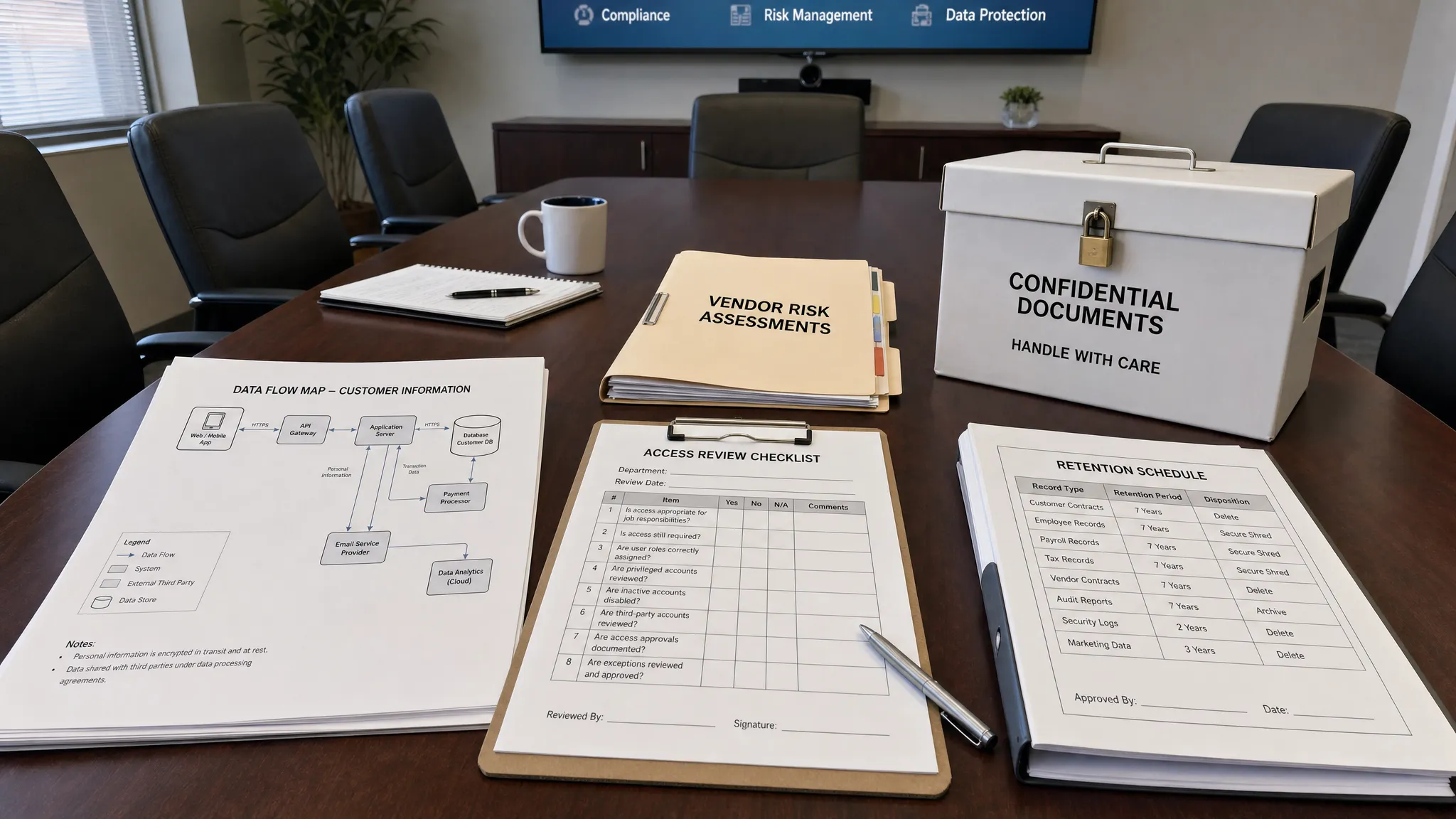
Gap 4: Vendor access that continues after the business need ends
Vendor risk is not limited to selecting the right provider. It continues for as long as a vendor can access systems, files, portals, APIs, backups, or customer records. Leaders often see signed contracts and assume the issue is handled, but contracts do not automatically remove unnecessary access.
The gap is most visible in support vendors, outsourced IT, payroll providers, marketing platforms, cloud service providers, consultants, payment processors, and specialist compliance tools. If the organisation does not maintain a live view of vendor access, it may not know which third parties can still view or process personal data.
The leadership question is not only, “Do we have vendor agreements?” It is, “Which vendors have access to personal data today, what data can they access, where is it hosted, who approved it, and when will access be reviewed?”
This is also important where Jamaican organisations deal with overseas service providers or international clients. Cross-border processing, GDPR-related due diligence, and contractual security commitments can become business issues, not just legal ones.
Gap 5: Security exceptions with no expiry date
Every organisation has exceptions. A legacy system cannot support multi-factor authentication. A department needs temporary access to complete a project. A vendor requires a workaround. A patch must be delayed due to operational risk.
The problem is not the existence of exceptions. The problem is unmanaged exceptions. If exceptions do not have owners, compensating controls, expiry dates, and review points, they become permanent weaknesses.
Leaders should request an exception register that shows:
The business reason for each exception.
The risk accepted and by whom.
The compensating control in place.
The expiry or review date.
The current status of remediation.
This moves the conversation from “IT has issues” to “management has accepted specific risks and is monitoring them.” That distinction matters for governance and accountability.
Gap 6: Retention rules that exist on paper only
Retention is one of the most underestimated compliance data security issues. Many organisations write retention schedules, but do not connect them to systems, archives, backups, email, shared drives, paper files, and vendor platforms.
When retention is not enforced, the organisation stores more personal data than necessary. That increases breach impact, complicates access requests, raises discovery costs, and creates uncertainty when teams need to delete or anonymise records.
There is also a governance challenge in regulated areas. For example, anti-money laundering obligations may require certain records to be retained for defined periods, while privacy principles still require purpose limitation, access control, and eventual disposal. The answer is not to keep everything forever. The answer is to document the legal or business reason for retention, restrict access, and delete or anonymise data when the reason expires.
Leaders should ask whether retention is technically enforced or manually dependent. They should also ask whether old shared folders, archived mailboxes, former employee files, and vendor-held records are included.
Gap 7: Backups, logs, and test environments left outside privacy planning
Security and IT teams often treat backups, logs, and test environments as technical assets. Privacy and compliance teams sometimes focus on live production systems. This creates a gap.
Backups may contain old personal data after the live system has been corrected or deleted. Logs may include usernames, IP addresses, customer identifiers, transaction details, or free-text fields. Test environments may contain copied production data that was never masked or minimised.
These areas matter because they can expand the amount of personal data exposed during an incident. They can also create conflicts with data subject requests, retention schedules, and vendor access controls.
The leadership fix is to include backups, logs, and test data in data inventories and risk assessments. Leaders should ask whether personal data in test environments is masked, whether log retention is justified, and whether backup restoration procedures have been tested.
Gap 8: Incident response plans that do not include privacy decisions
Many organisations have cybersecurity incident response plans. Fewer have plans that clearly connect technical response to privacy, legal, communications, customer service, insurance, vendor, and executive decisions.
This gap becomes visible in the first hours of an incident. Teams may know how to isolate a device, but not who decides whether personal data is involved. They may know how to reset passwords, but not how to preserve evidence. They may know how to contact IT support, but not when to involve Legal, Compliance, the Data Protection Officer or privacy lead, senior management, affected vendors, or external advisors.
The plan should answer practical questions before stress sets in. What counts as a suspected data incident? Who triages it? What information is collected first? Who decides whether notifications may be required? Who communicates with affected individuals, regulators, clients, or partners if needed?
A tabletop exercise is one of the best ways to expose this gap. Leaders should participate, not only observe. The exercise should test decision-making, not just technical containment.
Gap 9: Training that measures attendance instead of judgement
Training completion is easy to report. Behaviour change is harder to prove. That is why leaders often miss the gap between awareness and practical judgement.
Employees need to recognise everyday risk moments: sending a file to the wrong recipient, discussing customer information in public areas, using personal email for work, clicking phishing links, collecting unnecessary data, storing records too long, or sharing information with a vendor without approval.
Role-based training is more useful than generic annual training. HR needs different scenarios from Sales. Customer Service needs identity verification practice. IT needs privacy-by-design and incident escalation. Procurement needs vendor due diligence. Executives need governance and accountability.
Leaders should ask training owners to show not only attendance, but scenario scores, incident reporting trends, manager follow-up, policy acknowledgements, and changes made after training feedback. PLMC’s guide on privacy and data protection training by role provides a practical way to structure this.
Gap 10: Board reporting that hides residual risk
A final gap sits in the reporting itself. Board and executive reports often include activity metrics: training completion, number of policies approved, number of vendors reviewed, number of incidents closed, number of systems patched. These are useful, but they can hide the real question: what residual risk remains?
A better report connects activity to risk reduction. For example, instead of saying “20 vendors reviewed,” the report should say how many high-risk vendors remain without updated contracts, how many have unresolved security findings, and which business owners accepted the risk. Instead of saying “access reviews completed,” it should say how many excessive permissions were removed and which systems remain overdue.
Good leadership reporting should include trends, overdue actions, risk owners, exceptions, incident lessons, and decisions required. This allows the board to exercise oversight rather than receive reassurance.
For more on board-level reporting, see PLMC’s guide to governance data protection KPIs.
A leadership checklist for finding hidden gaps
Leaders do not need to become system administrators to challenge compliance data security effectively. They need a disciplined review rhythm and the right questions.
Review area | Evidence to request | Red flag |
Data inventory | Current system, vendor, export, and paper record map | Inventory covers only major systems |
Access control | Latest access recertification and removed permissions | Business owners did not validate access |
Vendor security | Vendor register, due diligence, access review, contract terms | Vendor list exists but access is unknown |
Retention | Retention schedule mapped to systems and disposal evidence | “We keep it just in case” is common practice |
Incident response | Tabletop results, incident log, escalation procedure | Plan has not been tested with executives |
Training | Role-based attendance, scenario testing, follow-up actions | Training is annual and generic |
Exceptions | Exception register with expiry dates and risk owners | Exceptions have no review dates |
Board reporting | Risk trends, overdue actions, decisions required | Reports show activity without residual risk |
A quarterly review is a practical starting point. High-risk organisations, such as those handling health, financial, employee, children’s, biometric, or large-scale customer data, may need more frequent review. Major changes should also trigger a review, including new systems, outsourcing, mergers, new marketing channels, AI tools, regulatory changes, or significant vendor changes.
How to close the gaps without overwhelming the organisation
The mistake many organisations make is trying to fix everything at once. A better approach is to focus on the data that would cause the greatest harm if misused, lost, accessed unlawfully, or retained too long.
Start by identifying your highest-risk personal data and where it sits. Then confirm who owns the data, who can access it, which vendors support it, what retention rules apply, and what evidence proves controls are working. This creates a focused risk picture that leaders can act on.
Next, convert findings into a short remediation plan. Each action should have an owner, due date, risk rating, evidence requirement, and status. Avoid vague actions such as “improve security” or “update policy.” Use specific actions such as “complete access recertification for HR files,” “remove inactive vendor accounts,” “map customer data exports,” or “test breach escalation with Legal and Communications.”
Finally, build evidence as the work is done. Evidence may include screenshots, approved procedures, access review logs, vendor assessments, training records, incident exercise notes, deletion certificates, board minutes, and exception registers. For audit readiness, PLMC’s article on data security compliance evidence auditors expect to see is a useful companion resource.
Frequently Asked Questions
What is a compliance data security gap? A compliance data security gap is a weakness between what an organisation is required to do and what its controls can actually prove. It may involve access, vendors, retention, incident response, training, documentation, or evidence.
Is compliance data security only an IT responsibility? No. IT manages many technical controls, but Legal, Compliance, HR, Procurement, Operations, senior management, and the board all play roles. Data protection compliance depends on people, process, technology, and governance working together.
How often should leaders review data security gaps? Quarterly is a practical baseline for many organisations. Reviews should also happen after major business changes, new systems, new vendors, incidents, regulatory developments, or changes in how personal data is collected and used.
How does Jamaica’s Data Protection Act affect security decisions? The Act requires organisations handling personal data to apply appropriate safeguards and demonstrate responsible processing. Security decisions should therefore be linked to lawful use, access control, retention, vendor management, transparency, and accountability.
What is the fastest way to find hidden gaps? Start with your highest-risk data, then test five areas: where it is stored, who can access it, which vendors handle it, how long it is retained, and what happens if it is exposed. This often reveals the most urgent weaknesses quickly.
Strengthen compliance data security before gaps become incidents
If your organisation has policies, tools, and training but still lacks a clear view of residual risk, it may be time for an independent compliance data security review. Privacy & Legal Management Consultants Ltd. helps Jamaican organisations strengthen data protection implementation, cyber security alignment, corporate governance, AML compliance, GRC integration, and staff training.
PLMC can help you identify hidden gaps, prioritise remediation, and build evidence that supports Data Protection Act readiness. To discuss your organisation’s needs, visit Privacy & Legal Management Consultants Ltd. and explore support options for assessments, training, and compliance implementation.