

Compliance Data Security Controls Every Jamaica Org Needs
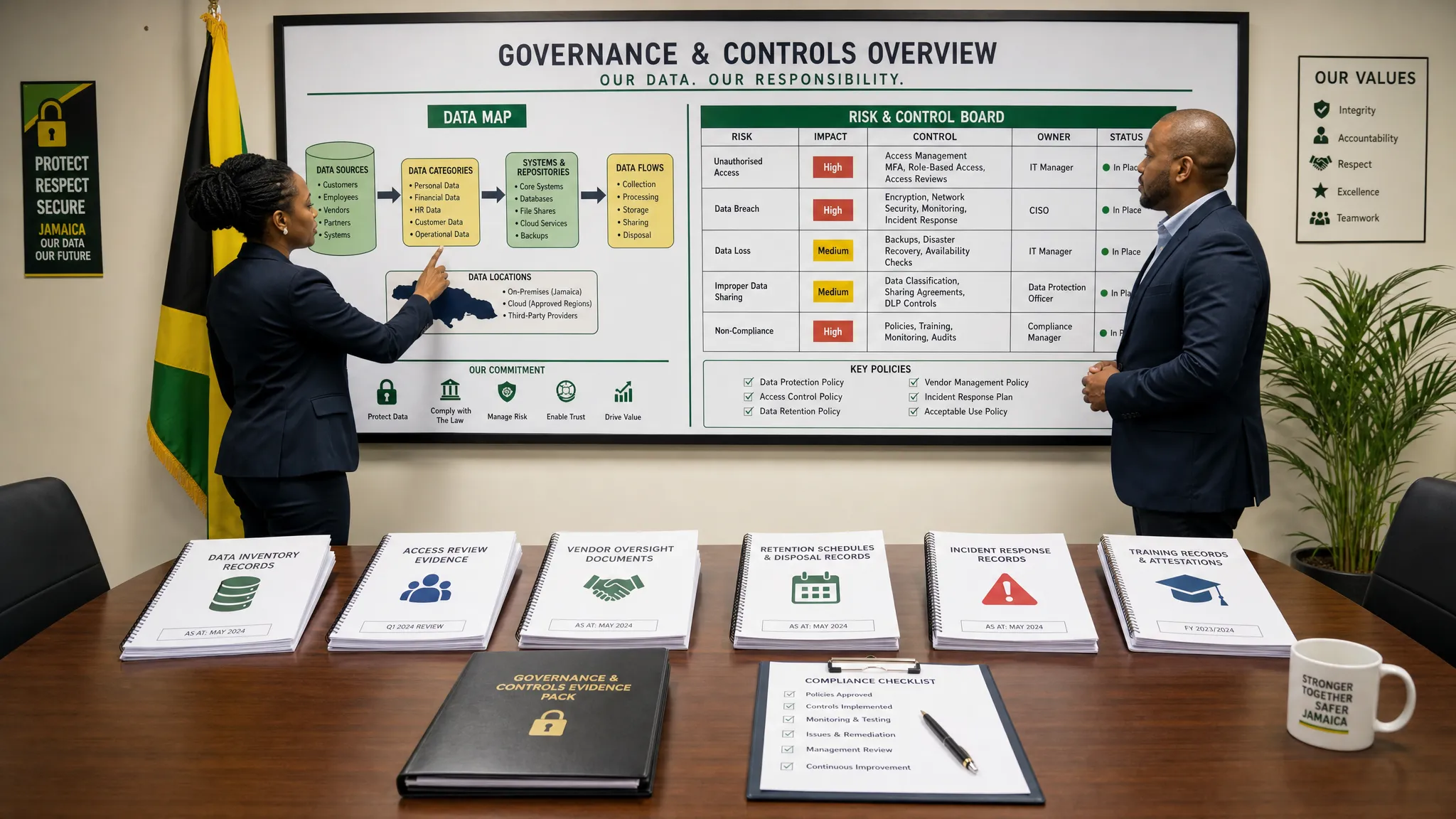
Jamaican organisations do not need more vague policies sitting in a shared folder. They need compliance data security controls that reduce real exposure, support Data Protection Act obligations, and create evidence leadership can rely on.
For many businesses in Jamaica, personal data now flows through payroll platforms, WhatsApp groups, cloud storage, payment systems, customer relationship tools, visitor logs, outsourced service providers, and remote devices. A privacy policy alone cannot control that environment. Neither can cyber security tools if no one has defined who may use the data, why it is being collected, how long it should be kept, and what happens when something goes wrong.
The strongest approach is to treat compliance and security as one operating discipline. That means assigning ownership, implementing practical controls, testing them, and keeping records that show the organisation is acting responsibly.
Why compliance and security must be managed together
Jamaica’s Data Protection Act, 2020 places responsibility on organisations that determine how personal data is collected, used, shared, stored, and disposed of. The Act is not only a legal issue for counsel or a technical issue for IT. It affects HR, sales, customer service, finance, operations, executive leadership, and any department that handles personal data.
The Office of the Information Commissioner is the key regulatory body for data protection in Jamaica, and organisations should take a proactive approach to demonstrating accountability. If your organisation is still clarifying what the Act requires in daily operations, PLMC’s guide on what Jamaican organisations must do under the Data Protection Act is a helpful starting point.
Security controls protect systems from misuse, loss, unauthorised access, and disruption. Compliance controls prove that personal data is handled lawfully, fairly, transparently, and with appropriate safeguards. In practice, they overlap. Access reviews, vendor checks, retention schedules, incident response plans, and staff training all serve both purposes.
Internationally recognised frameworks can help structure this work. The NIST Cybersecurity Framework 2.0 organises cyber risk outcomes around govern, identify, protect, detect, respond, and recover. Jamaican organisations can adapt that logic without overcomplicating their control environment.
The baseline controls leaders should expect to see
A useful compliance control is not just an instruction. It has an owner, a repeatable process, and evidence that it is working. Leadership should be able to ask simple questions and receive clear answers: What personal data do we hold? Who can access it? Which vendors process it? What risks have we accepted? What proof do we have?
Control area | What it helps prove | Evidence to keep |
Governance and accountability | Privacy and security have assigned owners | Approved policies, role descriptions, board or management minutes |
Data inventory and classification | The organisation knows what personal data it holds | Data maps, processing registers, system inventories |
Access control | Only authorised persons can access personal data | User access reviews, MFA records, joiner and leaver checklists |
Secure configuration | Systems are protected against common weaknesses | Patch logs, hardening standards, encryption settings |
Vendor management | Third parties are assessed and monitored | Contracts, due diligence records, security questionnaires |
Incident response | The organisation can detect, escalate, and respond | Incident plans, test results, breach assessment records |
Retention and disposal | Data is not kept longer than necessary | Retention schedules, deletion logs, disposal certificates |
Training and awareness | Staff understand their responsibilities | Attendance records, role-based training content, quiz results |
Assurance and audit | Controls are reviewed and improved | Internal audit findings, risk registers, remediation trackers |
This baseline is scalable. A small professional services firm will not implement it in the same way as a bank, hospital, BPO, university, or public body. The principle remains the same: controls must match the sensitivity, volume, and business value of the data being handled.
1. Data inventory and classification
You cannot protect what you cannot see. A data inventory identifies where personal data enters the organisation, where it is stored, who uses it, who it is shared with, and when it should be deleted or anonymised.
For Jamaican organisations, this inventory should include employee data, customer data, supplier records, CCTV, website enquiries, payment information, health-related information where applicable, and any sensitive personal data handled in operations. It should also include informal channels, such as spreadsheets, email attachments, shared drives, messaging apps, and locally stored files on laptops.
A practical inventory should capture:
The categories of personal data collected
The purpose for collecting and using the data
The systems, files, and locations where the data is stored
The internal roles and external parties with access
The retention period or deletion trigger
The security controls protecting the data
Classification then helps teams apply the right safeguards. Public marketing content does not need the same level of protection as payroll records, medical information, disciplinary files, customer identification documents, or anti-money laundering documentation.
2. Access control and identity management
Access control is one of the most important compliance data security controls because it directly limits who can view, change, copy, download, or delete personal data. It also creates accountability when something goes wrong.
Every organisation should apply least privilege. Staff should only have the access required for their role, and privileged access should be tightly controlled. Shared accounts should be removed wherever possible because they weaken accountability. Multi-factor authentication should be used for email, cloud platforms, remote access, finance systems, HR systems, and any system containing sensitive or high-volume personal data.
The joiner, mover, and leaver process is especially important. New employees need the right access, employees who change roles need old access removed, and departing employees should be disabled promptly. Access reviews should be scheduled, documented, and signed off by business owners, not left entirely to IT.
3. Secure configuration, patching, and endpoint protection
Many data incidents begin with preventable technical weaknesses: outdated software, weak passwords, exposed remote access, misconfigured cloud storage, missing backups, or unmanaged devices. These are not only cyber security concerns. They create privacy and compliance risk because they can lead to unauthorised access, data loss, or service disruption.
A strong control environment includes a current asset register, supported operating systems, timely patching based on risk, anti-malware or endpoint protection, device encryption, secure cloud settings, and restrictions on unauthorised software. Organisations should also decide how personal devices, removable media, and remote work environments will be governed.
Backups need special attention. A backup that cannot be restored is not a control. Regular restore testing should confirm that critical data can be recovered within a timeframe the business can tolerate. Backup access should also be restricted because backup repositories often contain large volumes of personal data.
4. Privacy by design in projects and process changes
Compliance should not be bolted on after a new system goes live. Privacy by design means teams assess data protection risk before launching a new app, campaign, vendor relationship, customer portal, HR platform, surveillance tool, or analytics project.
A simple project gate can prevent major issues. Before approval, the business should confirm what data will be collected, why it is needed, whether the privacy notice is accurate, whether consent or another lawful basis is appropriate, who will access the data, whether a vendor is involved, and how the data will be retained or deleted.
For more structured implementation, PLMC’s step-by-step roadmap for implementing the Data Protection Act explains how organisations can move from mobilisation and discovery through to embedding and assurance.
5. Vendor and cross-border data control
Most organisations rely on third parties. Payroll providers, accountants, cloud platforms, payment processors, IT support companies, marketing tools, call centres, logistics providers, and professional advisers may all process personal data on behalf of the business.
Vendor management should begin before data is shared. The organisation should understand what data the vendor will handle, where it will be stored, whether subcontractors are involved, what security measures apply, and how incidents will be reported. Contracts should address confidentiality, permitted processing, security expectations, assistance with data subject requests, return or deletion of data, and audit or assurance rights where appropriate.
Cross-border processing deserves particular attention. Many common cloud and software services store or support data outside Jamaica. That does not automatically make them unsuitable, but it does mean the organisation must understand the transfer, document the basis for using the service, and ensure appropriate safeguards are in place.
6. Monitoring, logging, and incident response
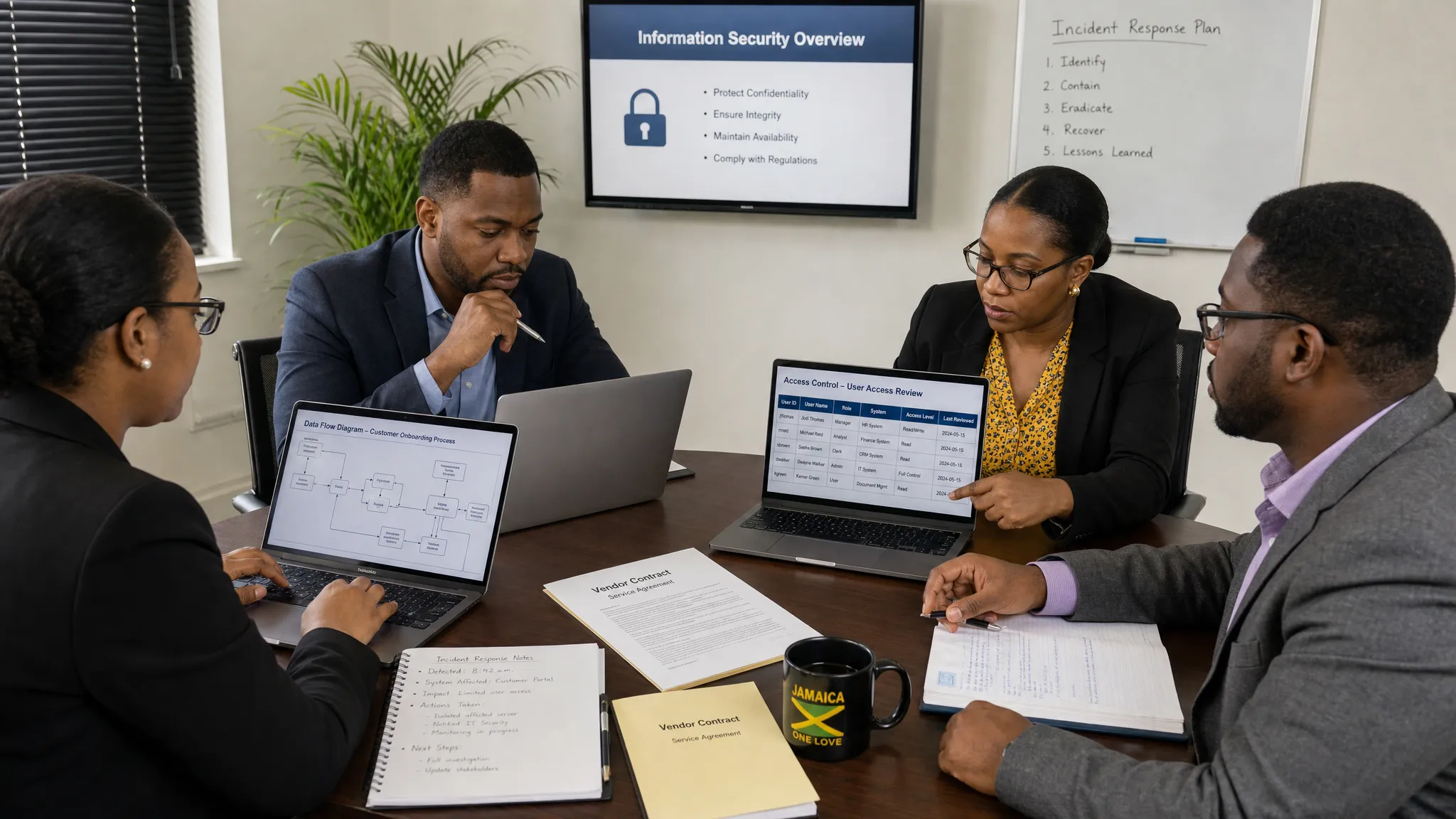
Controls fail when no one is watching. Logging and monitoring help organisations detect suspicious activity, investigate incidents, and demonstrate what happened. At minimum, key systems should record login activity, failed login attempts, administrative actions, major permission changes, data exports, and unusual access patterns where the technology allows it.
Incident response should be written for real use, not just for audit. The plan should identify who receives the first report, who assesses privacy impact, who communicates with affected stakeholders, who handles legal and regulatory considerations, and who preserves evidence. It should also define escalation criteria for suspected data breaches, ransomware, lost devices, misdirected emails, unauthorised disclosure, and vendor incidents.
Tabletop exercises are valuable because they reveal gaps before a crisis. A realistic exercise might test what happens when a laptop containing employee records is stolen, a cloud folder is accidentally shared publicly, or a phishing attack compromises an executive email account.
7. Retention, disposal, and backup governance
Keeping data forever is not a risk management strategy. It increases storage costs, complicates discovery, and expands the potential impact of a breach. Retention controls ensure that personal data is kept only for as long as there is a legitimate business, legal, regulatory, or operational need.
Each department should know the retention period for the records it manages. HR may need defined rules for recruitment files, personnel records, performance records, and disciplinary documentation. Finance may have requirements for invoices, tax records, transaction records, and anti-money laundering documentation. Customer service may need rules for call recordings, complaints, and support tickets.
Deletion should be controlled and documented. Paper records should be shredded or securely destroyed. Digital records should be deleted from active systems where appropriate, and backup retention should be aligned with business continuity needs. Backups should not become a hidden archive for records the organisation intended to remove.
8. Staff training and role-based awareness
A well-designed control can be defeated by a single careless action. Staff need to understand how privacy and security apply to their actual work. Generic annual training has value, but role-based training is stronger.
HR teams need to know how to handle employee files, medical notes, disciplinary matters, and references. Sales and marketing teams need to understand consent, privacy notices, customer lists, and data minimisation. Finance and compliance teams need to balance anti-money laundering obligations with privacy safeguards. IT teams need deeper training on access, logging, encryption, incident response, and vendor assurance.
Training records matter. Keep attendance logs, training materials, assessment results, and evidence of refresher sessions. If a regulator, auditor, client, or board committee asks how staff were prepared, the organisation should be able to show more than a calendar invitation.
9. Board reporting and control assurance
Executives and directors do not need every technical detail, but they do need reliable reporting. Privacy and security should appear on the governance agenda with clear metrics, risk updates, unresolved issues, and remediation progress.
Useful board or senior management reporting may include the status of the data inventory, overdue access reviews, unresolved high-risk vendor findings, incident trends, training completion, overdue policy reviews, unresolved audit findings, and progress on remediation plans.
Assurance should not depend on trust alone. Internal audits, control testing, management reviews, and independent assessments help validate whether the programme is working. PLMC’s audit-ready data privacy checklist for Jamaican firms can help leaders think about the evidence they may need to produce.
How to prioritise if resources are limited
Not every organisation can implement every control at once. The key is to reduce the highest risks first while building a sustainable programme.
Priority window | Focus area | Practical outcome |
First 30 days | Assign owners, identify critical systems, enable MFA on high-risk platforms, document major vendors | Immediate accountability and reduced unauthorised access risk |
Next 60 to 90 days | Build the data inventory, complete access reviews, approve retention rules, test incident escalation | Stronger visibility and operational discipline |
Next quarter | Review vendor contracts, run staff training, test backups, conduct a tabletop exercise | Better resilience and evidence of control operation |
Ongoing | Report to leadership, track remediation, update policies, repeat assurance reviews | Continuous improvement and audit readiness |
This staged approach is often more effective than trying to create a perfect programme on paper. The organisation learns where the real data flows are, where staff need support, and which systems carry the most exposure.
What good compliance evidence looks like
Evidence should be current, complete, and connected to real activity. A policy that was approved three years ago but never implemented is weak evidence. A documented access review with business owner sign-off, removed accounts, and follow-up actions is much stronger.
Good evidence usually has four qualities. It is dated, so reviewers can see when it happened. It is owned, so accountability is clear. It is traceable, so it connects to a system, process, vendor, or risk. It is retained, so it can be produced when needed.
For Jamaican organisations, this evidence is not only useful for regulatory readiness. It also supports client due diligence, cyber insurance discussions, internal audits, board oversight, vendor negotiations, and public trust.
Frequently Asked Questions
What are compliance data security controls? Compliance data security controls are policies, processes, technical safeguards, and evidence records that protect personal data while helping an organisation meet legal, regulatory, and governance obligations.
Is cyber security alone enough for Data Protection Act compliance in Jamaica? No. Cyber security is essential, but compliance also requires accountability, lawful processing, privacy notices, data subject rights processes, retention rules, vendor governance, staff training, and evidence that controls are operating.
Do small Jamaican businesses need the same controls as large organisations? Small businesses still need appropriate controls, but the scale and complexity should match the risk. A small firm may use simpler registers, checklists, and reviews, while a larger or regulated organisation may need formal governance, audits, and specialist tools.
How often should access reviews be performed? Access should be reviewed on a regular schedule and whenever staff change roles or leave. High-risk systems, such as finance, HR, email, and customer databases, should receive more frequent attention than low-risk systems.
What is the most important first step? Start by assigning ownership and creating a practical inventory of personal data, systems, vendors, and access points. Without that visibility, it is difficult to prioritise security measures or prove compliance.
Build controls that stand up to scrutiny
Compliance is not achieved by having documents. It is achieved when governance, people, technology, vendors, and records work together to protect personal data every day.
Privacy & Legal Management Consultants Ltd. helps organisations in Jamaica strengthen data protection implementation, corporate governance, cyber security, anti-money laundering compliance, GRC integration, training, and risk assessment. If your organisation needs a practical view of its current gaps and next steps, you can request a free consultation with PLMC and begin building a control environment that is proportionate, defensible, and ready for scrutiny.