

CCTV Compliance in Jamaica: A Practical Guide
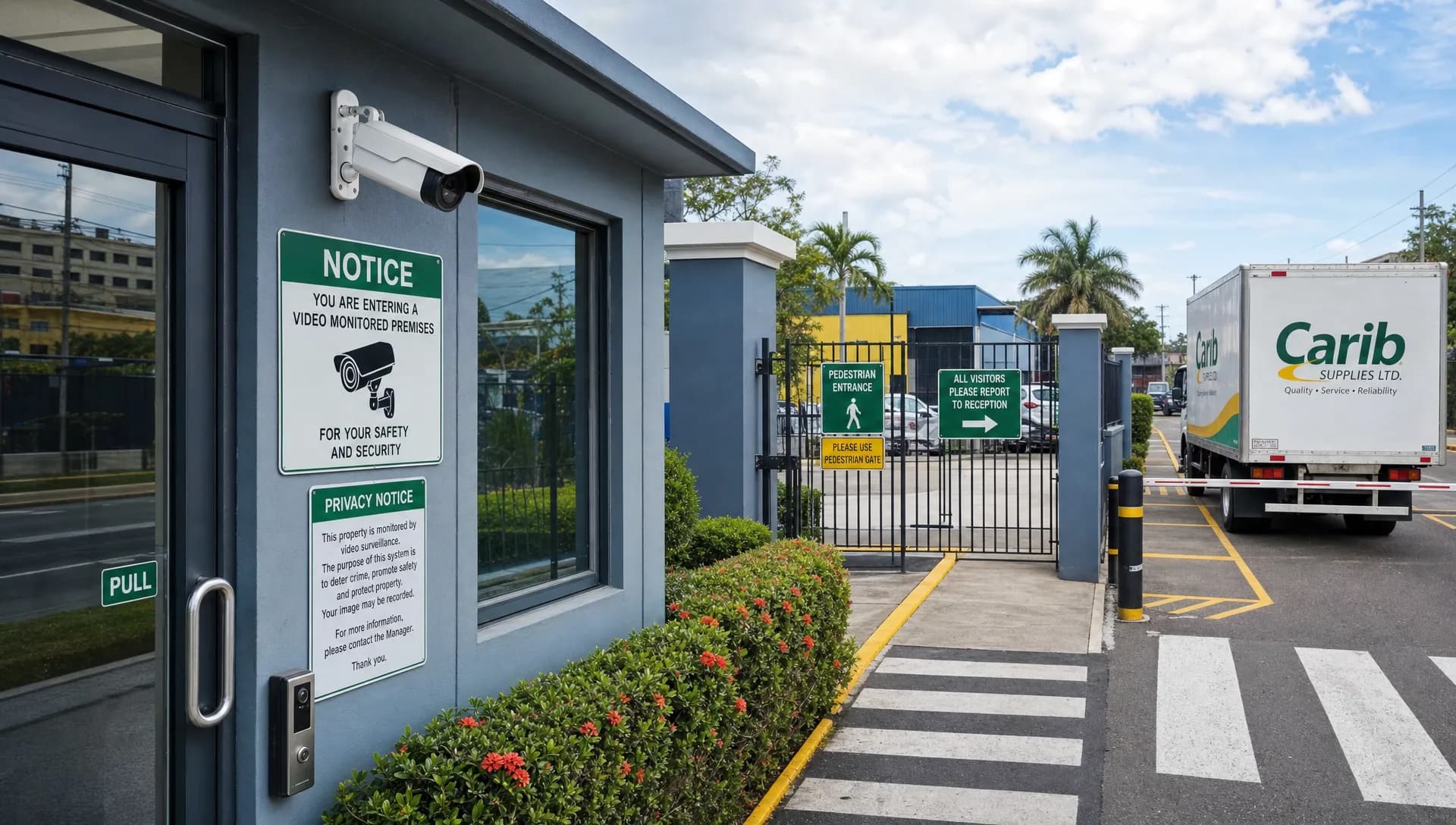
CCTV is now part of daily business life in Jamaica. Retail stores use cameras to deter theft, offices use them to protect staff, schools use them to manage safety, and apartment complexes use them to monitor entrances and common areas. But once a camera records an identifiable person, the footage becomes personal data.
That means CCTV compliance in Jamaica is not only a security issue. It is also a data protection issue under the Data Protection Act, 2020. A camera system that is poorly placed, records for too long, lacks signage, or gives too many people access to footage can create legal, reputational, and operational risk.
This guide gives Jamaican organisations a practical way to manage CCTV responsibly, from planning and signage to retention, access, sharing, and audit evidence. It is general guidance, not a substitute for legal advice in high-risk or disputed situations.
Why CCTV falls under data protection law
The starting point is simple: if CCTV footage can identify a living individual, directly or indirectly, it is personal data. Identification may come from a clear image of a face, a vehicle registration plate, a uniform, a timestamp, a location, or a combination of details.
Under Jamaica’s Data Protection Act, organisations that decide why and how personal data is processed generally act as data controllers. If your company installs cameras, determines where they point, decides how long footage is stored, and controls who can view it, you are responsible for that processing.
For a broader explanation of the Act’s core concepts, including personal data, controllers, processors, and data protection standards, see this practical overview of the Jamaica Data Protection Act for businesses.
CCTV compliance is about proving that surveillance is lawful, fair, necessary, proportionate, transparent, secure, and properly documented. In practice, regulators and stakeholders will want to see that your organisation has thought carefully about the purpose of cameras and has not used surveillance in a way that goes beyond what is needed.
Start with a clear purpose
Before installing or expanding CCTV, write down the specific reason for using it. Vague statements like “security purposes” are not always enough. A better purpose statement might be: “to deter and investigate theft at the warehouse loading bay” or “to protect staff and visitors at the main reception entrance.”
A clear purpose helps you answer key compliance questions. Where should cameras be placed? Is audio recording necessary? Who needs access? How long should footage be kept? When should footage be shared with law enforcement, insurers, or internal investigators?
Common lawful purposes for CCTV may include:
Protecting staff, customers, students, residents, and visitors
Preventing or investigating theft, fraud, vandalism, or unauthorised access
Supporting health and safety management in higher-risk areas
Managing access to restricted premises or sensitive assets
Preserving evidence after a specific incident
The important point is that each camera should support a defined purpose. If a camera does not support a legitimate and documented purpose, it may be difficult to justify.
Apply necessity and proportionality
CCTV should not be used simply because it is convenient or because the technology is available. The organisation should be able to show that cameras are necessary for the stated purpose and that the level of monitoring is proportionate to the risk.
For example, a camera at a jewellery display, pharmacy storeroom, cash handling point, or server room may be easier to justify than continuous monitoring of a staff lunchroom. A camera at a building entrance may be proportionate, while a camera pointing into neighbouring homes or private offices may not be.
Ask these questions before deploying cameras:
What specific risk are we trying to address?
Can the same result be achieved with a less intrusive measure?
Is the camera angle limited to the relevant area?
Are we recording only video, or are we also recording audio?
Are people likely to expect privacy in this location?
Have we documented the decision and reviewed it recently?
Audio recording deserves special caution. Recording conversations is usually more intrusive than recording images. In most ordinary workplace, retail, school, or residential settings, audio should be avoided unless there is a strong, documented reason and appropriate advice has been taken.
Use CCTV signage and privacy notices properly
Transparency is one of the most visible parts of CCTV compliance in Jamaica. People should not have to guess whether they are being recorded or who is responsible for the system.
At a minimum, CCTV signs should be placed where people can see them before or as they enter a monitored area. Signs should be clear, readable, and not hidden behind doors, plants, counters, or tinted glass. They should state that CCTV is in operation, identify the organisation responsible, explain the general purpose, and provide a way to get more information.
A short sign is useful at the entrance, but it should be supported by a fuller privacy notice. That notice can be available at reception, on your website, in an employee handbook, in a tenant pack, or by QR code. The privacy notice should explain:
Who controls the CCTV system
Why footage is collected
The types of areas monitored
Who may receive footage, such as security providers or law enforcement
How long footage is normally retained
How individuals can make privacy requests or complaints
Who to contact for data protection queries
Signage alone does not make unlawful surveillance lawful. It is part of a wider compliance framework that also includes purpose limitation, security, retention, access controls, and documented governance.
Design camera placement with privacy in mind
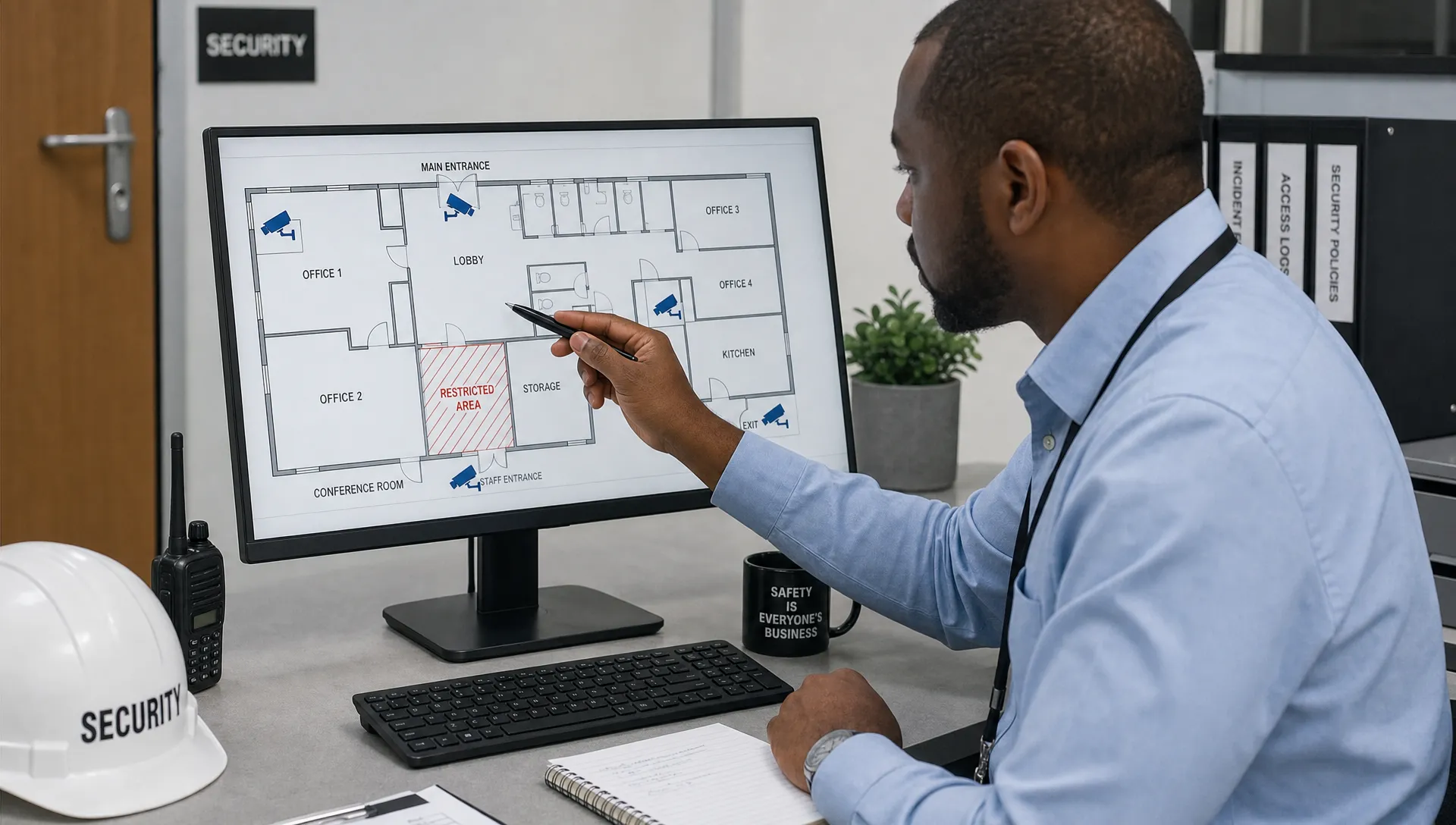
Camera placement is one of the most practical ways to reduce risk. The goal is to capture what is necessary, not everything that is technically possible.
For outdoor cameras, avoid recording more of the public road, neighbouring property, or adjacent businesses than is needed. For indoor cameras, avoid areas where people have a higher expectation of privacy, such as bathrooms, changing rooms, prayer rooms, medical treatment rooms, and private break areas.
The same principle applies to camera features. Pan, tilt, zoom, facial recognition, licence plate recognition, cloud analytics, and motion-triggered alerts may increase the privacy impact of the system. These features are not automatically unlawful, but they should be assessed carefully and used only where justified.
CCTV decision | Compliance risk | Practical control |
Camera at main entrance | Captures visitors, staff, contractors, and delivery personnel | Use visible signage, limit the angle, and define retention |
Camera in cash handling area | May capture staff performance and customer transactions | Limit access, avoid audio, and document the security purpose |
Camera in staff-only area | Can become intrusive workplace monitoring | Explain the purpose in employee policies and review necessity |
Cloud storage of footage | May involve third-party processing or overseas transfer | Review vendor contracts, access controls, and data location |
Footage shared after an incident | Risk of excessive or informal disclosure | Record the reason, recipient, date, and authorisation |
Set a sensible retention period
Keeping CCTV footage “just in case” is a common compliance weakness. The Data Protection Act requires personal data to be kept no longer than necessary for the purpose for which it was collected.
There is no single retention period that fits every organisation. A small retail shop, a hotel, a school, a financial institution, and a port facility may have different risk profiles. However, the organisation should be able to explain why its chosen retention period is necessary.
Many organisations adopt a short standard retention period for routine footage, then preserve specific clips for longer when an incident occurs. For example, routine footage may be overwritten automatically after a defined period, while footage linked to theft, injury, litigation, disciplinary action, insurance claims, or police requests may be placed under a documented hold.
Your CCTV retention policy should answer four questions. How long is routine footage stored? Who can extend retention? What triggers an incident hold? How is footage securely deleted when no longer needed?
A retention period is only credible if the technology supports it. Check whether your digital video recorder, network video recorder, or cloud platform actually overwrites or deletes footage as intended. If the system keeps footage indefinitely because no one configured it, the written policy will not protect the organisation.
Control who can view and export footage
CCTV footage should not be available to everyone in the organisation. Viewing, downloading, exporting, emailing, or copying footage should be limited to authorised personnel with a genuine need.
Good access control usually includes named user accounts, strong passwords, multi-factor authentication where available, restricted admin rights, audit logs, and periodic access reviews. Shared logins such as “securitydesk” or “admin” make it difficult to prove who viewed or exported footage.
Physical security also matters. DVRs, NVRs, monitors, backup drives, and server rooms should be protected from unauthorised access. If monitors are located at a reception desk or guard post, consider whether visitors can see live feeds that reveal private areas or sensitive operations.
If an external security company monitors cameras or maintains the system, it may be acting as a data processor or service provider. Your contract should explain confidentiality, permitted use, security controls, incident reporting, return or deletion of footage, subcontracting, and assistance with data subject requests.
Manage sharing with police, insurers, and third parties
CCTV footage is often requested after incidents. Police may request footage for an investigation. Insurers may request it for a claim. A customer may request footage after a fall. An employee may request footage related to a workplace complaint.
The risk is not only refusing a valid request. The risk is also sharing too much, sharing informally, or sharing without a record. Every disclosure should be considered, authorised, and logged.
A disclosure log should capture the date, requester, organisation, reason, footage period, camera location, legal or business justification, person approving release, and method of transfer. Where possible, share only the relevant clip rather than hours of footage. If unrelated individuals are visible, consider whether redaction, blurring, still images, or supervised viewing would be more appropriate.
Avoid sending CCTV footage casually by WhatsApp, personal email, or unsecured links. If footage must be transferred electronically, use secure methods and limit access to the intended recipient.
Handle individual rights requests
Individuals may ask whether they have been recorded and may request access to their personal data. CCTV footage can be more complicated than ordinary documents because it may show several people at once.
Your organisation should have a process for verifying the requester’s identity, locating relevant footage, assessing whether disclosure affects other individuals, and responding within the applicable legal timeframe. If footage has already been deleted under a legitimate retention schedule before the request is received, document that clearly.
Do not automatically refuse a request because other people appear in the footage. Instead, assess whether it is possible to provide access in a way that protects others, such as by redacting, blurring, providing still images, limiting the clip, or arranging supervised viewing. In complex cases, seek advice before responding.
This is where a well-maintained data inventory and request handling procedure becomes valuable. Organisations that have already mapped systems, retention periods, owners, and workflows will find it much easier to respond confidently.
Treat workplace CCTV with extra care
Employee monitoring is one of the most sensitive CCTV areas. Employers may have legitimate reasons to protect premises, assets, staff, customers, and confidential information. But constant surveillance of workers can damage trust and may be disproportionate if not carefully managed.
Employees should be told where cameras are located, why they are used, how footage may be used, who can access it, and whether footage may support disciplinary investigations. This information should be included in employee privacy notices, handbooks, workplace policies, and training.
Covert CCTV should be exceptional. It may be considered only where there is a serious issue, open monitoring would undermine the investigation, the monitoring is limited in time and scope, and appropriate advice has been taken. Routine covert recording is a high-risk practice.
Managers should also be trained not to use CCTV for casual performance monitoring unless that purpose has been properly assessed, communicated, and justified. A camera installed to protect a stockroom should not quietly become a tool for monitoring bathroom breaks or staff conversations.
Build an audit-ready CCTV compliance file
The strongest CCTV programmes are not based on memory. They are based on evidence. If your organisation is questioned by a regulator, board, customer, staff member, or business partner, you should be able to produce documents showing how the system is governed.
A practical CCTV compliance file may include:
CCTV policy and standard operating procedure
Camera register with locations, purposes, and responsible owners
CCTV privacy assessment or risk assessment
Copies or photos of signage
CCTV privacy notice
Retention schedule and deletion settings
Access control list and access review records
Vendor contracts and maintenance agreements
Disclosure log for footage shared externally
Incident records and breach response procedure
Training records for staff who handle footage
Periodic review notes and approvals
If your organisation is building its wider privacy governance framework, this guide to audit-ready data protection policies and procedures can help you align CCTV controls with your broader compliance documents.
Review CCTV regularly, not only after an incident
CCTV systems tend to expand over time. A camera is added after a theft. Another is installed during renovations. A vendor upgrades the platform. A cloud feature is switched on. Before long, the organisation may have a system that no longer matches its original purpose or policy.
Schedule a periodic review, at least annually or whenever there is a major change. Review camera locations, signage, retention, access rights, vendor arrangements, security settings, incident logs, disclosure records, and complaints. Remove cameras that are no longer necessary. Update notices when purposes, recipients, or retention periods change.
This review should also connect with your wider data protection compliance programme. If your organisation is preparing for internal review, board reporting, or regulatory scrutiny, an audit-ready data privacy checklist for Jamaican firms can help ensure CCTV does not sit outside the rest of your governance framework.
Practical CCTV compliance checklist for Jamaican organisations
Use this checklist to test whether your CCTV programme is moving in the right direction.
Area | What to check | Evidence to keep |
Purpose | Each camera has a clear and lawful reason | Camera register and risk assessment |
Transparency | People are told CCTV is operating | Signs, privacy notice, website notice |
Proportionality | Cameras avoid excessive or private monitoring | Placement review and approval notes |
Retention | Footage is not kept longer than necessary | Retention policy and system settings |
Access | Only authorised persons can view or export footage | User list, logs, access reviews |
Security | Footage is protected against loss or misuse | Technical controls and incident procedures |
Vendors | Third-party providers are contractually controlled | Contracts, due diligence, service records |
Disclosures | Sharing is justified and recorded | Disclosure log and approval record |
Rights requests | Individuals can request access appropriately | Request procedure and response records |
Review | The system is periodically reassessed | Review schedule and action tracker |
Frequently Asked Questions
Is CCTV legal in Jamaica? Yes, CCTV can be legal in Jamaica when it is used for a lawful, fair, necessary, and proportionate purpose. Organisations should comply with the Data Protection Act, use appropriate signage, protect footage, limit retention, and document their decisions.
Do I need consent to use CCTV? Not always. Consent may be difficult to rely on in many CCTV settings, especially where people have little real choice, such as employees entering the workplace. Organisations should identify the appropriate lawful basis or condition for processing and document it.
How long should CCTV footage be kept? Footage should be kept only as long as necessary for the stated purpose. Routine footage should usually have a defined automatic deletion or overwrite period. Footage linked to an incident may be kept longer if there is a documented reason.
Can employees request CCTV footage of themselves? Employees may be able to request access to their personal data, including relevant CCTV footage. The employer should verify identity, locate the footage, consider the privacy rights of others, and respond through a documented process.
Can my organisation record audio with CCTV? Audio recording is more intrusive than video-only monitoring and should be treated with caution. It should not be used by default. If audio is considered necessary, document the justification, update notices, restrict access, and seek advice for higher-risk settings.
Do small businesses need CCTV policies? Yes. A policy does not need to be complicated, but even small businesses should document why cameras are used, where they are located, how long footage is kept, who can access it, and when footage may be shared.
Making CCTV compliance practical
CCTV compliance in Jamaica does not require organisations to stop protecting their people and property. It requires them to use surveillance responsibly and to keep evidence that their decisions are fair, lawful, secure, and proportionate.
A practical next step is to review your current cameras, confirm the purpose of each one, update signage and privacy notices, set retention periods, restrict access, and create a disclosure log. From there, build CCTV into your wider data protection, cyber security, and governance programme.
Privacy & Legal Management Consultants Ltd. supports Jamaican organisations with data protection implementation, privacy awareness, training, risk assessment, cyber security, and GRC integration. If your CCTV programme needs a compliance review or your team needs practical guidance, you can contact Privacy & Legal Management Consultants Ltd. to discuss your next steps.