

A Board Guide to Privacy Reporting That Drives Action
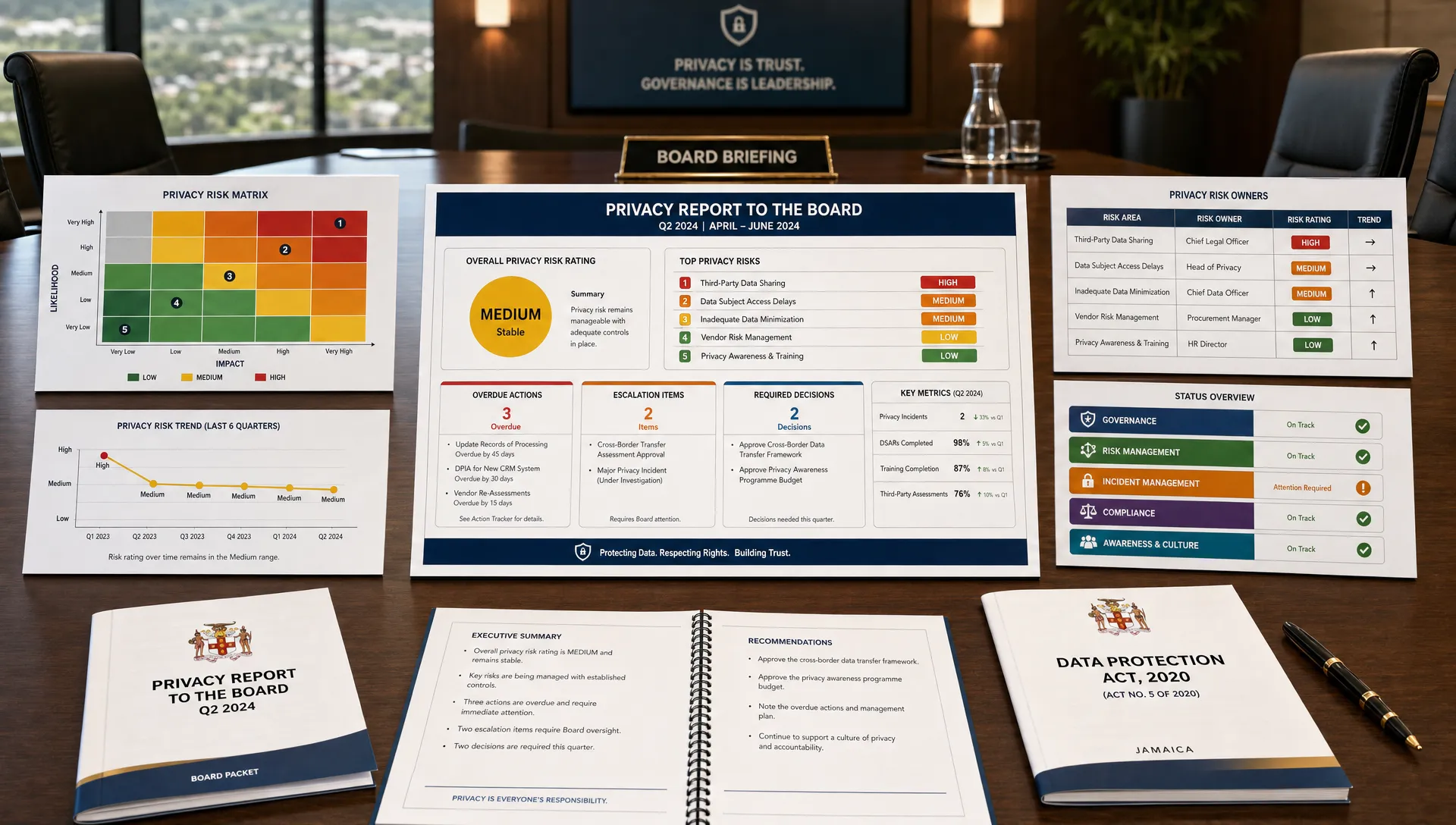
Privacy reporting should not be a ceremonial item at the end of a board pack. If directors simply “note” a privacy update and move on, the organisation may be missing the real value of reporting: better decisions, sharper accountability, and earlier intervention before privacy risk becomes legal, financial, or reputational damage.
For Jamaican organisations, this matters even more as the Data Protection Act, 2020 continues to shape expectations around how personal data is collected, used, shared, secured, retained, and deleted. Boards do not need to manage every privacy control themselves, but they do need reporting that helps them understand whether the organisation is operating within its risk appetite and whether management is taking the right actions.
A strong privacy report answers one board-level question: what must we decide, challenge, approve, or escalate now?
Why privacy reporting often fails to drive action
Many privacy reports are technically accurate but strategically weak. They may contain long lists of activities, training attendance numbers, policy updates, or incident counts, but they do not tell the board what those details mean for governance.
Common problems include reporting that is too operational, too backward-looking, or too disconnected from business decisions. Directors may see that “privacy notices were reviewed” or “staff completed training,” but they may not see whether high-risk processing has been assessed, whether data subject rights requests are being handled within acceptable timeframes, or whether a new vendor creates material exposure.
Privacy reporting also fails when every issue is presented with the same level of urgency. If a minor documentation delay appears beside an unresolved cyber weakness affecting customer data, the board has to work too hard to identify what matters. The report should do that prioritisation before it reaches the boardroom.
The goal is not to give directors more information. The goal is to give them better judgement support.
Start with the board’s role, not the privacy team’s workload
A board privacy report should be designed around oversight responsibilities. Directors need to know whether management has an effective privacy programme, whether key risks are being controlled, whether legal obligations are being met, and whether the organisation’s behaviour is consistent with its stated governance standards.
That means the report should support four board actions:
Decision: Approve funding, endorse a remediation plan, accept residual risk, or require management to change course.
Challenge: Ask whether assumptions, timelines, or risk ratings are realistic.
Escalation: Bring material privacy issues into the wider enterprise risk, audit, legal, cybersecurity, or corporate governance agenda.
Accountability: Confirm who owns the action, when it will be completed, and how progress will be verified.
This is where privacy reporting connects directly to governance. If the organisation has not yet clarified board, executive, Data Protection Officer, legal, compliance, IT, HR, marketing, and business-unit responsibilities, reporting will feel fragmented. For a broader view of how oversight should operate, PLMC’s guide to privacy governance, board oversight, and operating models provides useful context.
The privacy report should answer six board questions
A practical board report does not need to be lengthy. It does, however, need to be structured around the questions directors are expected to ask.
Board question | What the report should show | Action it should trigger |
Are we complying with core privacy obligations? | Status of key Data Protection Act requirements, policies, notices, rights handling, security controls, and records | Approve priorities or require remediation |
What has changed since the last report? | New processing, new systems, new vendors, incidents, complaints, regulatory developments, or business changes | Challenge risk assumptions and timing |
Where are we outside tolerance? | Overdue actions, unresolved high risks, repeat incidents, training gaps, or contract weaknesses | Escalate and assign ownership |
Which risks could materially affect the organisation? | High-impact privacy, cyber, legal, customer, employee, or reputational risks | Integrate into enterprise risk management |
Are people behaving differently? | Evidence from training, awareness, testing, incident trends, and process adherence | Strengthen culture and accountability |
What decisions are required today? | Clear decision papers, options, cost, risk, and recommended action | Approve, reject, defer, or request more analysis |
This format keeps privacy reporting aligned with board oversight instead of turning it into an operational diary.
Build the report around action lanes
A useful privacy report can be organised into a small number of “action lanes.” These lanes help the board see where the organisation is progressing, where it is exposed, and where intervention is needed.
1. Compliance readiness and legal obligations
For organisations in Jamaica, this section should show progress against the Data Protection Act, 2020 and any other relevant legal, contractual, or sector-specific obligations. It should not simply state that “compliance work is ongoing.” It should show what is complete, what is delayed, what is high risk, and what support is needed.
Useful items include the status of privacy notices, records of processing activities, lawful basis assessments, consent practices where relevant, data subject rights processes, retention schedules, breach response procedures, and cross-border data transfer controls.
The board does not need to review every policy line by line. It needs to know whether key obligations are owned, implemented, tested, and maintained. Where there are gaps, the report should show the consequence of delay.
2. Operational privacy risk
This section should translate privacy issues into business risk. For example, a weak access control process is not only an IT issue. It may create unauthorised access to employee, customer, patient, student, member, or client information. A poorly managed retention process is not only an administrative issue. It may mean the organisation is holding personal data longer than necessary, increasing exposure if a breach occurs.
Operational privacy reporting should highlight trends, not just events. Are incidents increasing in one department? Are errors linked to manual processes? Are access reviews overdue? Are customer complaints pointing to confusion about how data is used?
The board should receive enough context to ask whether management is treating root causes or repeatedly correcting symptoms.
3. Third-party and data-sharing risk
Many privacy exposures sit outside the organisation’s direct environment. Payroll providers, cloud platforms, payment processors, marketing tools, outsourced service providers, professional advisers, and technology vendors may all process personal data on behalf of the organisation.
Board reporting should show whether third-party risk is being managed before contracts are signed, not only after a problem occurs. Directors should know whether high-risk suppliers have been assessed, whether data protection clauses are in place, whether security expectations are documented, and whether ongoing monitoring is happening.
Where a major vendor is critical to operations, the board should also understand the contingency plan. Privacy risk and business continuity risk often meet at the vendor level.
4. Culture, training, and behaviour change
Training completion rates are useful, but they are not enough. A report that says “96% of staff completed privacy training” may look positive, but it does not prove that employees know how to identify a data subject request, avoid oversharing personal information, report a suspected breach, or handle customer data securely.
The board should see evidence of behaviour change. This may include phishing simulation results, scenario-based quiz performance, incident reporting trends, repeated errors by department, completion of role-specific training, or improvements after awareness campaigns.
For example, if employees are reporting suspected incidents earlier, a short-term rise in reports may be a positive sign. It may show that awareness is improving. The board report should explain that context so directors do not misread the number.
Turn privacy metrics into board-level meaning
Metrics are helpful only when they are tied to thresholds, trends, and decisions. A privacy report that says “12 incidents occurred this quarter” is incomplete. Directors need to know whether that number is better or worse than previous periods, whether any incident was material, whether root causes have changed, and whether management response was timely.
The same principle applies to requests from individuals, vendor assessments, training, policy exceptions, and remediation actions. Numbers should be used to support governance judgement, not to create the impression of control.
If your organisation needs a deeper list of possible KPIs and KRIs, PLMC has a dedicated article on data protection board reporting KPIs. The board guide here focuses on how to convert those indicators into decisions.
A useful board-level privacy metric usually has four parts: the current status, the trend, the tolerance level, and the required action.
Weak metric | Stronger board-ready version |
85% of staff completed training | Training completion is 85%, below the approved 95% target. HR and department heads are required to close the gap by month-end, with priority on teams handling customer data. |
10 vendor reviews completed | 10 vendor reviews were completed, but 4 high-risk vendors remain unassessed. Two support critical business processes and require executive escalation. |
5 privacy incidents reported | 5 incidents were reported, down from 8 last quarter. However, 3 involved the same process, indicating a control weakness requiring remediation. |
Privacy policy updated | Privacy policy updated and approved. Implementation risk remains because related procedures and staff guidance have not yet been rolled out. |
This style of reporting helps directors see what has actually changed and where they are expected to act.
Use a one-page action summary at the front of the report
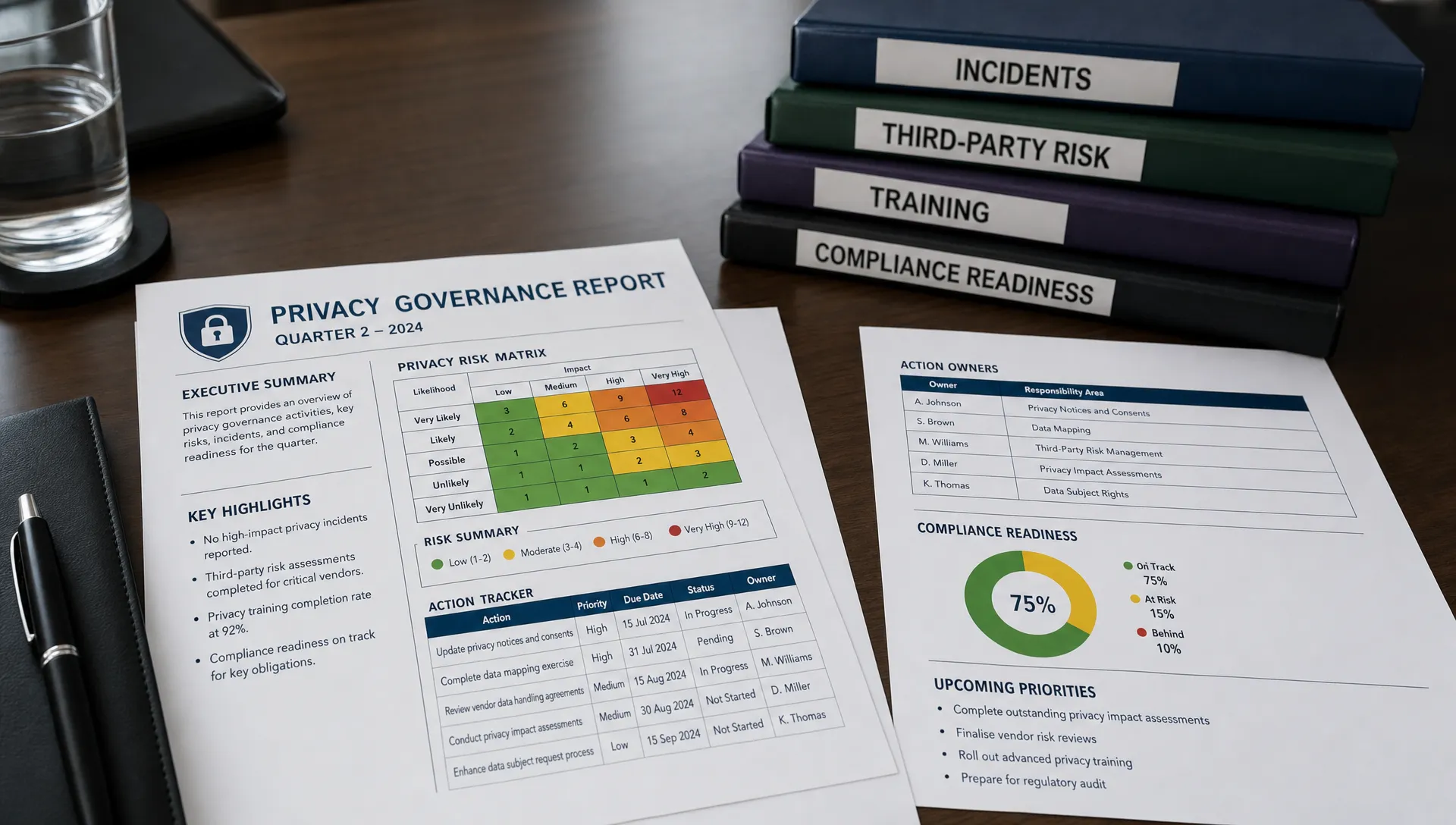
The most important page in a privacy board pack is the first page. It should give directors an immediate view of what requires attention.
A strong one-page privacy action summary can include:
Section | What to include |
Overall privacy risk rating | Current rating, previous rating, and reason for movement |
Top three privacy risks | Concise risk statements, owners, due dates, and current treatment plans |
Decisions required | Specific approvals, funding requests, risk acceptance, or policy endorsements |
Items outside tolerance | Overdue actions, unresolved high risks, missed targets, or repeated control failures |
Material changes | New systems, new data uses, incidents, complaints, vendor changes, or regulatory updates |
Forward look | Key activities and risks expected in the next quarter |
The action summary should be written in plain language. It should avoid technical shorthand unless all directors understand it. If a term is necessary, explain its board relevance.
For example, instead of writing “DPIA backlog remains open,” write “Three high-risk projects have not completed privacy impact assessments, meaning risks to personal data have not been formally assessed before implementation.”
That sentence gives the board a reason to act.
Write risk statements that lead to decisions
Privacy reports often lose impact because issues are described as tasks rather than risks. “Update data retention policy” is a task. It does not explain the exposure. A board-ready risk statement connects the issue to impact.
A useful structure is: because of X, Y may happen, leading to Z impact, unless management does A by B date.
For example:
Task-based wording | Board-ready wording |
Review employee data retention | Because employee records are retained inconsistently across departments, the organisation may keep personal data longer than necessary, increasing legal and breach exposure. Management will complete a retention review and deletion plan by the next reporting cycle. |
Improve breach response | Because breach escalation steps are not consistently understood, suspected incidents may not be assessed and escalated quickly enough. Management will complete refresher training and a tabletop exercise this quarter. |
Review vendor contracts | Because several vendors process personal data without updated data protection terms, the organisation may lack clear contractual controls. Legal and procurement will prioritise high-risk vendors and report exceptions to the board. |
This approach respects the board’s time and makes accountability clear.
Set escalation thresholds before a crisis
Boards should not wait for management to decide informally which privacy matters deserve escalation. The organisation should agree thresholds in advance.
Escalation thresholds may relate to the sensitivity of data, the number of individuals affected, involvement of vulnerable persons, regulatory notification considerations, media or customer impact, repeated control failures, financial exposure, or strategic significance.
For example, a privacy issue should normally be escalated when it involves a material incident, a high-risk processing activity without adequate assessment, a critical vendor weakness, repeated failure to meet approved privacy targets, or a decision to accept significant residual risk.
Thresholds should be documented and reviewed periodically. They should also align with the organisation’s incident response plan, enterprise risk management framework, cybersecurity procedures, legal obligations, and communications protocols. The NIST Privacy Framework is one external reference that organisations can use to think about privacy risk in a structured, risk-based way.
Connect privacy reporting to other board agendas
Privacy should not sit in isolation. Personal data risk often overlaps with cybersecurity, corporate governance, anti-money laundering compliance, employment practices, procurement, customer trust, digital transformation, and regulatory risk.
A privacy report drives stronger action when it clearly identifies which other board or committee agenda should own related issues. For example, a cyber weakness involving personal data may need audit and risk committee oversight. A customer data-sharing initiative may require legal and commercial review. A new onboarding process may raise both privacy and anti-money laundering considerations.
This integrated view is especially important for governance, risk, and compliance teams. If privacy reporting is separated from enterprise risk reporting, directors may underestimate the cumulative exposure created by small but connected weaknesses.
Boards may also benefit from a quarterly legal-risk lens. PLMC’s article on privacy legal risks boards should review can help organisations identify issues that deserve periodic board attention.
Ask better questions in the boardroom
Good privacy reporting should lead to better board questions. Directors do not have to be privacy specialists, but they should be willing to challenge whether management’s approach is credible.
Useful board questions include:
Which privacy risks are outside our approved tolerance, and why?
What has changed since the last report that affects our exposure?
Are high-risk projects being assessed before launch or after implementation?
Which unresolved actions have missed their deadlines more than once?
Are we seeing repeated incidents from the same process, system, or department?
Do our vendors meet our data protection and cybersecurity expectations?
How do we know training is changing behaviour, not just producing attendance records?
What decisions does management need from the board this quarter?
These questions help move privacy from passive reporting to active governance.
Keep the cadence realistic
Not every privacy issue belongs on every board agenda. The right cadence depends on the size, complexity, sector, and risk profile of the organisation. However, most organisations benefit from a layered rhythm.
Reporting level | Typical focus | Suggested cadence |
Operational teams | Tasks, incidents, requests, assessments, vendor follow-ups, control testing | Weekly or monthly |
Executive management | Risk trends, resource needs, overdue actions, cross-functional blockers | Monthly or bi-monthly |
Board or board committee | Material risk, compliance posture, decisions required, risk acceptance, strategic changes | Quarterly, with immediate escalation for material issues |
The board report should be concise because detailed monitoring should already happen at management level. If every operational item must come to the board for visibility, that may signal that the governance structure below the board is not working.
Avoid these reporting traps
A privacy report can look polished and still fail to drive action. Boards and management teams should watch for a few recurring traps.
First, avoid “greenwashing” the report. If every item is marked green, directors may assume the programme is mature when important risks are simply not being measured. A credible report includes uncomfortable facts and clear remediation.
Second, avoid burying decisions. If management needs approval, funding, risk acceptance, or policy direction, that request should be visible at the front of the report.
Third, avoid reporting only activity. Activity is not the same as effectiveness. A policy can be drafted but not implemented. Training can be completed but not understood. A vendor questionnaire can be collected but not reviewed.
Fourth, avoid vague ownership. “The business” is not an owner. Each material action should have a named accountable executive, function, or committee.
Finally, avoid treating privacy as a once-a-year compliance update. Privacy risk changes whenever the organisation changes how it uses people’s information. Reporting should be regular enough to catch those changes while decisions can still be made.
A practical privacy reporting checklist for boards
Before the next board meeting, ask whether the privacy report meets these standards:
It opens with the decisions required from the board.
It shows movement since the last report.
It separates material issues from routine updates.
It links privacy risks to business impact.
It includes owners, due dates, and status for key actions.
It identifies items outside tolerance.
It explains whether training and awareness are changing behaviour.
It flags third-party and data-sharing exposure.
It connects privacy issues to cyber, legal, governance, and enterprise risk agendas.
It is written in language directors can challenge and act on.
If the answer is no, the issue may not be the privacy programme itself. The issue may be that reporting is not yet designed for governance.
Frequently Asked Questions
What should a board privacy report include? A board privacy report should include the current privacy risk position, material changes, top risks, compliance status, incidents, third-party exposure, training effectiveness, overdue actions, and clear decisions required from directors.
How often should boards receive privacy reporting? Many organisations use quarterly board reporting, supported by more frequent management reporting. Material incidents or high-risk issues should be escalated sooner according to approved escalation thresholds.
Should directors receive detailed operational privacy metrics? Directors should receive summarised metrics that show trends, thresholds, and required action. Detailed operational data is usually better handled by management, audit, risk, compliance, legal, IT, or privacy teams.
How does privacy reporting support Data Protection Act compliance in Jamaica? Privacy reporting helps boards oversee whether management is implementing controls, addressing gaps, responding to incidents, managing data subject rights, and maintaining accountability under the Data Protection Act, 2020.
What makes privacy reporting actionable? Actionable reporting clearly states what has changed, what is outside tolerance, who owns the issue, when it will be resolved, what decision is needed, and what risk remains if no action is taken.
Need privacy reporting your board can act on?
Privacy & Legal Management Consultants Ltd. supports organisations in Jamaica with data protection implementation, governance, risk, compliance, cybersecurity alignment, anti-money laundering compliance, and privacy training.
If your board needs clearer privacy reporting, stronger accountability, or practical support with Data Protection Act readiness, contact PLMC to discuss how your reporting can move from compliance updates to board-level action.