

Access to Information and Privacy in Jamaican Public Bodies

A request for government records can raise two legitimate concerns: the public’s right to understand official decisions and an individual’s right to have personal information handled lawfully. Managing access to information and privacy in Jamaican public bodies requires a reasoned decision about what can be disclosed, what must be protected and whether both objectives can be met through partial access.
For ministries, departments, agencies and other public bodies, the practical challenge is rarely solved by choosing transparency over privacy, or the reverse. It is solved by identifying the applicable law, examining the records and documenting a defensible response.
How access to information and privacy fit together
Jamaica’s Access to Information Act, 2002 provides a framework for obtaining official documents held by public bodies, subject to exemptions and procedural requirements. The Data Protection Act, 2020 regulates the processing of personal data, including its disclosure.
The two frameworks address different questions. An ATI assessment asks whether access to an official document should be granted under that legislation. A data protection assessment considers the lawful handling of personal data throughout the process, from searching staff files to delivering the response.
A public body should not treat the presence of personal data as an automatic reason to refuse an ATI request. Equally, an ATI request does not automatically justify releasing every personal detail in a responsive document.
The Access to Information Unit provides official ATI resources, while the Office of the Information Commissioner provides guidance on Jamaica’s data protection framework. Staff should use the applicable legislation and current official guidance rather than relying on a general statement that a record is “confidential”.
The central distinction is between information that is sensitive in everyday language and information that qualifies for protection under a particular legal provision.
Identify the request before choosing the process
Requests do not always arrive with the correct legal label. Someone may ask for “all information about my application”, “the contract awarded last year” or “the complaints made against an employee”. Those requests may require different handling.
What the person wants | Likely starting point | Key assessment |
Records explaining a public decision, contract or programme | ATI process | Identify responsive official documents and assess applicable exemptions |
Access to their own personal data | Data subject access process, while considering whether ATI also applies | Verify identity proportionately and assess information concerning other people |
Their own case records plus wider administrative information | Potentially both processes | Coordinate searches, responsibilities and applicable deadlines |
Records containing another person’s personal affairs | ATI process with a privacy assessment | Determine whether disclosure would be unreasonable and whether partial access is possible |
The wording of an email should not be the sole basis for routing it. Clarify genuinely ambiguous requests without creating unnecessary barriers or asking applicants to justify why they want public records.
Identity checks should match the risk. Access to someone’s medical or employment information requires different safeguards from a request for an already published policy. PLMC’s guide to data privacy principles and individual rights in Jamaica provides useful background for staff distinguishing these requests.
Apply the privacy exemption to the information, not just the file
The ATI Act’s personal privacy exemption concerns disclosure that would be unreasonable in relation to a person’s personal affairs. It is not a rule that every document containing a name must be withheld.
A procurement evaluation, for example, may contain information about public expenditure alongside an employee’s private telephone number. These elements should not necessarily receive the same treatment.
Assess the nature of each relevant item, the context in which it appears and the requirements of the applicable exemption. A person acting in an official capacity may have a different privacy interest in information about that role from information about their health, family or financial difficulties. That distinction still requires an assessment, not a blanket assumption that public employees have no privacy.
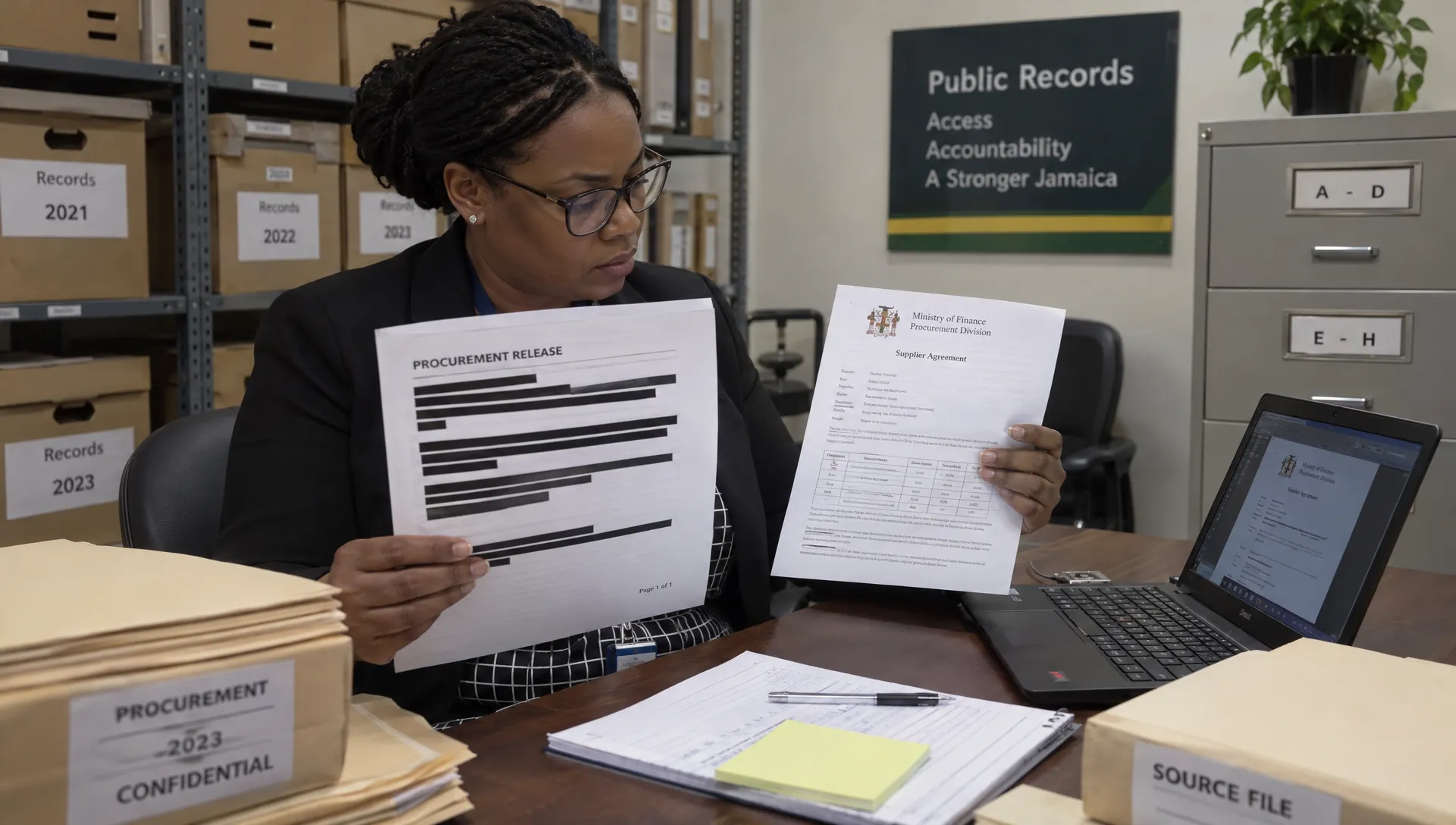
Where protected information can be separated from the rest, consider access to an edited copy. The response should explain what has been withheld and the legal basis without revealing the protected information in the explanation itself.
Handle public-interest arguments carefully
An applicant may argue that disclosure would expose waste, misconduct or unfair treatment. Record that argument and apply any public-interest consideration required or permitted by the relevant provision.
Do not assume that a general appeal to transparency overrides every statutory exemption. Conversely, embarrassment, criticism or administrative inconvenience should not be substituted for a lawful exemption.
Where another person or organisation’s interests are affected, check whether consultation is required or appropriate. Their objection can inform the assessment, but it is not automatically a veto over disclosure.
A worked example: a procurement file with personal information
Suppose a public body receives a request for records concerning the award of a maintenance contract. The file contains the signed contract, evaluation material, supplier contact details, bank instructions and an email explaining that an evaluator missed a meeting because of medical treatment.
The appropriate response is not necessarily to disclose or withhold the entire file. A record-by-record assessment could distinguish the following issues.
Information in the file | Disclosure consideration |
Contract value, scope and award date | Assess access as information about public expenditure, subject to any applicable exemption |
Evaluation findings | Examine any relevant exemptions and consider whether an edited version can be released |
Names of officials performing public duties | Assess their official role and the context rather than treating every name as private |
Personal contact details and banking information | Assess privacy and security risks and the legal basis for withholding or disclosure |
Details of an employee’s medical treatment | Assess the personal privacy exemption and whether those details can be removed while releasing the surrounding record |
A confidentiality clause in a contract should prompt legal review, not end the ATI assessment. The public body still needs to identify the applicable statutory basis for its decision.
This approach preserves useful information about how public money was spent without assuming that accountability requires access to unrelated personal details.
Make redaction effective, not merely visible
Partial disclosure only protects privacy if the removed information cannot be recovered from the released copy. Drawing a black rectangle over text in a word-processing document or PDF may leave the underlying text accessible.
Use a controlled redaction process and test the actual file that will be sent. For electronic records, checks should cover hidden content as well as what appears on the page.
Use a redaction function that removes the underlying content, not an overlay that merely hides it.
Check comments, tracked changes, document properties, attachments and hidden spreadsheet content.
Test searching, copying and extracting text from the release copy.
Have a second reviewer check that the correct information was removed and that useful, releasable content remains.
Preserve the original record separately. Keep a secure record of the redactions, their reasons and who approved them. The same discipline matters for sensitive governance documents, including board papers containing personal data.
Build a controlled request-handling workflow
Log the request and manage the statutory clock
Record when the request arrived, what it seeks, who owns the response and which legal process applies. Staff monitoring reception desks, shared inboxes and general enquiry channels should know how to recognise and route requests promptly.
Under the ATI framework, requests generally require a response within 30 days, with an extension of up to a further 30 days where the Act permits it. Check the statutory conditions and notification requirements before relying on an extension. An internal referral should not be treated as restarting the clock.
Do not assume that an ATI timetable also governs a request made under the Data Protection Act. Identify the applicable requirements separately and coordinate the work where both processes are engaged.
The request log should contain enough information to manage the case, but it should not become an unnecessarily broad repository of identity documents, medical details or other sensitive material.
Search consistently and assign decision-making responsibility
Identify the business units, paper files and electronic systems likely to hold responsive records. Record the searches undertaken and resolve gaps before stating that information is not held.
The ATI officer, records manager, relevant business unit and data protection officer or privacy lead should have defined responsibilities. Legal advice may be needed for disputed exemptions, sensitive records or uncertainty about overlapping obligations. Routine requests should still have a clear route to timely completion.
A practical division of responsibility is for records staff to locate material, business owners to explain its context and authorised decision-makers to determine access. Privacy input should help identify risks and lawful safeguards rather than operate as an unexplained refusal mechanism.
Once a request is received, ensure responsive records are preserved. Routine deletion schedules should not be allowed to undermine the handling of a live request or its review.
Keep support providers within an appropriate role
Public bodies using external platforms or enquiry support need to control who can see requests and attachments. A ticketing system can expose sensitive information if access is too broad, notifications reproduce private content or records are retained without a defined purpose.
When procuring help desk implementation or customer service support, distinguish administrative routing from statutory decision-making. A provider may support intake and workflow, but the public body should retain responsibility for determining access and applying exemptions.
Assess confidentiality terms, permissions, security, retention and any overseas access or hosting before placing personal data in a third-party service. Automation should not close a request merely because a ticket has reached an internal service target.
Explain the outcome and preserve the decision record
A response should identify the outcome clearly: access granted, partial access, refusal or another outcome permitted by the Act. Where information is withheld, explain the relevant provision and reasons sufficiently for the applicant to understand the decision.
Include the applicable internal review and appeal information, including access to the ATI Appeal Tribunal where available. Use the correct route for the particular decision rather than sending every dissatisfied applicant to the privacy regulator.
Retain the request, search record, consultation history, decision, redaction rationale and exact release copy securely. This creates an audit trail for review without requiring staff to reconstruct the case from memory months later.
Frequently asked questions
Can a Jamaican public body refuse a request simply because the record contains personal data? No. The body should assess the applicable ATI exemption and consider whether protected information can be removed while the remaining material is disclosed. A reference to the Data Protection Act alone is not a substitute for that assessment.
Does a public employee’s name always have to be removed? No. Information about an official performing public duties requires a contextual assessment. Private contact details, medical information and unrelated family matters raise different considerations from information about an official’s role in a public decision.
Is consent always required before disclosing personal information? No. Consent is not the only possible lawful basis for processing personal data. A disclosure required by law must be distinguished from an optional disclosure. The body should identify the applicable authority and comply with any relevant procedural safeguards.
Should an ATI complaint go to the Office of the Information Commissioner? ATI decisions have their own review and appeal framework. Complaints about the handling of personal data may engage the Information Commissioner’s remit. Where both issues arise, explain the separate routes rather than treating them as interchangeable.
Strengthen transparency without unnecessary disclosure
Effective access management depends on clear ownership, reliable searches, defensible exemption decisions and secure release procedures. Public bodies should test these arrangements using realistic cases, especially files that combine public accountability information with sensitive personal details.
Privacy & Legal Management Consultants Ltd. offers data protection implementation, governance support and training in Jamaica. Request a free consultation to discuss how your public body can strengthen the processes connecting ATI handling, records management and privacy compliance.