

What the Data and Protection Act Means for Jamaican Firms
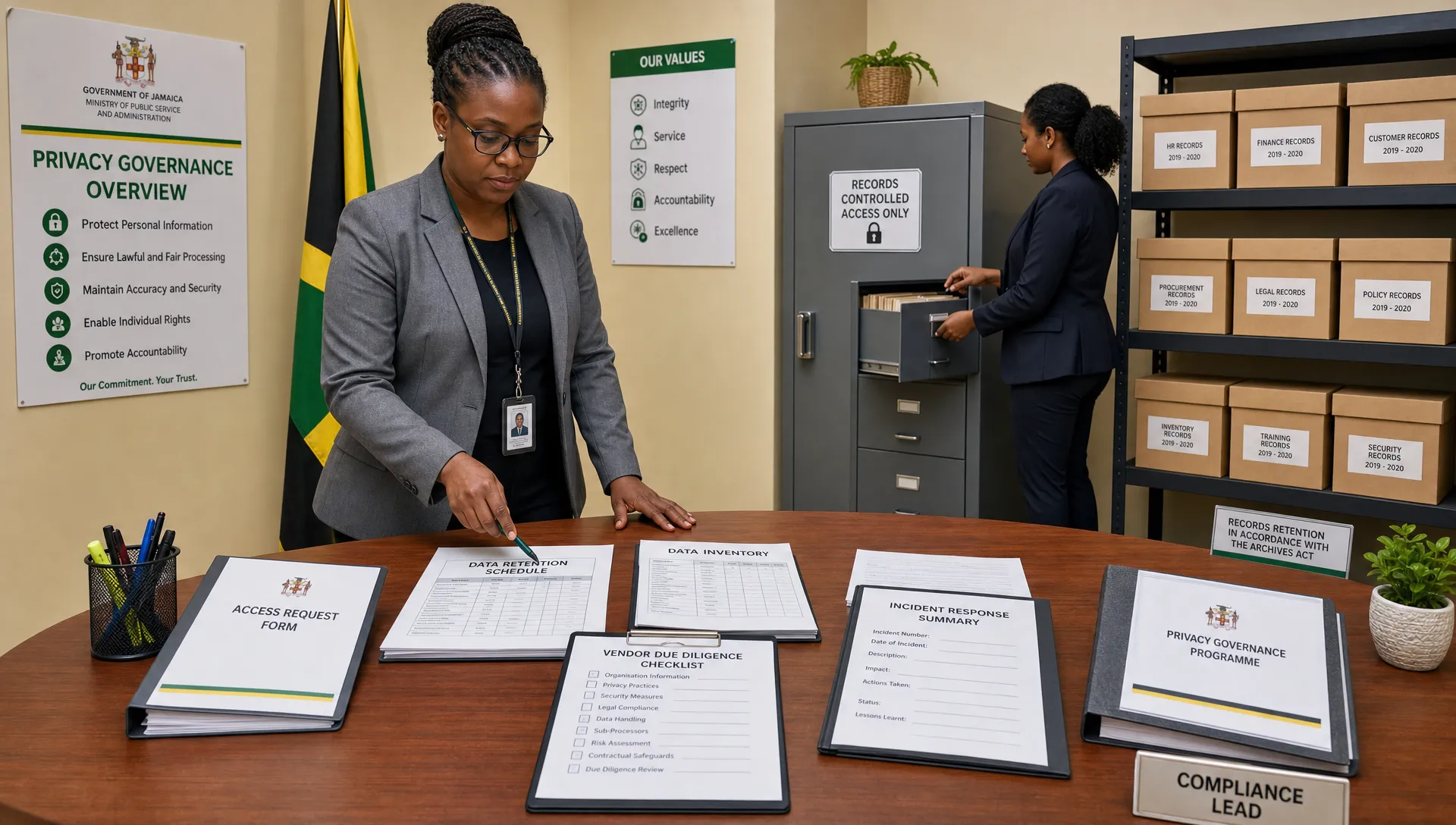
If your clients, directors or staff have been asking about the “Data and Protection Act,” they are usually referring to Jamaica’s Data Protection Act, 2020. For Jamaican firms, the law is not simply a privacy policy requirement. It affects how the business collects customer information, manages employee files, uses vendors, stores records, responds to data requests and protects systems from misuse.
In practical terms, the Act turns personal data into a governance issue. A firm that handles names, addresses, TRNs, ID documents, payroll information, health details, CCTV footage, account records or customer communications must be able to explain why it has that information, how it uses it, who can access it, how long it is kept and how it is protected.
That matters in 2026 because the transition period for compliance has already passed. Jamaican firms should no longer treat data protection as a future project. It is now part of day-to-day risk management, customer trust and regulatory readiness. If you want the background dates, this year-by-year timeline of Jamaica’s Data Protection Act explains how the law moved from enactment to ongoing compliance expectations.
What the Act is designed to do
Jamaica’s Data Protection Act gives individuals stronger rights over their personal data and places legal duties on organisations that decide how personal data is used. These organisations are generally known as data controllers. Businesses that process personal data on behalf of another organisation may be treated as processors, depending on the arrangement.
The Act is built around familiar privacy principles: fairness, lawful processing, transparency, purpose limitation, data minimisation, accuracy, security, retention control and safeguards for data transfers. These principles are not abstract legal language. They affect the decisions firms make every day.
For example, a retailer collecting customer contact details for delivery should not automatically use that same information for unrelated marketing unless it has a proper basis to do so. An employer collecting medical information for sick leave should treat that data with stronger safeguards than ordinary administrative records. A professional services firm sending client files to a cloud provider should understand where the data is stored, who can access it and what contractual protections apply.
The Office of the Information Commissioner is the regulator responsible for Jamaica’s data protection framework. Firms should therefore be prepared to demonstrate compliance, not merely say that they take privacy seriously.
What this means for Jamaican firms in business terms
For many firms, the biggest change is accountability. The Act expects organisations to move away from informal handling of personal data and towards documented, controlled and reviewable processes.
Area of business | What the Act means | Practical example for a Jamaican firm |
Customer onboarding | Collect only what is necessary and explain the purpose clearly | A financial services firm tells customers why ID, proof of address and contact details are required |
Human resources | Employee records must be handled with confidentiality, accuracy and retention controls | HR limits access to payroll, disciplinary and medical records |
Marketing | Customer data should not be reused without a lawful basis and proper notice | A store reviews whether customers agreed to receive promotional messages |
Vendor management | Outsourcing does not remove responsibility for personal data | A firm checks data protection clauses before using a payroll, cloud or CRM provider |
Cybersecurity | Appropriate technical and organisational measures are expected | Access controls, password rules, backups and incident response procedures are maintained |
Record retention | Personal data should not be kept indefinitely without a valid reason | Old job applications, expired contracts and inactive customer files are reviewed and securely disposed of |
Individual rights | People may have rights to access or challenge how their data is handled | A company creates a process for responding to data access requests |
International transfers | Sending data overseas requires attention to safeguards | A firm reviews cloud hosting, overseas group companies and foreign service providers |
This is why the Data Protection Act should be discussed by directors, senior managers, compliance officers, HR teams, IT leaders and operations staff. It is not limited to lawyers or technology teams.
For a deeper explanation of the core obligations, PLMC’s guide to data protection legal duties every Jamaican firm should know breaks down the main duties in more detail.
The major shift: privacy is now part of governance
Good data protection starts with leadership. A firm cannot comply effectively if privacy is treated as a one-time document or a policy copied from another jurisdiction. The organisation needs clear accountability for how personal data is governed.
That means senior management should know what types of personal data the firm handles, which activities create the greatest risk and who is responsible for maintaining compliance. In some organisations, that responsibility may sit with a dedicated privacy lead, compliance officer, data protection officer or cross-functional governance team. The title matters less than the authority, competence and consistency of the role.
Leadership should also connect data protection to wider enterprise risk. Privacy overlaps with cybersecurity, customer service, outsourcing, anti-money laundering compliance, corporate governance and incident management. A breach, misuse of data or failure to respond properly to an individual’s request can create legal, financial and reputational consequences.
At a practical level, governance should include:
A clear owner for data protection compliance across the firm.
A documented inventory of major personal data processing activities.
Internal policies for collection, access, retention, disposal and incident escalation.
Training for staff who handle customer, employee or sensitive personal data.
Periodic reviews of vendors, systems and high-risk processes.
This is where many firms underestimate the Act. Having a privacy notice on a website is useful, but it is only one piece of the compliance structure. The firm also needs internal evidence that its practices match what the notice says.
What changes in day-to-day operations
The Act affects ordinary business workflows. Most Jamaican firms process personal data in more places than they realise. Customer forms, WhatsApp messages, email inboxes, accounting systems, visitor logs, CCTV, recruitment files and vendor portals can all contain personal data.
Different departments will experience the Act in different ways.
Department or function | Common personal data handled | Key privacy question |
HR and administration | Employee files, emergency contacts, medical certificates, payroll data | Who has access, and how long are records kept? |
Sales and customer service | Contact details, purchase history, complaints, call notes | Was the customer told how the data would be used? |
Finance and accounting | Invoices, bank details, tax records, payment information | Are records secured and retained only as long as required? |
IT and cybersecurity | User accounts, logs, devices, system access records | Are controls proportionate to the sensitivity of the data? |
Compliance and risk | Due diligence files, identification records, transaction information | Are AML and privacy duties aligned rather than treated separately? |
Marketing | Mailing lists, campaign data, preferences, analytics | Is there a lawful basis for contacting the individual? |

The operational challenge is not just knowing that the Act exists. It is ensuring that staff understand what to do when personal data appears in real work situations. For instance, if a customer asks for a copy of information held about them, the frontline team should know how to escalate the request. If an employee accidentally emails a file to the wrong recipient, staff should know when and how to report the incident internally. If a vendor asks for access to customer records, someone should confirm that the vendor has a legitimate need and adequate safeguards.
Common misunderstandings about the Data Protection Act
“This only applies to large companies”
Size alone is not the deciding factor. A small firm can still process sensitive or high-volume personal data. A medical practice, school, security company, accounting firm, law office, real estate agency or online retailer may face meaningful privacy obligations even with a small team. If you are unsure whether your organisation falls within scope, this guide on who the Data Protection Act applies to in Jamaica is a useful starting point.
“Consent solves everything”
Consent is important in some situations, but it is not the only lawful basis for processing personal data. Firms may process data for contractual, legal, legitimate or other recognised reasons depending on the facts. Overusing consent can create problems, especially where the individual has little real choice or where the firm would still need the data to provide a service or meet a legal duty.
The better approach is to identify the correct basis for each major processing activity and explain it clearly in privacy notices, forms and internal records.
“If a vendor handles the data, the vendor is responsible”
Outsourcing a process does not outsource accountability. If your firm decides why and how personal data is used, you may remain responsible even when a third-party service provider handles storage, payroll, marketing, IT support or cloud hosting.
Vendor due diligence should therefore include privacy and security questions. What data will the vendor access? Where will it be stored? Can the vendor use subcontractors? What happens if there is a breach? How is data returned or deleted when the contract ends?
“Cybersecurity equals data protection compliance”
Cybersecurity is essential, but it is not the whole Act. A firm may have strong passwords and firewalls but still fail to give proper privacy notices, keep data too long, collect excessive information or ignore individual rights.
Data protection requires a wider governance view. Security protects data from unauthorised access, but privacy also asks whether the data should be collected, how it should be used and whether the individual has been treated fairly.
“Old records do not matter”
Legacy data can create serious risk. Old employee files, outdated customer databases, archived emails and paper records may still contain personal data. If the firm keeps them without a valid reason, cannot locate them when needed or stores them insecurely, the risk remains.
A retention review is one of the most practical compliance steps. It helps the firm decide what must be kept, what can be deleted and what should be archived with stronger controls.
What Jamaican firms should do in 2026
Firms that are behind should avoid panic and start with a structured compliance plan. The aim is to build a practical system that fits the organisation’s size, sector and risk profile.
Assign accountability: Decide who owns data protection compliance and ensure they have authority to coordinate across departments.
Map personal data: Identify what personal data the firm collects, where it is stored, who uses it, who receives it and how long it is kept.
Classify higher-risk data: Pay special attention to sensitive data, children’s data, financial information, health records, ID documents and large customer databases.
Confirm lawful bases: Document why each major processing activity is permitted and whether consent is genuinely required.
Update notices and forms: Ensure customers, employees and other individuals receive clear information about how their data is used.
Review contracts and vendors: Add appropriate privacy, confidentiality, security, breach reporting and data return clauses where needed.
Create rights response procedures: Train staff to identify and escalate access, correction, objection or complaint-related requests.
Strengthen security and retention controls: Review access rights, backups, disposal practices, incident reporting and physical file security.
Train staff and keep evidence: Maintain attendance records, policy acknowledgements, risk assessments and review logs.
This roadmap does not require every firm to operate like a multinational corporation. It does require proportionate action. A small business may need a simpler programme than a bank or telecommunications provider, but it still needs to show that personal data is handled responsibly.
How to prioritise if resources are limited
Not every compliance task carries the same risk. Firms should prioritise areas where misuse of data could harm individuals, trigger complaints or disrupt operations.
Start with sensitive personal data and high-volume processing. Health information, biometric data, financial records, identity documents and children’s data should receive early attention. Customer-facing processes should also be reviewed quickly because unclear notices, excessive collection and poor complaint handling can damage trust.
Vendor risk should be another priority. Many Jamaican firms rely on external IT providers, cloud platforms, payment processors, outsourced payroll companies, marketing tools and professional advisers. If those providers handle personal data, the firm should understand the arrangement and document appropriate controls.
Finally, review incident readiness. Even firms with strong systems can experience mistakes, unauthorised access or cyber events. A simple incident response process can reduce confusion when time matters most.
What compliance evidence should look like
Regulators, auditors, business partners and clients are unlikely to be satisfied with verbal assurances. Firms should be able to produce evidence that privacy governance is active.
Useful evidence may include a data inventory, privacy notices, internal policies, vendor contract clauses, staff training records, access control reviews, retention schedules, incident logs and records of how individual requests are handled. These documents do not need to be unnecessarily complex, but they should reflect the firm’s real operations.
The strongest compliance programmes are living systems. They are reviewed when the business launches a new service, changes software, starts a marketing campaign, hires a new vendor, expands into another jurisdiction or collects a new category of personal data.
The commercial upside of compliance
Although the Act creates legal obligations, compliance is not only about avoiding penalties. Strong privacy practices can improve customer confidence, support tender readiness, strengthen corporate governance and reduce operational risk.
Clients increasingly want assurance that their information will be treated responsibly. Business partners may ask privacy and cybersecurity questions before signing contracts. Regulators and auditors may expect documentation. Employees also benefit when HR data is handled with clarity and confidentiality.
For Jamaican firms, data protection is becoming part of professional credibility. The organisations that treat it as a strategic governance issue will be better prepared for enforcement, cyber risk, customer expectations and cross-border business relationships.
Frequently Asked Questions
Is the Data and Protection Act the official name of the Jamaican law? The official law is Jamaica’s Data Protection Act, 2020. People sometimes refer to it informally as the “Data and Protection Act,” but firms should use the correct legal name in policies, training and governance documents.
Does the Act apply to small Jamaican businesses? It can. If a small business collects, stores, uses or shares personal data in a way that falls within the Act’s scope, it may have compliance obligations. The level of documentation and controls should be proportionate to the risk.
Is consent always needed to process personal data? No. Consent is only one possible basis. Depending on the situation, a firm may process data to perform a contract, comply with a legal obligation or for another recognised basis. The key is to identify and document the correct basis.
Does the Act only cover digital records? No. Personal data may exist in electronic systems, paper files, scanned documents, emails, CCTV footage and other structured records. Firms should review both digital and physical information handling.
What is the first step for a firm that has not started? Begin with a personal data inventory. Once the firm knows what data it has, why it has it, where it goes and how long it is kept, it can prioritise privacy notices, policies, vendor reviews, security controls and training.
Turn the Act into a practical compliance programme
Jamaica’s Data Protection Act is now a core governance, risk and compliance issue for firms that handle personal data. The best response is not a generic policy. It is a practical framework that reflects how your organisation actually operates.
Privacy & Legal Management Consultants Ltd. supports Jamaican organisations with data protection implementation, privacy awareness, governance, risk assessment, cybersecurity alignment, AML compliance and training. If your firm needs help understanding its obligations or building a workable compliance roadmap, you can request support through Privacy & Legal Management Consultants Ltd..