
Data Protection Act Year by Year: Jamaica's Timeline

If you are trying to understand the Data Protection Act year by year, the most important point is this: Jamaica’s law is the Data Protection Act, 2020, but its compliance journey did not happen in one moment.
For Jamaican organisations, the practical timeline runs from enactment in 2020, through the transition period that began in 2021, to full compliance expectations from 1 December 2023, and into ongoing operational maturity in 2024, 2025 and 2026.
That history matters. A board, CEO, compliance officer, HR manager, school administrator, health provider or SME owner cannot treat data protection as a one-time policy exercise. The timeline shows how Jamaica moved from legal enactment to active accountability, and it helps organisations assess whether their privacy programme is current, documented and defensible.
The official regulator for data protection in Jamaica is the Office of the Information Commissioner. Organisations should monitor the OIC for current guidance, registration instructions and regulatory updates.
Quick answer: what year is Jamaica’s Data Protection Act?
Jamaica’s data protection statute is the Data Protection Act, 2020. That is the year of the Act.
However, from a compliance perspective, three dates are especially important:
Timeline point | Why it matters |
2020 | Jamaica enacted the Data Protection Act, creating the legal framework for personal data protection. |
2021 | The implementation period began, giving organisations time to prepare policies, processes and controls. |
1 December 2023 | The transition period ended, making compliance a current operational obligation rather than a future project. |
In 2026, the relevant question is no longer whether the Act is coming. It is whether your organisation can prove that privacy controls are embedded in day-to-day operations.
Why the timeline matters for Jamaican organisations
A year-by-year view helps leaders understand how quickly a data protection obligation can move from legal text to regulatory exposure. Many organisations first responded to the Act by preparing a privacy policy or assigning responsibility to a manager. Those steps were useful, but they are not enough by themselves.
The Act affects how organisations collect customer data, handle employee records, share information with vendors, use cloud platforms, retain documents, respond to access requests and manage cyber incidents involving personal data. It also connects closely with governance, risk, compliance, anti-money laundering controls and cyber security.
The timeline is useful because it allows organisations to ask practical questions. Did we begin preparing during the transition period? Did we update our privacy notices when our services changed? Did we document our lawful bases for processing? Did we train staff by role? Did we review our vendors after the transition period ended?
If the answer is unclear, 2026 is the right time to close the gap.
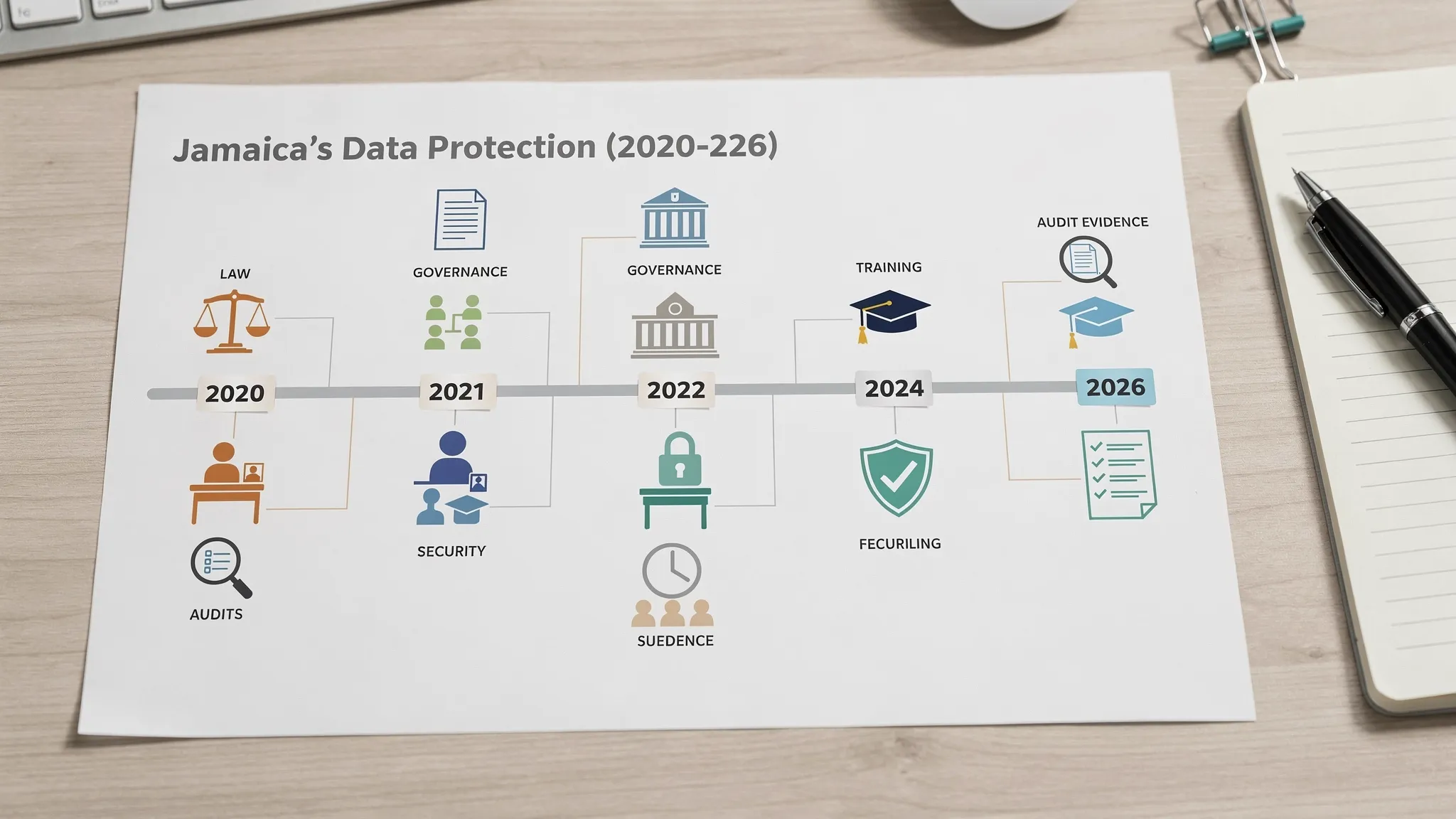
Jamaica’s Data Protection Act timeline year by year
The following timeline gives a practical overview of how the Data Protection Act developed and what each year means for organisations in Jamaica.
Year | Key development | Practical meaning for organisations |
2020 | Jamaica enacted the Data Protection Act, 2020. | Organisations needed to recognise data protection as a statutory governance obligation, not merely an IT or customer service issue. |
2021 | The implementation framework moved forward and the transition period began. | Data controllers had a runway to identify personal data, assign responsibility and begin building compliance programmes. |
2022 | Organisations were expected to use the transition period to prepare. | This was the year to conduct data inventories, review privacy notices, update policies and begin staff awareness. |
2023 | The transition period ended on 1 December 2023. | Compliance moved from preparation to active expectation. Organisations needed operational controls and evidence. |
2024 | Jamaica entered the first full post-transition year. | Data protection became part of live governance: rights handling, vendor oversight, breach readiness, training and documentation. |
2025 | Compliance maturity became the focus. | Organisations needed to test whether controls worked, not simply whether documents existed. |
2026 | The Act is part of normal business risk management. | Boards and leaders should expect measurable reporting, audit-ready evidence and continuous improvement. |
This timeline is not a substitute for legal advice or official regulatory guidance. It is a practical management view of how the law has evolved for organisations that collect, use or store personal data in Jamaica.
2020: Jamaica enacts the Data Protection Act
The Data Protection Act, 2020 established Jamaica’s modern data protection framework. It sets standards for how personal data should be processed and gives individuals rights in relation to their information.
For businesses, public bodies, professional firms, schools, financial institutions, healthcare providers and non-profits, 2020 was the point at which privacy became a formal compliance priority. The Act placed accountability on data controllers, meaning the organisations or persons that determine why and how personal data is processed.
The Act also brought Jamaica closer to international privacy expectations. That matters for organisations that deal with overseas clients, cross-border service providers, international partners or cloud-based systems. A Jamaican entity may be local in ownership but global in data flows.
The practical lesson from 2020 is simple: data protection became a board-level and management-level issue.
2021: the transition period begins
The transition period gave organisations time to prepare. That period should have been used to move from awareness to implementation.
For many organisations, the right starting point was not a long legal document. It was visibility. Leaders needed to know what personal data the organisation collected, where it was stored, who had access, why it was used, how long it was kept and whether it was shared with third parties.
In 2021, a sensible compliance programme would have included the appointment of a privacy lead, development of a data inventory, review of high-risk processing and initial staff awareness. Organisations handling sensitive personal data, such as health information, financial records, children’s data or identity documents, had even stronger reasons to prioritise early action.
The transition period was a grace period for preparation, not a reason to delay.
2022: preparation should become structured implementation
By 2022, organisations should have moved beyond asking whether the Act applied. For most entities that process personal data in Jamaica, the more useful question was how to comply in a proportionate and risk-based way.
A small professional firm would not need the same privacy structure as a large bank, telecoms company or public authority. However, every organisation needed basic controls. These included privacy notices, access controls, retention practices, vendor management and procedures for responding to individuals who exercise their rights.
This was also the year when staff training became important. Data protection failures often begin with everyday actions: sending information to the wrong recipient, saving records in unsecured locations, collecting more information than necessary, using old forms or sharing customer data informally with vendors.
A practical 2022 programme should have translated the Act into working habits.
2023: the transition period ends
The most important compliance milestone for many organisations was 1 December 2023, when the transition period ended.
This date changed the tone of data protection in Jamaica. Before then, many organisations were preparing for the Act. After that point, they needed to demonstrate that compliance was being managed in real time.
By the end of the transition period, organisations should have been able to show evidence of core data protection controls. Evidence matters because regulators, auditors, customers, employees and business partners may ask not only what your policy says, but what your organisation actually does.
Useful evidence may include approved policies, staff training records, data inventories, vendor review files, security control documentation, incident response procedures, retention schedules and records of decisions about lawful processing.
If your organisation did not complete these steps by 2023, it should not ignore the issue. It should prioritise a remediation plan and document the steps being taken now.
2024: the first full post-transition year
In 2024, data protection became an operational compliance issue for Jamaican organisations. This meant moving from project mode to business-as-usual management.
The first full post-transition year was a time to test whether the privacy programme worked under pressure. Could staff recognise a data subject access request? Could the organisation identify all locations where a customer’s data was stored? Could IT, HR, legal, compliance and operations work together during a suspected data breach? Were vendors contractually required to protect personal data?
For many organisations, 2024 exposed a common gap: policies existed, but processes were not fully embedded. A privacy notice may have been published, but forms, scripts, contracts, databases and staff practices had not been aligned.
That gap is where governance becomes important. Data protection needs owners, reporting lines, escalation procedures and periodic review.
2025: compliance maturity and assurance
By 2025, the focus should have shifted from basic readiness to assurance. In other words, organisations needed to ask whether their controls were effective.
This is where internal reviews, audits, tabletop exercises and training refreshers became valuable. A data protection programme should not remain unchanged for years, especially when the organisation introduces new systems, digital services, analytics tools, outsourcing arrangements or cross-border vendors.
A mature privacy programme should be able to answer questions such as:
What personal data do we process and for what purposes?
Which processing activities carry the highest risk?
Which vendors process personal data for us?
How do we handle access, correction, objection or deletion requests?
How quickly can we detect, assess and escalate a privacy incident?
What evidence would we provide if asked to show compliance?
This is also where data protection connects strongly with cyber security and corporate governance. A breach is not only a technical event. It can become a privacy, legal, reputational and operational crisis.
2026: data protection as ongoing governance
In 2026, Jamaican organisations should treat the Data Protection Act as part of normal governance, risk and compliance operations.
The Act is no longer new. Organisations that still rely on informal practices should move quickly to document and improve their controls. Organisations that prepared earlier should review whether their documentation still reflects reality.
This is especially important because business operations change. New software may be introduced. Staff may use new collaboration tools. Customer onboarding may become more digital. HR records may move to cloud platforms. Marketing teams may collect new categories of data. A vendor may start processing information overseas.
Each change can affect data protection compliance.
A strong 2026 privacy programme should be measurable. Boards and senior leaders should be able to receive simple reporting on training completion, rights requests, incidents, vendor reviews, policy updates, overdue retention actions and high-risk projects.
What organisations should have in place by 2026
By 2026, organisations in Jamaica should be able to show more than good intentions. They should be able to show a functioning privacy management system.
Compliance area | Evidence to look for | Why it matters |
Governance | Assigned privacy responsibility, management reporting, approved policies | Shows accountability and leadership oversight. |
Data inventory | Record of personal data categories, systems, purposes, users and sharing | Helps the organisation understand what it must protect. |
Lawful processing | Documented reasons for collecting and using personal data | Reduces the risk of unfair, excessive or unjustified processing. |
Transparency | Clear privacy notices for customers, employees and other individuals | Helps individuals understand how their data is used. |
Individual rights | Procedure for receiving, verifying, tracking and responding to requests | Supports access, correction, objection and related rights. |
Security | Access controls, authentication, backups, logging and incident procedures | Protects personal data against unauthorised access, loss or misuse. |
Vendor management | Contracts, due diligence and review of processors and service providers | Controls risk when third parties handle personal data. |
Retention | Retention schedule and secure disposal process | Prevents unnecessary storage of old or excessive personal data. |
Training | Role-based privacy training records | Reduces human error and supports a culture of compliance. |
For a more implementation-focused approach, see PLMC’s Data Protection Jamaica: Compliance Roadmap for 2026 and Privacy and Data Protection: A Practical Checklist.
Common misunderstandings about the Data Protection Act timeline
One common misunderstanding is that because the Act was passed in 2020, a privacy policy written in 2020 is enough. It is not. A privacy policy is only one part of compliance. The organisation also needs operational controls.
Another misunderstanding is that 1 December 2023 was the finish line. In reality, it was a major compliance milestone. Data protection obligations continue as long as the organisation processes personal data.
A third misunderstanding is that cyber security compliance automatically equals data protection compliance. Security is essential, but privacy is broader. It includes fairness, purpose limitation, minimisation, transparency, rights handling, retention and accountability.
A fourth misunderstanding is that only large organisations need to pay attention. Risk varies by size and sector, but small organisations also collect employee, customer, supplier and financial information. A small business can still mishandle personal data.
How to use the year-by-year timeline in your next review
The timeline can be used as a diagnostic tool. Instead of asking whether your organisation has done data protection, ask what changed each year and whether your records show progress.
Start with the 2020 question: did leadership formally recognise data protection as a compliance obligation? Then move to the transition period: did the organisation use 2021 and 2022 to map data, assign responsibility and update policies? Next, review 2023: was the programme ready by the end of the transition period, or were major gaps still open?
For 2024 and 2025, examine whether the programme operated in practice. Look for rights requests, incidents, vendor reviews, staff training, policy approvals and documented decisions. If there is no evidence, the organisation may have a compliance visibility problem even if staff believe they are doing the right thing.
For 2026, focus on continuous improvement. Data protection should be built into new projects, procurement, HR processes, customer onboarding, marketing initiatives, technology changes and executive reporting.
Frequently Asked Questions
What year is Jamaica’s Data Protection Act? Jamaica’s data protection law is the Data Protection Act, 2020. However, the practical compliance timeline includes the transition period that began after enactment and the end of that transition on 1 December 2023.
When did organisations in Jamaica need to be compliant? Organisations should have used the transition period to prepare, with full compliance expectations applying after the transition period ended on 1 December 2023. Compliance remains ongoing in 2026.
Does the Data Protection Act apply only to companies? No. The Act is relevant to organisations and persons that determine how personal data is processed, including businesses, public bodies, schools, professional firms, non-profits and other entities, depending on their activities.
Is a privacy policy enough for compliance? No. A privacy policy is important, but it must be supported by data inventories, procedures, security controls, vendor oversight, retention practices, rights handling and staff training.
What should Jamaican organisations prioritise in 2026? Organisations should prioritise evidence. That means proving that policies are current, staff are trained, vendors are reviewed, incidents can be managed, rights requests can be handled and data processing decisions are documented.
Where should organisations check for official updates? Organisations should monitor the Office of the Information Commissioner for official guidance, regulatory updates and current compliance information.
Need help placing your organisation on the timeline?
Privacy & Legal Management Consultants Ltd. supports Jamaican organisations with data protection implementation, governance, cyber security, anti-money laundering compliance, training and risk-based privacy reviews.
If your organisation is unsure whether it is still in catch-up mode or ready for 2026 assurance, PLMC can help you assess the gaps, prioritise actions and build practical evidence of compliance. Visit Privacy & Legal Management Consultants Ltd. to request support or explore more educational resources on Jamaica’s data protection requirements.