
What Regulators Expect From Your Privacy Documentation
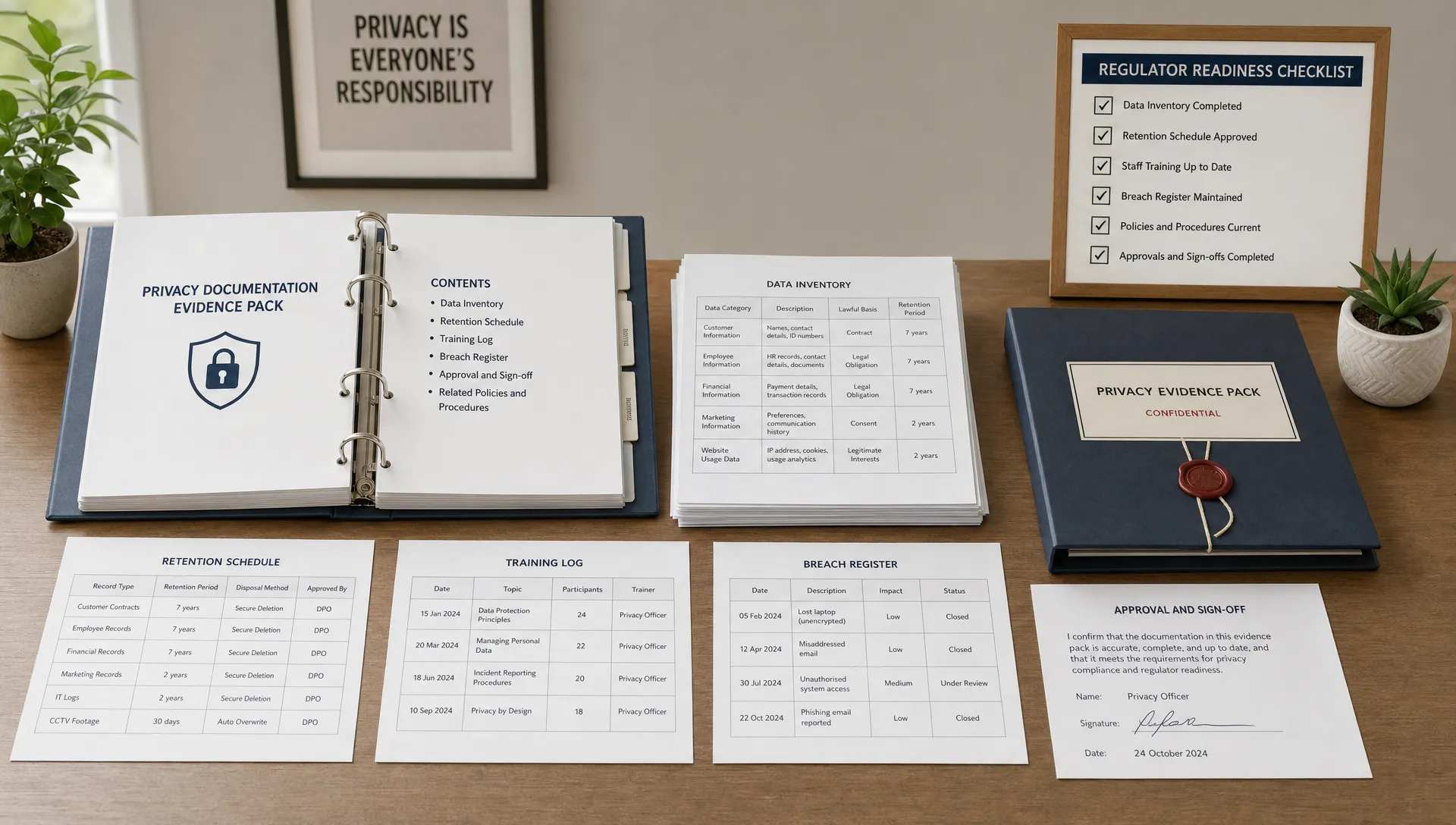
Privacy documentation is more than a compliance folder. When a regulator, auditor, board committee, bank, insurer, customer, or business partner asks to see it, they are usually looking for proof that privacy controls exist, operate in practice, and are being reviewed.
For organisations in Jamaica, this has become more urgent. The Data Protection Act, 2020 is no longer a future concern for most organisations. By 2026, privacy documentation should be treated as an operational governance requirement, not an optional legal exercise.
The key question is not simply whether your organisation has a privacy policy. The real question is whether you can show, with evidence, how personal data is collected, used, shared, protected, retained, and disposed of. Regulators expect documentation that tells a consistent story from policy to day-to-day practice.
The accountability test behind every document request
Regulators do not review privacy documentation only to admire neat templates. They use documents to test accountability. If an organisation says it follows privacy principles, its records should show who is responsible, what decisions were made, what risks were considered, and how controls are monitored.
The Office of the Information Commissioner is central to Jamaica’s privacy regulatory framework. While each review will depend on the facts, the general regulatory expectation is that a data controller can demonstrate compliance with the standards and obligations that apply to its processing activities.
This is why regulators often compare documentation against interviews, systems, contracts, complaint records, training logs, and incident reports. A privacy notice may say one thing, while customer service scripts, marketing lists, or vendor arrangements show something else. Those gaps create regulatory concern because they suggest privacy is not embedded into governance.
Good privacy documentation answers four basic questions:
What personal data do you process? The organisation should know the categories of personal data it holds, the sources, the systems involved, and the business purpose.
Why are you allowed to process it? The organisation should be able to explain the legal or operational basis for collection and use, including any consent records where consent is relied on.
How do you protect it? The organisation should document access controls, security measures, staff handling rules, vendor safeguards, and breach response procedures.
How do you keep it under control? The organisation should show review cycles, retention rules, disposal evidence, risk assessments, and governance reporting.
If the answer to any of these questions depends on one person’s memory, the documentation is probably not regulator-ready.
The core privacy documentation regulators expect
The exact documentation set will vary by sector, size, risk profile, and data processing activities. A small professional services firm will not need the same level of documentation as a financial institution, telecoms provider, healthcare organisation, university, or public body. Still, regulators generally expect a proportionate but complete record of how privacy compliance is managed.
For a deeper look at the minimum documentation set, PLMC has also outlined how organisations can document privacy compliance through policies, procedures, notices, and records.
Documentation area | What it should show | What a regulator may test |
Data inventory or processing register | What personal data is processed, by whom, where it is stored, and why it is needed | Whether the organisation actually knows its data flows |
Privacy notices | What individuals are told at the point of collection and through public-facing notices | Whether notices are clear, accurate, and consistent with practice |
Internal privacy policies | The organisation’s rules for handling personal data | Whether staff have practical guidance, not just legal language |
Procedures and workflows | How requests, incidents, corrections, access controls, and disposal are handled | Whether privacy tasks are repeatable and assigned |
Risk assessments | How privacy risks are identified, rated, treated, and escalated | Whether high-risk activities were reviewed before launch |
Vendor and processor records | Who receives personal data and what safeguards apply | Whether outsourcing decisions include privacy due diligence |
Training records | Who was trained, when, on what topics, and whether follow-up occurred | Whether staff awareness is current and role-appropriate |
Incident and breach records | What happened, when it was escalated, and what decisions were made | Whether the organisation can respond quickly and transparently |
Retention and disposal records | How long data is kept and how it is securely deleted or anonymised | Whether personal data is retained longer than necessary |
Governance records | Board or management oversight, decisions, action logs, and review evidence | Whether privacy is supervised at the right level |
The most important point is consistency. If your data inventory says customer records are retained for seven years, your retention schedule, privacy notice, system settings, archive process, and disposal records should not suggest five different answers.
What makes documentation regulator-ready
A regulator-ready privacy file is not necessarily long. It is accurate, current, approved, and supported by evidence. In many cases, a concise procedure that staff actually follow is more valuable than a lengthy policy that no one has read.
Strong documentation usually has these characteristics:
Clear ownership: Each document has an owner who is responsible for updates, approvals, and implementation.
Version control: The organisation can show when a document was created, reviewed, approved, and replaced.
Operational evidence: The policy is supported by logs, forms, training records, screenshots, risk assessments, or meeting minutes.
Plain language: Staff and data subjects can understand the document without needing legal translation.
Review triggers: Documentation is updated when systems, vendors, laws, business processes, or data uses change.
This is where many organisations fall short. They create documents once, usually during a compliance project, and then leave them untouched. By the time a regulator asks for evidence, the documents no longer reflect current operations.
Common red flags in privacy documentation
Regulators and auditors quickly notice when documentation is cosmetic. The problem is not always the absence of documents. Sometimes the bigger issue is that documents exist but do not align with the organisation’s actual practices.
Common red flags include privacy policies copied from another jurisdiction, notices that mention rights or lawful bases without explaining the organisation’s real data uses, and data inventories that ignore spreadsheets, shared drives, messaging apps, CCTV, employee files, or archived records.
Another warning sign is a policy-only approach. A policy may say that only authorised staff can access personal data, but a regulator will want to know how authorisation is granted, how access is reviewed, how departures are handled, and what happens when a staff member breaches the rule. This is why procedures and evidence matter.
Vendor management is another frequent weakness. If a third-party payroll provider, cloud platform, call centre, marketing agency, payment processor, or IT support provider handles personal data, the organisation should be able to show that privacy risks were considered and appropriate safeguards were agreed.
How regulators may test your documentation
Regulatory reviews are often practical. A regulator may start with a complaint, breach report, registration issue, sector review, or request for information. From there, they may test whether your documentation matches what actually happened.
For example, if an individual complains that they cannot access their personal data, the regulator may ask for the access request procedure, the request log, staff training records, correspondence with the individual, identity verification steps, and any reasons for delay or refusal.
If the matter involves a breach, the regulator may ask for the incident response plan, escalation records, security controls, forensic findings, notification decisions, board updates, and evidence that corrective action was completed.
If the matter involves marketing, the regulator may look for consent records, opt-out processes, vendor arrangements, data source records, and the privacy notice shown when the individual’s information was collected.
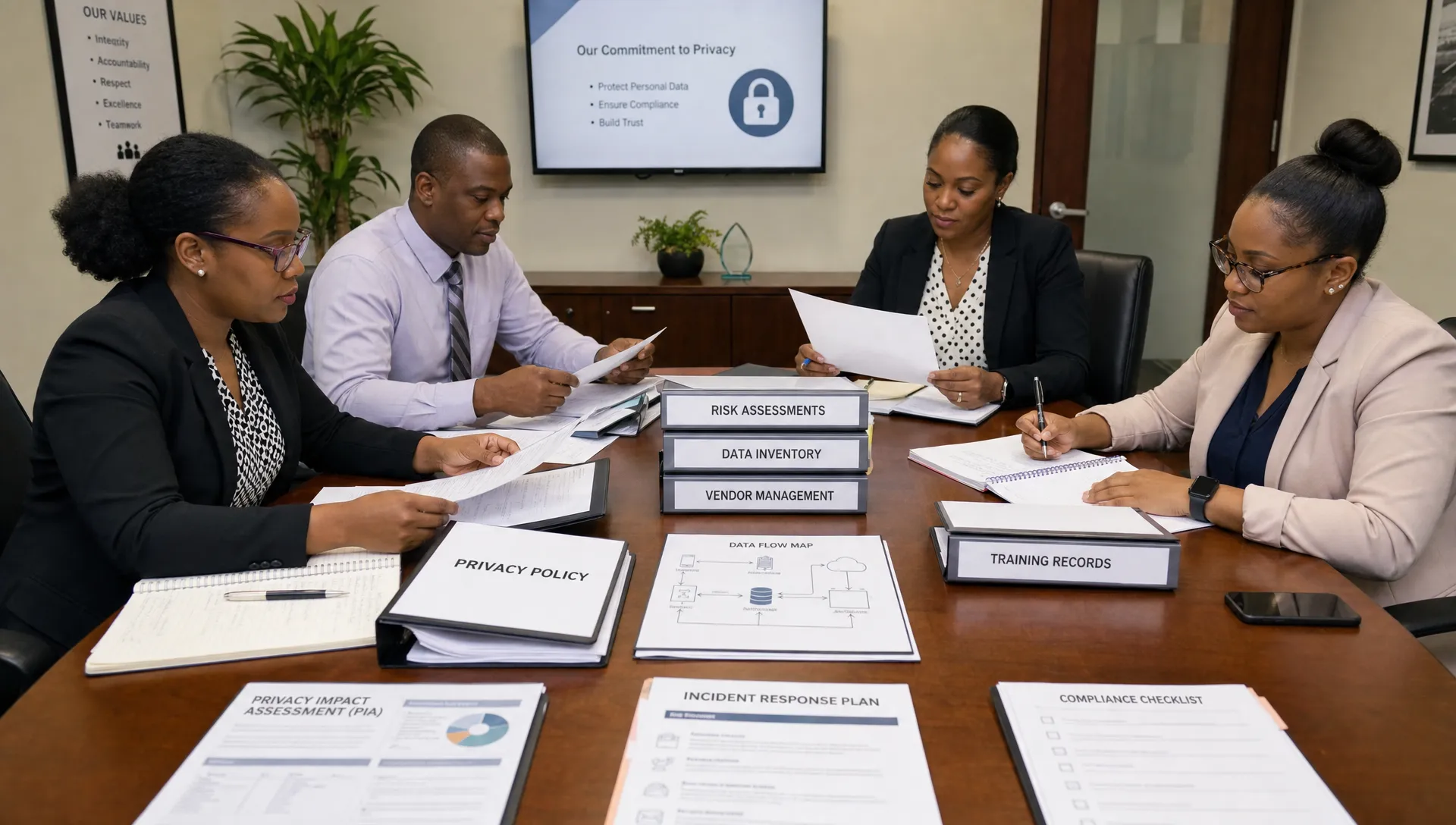
The pattern is clear. Regulators are not only checking whether a document exists. They are checking whether the document helped the organisation make the right decision at the right time.
Jamaica-specific considerations for 2026
In Jamaica, privacy documentation should be mapped to the requirements of the Data Protection Act, 2020 and the organisation’s role as a data controller or data processor. The Act is built around core data protection standards, including fair and lawful processing, purpose limitation, data minimisation, accuracy, retention control, data subject rights, security, and restrictions on certain transfers.
That means documentation should not be limited to public notices. It should also show how the organisation applies these standards internally. For instance, the retention standard should be reflected in retention schedules and disposal records. The security standard should be reflected in access controls, incident response procedures, cyber security practices, and staff handling rules.
Organisations that operate across borders should also be careful. GDPR Jamaica questions often arise when a Jamaican organisation serves individuals in the European Union, monitors their behaviour, processes data for an EU-based client, or works with international partners that impose GDPR-style obligations. GDPR compliance does not automatically equal Jamaica Data Protection Act compliance, and the reverse is also true. However, both frameworks place strong emphasis on accountability, transparency, and documented controls.
International privacy principles also point in the same direction. The OECD Privacy Guidelines recognise accountability as a core element of responsible data governance. In practice, accountability is difficult to prove without records.
Building a documentation system that survives scrutiny
A strong documentation system starts with data mapping. If the organisation does not know where personal data enters, where it travels, who can access it, and when it leaves, every other document will be incomplete.
From there, policies and procedures should be tied to actual business processes. HR data, customer onboarding, loan applications, patient intake, student records, CCTV, website forms, direct marketing, supplier management, and employee monitoring all create different privacy risks. A single generic policy cannot manage all of them.
This is why organisations should build documentation around risk. Higher-risk activities, such as processing sensitive personal data, large-scale customer databases, financial information, children’s data, employee surveillance, or cross-border transfers, deserve more detailed controls and evidence.
Privacy should also be included in the wider governance and risk management framework. If your organisation already has an enterprise risk register, data protection risks should not sit in a separate silo. PLMC has explained how to add data protection to your risk register, which can help management see privacy as a business risk, not only a legal issue.
Trigger event | Documentation that may need updating |
New system or software | Data inventory, risk assessment, access control procedure, vendor record |
New vendor or outsourcing arrangement | Vendor due diligence, contract clauses, transfer assessment, processor instructions |
New marketing campaign | Consent records, privacy notice, opt-out procedure, data source records |
Security incident | Incident log, breach assessment, corrective action plan, board or management report |
New category of personal data | Data inventory, privacy notice, retention schedule, risk assessment |
Staff role changes | Access permissions, training records, confidentiality records |
Regulatory guidance or legal change | Policy review log, implementation plan, management approval records |
The best approach is to make privacy documentation part of routine change management. Whenever the business introduces a new process, system, product, vendor, or data use, privacy should be checked before the change goes live.
Practical self-assessment before a regulator asks
A useful test is to imagine receiving a regulatory request tomorrow. Could your organisation produce the right documents within a reasonable time, and would those documents match actual practice?
Ask these questions before there is pressure:
Can we identify all major personal data processing activities across departments?
Do our privacy notices match what we actually collect and do?
Do staff know where to find privacy procedures and when to escalate issues?
Can we show evidence of staff training and refresher training?
Do we have records of data subject requests and how they were handled?
Are vendor contracts and due diligence records easy to locate?
Do we have a documented incident and breach response process?
Can we justify retention periods and show disposal activity?
Are privacy risks included in governance reports or risk registers?
Have policies and procedures been reviewed in the last 12 months or after major changes?
If several answers are no or not sure, the organisation likely needs a documentation review. The goal is not perfection. The goal is to close the gaps that would make it difficult to prove compliance.
For operational guidance, PLMC’s article on data protection policies and procedures that hold up explains how to move from paper compliance to practical controls that staff can follow.
Frequently Asked Questions
What is privacy documentation? Privacy documentation is the set of policies, procedures, notices, registers, risk assessments, training records, contracts, logs, and governance records that show how an organisation manages personal data.
Is a privacy policy enough for regulators? No. A privacy policy is important, but regulators usually expect supporting evidence. That may include data inventories, request logs, training records, incident records, vendor due diligence, retention schedules, and management oversight.
How often should privacy documentation be reviewed? At minimum, organisations should review privacy documentation regularly and whenever there is a major change in systems, vendors, data use, business processes, or applicable law. Annual review is a common baseline, but higher-risk processing may need more frequent attention.
Do small organisations in Jamaica need privacy documentation? Yes, but the documentation should be proportionate. A small organisation may not need highly complex frameworks, but it should still be able to explain what personal data it handles, why it uses it, how it protects it, and how it responds to requests or incidents.
What happens if documentation does not match actual practice? Inconsistent documentation can create regulatory, legal, reputational, and operational risk. It may suggest that the organisation has not implemented its own controls or has provided inaccurate information to individuals.
How does GDPR relate to Jamaica data privacy compliance? GDPR may apply in some cross-border situations, but it is not a substitute for Jamaica’s Data Protection Act, 2020. Organisations with international operations should map obligations carefully and avoid assuming that one framework automatically satisfies the other.
Prepare your privacy documentation before it is requested
The best time to strengthen privacy documentation is before a regulator, customer, bank, insurer, partner, or board committee asks for it. Review-ready documentation gives management confidence, helps staff follow clear rules, and reduces the risk of rushed responses during complaints or incidents.
Privacy & Legal Management Consultants Ltd. supports Jamaican organisations with data protection implementation, compliance documentation, governance, cyber security, training, risk assessment, and broader GRC integration. If your organisation needs to assess whether its privacy documentation is regulator-ready, you can start with a free consultation through PLMC.