

Pseudonymisation vs Anonymisation for Business Analytics

A business can remove customer names from a sales report and still leave those customers identifiable. That is why pseudonymisation vs anonymisation is a business analytics decision, not simply a data-cleaning choice. The right approach depends on whether analysts need to follow individual behaviour, whether someone must reconnect results to customers and who will receive the output.
For Jamaican organisations, this choice affects both the usefulness of an analysis and how information should be handled under the Data Protection Act, 2020. Start with the business question, then choose controls that protect people without stripping away the information needed to answer it.
Pseudonymisation vs Anonymisation: The Practical Difference
Pseudonymisation replaces identifying information with codes while keeping additional information separately, allowing records to be attributed to individuals under controlled conditions. For example, a retailer might replace customer names and account numbers with randomly assigned customer IDs, storing the identity mapping elsewhere.
Anonymisation aims to produce information from which people are no longer identifiable, considering the data and relevant information that could be used alongside it. Removing names alone does not achieve that outcome.
Decision point | Pseudonymisation | Anonymisation |
Individual linkage | Preserves controlled links to people | Must prevent identification, including through relevant linkage |
Repeat-customer analysis | Supports tracking through stable codes | Can support sufficiently protected cohort or aggregate analysis |
Reconnecting findings to customers | Possible using separately held information | Inconsistent with a claim that those records are anonymous |
Typical analytics output | Coded transaction-level dataset | Appropriately protected statistics or other non-identifying data |
Main governance concern | Controlling access, linkage and permitted use | Demonstrating that identification risk is adequately addressed |
Neither method is synonymous with encryption. Encryption protects information using cryptographic keys, but encrypted personal information remains personal information. Similarly, replacing names with codes does not remove the need for access controls, retention limits or a lawful purpose.
Choose According to the Analytics Question
Use pseudonymisation when individual continuity matters
Questions about repeat purchases, customer retention or account activity often require analysts to recognise the same customer across multiple transactions. A stable pseudonym can preserve that continuity without routinely exposing the customer's name or contact details.
For example, an analyst calculating the proportion of customers who return within 90 days needs reliable customer-level linkage. They usually do not need telephone numbers, street addresses or Taxpayer Registration Numbers (TRNs).
Pseudonymisation is also useful where an authorised operational team must act on a result, such as investigating a potentially fraudulent transaction. The analyst can work with coded records while a separate, authorised process handles any necessary identification.
Use anonymisation when the decision does not need identity
Management questions such as monthly sales by product category or changes in overall service demand often do not require customer-level records. Properly protected aggregate outputs may answer them with less exposure.
However, aggregation is not automatically anonymisation. A report showing one employee in a salary category or one customer making an unusually large purchase may still reveal personal information.
The intended audience matters too. A restricted internal analysis and a downloadable public report need different disclosure assessments. Information suitable for a controlled analytics environment is not automatically suitable for publication.
What This Means for Jamaican Data Protection Compliance
For Jamaican organisations, the starting point is the Data Protection Act, 2020 and guidance from the Office of the Information Commissioner. Do not assume that a dataset falls outside data protection requirements because the analytics team cannot see names. Consider what identifying information the organisation holds or is likely to obtain and whether the records can be connected to individuals.
Pseudonymisation does not, by itself, authorise a new use of customer or employee data. Organisations still need to address the purpose of processing, applicable legal conditions, transparency, security and retention. Sharing coded records with an analytics supplier also requires an appropriate assessment of the relationship and safeguards.
For organisations subject to the GDPR, Article 4(5) and Recital 26 provide an explicit distinction: pseudonymised information that can be attributed to a person using additional information remains personal data, while genuinely anonymous information falls outside the Regulation. The identification assessment considers means reasonably likely to be used.
The GDPR does not apply to every Jamaican business simply because it is an international standard. Assess its territorial scope separately from local obligations. Equally, anonymising an output does not erase obligations associated with collecting and processing the source records.
Build a Controlled Analytics Workflow
Define the decision before selecting the fields
Write down what the analysis must establish, who needs the result and whether anyone must act at individual level. This prevents a common mistake: exporting the entire customer database before deciding what the dashboard should show.
For a regional demand forecast, broad geographic areas and monthly totals may be sufficient. Exact addresses and transaction timestamps may add identification risk without improving the decision.
Record the minimum detail needed for each field. If a supplier requests a full date of birth, ask whether an age band would answer the same question. If daily reporting is unnecessary, consider whether weekly or monthly periods would be adequate.
Separate the identity mapping from the analytics environment
For pseudonymised analysis, keep the mapping between identities and codes apart from the working dataset. Restrict access according to roles, protect the mapping and log authorised re-identification.
Giving an analyst both the coded dataset and its identity lookup file defeats much of the intended separation. The same problem arises when analysts can freely join coded records to an identified customer database.
Avoid treating an ordinary hash of an email address or telephone number as a reliable anonymisation method. Predictable inputs can be guessed and tested. Random tokens or appropriately designed keyed methods may provide stronger pseudonymisation, but neither automatically makes the underlying records anonymous.
Assess the output for its actual recipient
Review what the recipient could infer using the proposed output, their existing knowledge and other reasonably available information. A customer code may conceal a name while an exact purchase time and distinctive basket reveal the person to a branch employee.
For aggregate reports, consider minimum group sizes, broader categories and suppression of revealing cells. Check whether totals allow someone to calculate a suppressed value by subtraction.
Repeated releases also need attention. Two individually acceptable reports may expose an individual when compared. An analyst could, for example, infer a new employee's salary from a change in a small team's published total. The related guide to when data anonymity works and when it fails explores these identification risks in more detail.
Assign ownership and reassess changes
Give a named role responsibility for approving datasets, permitted uses and releases. Record the transformations applied, the intended audience, identified risks and reasons for accepting the remaining risk.
Reassess when the dataset gains new fields, the audience expands or analysts introduce new joins. An output approved for internal planning should not be reused in a public presentation without review.
Retention decisions should cover source extracts, working files, identity mappings and exports, not just the final dashboard. Staff also need clear instructions about whether they may download records, attempt identification or share results. These operational rules belong in privacy awareness training that staff can apply to their work.
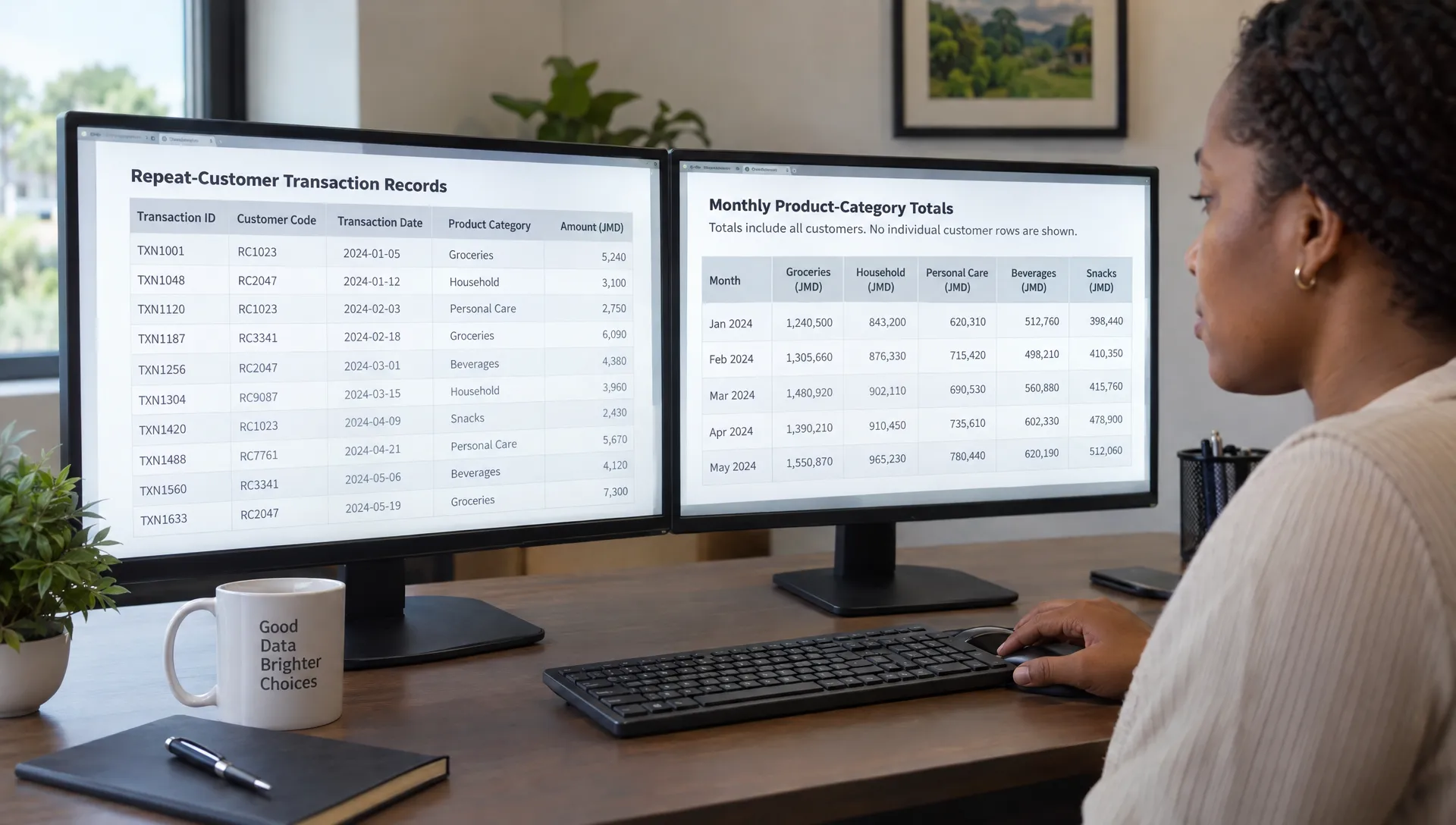
Worked Example: Customer Retention at a Jamaican Retailer
Consider a hypothetical retailer that wants to understand why customers stop returning after their first purchase. It also wants to share a quarterly performance summary with external business partners.
For the internal investigation, the analytics team receives randomly assigned customer codes, purchase dates, product categories and transaction values. Names, contact details and TRNs are excluded. Geographic detail is reduced to the level needed for the analysis. A separate authorised team controls the identity mapping.
This is pseudonymised analysis, not anonymous analysis. The organisation can still reconnect codes to customers, and detailed transaction patterns may provide other routes to identification.
If the retailer later wants to contact selected customers, it must assess that activity against its permitted purposes, applicable legal conditions and customer communications. The existence of a lookup key is not permission to use it for any purpose.
For the partner summary, customer-level rows are unnecessary. The retailer produces quarterly retention rates for sufficiently broad groups, checks small categories and reviews whether partners could identify customers through their own knowledge. Only outputs that withstand the relevant assessment should be described as anonymous.
This illustrates a useful pattern: use controlled pseudonymised records for analysis, then assess a separately prepared output for wider sharing. The internal dataset and the external report do not need the same level of detail.
Check Analytical Quality as Well as Privacy Risk
Privacy controls can change the answer an analysis produces. Removing rare transactions may understate demand for specialist products. Combining locations may conceal a branch-level service problem. Broad age bands may make a trend harder to detect.
Test the proposed transformation against the actual business decision. Compare key metrics within an appropriately controlled environment, rather than assuming that a less detailed dataset remains equally useful.
Useful checks include:
Metric accuracy: Does the transformation materially change retention rates, averages or forecasts?
Group representation: Are small customer segments excluded or distorted?
Linkage quality: Do token changes or matching errors incorrectly split or merge customer histories?
Disclosure risk: Can someone isolate a person, connect records or infer personal information from the output?
There is no universal group-size threshold that guarantees anonymity. Context, sensitive attributes, background knowledge and repeated releases all affect the assessment.
For recurring statistical releases, specialist methods such as differential privacy may be worth evaluating. They require careful design and a privacy budget, rather than simply adding arbitrary noise to figures.
Frequently Asked Questions
Is pseudonymised data still personal data? Usually, yes, where the information can still be attributed to individuals using separately held information or other relevant means. Treat coded customer or employee records as personal data unless a documented assessment supports a different conclusion under the applicable law.
Does deleting the lookup key make a dataset anonymous? Not necessarily. Other fields, backup copies, linked datasets or distinctive behaviour may still identify people. Key deletion can reduce one route to identification, but it does not settle the assessment of the remaining information.
Which approach is better for business analytics? Pseudonymisation generally suits work requiring reliable individual-level continuity or controlled follow-up. Anonymisation suits outputs that can answer the business question without identifying people. Many organisations need both at different stages of the same workflow.
Can we send pseudonymised records to an analytics provider? Potentially, but pseudonymisation alone is insufficient. Assess the purpose, provider's role, security, contractual safeguards, retention and any applicable international transfer requirements. Share only the fields needed and restrict identification or onward sharing as appropriate.
Review Your Analytics Data Before Sharing It
Before approving the next dataset, establish whether the business needs individual linkage, who can reconnect identities and what the recipient could infer. Document those answers alongside the release decision.
Privacy & Legal Management Consultants Ltd. offers data protection implementation, risk assessment tools and training for Jamaican organisations. A free consultation can help you discuss your analytics workflow and the compliance questions it raises.