
How to Spot Over-Collection Before It Becomes a Problem
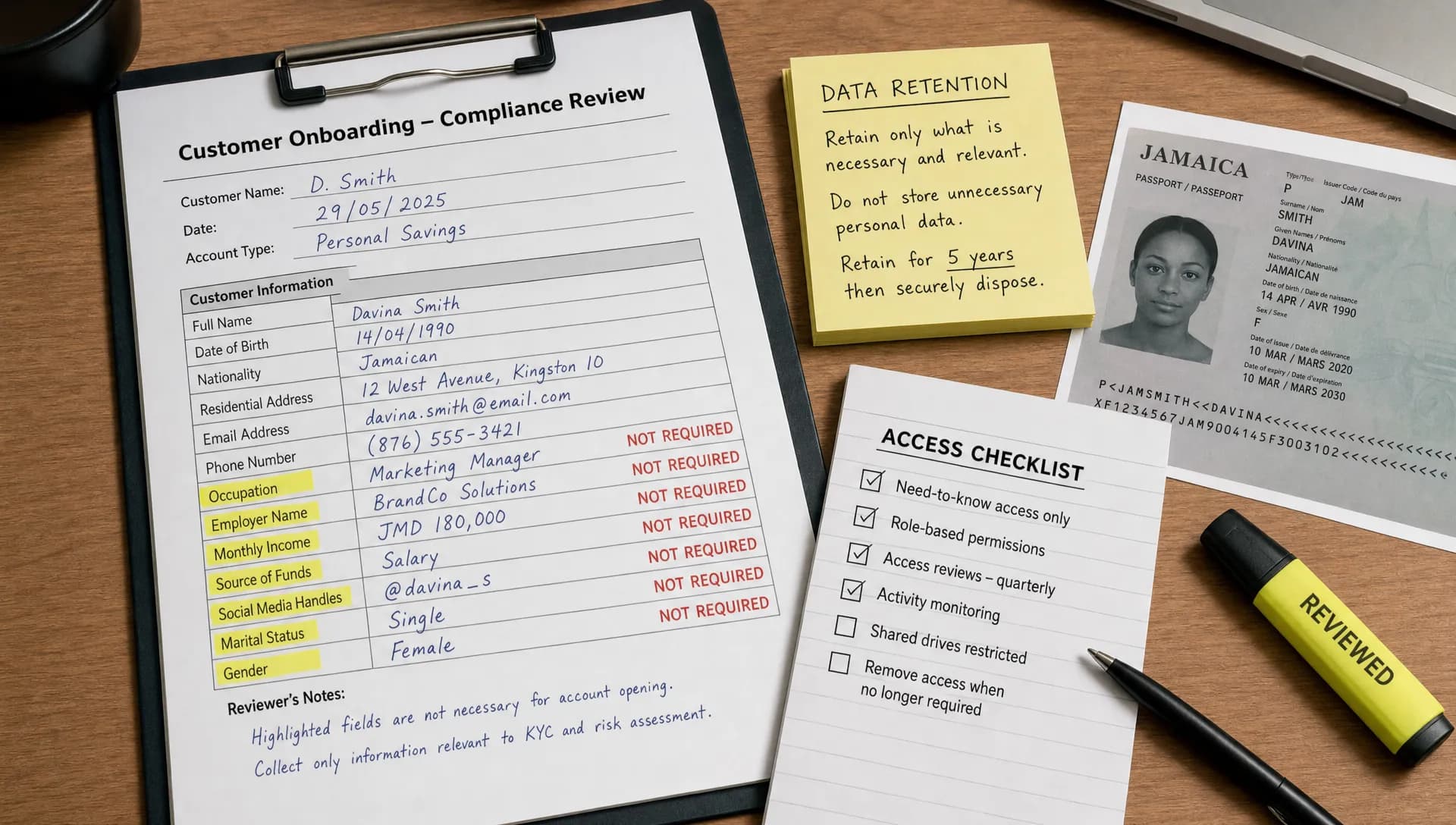
Most over-collection starts with a reasonable request. A department adds one more field to a form, a spreadsheet keeps an old identifier, a customer onboarding process asks for a document copy just in case, or a marketing list captures details no one ever uses. None of these decisions may feel risky at the time, but together they can create a serious privacy and governance problem.
For Jamaican organisations, the issue is not whether personal data can be useful. The real question is whether each item is necessary, proportionate, explained, protected, and eventually deleted. Under Jamaica's Data Protection Act, 2020, organisations should pay close attention to whether personal data is adequate, relevant, and not excessive for the purpose for which it is processed. Over-collection makes that harder.
The good news is that over-collection is often visible before it causes harm. You can spot it in forms, workflows, databases, email attachments, visitor logs, staff files, and third-party integrations. The earlier you find it, the easier it is to reduce breach exposure, simplify compliance, and build trust with customers, employees, and partners.
What over-collection means in practice
Over-collection happens when an organisation collects more personal data than it reasonably needs for a clear business, legal, or operational purpose. It can also happen when data is collected too early, retained too long, copied into too many places, or requested from too many people.
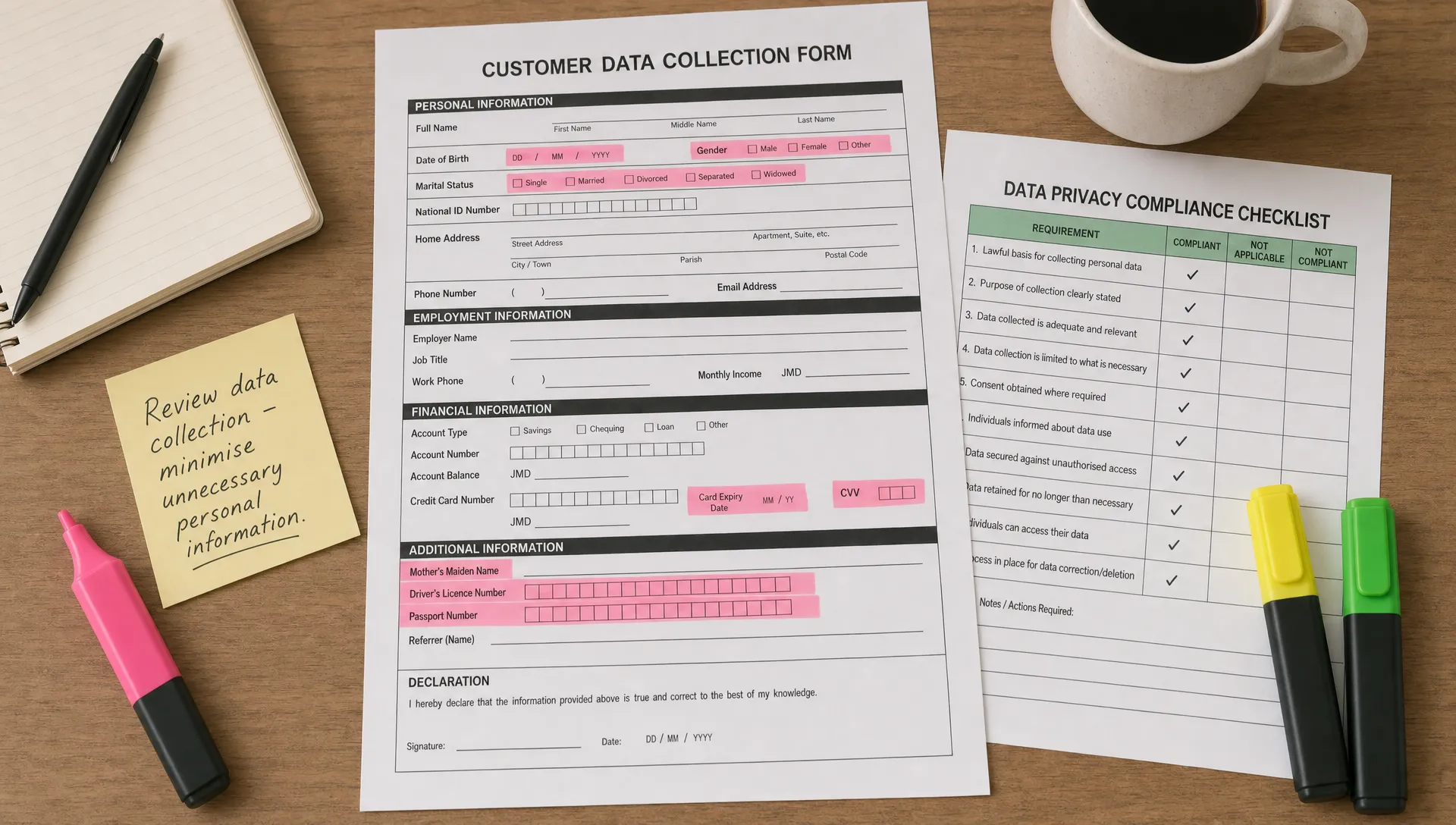
A field may be excessive even if it seems ordinary. For example, a date of birth may be unnecessary if an age range is enough. A copy of an identification document may be unnecessary if a trained staff member can verify the document and record that verification took place. A Taxpayer Registration Number may be appropriate in payroll or regulated financial contexts, but not for a general newsletter sign-up.
Over-collection is not limited to forms. It can appear in call recordings, CCTV coverage, website analytics, HR screening processes, event registrations, customer relationship management systems, and anti-money laundering files. In regulated sectors, some collection is legally required, especially for customer due diligence and recordkeeping. The risk arises when teams cannot explain why each data element is required, who can access it, how long it is kept, and what control protects it.
Why over-collection becomes a problem
The most obvious risk is legal compliance. If the organisation cannot justify the collection, it may struggle to demonstrate that its processing aligns with data protection principles. This matters under the Data Protection Act, 2020, and it also matters for organisations that work with international partners and are expected to follow GDPR-style privacy standards.
There is also a security risk. The more data you collect, the more you have to secure. A database containing names and emails is one level of exposure. A database containing names, emails, addresses, ID scans, financial details, health information, and family contacts is much more attractive to criminals and much more damaging if compromised.
Over-collection also increases operational burden. More data means more access controls, more retention decisions, more records to search when responding to data subject requests, and more complexity when systems are migrated or decommissioned. It can also reduce customer trust. People notice when forms ask for details that seem unrelated to the service.
The UK Information Commissioner's Office offers a useful explanation of data minimisation, including the need to collect only what is adequate, relevant, and necessary. While that guidance is written for the UK GDPR context, the principle is highly relevant for organisations in Jamaica that want mature data protection compliance.
If you are building a broader compliance framework, over-collection controls should sit inside a practical data compliance programme, not as a one-off clean-up exercise.
Early warning signs that your organisation is collecting too much
A field exists because the organisation has always asked for it
Legacy forms are one of the biggest sources of over-collection. A question may have been added years ago for a project, a manager, or an old system requirement. If no one can explain the current purpose, the field deserves review.
This is especially common in HR, customer onboarding, school administration, membership applications, and supplier registration forms. When reviewing these forms, ask whether the answer is actively used to make a decision, provide a service, satisfy a legal obligation, or manage a genuine risk.
The purpose depends on future possibility rather than current need
Phrases such as it might be useful later or we may need it someday are warning signs. Future usefulness is not the same as necessity. If the organisation wants to use data for a future purpose, that purpose should be defined, assessed, and communicated before collection.
A practical test is simple: can the team explain the purpose in one sentence? If the answer is vague, the field is probably not ready for collection.
Identity documents are copied by default
Many organisations request passport, driver's licence, TRN, or national identification details as part of onboarding or verification. In some cases, this is required or justified. In other cases, staff copy documents because it feels safer than recording a verification outcome.
Copying identity documents creates significant risk. It may expose sensitive identifiers, photographs, signatures, addresses, and document numbers. If the organisation only needs to confirm identity, consider whether it can record the fact of verification, the type of document seen, the date, and the staff member responsible, without keeping a full copy. Where copies are legally required, access and retention should be tightly controlled.
Optional fields behave like mandatory fields
Sometimes forms mark a field as optional, but the process makes people feel they must complete it. For example, a customer may believe that leaving a field blank will delay approval, reduce service quality, or create suspicion. This is still a collection risk because the organisation is encouraging unnecessary disclosure.
Optional fields should be genuinely optional, clearly labelled, and separated from required information. If an optional field is never used, remove it.
Data leaves the official system and spreads through email or spreadsheets
Over-collection often grows when teams export data from approved systems into shared spreadsheets, email attachments, messaging apps, or local folders. A controlled system may only collect five fields, but a spreadsheet created later may combine those fields with notes, IDs, screenshots, and other details.
This creates hidden databases. They are harder to secure, harder to update, harder to delete, and often forgotten during audits. If teams need spreadsheets to do their work, the organisation should review whether the official process or system is missing a legitimate requirement.
Retention rules are unclear
Collecting data is only one part of the problem. Keeping it indefinitely can turn reasonable collection into excessive processing. If no one knows when a field or record should be deleted, the organisation may be holding data long after the purpose has expired.
Retention should be linked to the reason for collection. Some records must be kept for legal, tax, employment, contractual, anti-money laundering, or audit reasons. Others can be deleted sooner. The key is to document the reason and apply it consistently.
A quick over-collection check for any process
You do not need to begin with a complex audit. Start with one form, one database, or one customer journey. Review each data field and test it against the questions below.
Audit question | Healthy answer | Red flag |
What purpose does this field support? | It supports a named service, decision, legal obligation, or risk control. | The team says it is useful, traditional, or requested by preference. |
Can a less intrusive field meet the same need? | An age range, verification note, or yes or no answer is enough. | The form asks for exact dates, full documents, or detailed history by default. |
Who needs access to it? | Access is limited to staff with a defined role. | Entire departments, shared inboxes, or temporary workers can view it. |
When should it be deleted or anonymised? | There is a retention period tied to the purpose. | The answer is indefinitely, until further notice, or no one knows. |
Is it explained to the individual? | The privacy notice or collection statement matches the actual use. | The notice is vague or does not mention the field's real purpose. |
Is there a legal or regulatory reason? | The obligation is identified and documented. | The team assumes a law requires it but cannot name the requirement. |
A useful exercise is to highlight every field in three colours. Use green for necessary, amber for uncertain, and red for unnecessary or excessive. The amber fields are often where the most important discussions happen, because they reveal unclear ownership, outdated assumptions, or gaps in policy.
Where to look first
Some business areas are more likely to collect excessive personal data because they handle identity, eligibility, risk, security, or sensitive life events. Start where the impact would be greatest if the data were lost, misused, or disclosed.
Area | Common over-collection pattern | Better review question |
Customer onboarding | Asking for full identity documents, financial details, or household information before eligibility is confirmed. | What is needed at this stage, and what can wait until later? |
HR and recruitment | Collecting ID, bank, medical, or emergency contact details from candidates too early. | Can some details be requested only after an offer or employment decision? |
Marketing and events | Capturing job title, employer, phone number, preferences, and demographic details for simple registrations. | Which fields are essential for attendance, communication, or consent management? |
CCTV and physical security | Recording areas or activities beyond the security purpose. | Is coverage proportionate, signposted, restricted, and retained for a defined period? |
AML and due diligence | Collecting broad personal histories or document copies without mapping them to a specific compliance requirement. | Which information is required for risk assessment, and who can approve exceptions? |
This review should not weaken legitimate compliance duties. For example, anti-money laundering obligations may require specific customer information, verification steps, and retention periods. The goal is not to collect less than the law requires. The goal is to collect what is required, document why, protect it properly, and avoid adding extra data without a defensible purpose.
How to stop over-collection before launch
Over-collection is easiest to prevent at the design stage. Once a form is published or a system goes live, staff become accustomed to the fields, customers adapt to the request, and the data starts spreading through reports and exports. Prevention requires a simple approval habit.
Before any new form, app, portal, questionnaire, spreadsheet, campaign, or onboarding workflow goes live, require the process owner to answer these questions:
What personal data will be collected?
Why is each field necessary?
What happens if the individual does not provide it?
Who will access the data?
Will the data be shared with any third party?
How long will it be kept?
What notice, consent wording, or other explanation will be provided to the individual?
These questions should be part of normal governance, not an afterthought. Documenting the answers in a policy or internal checklist helps teams make consistent decisions. PLMC's guide on what to include in a data protection policy template can help organisations think through ownership, procedures, and accountability.
Your external privacy notice should also match reality. If a form asks for personal data, individuals should understand what is being collected and why. For Jamaican organisations reviewing their public-facing notices, this guide to must-have privacy clauses for Jamaica is a helpful companion.
Controls that make minimisation part of daily work
Policies alone do not stop over-collection. People need practical controls that fit their daily routines. The strongest organisations combine governance, system design, training, and periodic review.
Assign an owner for each form or dataset so there is someone accountable for adding, changing, or removing fields.
Require approval for high-risk fields such as identity documents, health information, biometric data, financial details, children's data, or sensitive employee records.
Build privacy review into procurement so new software tools are assessed before they start collecting personal data.
Use role-based access so staff only see the data they need to perform their duties.
Set retention rules at the point of collection, not after the system is full.
Train frontline teams to challenge unnecessary requests and explain collection purposes clearly.
The cultural shift is important. Staff should not feel that privacy review is blocking business. They should see it as a way to reduce risk, improve customer confidence, and make processes cleaner. A shorter form can increase completion rates. A smaller dataset can reduce breach impact. A clearer privacy notice can reduce complaints and confusion.
A 30-minute exercise you can run this week
Choose one active form used by your organisation. It could be a customer form, recruitment form, visitor form, supplier form, event registration page, or internal spreadsheet.
Create a simple purpose-field map with the following columns: field name, purpose, required or optional, legal or business reason, access group, retention period, and decision. For the decision column, use keep, change, move to later, restrict, or remove.
Then invite the process owner, a staff member who uses the data, an IT or security representative, and a privacy or compliance lead to review it together. In many organisations, this short conversation reveals that some fields are no longer needed, some should be collected later, and some require stronger access controls.
The result does not need to be perfect on day one. The value is creating a repeatable habit. Every time a team reviews a process this way, the organisation becomes better at spotting over-collection before it becomes a breach, complaint, or regulatory concern.
Frequently Asked Questions
Is over-collection illegal in Jamaica? Over-collection can create compliance risk under the Data Protection Act, 2020, because organisations should not collect personal data that is excessive for the stated purpose. Whether a specific practice is unlawful depends on the facts, the purpose, the applicable legal obligations, and the controls in place.
Can we keep extra data if the customer gives consent? Consent does not automatically make excessive collection appropriate. The organisation should still ask whether the data is necessary, whether the individual has a real choice, and whether the purpose is clearly explained.
How often should we review forms and databases for over-collection? High-risk processes should be reviewed before launch and whenever the purpose, system, vendor, law, or workflow changes. Many organisations also benefit from an annual review of key forms, HR records, customer onboarding processes, and marketing databases.
Does data minimisation conflict with anti-money laundering compliance? No. Regulated organisations may need to collect specific information for customer due diligence, monitoring, and recordkeeping. Data minimisation means collecting what is required and justified, not adding unnecessary details beyond the compliance purpose.
Need help reducing privacy risk before it grows?
Over-collection is a small issue until it is not. The best time to fix it is before excess personal data spreads across systems, inboxes, and spreadsheets.
If your organisation needs an independent review of its forms, workflows, privacy notices, or data protection controls, Privacy & Legal Management Consultants Ltd. can support your governance, risk, and compliance efforts with practical data protection implementation, training, and advisory services tailored for Jamaica.